In this guide
EV Charging at Home in the UK: The Full Guide
Around 85% of all EV charging in the UK happens at home1. Zapmap estimates that around 1.4 million chargers were installed at UK homes with driveways by the end of 20252. The usual equipment is a wall-mounted charge point rated at 7kW, fitted by a registered electrician on its own new circuit. Zapmap puts a typical 7kW unit at between £700 and £1200 fully installed3.
Which? gives a wider range of £500 to £1,200 to buy and install a home charger, with 7kW models at around £900 (February 2026)4. The Energy Saving Trust puts the average cost of 220 miles of charge at £17 at home, £37 on public fast chargers and £53 on public rapid chargers, against £45 for a full tank of petrol5.
This page is the hub for the detailed guides on this site. It covers the hardware, the installation rules, planning and building regulations, grants, solar-aware charging, vehicle-to-grid and running costs. It also sets out what a home charger does, and does not do, for a household's energy independence.
Home charging carries most of the UK's EV miles
Several sources report the same pattern. Zapmap says around 85% of all EV charging happens at home1, and the Energy Saving Trust says most electric car charging in the UK is done at home8. BEAMA's guide to EV infrastructure, dated September 2024, reports that 82% of EV drivers have access to charging at home and that 93% use public networks9. Most drivers use both, with the home charger supplying the bulk of the energy and the public network covering long journeys and top-ups.
Home access is not universal among EV drivers. Uswitch's statistics page records that 79% of EV owners surveyed in 2024 had a home charger, five percentage points fewer than in 202210. No reason for the fall is reported alongside the figure.
Cost and convenience are bound up with home access. Uswitch makes the dependency explicit: an EV tariff is of no use to a household that cannot charge at home11. It also notes that a household with a home charger should be able to charge back to full every night if it needs to12. The pages on EV tariffs and home charging and smart EV chargers explain how timed charging works.
Home charge points also feature in public policy. BEAMA's consultation response refers to an additional £100 million for EV charging infrastructure, including funding to support home and workplace charge points13.
Around 1.4 million home chargers, and no official register

Every headline figure for home chargers is an estimate, because nobody keeps a count.
"There is no official register of home charge devices in the UK"
Zapmap's figure of around 1.4 million chargers at UK homes with driveways, as of the end of 2025, is modelled from three inputs. These are the last available government statistics on installations under the Electric Vehicle Homecharge Scheme, car registration data from the SMMT, and Zapmap's annual EV Charging Survey2. Other bodies give lower or looser figures, and some of the difference comes from their dates and definitions:
| Source | Figure | Scope and date |
|---|---|---|
| Zapmap2 | around 1.4 million | chargers at UK homes with driveways, end of 2025 |
| Citizens Advice14 | around 1 million | home EV chargers in the UK, estimate |
| Uswitch11 | over a million | home EV chargers in the UK, as of 2024 |
| Zapmap15 | more than one million | charge points at home or work |
| ChargeUK16 | over half a million | home and work-place chargers |
| English Housing Survey17 | around 930,000 dwellings | access to a charge point for exclusive use, England, 2023 |
The only official counts cover grant-funded installations, which are a subset of the total. Government statistics to 1 July 2026 show that home charging grant schemes have funded 412,682 installations across the UK since 2013, including 10,833 in the last 12 months. Of that total, the Domestic Recharge Scheme funded 40,333 installations between 2013 and 2014 and the Electric Vehicle Homecharge Scheme funded 340,22218. The history of that closed scheme is on the Electric Vehicle Homecharge Scheme page.
The public network is much smaller. The UK had 121,171 public EV chargers on 1 July 202619. Uswitch reports that this equals 1.3 chargers per 1,000 people, the 14th highest figure in Europe10. There are several times more private charge points at homes than public devices, which explains the UK's heavy reliance on domestic charging. It also explains why households without a driveway are at a disadvantage, a point covered in public EV charging.
Tethered or untethered: which charger suits which household
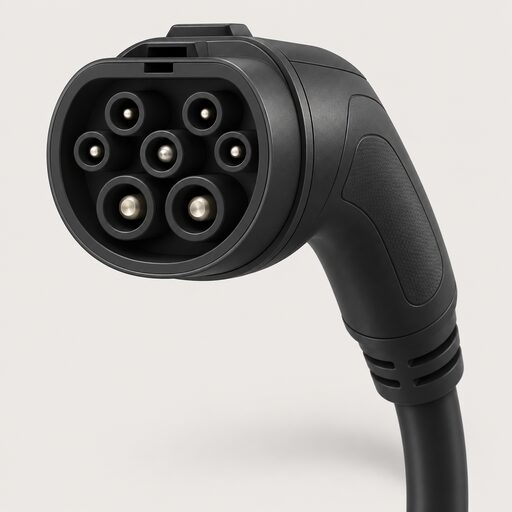
Home chargers come in two physical forms. Zapmap describes them as available either with a tethered Type 1 or Type 2 cable, which plugs straight into the car, or with a Type 2 socket for use with the vehicle's own charging cable3. NICEIC draws the same line: tethered chargers come with a cable and connector installed, and untethered chargers have only a socket20.
| Tethered | Untethered | |
|---|---|---|
| What is on the wall | unit with a fixed cable and connector20 | unit with a Type 2 socket only3 |
| Cable used | the attached Type 1 or Type 2 cable3 | the vehicle's own charging cable3 |
| Tied to a connector type | yes, the fixed cable is Type 1 or Type 2 | no, the socket accepts whichever cable is plugged in |
The practical differences follow from the hardware. A tethered unit is committed to one connector type, which matters if the household later changes to a car with a different inlet. A socket-only unit works with any suitable cable, but the cable has to be fetched and stowed at every charge. Neither form affects charging speed, which is set by the unit's power rating and by the car.
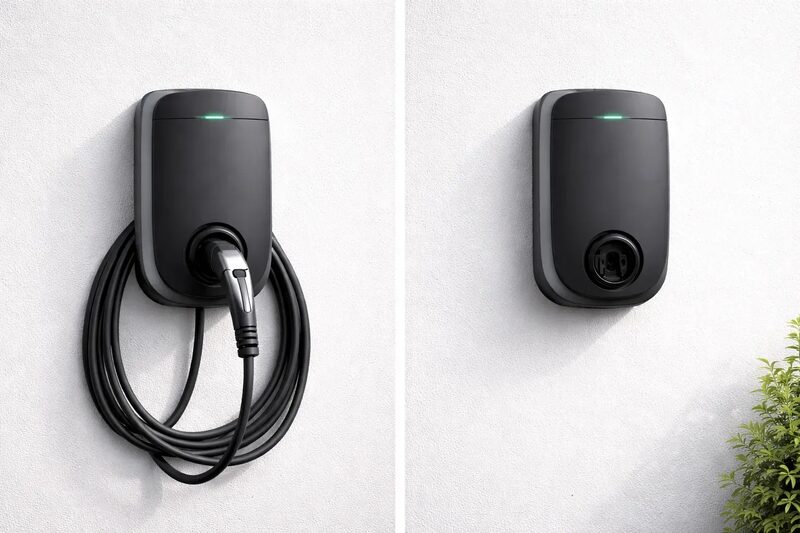
The two forms are compared in detail on tethered vs untethered EV charger. The wider categories, including smart and solar-aware units, are covered in types of home EV charger. Connector standards are explained in EV connectors and charging cables.
Power ratings: 7kW is the standard for UK homes
Zapmap states that the standard power rating for a home charger is 7kW3, and NICEIC says home chargers are usually around 7kW20. Which? gives the ceiling: for a typical UK home the maximum EV charger power is 7.4kW4. Which? also names 7.4kW as the rating to look for if reasonable charging times are wanted21. The figures 7kW and 7.4kW are used interchangeably in UK guidance for the same class of charger. Higher ratings, and the three-phase supply they need, are covered on 7kW vs 22kW home EV charger.
Zapmap says a 7kW charger will generally charge a car from 20 to 80% within six to 12 hours, which suits overnight charging6. The range is wide because battery sizes vary. Electric cars are built on either a 400 volt or an 800 volt platform, but the difference matters mainly for rapid public charging and not for a home unit6.
Much of the public network is no quicker. Which? found that in January 2025, 57% of UK public charging devices were rated between 3 and 8kW, which is at best only slightly faster than a home charger21.
Three-pin sockets
An EV can be charged from a domestic socket, but only slowly. Which? describes a regular three-pin wall socket as delivering 2.4kW4, and Uswitch describes a standard three-pin plug as running at 3kW22. The two documents disagree on the exact figure. Either one is less than half the rate of a 7kW unit. The detail is on charging an EV from a 3-pin socket, and the full range of speeds is on EV charging speeds and times.
Cost: roughly £1,000 fully installed, and what the price covers

The most quoted single figure comes from a Checkatrade report cited by Uswitch, which put the average cost of installing a home EV charger at £1,000 for parts and labour10. Other published figures fall around it:
| Source | Figure | What it covers | Date |
|---|---|---|---|
| Checkatrade, via Uswitch10 | £1,000 average | parts and labour | December 2025 |
| Which?4 | £500 to £1,200, around £900 for 7kW | buying and installing | February 2026 |
| Zapmap3 | £700 to £1200 | 7kW charge point, fully installed | June 2025 |
| Energy Saving Trust23 | around £800 to £1200 | installing a home charge point | September 2025 |
| Planning Portal24 | £450 basic, rising to around £1,200 | installation, by power and capability | 2026 |
| nidirect25 | up to £1,000 | an EV charger | 2026 |
| Uswitch26 | up to £500 to £1,000 per charger | installation element | July 2025 |
| Elec-Mate27 | £800 to £1,500 | electrical work, excluding the charger unit | July 2026 |
The sources do not state whether these figures include VAT.
Most of the spread comes from what each figure includes. A "fully installed" price covers the unit together with the labour. The Elec-Mate figure of £800 to £1,500 covers the electrical work alone, excluding the charger unit, so it reflects jobs where the wiring is a large part of the cost27. The Planning Portal links price to specification: around £450 for a basic model, rising to about £1,200 as power and capabilities increase24. Smart functions, solar-aware modes and a tethered cable all sit at the upper end of that scale.
In practice, quotes for a standard 7kW unit on a simple cable run cluster between £700 and £1,200. The price rises with a long cable run or additional electrical work. Households with more than one EV face the installation cost for each charger26.
Grant support narrows the cost for some households. Uswitch notes that the grant of up to £350 for landlords and flat tenants can reduce the fee to as low as £65010. Owner-occupiers of houses are not eligible, as the planning, parking and eligibility section explains. A full breakdown is on home EV charger cost.
Brands and product ranges sold in the UK
The UK market has many charger makers, and this site has a page on each main range. One product can be described here from the available information, the Hypervolt Home 3 Pro. The maker's UK sales partner states that it is made in the UK and carries a 3-year manufacturer's warranty. It also states that OVO will install it for customers and non-customers alike28. Carwow's review describes three charging modes: Boost, Eco (solar and grid) and Super Eco (solar only)29.
| Model | Attribute | Value |
|---|---|---|
| Hypervolt Home 3 Pro | Warranty | 3-year manufacturer's warranty (maker's statement)28 |
| Hypervolt Home 3 Pro | Country of manufacture | made in the UK (maker's statement)28 |
| Hypervolt Home 3 Pro | Charging modes | Boost, Eco (solar and grid), Super Eco (solar only)29 |
| Hypervolt Home 3 Pro | Installation route | installed by OVO for customers and non-customers28 |
Other ranges have their own pages, including:
Warranty terms differ between makers, and a warranty depends on the maker continuing to trade. The page on EV charge point warranties covers this.
Installation: a registered electrician, BS 7671 and building control
A home charger is a fixed electrical installation on a new circuit, and the wiring standards govern it. BSI states that all electrical installations in the UK must comply with the requirements in BS 767130. NICEIC says an EV charger must be installed in line with the current edition of the standard20. It adds that the 2025 planning changes left this unchanged, so all EV charging installations must continue to comply31. The current edition listed by BSI is BS 7671:2018+A4:2026, the IET Wiring Regulations, the national standard for the design, erection and verification of electrical installations32.
Building regulations are a separate requirement from planning.
"Building regulations approval is always required when installing an EV home charger"
In England and Wales, an EV charger installation must be notified to local authority building control because it creates a new circuit31. Electrical Safety First explains that a registered electrician's work will meet BS 767133. The householder should receive an Electrical Installation Certificate or a Minor Work Certificate confirming this, together with a Building Regulations Compliance Certificate34. The Planning Portal notes that non-notifiable electrical work must also be designed, installed, inspected, tested and certificated in accordance with BS 767135. NICEIC's guidance refers householders to an electrician registered with a recognised certification body20.
A typical job runs in this order:
- The installer surveys the property, covering the parking position, the cable route and the existing electrical installation.
- The installer fits the unit and its new dedicated circuit. Uswitch says this should take a couple of hours or so, depending on the charger type and location22.
- The installer inspects and tests the work to BS 767135.
- The installer issues the electrical certificate and the Building Regulations Compliance Certificate34.

Notifying the electricity network operator is covered on telling the network operator about a home EV charger. Supply capacity and protective devices are covered in electrical requirements for a home EV charge point and load management. The full process is on home EV charge point installation. Self-installation is addressed on installing an EV home charger yourself.
Planning permission, parking and eligibility: where a standard install falls short

The standard case needs no planning application. The Planning Portal says that where a home has off-street parking, a domestic charger is likely to fall under permitted development, provided it meets the criteria36. NICEIC reports that on 29 May 2025 the government removed the requirement for homeowners and businesses in England to obtain planning permission for EV charger installations. Home chargers now fall under permitted development rights, with limits on the size and height of the equipment31. One council's guidance gives an example of such a limit: a wall-mounted outlet and its casing must not exceed 0.2 cubic metres, and must not be on scheduled ancient monument land37.
Responsibility stays with the householder. The Planning Portal classifies a home charger as development, and it is up to the householder to ensure the correct permissions are in place38.
Permission is usually required in these cases:
- on-street parking38
- conservation areas and listed buildings38
- areas restricted through article 4 directions38
- more than one upstand per parking space38
- in England, world heritage sites and other protected buildings and landscapes31
- according to the Energy Saving Trust, where there is no off-street parking, or where the charger is less than two metres from the highway39
More detail is on planning permission across the UK, conservation areas and charging without a driveway.
Grants: who qualifies
The electric vehicle chargepoint grant offers up to £350 per socket for residential landlords, people living in flats and people who rent5. Under the official eligibility rules:
- The applicant must either live in a flat they own, including one bought through shared ownership, or rent a residential property.
- The home must have its own private off-street parking space.
- The applicant must own or use an eligible vehicle41.
The rules exclude someone who owns and lives in a house, unless the house is converted into flats and they live in one of them42. NICEIC adds that the vehicle must be on OZEV's approved list and that the installer must be OZEV-approved20. The SMMT summarises the same conditions43.
Households with on-street parking have a separate grant. It requires a cross-pavement solution such as a charging gully44, together with highways authority permission and all necessary planning permissions20. See the chargepoint grant for renters and flat owners, the landlord grant and the cross-pavement charging grant.
Differences between the nations
A Scottish Government document from May 2024 states that Scotland's domestic charge point grant funding was available only for residential properties in Scotland with dedicated off-street parking45. The Welsh Government has consulted on amending Building Regulations in Wales to require EV charging points where car parking is part of a development46. In England, Approved Document S gives the technical guidance on charge point requirements under Part S of the Building Regulations47. New homes are covered on EV charging in new build homes.
Charging with solar: solar-only and mixed modes, and what is needed to enable them
Solar panels can charge an electric car, within limits. The Contract Power Association's guidance says solar power alone is unlikely to be relied on all year in the UK, especially in winter. For most homeowners the practical reality is a hybrid approach: solar covers as much of the charging as it can, and the grid fills the gaps48. NICEIC notes that charging from renewable sources such as solar panels can significantly reduce the carbon footprint of driving49.
Solar-aware chargers offer selectable modes. Makers use different names, often "green" or "eco", and the Hypervolt Home 3 Pro is one example. It has the three modes described above: Boost, Eco and Super Eco29. A solar-only mode uses nothing from the grid, but the car charges only while the panels produce a surplus. A mixed mode guarantees progress whatever the weather and draws from the grid to do so. The extra hardware a charger needs in order to detect solar surplus is described in CT clamps and sensors and special chargers for solar EV charging.

A home battery changes the timing. With a battery, surplus solar energy is captured and held for when it is needed, including overnight EV charging. Without one, unused solar electricity is exported, often at a relatively low rate48. A Parliamentary Office of Science and Technology briefing reports Solar Energy UK's suggestion that rooftop solar combined with a battery could supply 80% of a household's annual electricity50. The briefing does not say whether that figure includes EV charging demand. Further detail is on charging an EV from solar panels, EV charging alongside a home battery and solar vs grid charging.
Vehicle-to-Grid: the car as a battery store, estimated at £150 to £200 a year
A bidirectional charger lets the car's battery discharge back to the house or the grid. Cenex estimates average UK revenue from vehicle-to-grid (V2G) at £150 to £200 per year51. Cenex also reports a larger figure from the EV-elocity project, a saving of £400 per vehicle per year, but that applies to commercial users and study results vary52.
Cenex argues that the value goes beyond revenue. All of the following are modelled or projected figures from Cenex:
| Claimed benefit | Figure |
|---|---|
| Reduced battery capacity fade through battery management | 9.1% over a year51 |
| Extension of useable battery life | 10%51 |
| Annual depreciation saving | £23051 |
| Deferred network upgrades | £5bn, or £180 per household51 |
| Reduced renewable curtailment | 6 MtCO₂e per year51 |
| Storing output from a 4 kWp solar system over a sunny weekend | over 600 kgCO₂e per year51 |
| Additional system savings in GB by 2030 | £40 to 90M annually53 |
Hardware cost is currently the obstacle. Cenex predicts V2G charger cost will fall to £1000 by 203051. The V2G Britain report expects the premium over an equivalent smart charger to reduce to between £656 and £1,164 by 203052. Set against the estimated revenue of £150 to £200 a year, that premium remains a substantial outlay. Current V2G charger prices are installer-quoted. See vehicle-to-grid and vehicle-to-home, V2G earnings, V2G charger cost and whether an EV can power a house.
Running costs: £17 at home against £37 to £53 at public points
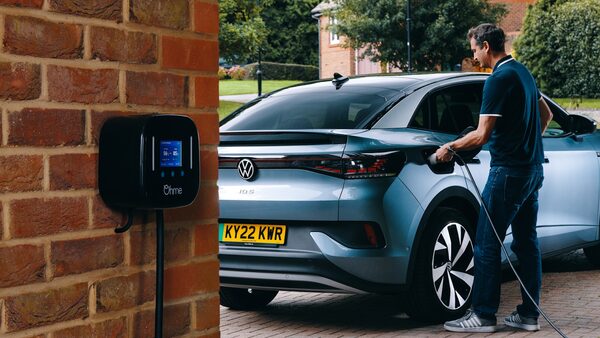
The Energy Saving Trust gives these average costs for a full 220 miles of charge (April 2026): £17 for home charging, £37 for public fast charging and £53 for public rapid charging. A full tank of petrol is put at £455. On those figures home charging costs less than half as much as either public option, and public rapid charging costs more than the petrol.
Other figures differ because they use different tariffs and battery sizes:
- The Energy Saving Trust's myth-busting page gives £8 per full charge on an EV or other time-of-use tariff, which typically requires a smart meter23. The £8 and £17 figures come from the same organisation. They rest on different assumptions and do not contradict each other.
- Uswitch reports an average of £13 per home charge in October 2024, based on a typical 54 kWh battery10.
- Uswitch puts the average public price at 52p per kWh on slow and fast devices in July 2025, about 15p per mile10.
- ChargeUK's comparison table (July 2026) lists home off-peak electricity at 3.59 pence per kWh and a blend of 80% off-peak home and 20% rapid charging at 22.20 pence per kWh54.
Annual estimates also vary by source:
| Source | Annual figure |
|---|---|
| Carwow55 | The average EV owner spends about £680 a year charging at home. |
| Uswitch56 | EV charging on a flat-rate tariff costs £700 a year for a typical household with an EV and a heat pump. |
| Energy Saving Trust57 | Charging an EV is around £760 a year cheaper than fuel for the same mileage. |
| Carbon Brief (Climate Change Committee analysis)58 | The average home with off-street parking would save at least £660 a year by switching from petrol to an EV. |
Carbon Brief adds that running costs could increase for households reliant on public charging58. In Northern Ireland, nidirect states that home charging is the least expensive way to charge because lower home tariffs can be used25. More detail is on EV charging running costs and home vs public charging cost.
What owning a charger means for energy independence
A home charger replaces forecourt fuel with household electricity. On the Energy Saving Trust's figures that is a £17 fill in place of a £45 tank, and it takes the household out of public charging prices of £37 to £535. With solar panels, part of that electricity is generated on the household's own roof. With a battery, more of the solar output is kept for charging the car48. With a bidirectional charger, the car itself becomes storage that the house can draw on51. These layers build on one another, and the EV charging and energy independence page looks at how they combine.
Several dependencies remain:
- The grid: solar is unlikely to cover charging all year in the UK, and the practical model is a hybrid in which the grid fills the gaps48.
- A supplier and a tariff: the lowest home charging costs depend on an EV or time-of-use tariff, which typically requires a smart meter23.
- Off-street parking: permitted development, the grants and the low running costs all assume a private parking space36. Households without one depend on public networks or on permissions for a cross-pavement solution40.
- The maker and its software: smart functions and warranties rely on a company that continues to trade and to support its app. See EV charger apps and connectivity and cybersecurity and data.
Two studies report an effect on property value. NICEIC cites the National Association of Property Buyers, which says a charger could add between £3,000 and £5,000 to a property's value, depending on location, charger type and local public charging availability20. A Cambridge, ScottishPower and WWF study of over five million existing homes, reported by the Home Builders Federation, puts the uplift from EV charging points at £5,400 to £7,400, or 2.0 to 2.75%59. Both are statistical estimates and the two sources disagree on the scale. The evidence is examined further on EV chargers and home value.
Sources59 cited
- Electric car charging costs: all you need to know, Zapmap, 2026-09-04
- Home and community charging statistics, Zapmap, 2026
- Home charging guide, Zapmap, 2025-06-19
- Electric car charging at home, Which?, 2026-02-25
- Charging electric vehicles, Energy Saving Trust, 2026-04-23
- How long does it take to charge an electric car, Zapmap, 2026-04-15
- EV charging: building regulations, Planning Portal, 2026-09-17
- Making the switch: experiences of EV users, Energy Saving Trust, 2025-03-31
- Guide to Electric Vehicle Infrastructure, BEAMA, 2024-09
- EV charging statistics, Uswitch, 2025-12-15
- EV energy tariffs, Uswitch, 2025-09-17
- Electric car myths busted, Uswitch, 2024-11-26
- Response to the eVED consultation, BEAMA, 2026
- Navigating the network: installing low carbon technology, Citizens Advice, 2026-07-01
- EV charging statistics, Zapmap, 2026
- Our Electric Future manifesto launch, ChargeUK
- English Housing Survey 2023 to 2024: low carbon technologies fact sheet, GOV.UK, 2023
- Grant schemes for EV charging infrastructure statistics, 1 July 2026, GOV.UK, 2026-08-27
- Public EV charging infrastructure statistics, 1 July 2026, GOV.UK, 2026-07-01
- EV charger installation and maintenance, NICEIC, 2025-08
- Should I buy an electric car?, Which?, 2026-04-16
- EV charging guide, Uswitch, 2026-09-19
- Electric vehicles: debunking myths, Energy Saving Trust, 2025-09-22
- Electric vehicle chargers, Planning Portal, 2026
- Electric vehicles, nidirect, 2026-09-17
- EV tariffs for multi-car families, Uswitch, 2025-07-02
- Section 722 EV charging guide, Elec-Mate, 2026-07-02
- Hypervolt smart charger, OVO Energy, 2026-09-17
- Home electric vehicle chargers, Carwow, 2026-01-09
- BS 7671 Requirements for Electrical Installations, BSI, 2026-09-17
- EV charger regulations in England: what's changed, NICEIC, 2026-08-19
- BS 7671:2018+A4:2026 IET Wiring Regulations, BSI, 2026-04-15
- Part P of the Building Regulations, Electrical Safety First, 2026-09-17
- Building regulations, Electrical Safety First, 2026-09-17
- Building regulations: minor works, Planning Portal, 2026
- Interactive guide: electric vehicle charging, Planning Portal, 2026
- Permitted development for retrofit and energy efficiency, Cotswold District Council, 2026-09-17
- EV charging: planning permission, Planning Portal, 2026
- Cross-pavement charging solutions, Energy Saving Trust, 2025-07-18
- Approved pavement crossings, Planning Portal, 2026
- Electric Vehicle Chargepoint Grant for Renters and Flat Owners, GOV.UK Find a Grant, 2026-09-18
- Chargepoint grant for renters or flat owners: eligibility, GOV.UK, 2026-09-17
- Incentives for electric vehicles, SMMT, 2025-03-26
- Electric vehicle chargepoint grants, GOV.UK, 2025-04-08
- FOI release on the domestic charge point grant, Scottish Government, 2024-05-22
- EV charging in residential and non-residential buildings, Welsh Government, 2024-09-06
- Approved Document S, Planning Portal, 2021-12
- Can solar panels charge electric cars?, Contract Power Association, 2026-04-15
- Everything you need to know about EV charging points, NICEIC, 2024-09-27
- POSTnote 771, UK Parliament POST, 2026-06-25
- More than money: finding the true power of V2G, Cenex, 2026-09-17
- An introduction to vehicle-to-grid charging, Cenex, 2022-08
- V2G Britain case study, Cenex
- Reduced public charging prices could boost EV sales, ChargeUK, 2026-07-31
- How to charge an electric car with no driveway, Carwow, 2025-07-18
- Tariffs for EV and heat pump households, Uswitch, 2025-07-02
- Electric vehicles for disabled drivers, Energy Saving Trust, 2026-04-23
- CCC: faster electrification will put money back into people's pockets, Carbon Brief, 2026-06-24
- Watt a Save report, Home Builders Federation, 2026-02