

In this guide
A FuseBox EV charger is a domestic wallbox from a brand best known for consumer units, the enclosure that holds a home's circuit breakers and is still widely called the fuse box. The logic of the pairing is straightforward: a charge point is a circuit-protection problem before it is a software product, and the company that already supplies the board supplying the charger is selling into the same electrician, the same van and the same certificate.
What that means for a household is that the charger is specified rather than bought off a shelf. The unit arrives through an accredited installer, and the deciding facts are electrical: the size of the main fuse, whether the property shares a supply cable with a neighbour, and whether the distribution board has a spare way for a dedicated circuit. Each EV charging point should be supplied by its own dedicated final circuit, protected by a separate MCB or RCBO at the distribution board for each charger, with no other loads sharing it, and the circuit must be designed as a continuously-rated load1.
Costs sit in the same band as the rest of the market. Installation costs range between £450 for a basic model, increasing to around £1,200 as the power and capabilities increase, according to official planning guidance2, while a Checkatrade report put the average cost of installing a home EV charger at £1,0003. Prices for a specific FuseBox unit are installer-quoted.
FuseBox EV chargers: what the range covers
The domestic charging market in the UK is built around 7kW single-phase wallboxes, with 22kW three-phase units sitting above them. The distinction matters because 22kW chargers often require a three-phase electricity supply, which can lead to higher unit and installation costs, and they are not offered by every supplier7. For most homes the practical ceiling is the single-phase unit, and the vehicle's own onboard charger usually limits acceptance below that anyway.
Comparable UK wallboxes in this class are described by their makers in terms that show what the category offers. One is listed as universal, fitting all types of electric cars and power supplies8. Another supports load and phase balancing of up to 101 EV chargers on a single circuit, a figure that matters in apartment blocks rather than houses8. Solar panel integration is listed as a feature on at least one mainstream wallbox9.
Where the range sits in the wider market is worth stating plainly. Chargers sold into homes are one part of a market that also includes commercial AC units from 7 to 22kW and DC units from 20 to 200kW10, and home storage products that pair with charging, such as modular high-voltage battery ranges using CAN communication11. A household buying a FuseBox wallbox is buying the domestic end of that spectrum, not the commercial end.
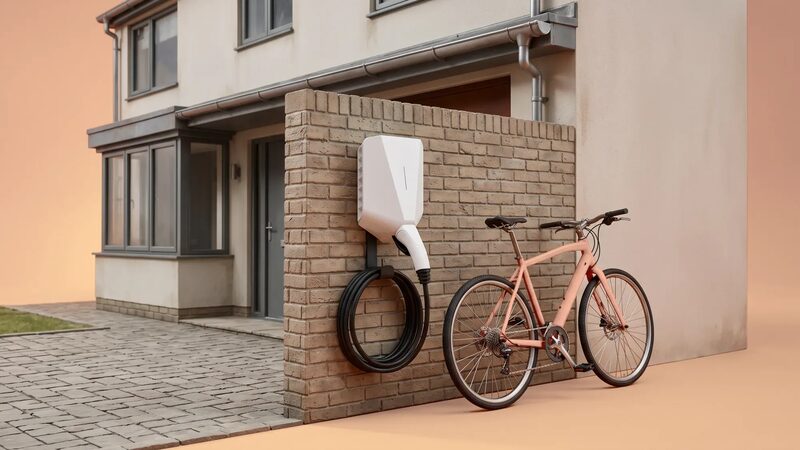
Who FuseBox is and why a consumer unit maker makes wallboxes
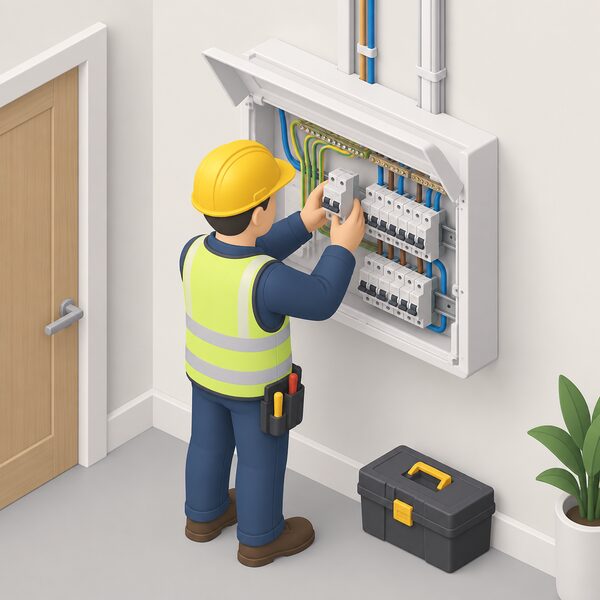
The consumer unit is the fixed electrical part of a home that holds the protective devices, alongside the wiring, the socket-outlets and the light fittings12. It is the point at which every circuit in the house is protected, and it is the natural place for a charge point to be added, because a charger is a new circuit with its own protection requirements.
That is the commercial logic. An electrician fitting a charge point is already working at the board: adding a protective device, checking spare capacity, and deciding whether the existing arrangement can carry the new load. A maker that already supplies that board has a route to the same trade customer, and the installer becomes the specification channel rather than a retail shelf.
The regulatory backdrop reinforces it. Certification schemes for EV charging equipment exist to meet legislative, market access, specifier and compliance requirements13, and the language is telling: specifier is a category, because charge points are chosen by the person designing the installation, not by the person standing in a shop. For a household, the practical consequence is that the brand on the wallbox is often the brand on the board, and the person who chose it was the electrician.
Specifications to check before you buy
The specification that decides whether a charger can be fitted is the electricity supply, not the charger. Your installer will check the main fuse, and the fuse may need upgraded to 80A to support the charger4. Older properties may have a 60A fuse, which may not safely handle the extra power an EV charger needs5.
A looped supply is the harder case. Installing a home EV charger typically requires a fuse upgrade to 80 to 100 amps, which often cannot be done on a looped supply without overloading the shared cable6. Where homes share a looped electricity cable with a neighbour, they need their own dedicated cable installed before the charger can go ahead4.
| Check | What it decides | Source |
|---|---|---|
| Main fuse rating | Whether 80A upgrade is needed; 60A is common in older homes | 4 |
| Looped or dedicated supply | Whether a new dedicated cable is required first | 4 |
| Spare way at the board | Whether a separate MCB or RCBO can be added | 1 |
| Circuit design | Must be treated as a continuously-rated load | 1 |
| Certification | Legislative, market access, specifier and compliance requirements | 13 |
Where a new supply is needed, the network operator's application requires the electrician to complete the load details section, including the make and model of EV chargers, PV panels and heat pumps14. That is the technical basis on which the connection is assessed, and it is why the installer, not the householder, drives the paperwork.
Cost and what installation adds
There is no published FuseBox list price for a supplied and fitted charger, so the figures that exist are market figures. Official planning guidance states that installation costs range between £450 for a basic model, increasing to around £1,200 as the power and capabilities increase2. A Checkatrade report found that the average cost of installing a home EV charger was £1,0003. Independent guidance puts a typical domestic installation at £800 to £1,500 for the electrical work, excluding the charger unit1.
Bundled offers show what an all-in price can include. One supplier quotes an Easee One charger including full installation, up to 15m of cabling, surge protection and a 3-year warranty, for a base cost of £89916. The same source notes that installation adds between £500 and £1,500 depending on complexity7. Those are one company's figures for one product, but they show the shape of a quote: unit, cable run, protection and labour.
Three things move the number. The first is the state of the supply: a fuse upgrade or a new dedicated cable on a looped supply is work beyond the charger itself4. The second is the cable run and the siting of the unit. The third is whether the installation is a like-for-like replacement or a first charge point, which brings the notification and certification work with it. VAT treatment is not stated in these figures, so they should be read as quoted rather than as confirmed VAT-inclusive prices.
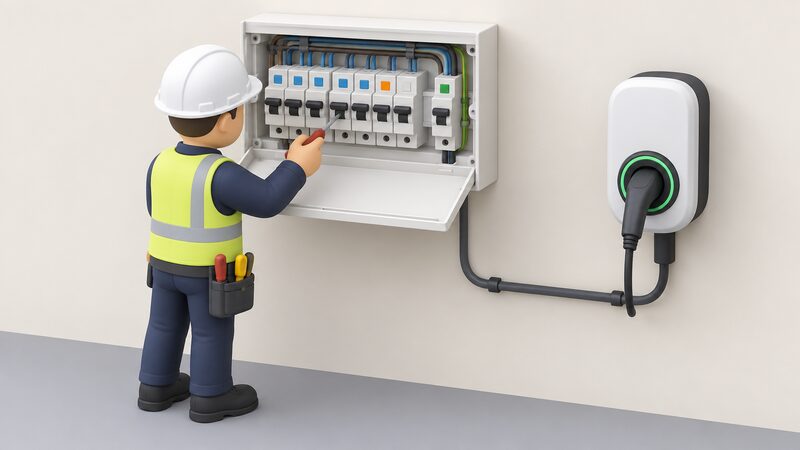
Warranty and registration
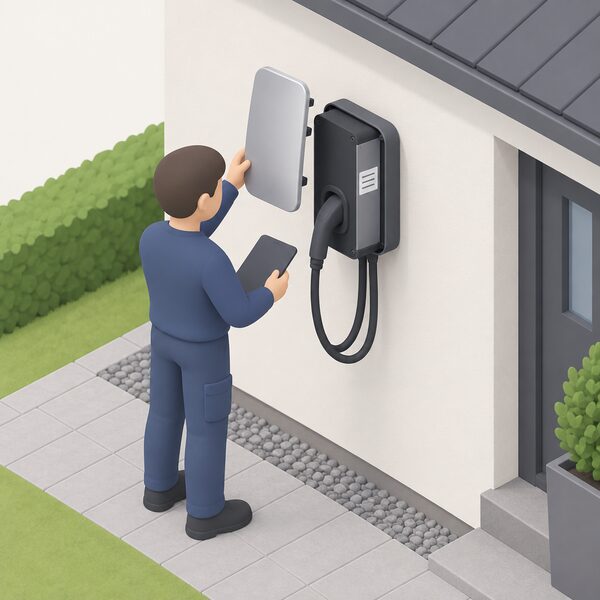
Warranty terms in this market are conditional, and the conditions are worth reading before the unit is fitted. One UK maker's terms state that products are covered by a 3-year parts and labour guarantee, that products registered outside the 30-day period will receive a 12-month part and labour guarantee only, and that products not registered will not benefit from this warranty17. Those are one company's terms, but they show the pattern: registration is not an administrative afterthought, it is the thing that switches the longer term on.
Registration also has a safety function. Electrical safety guidance advises owners to register an e-bike, battery and charger with the manufacturer so they can be contacted easily if there is a safety recall18. The same logic applies to a wallbox fixed to the outside of a house.
Where the serial number sits varies by product. On one UK wallbox the serial is provided on a sticker on the side of the unit, underneath the metal front, which can be removed and lifted off19. If the charger has not been registered, it should appear as an available charger within Bluetooth range when powered on, with the serial number shown below it19. The installer normally completes registration at commissioning, and the householder should keep the serial recorded.
UK availability and where to buy
Domestic charge points reach UK households through accredited installers rather than retail. Network operator guidance is explicit: where the supply needs work, you will need to contact an accredited EV charge point installer20. The installer handles the application, and where a network operator needs to hear from the household directly, it states that installers should contact it on the customer's behalf21.
The wider UK charging picture is worth keeping in proportion. There are 26,557 rapid and ultra-rapid chargers across 6,673 locations in the UK as of January 202622, and public networks continue to expand, with one network reporting 2,457 chargers across 589 locations23. Home charging remains the base of the pyramid, and the equipment is bought through the trade that installs it.
For households in Northern Ireland, the cross-pavement channel route has its own process: the completed form should be emailed to the address given on the form24. Where a household needs to reach a supplier about the electricity account rather than the charger, supplier contact routes are set out separately25. For the general process of getting a charge point fitted, see home EV charge point installation.
What owning a FuseBox charger means for energy independence
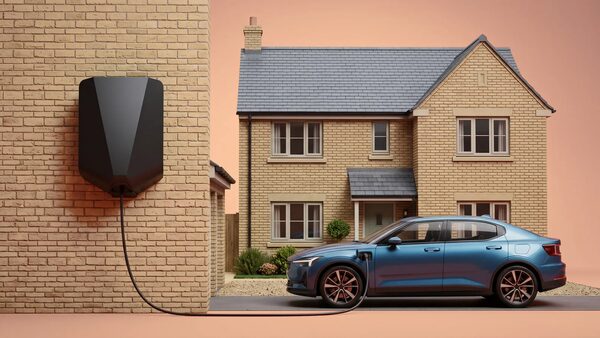
A wallbox is a load, not a source. Fitting one increases a household's electricity consumption and therefore its dependence on the grid and on a supplier, and the charger itself adds a further dependence on the installer who commissioned it and on the manufacturer for parts and support.
The independence a charger can support comes from what it is paired with. Time-of-use tariffs require the household to own or lease an EV26, and electric vehicle chargers are associated with an annual saving of £680 on a time-of-use tariff, with EV ownership required27. That saving comes from moving consumption to cheaper hours, not from generating anything. Solar panel integration is a listed feature on comparable wallboxes9, and pairing a charger with generation or a home battery is where a household starts to displace imported electricity rather than just time-shift it. Those routes are covered in charging an EV from solar panels and EV charging alongside a home battery.
The dependence that remains is concrete. The charger needs a live grid connection to deliver power, a supplier to bill it, and a functioning distribution board to protect it. Where the supply is looped, the household may need a new dedicated cable before any of this is possible4. And the electrical work itself is not a householder task: the circuit must be designed as a continuously-rated load with its own protective device1, which is why the accredited installer route exists20.
Faults, voltage and what the error means
Many wallbox errors are supply events rather than charger failures. If the voltage goes beyond the acceptable range, the charger will not function and will display a red ring or an error28. The same behaviour is described by a network operator: if the voltage goes outside this range, the charger will stop working and show an error, a safety feature that protects the charger and the vehicle29. Voltage drop or surge is listed as a cause of EV charger errors29.
Repeated resetting is not the first step. Guidance states that in the first instance the householder should speak to their installer or electrician to check there's not any problems with their equipment28. Where a product is subject to a safety notice, the instruction is firmer: if you believe you have an affected product, stop using it immediately and contact the retailer for further advice30. For suspected faults on charging equipment generally, the position is to stop using it immediately and report the fault to the manufacturer or retailer18.
Fault diagnosis on comparable domestic heating equipment shows how maker-specific fault codes work in practice: a fault code checker explains that an OC fault code on one boiler means there's insufficient power being supplied31. The principle carries across to chargers, where a code often points at the supply rather than the appliance. More on this is at EV charge point faults and troubleshooting.
Sources31 cited
- Section 722 EV charging: complete guide, Elec-Mate, 2026-07-02
- Electric vehicle chargers, Planning Portal, 2026
- EV charging statistics, Uswitch, 2025-12-15
- EVs and heat pumps: connections, NIE Networks, 2026-09-19
- If your electricity supply can't cope with the new equipment, NIE Networks, 2026-09-19
- Looped services, NIE Networks, 2026-09-19
- How much to install an EV charger at home, Fuse Energy, 2026-04-22
- Apartment blocks, Easee, 2026-03-13
- What is the lifetime cost of an electric vehicle?, Uswitch, 2024-11-26
- THOR 60-200DD-P, Growatt, 2026-09-17
- EQ Battery Range, Fox ESS, 2026-09-17
- Electrical safety standards in the private and social rented sectors: guidance, GOV.UK, 2025-11-01
- Powering trust in electric vehicle charging with BSI Kitemark certification, BSI, 2026-09-17
- What you need to start your application, NIE Networks, 2026-09-19
- Ratings of electrical appliances, Electrical Safety First, 2026-09-19
- EV charger grant Scotland, Fuse Energy, 2026-04-27
- Warranty information, evec, 2026-09-17
- E-bikes, Electrical Safety First, 2026-09-17
- Where do I find my serial, Simpson & Partners, 2026-09-17
- Electric vehicles for home charging, Electricity North West, 2026-09-19
- Adding more power, UK Power Networks, 2026-09-17
- Common misconceptions about electric cars, Zapmap, 2026-01
- Be.EV network guide, Zapmap, 2026
- Electric vehicle charging cross-pavement channel form, nidirect, 2025-10-03
- How to contact your energy supplier, Uswitch, 2026-02-09
- Electric cars and energy bills, Uswitch, 2026-04-27
- Clean heat: supporting low-income households, Energy UK, 2026-06-11
- Voltage changes in your home or business, UK Power Networks, 2026-09-17
- Managing voltage changes in your property, Electricity North West, 2026-09-19
- Flynsu Electric Vehicle Portable Charger sold via Amazon, Electrical Safety First, 2026-09-17
- What to do if your boiler breaks down at Christmas, Which?, 2025-12-12