

In this answer
Short answer
For most houses the answer is no. Around 1% of households require a three-phase connection, and the cost of providing one runs from £500 to £4,0001. The rest run on a single-phase supply, which is what the distribution network was built to deliver to domestic properties. A three-phase supply becomes relevant when a house's electrical load outgrows what a single-phase service can carry, most often because of a heat pump, an electric vehicle charger, or both together.
The distinction matters because the two supplies are not simply different sizes of the same thing. A single-phase service delivers power on one live conductor and a neutral. A three-phase service delivers it on three live conductors, each offset in timing, which is why a three-phase supply carries three 100amp fuses rather than one2. That arrangement suits large motors and heavy, balanced loads. It does not make a house's electricity cheaper, greener or more reliable in itself.
What it does change is headroom. A standard three-phase power connection offers 60kVA, distributing 80 amps per phase3, and SSEN states that most homes and small businesses can upgrade from single phase to three phase, giving up to 69kVA4. Against a typical domestic single-phase service, that is a step change in capacity. Whether a particular house needs it depends on the load being installed, not on the size of the house.
What a three phase supply is, and what most homes have instead
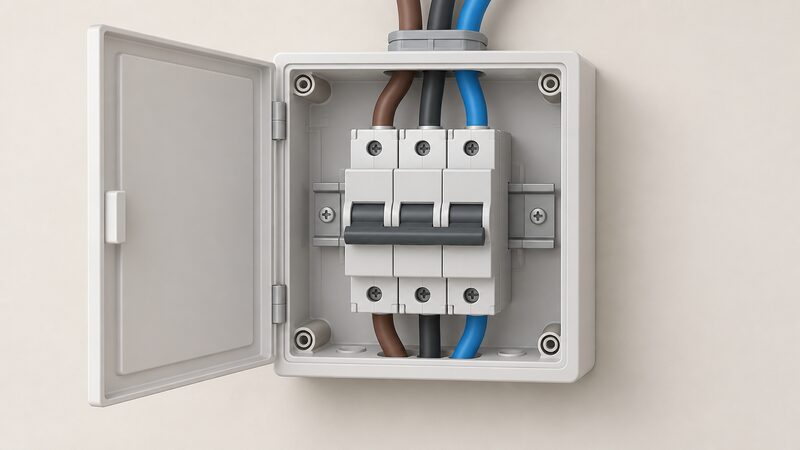
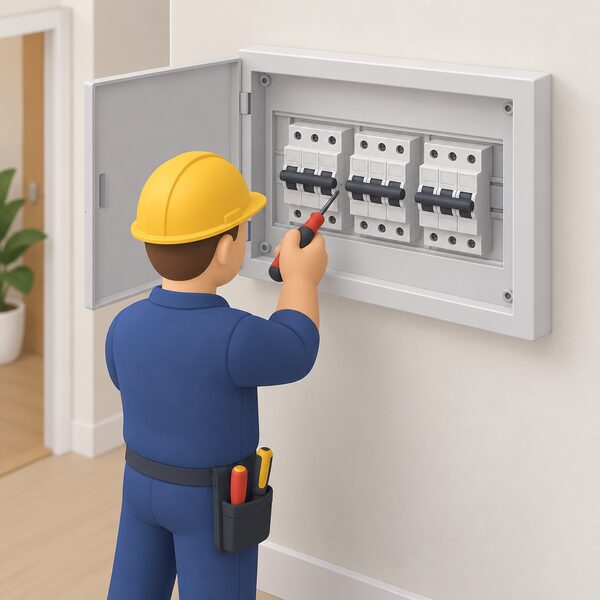
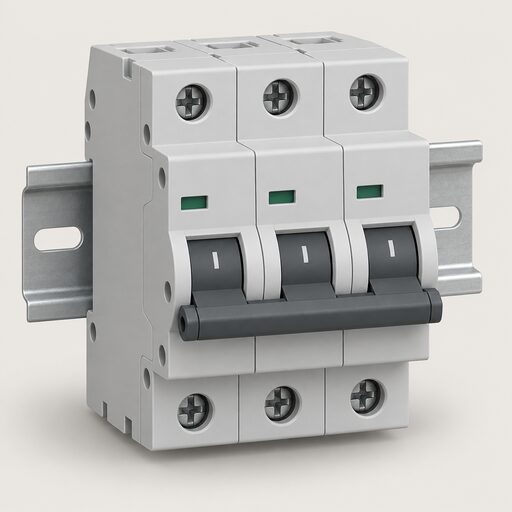
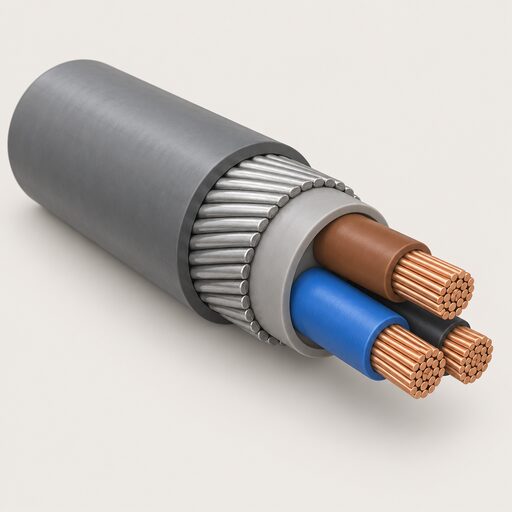
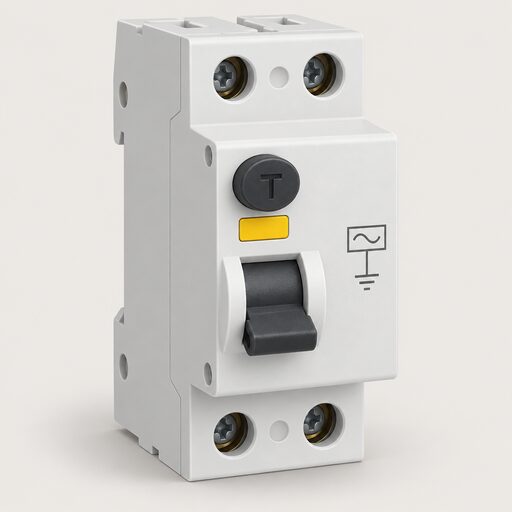
A three-phase supply uses three live conductors, each carrying an alternating current offset from the others by a third of a cycle. The practical effect is that power flows more smoothly and large motors run without the vibration and losses that single-phase supply imposes on them. At the meter, the giveaway is physical: eight reasonably thick cables connecting to the meter, four of which go to the consumer unit or fuse-board, together with a 3-pole or 4-pole linked miniature circuit breaker6. A single-phase installation has far fewer conductors and a single-pole breaker.
Most UK homes have a single-phase service. That is not an accident of history so much as a design choice: domestic loads were small and predictable, and a single-phase service met them. The pattern persists even in new build. The Building for 2050 research programme recorded a site where a 3-phase supply was installed to the site and homes, but only 2 phases were needed and used7. The infrastructure was there; the demand was not.
Three-phase connections are, however, increasingly common in residential properties and small commercial establishments like local food takeaways, hair and beauty salons, and newsagents3. The common thread is equipment rather than building type: commercial kitchens, salon dryers and similar loads draw more than a domestic single-phase service comfortably supplies.
For a household, the significance is straightforward. A single-phase supply is the default and it is adequate for most homes. A three-phase supply is a specific engineering answer to a specific load problem, and it comes with a network operator's process attached.
When a house genuinely needs three phase
The trigger is load, not property type. UK Power Networks lists the upgrade triggers as installing an electric vehicle charger, solar panels, energy storage or heat pumps, described collectively as Low Carbon Technology, along with installing power showers, or installing a Jacuzzi or hot tub8. Any one of those may fit within a single-phase service. Several together, particularly a high-power EV charger alongside a heat pump, can push a house past what its existing fuse will carry.
Electricity North West puts a figure on the threshold: if you require an electricity supply over 20kW, you may need to apply for an amp increase or an increase from a single phase to a three phase supply9. That is the point at which the conversation moves from a fuse upgrade to a supply change.
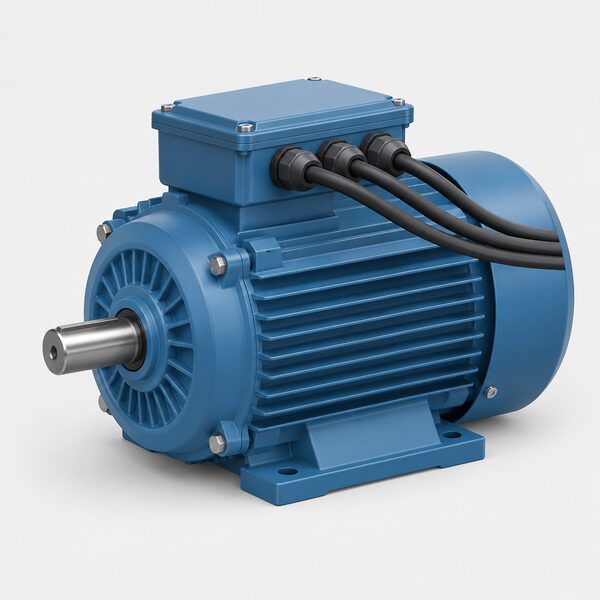
The equipment itself is the other signal. Installing any three phase electrical equipment, such as water pumps, is listed by UK Power Networks as a reason a three-phase supply is needed10. A three-phase motor cannot simply be run from a single-phase service without conversion equipment, and conversion brings its own losses.
For a household, the honest test is whether the planned equipment genuinely requires three phases or merely requires more amps than the current fuse provides. Many heat pump and EV charger installations are met by a fuse upgrade alone. The distinction determines whether the job is a same-day fuse change or a cable and connection project.
Single phase capacity: the 15kVA default and 80 or 100amp fuse upgrades
Before considering three phase, it is worth establishing what a single-phase service can be pushed to. UK Power Networks states it can upgrade a main fuse from a 30 or 60amp fuse up to either an 80amp or a 100amp fuse5. That is the ceiling for a domestic single-phase supply on its network, and it is reached without any change to the cable or the connection type.
A fuse upgrade is the cheaper and less disruptive route, and it resolves a large share of domestic capacity problems. It does not, however, change the fundamental shape of the supply: one live conductor, one neutral, one limit.
Where a fuse upgrade is not enough, the network operator's own guidance points to the next step. Electricity North West advises that a supply over 20kW may need an amp increase or a move from single phase to three phase9. SSEN frames the same move in capacity terms, describing an upgrade from single phase to three phase giving up to 69kVA4.
The gap between the two routes is worth stating plainly. A 100amp single-phase fuse is the top of the fuse upgrade ladder, and a three-phase connection offers 60kVA, distributing 80 amps per phase3. The three-phase service is not a marginal improvement; it is a different order of capacity, and it is priced and scheduled accordingly.
| Route | Capacity | What changes |
|---|---|---|
| Existing single phase | 30 or 60amp fuse | Nothing |
| Fuse upgrade | 80 or 100amp fuse5 | Main fuse only |
| Three phase (standard) | 60kVA, 80 amps per phase3 | Cable, cut-out, meter, consumer unit |
| Three phase (SSEN upgrade) | up to 69kVA4 | Cable, cut-out, meter, consumer unit |
How to apply for a three phase upgrade, step by step
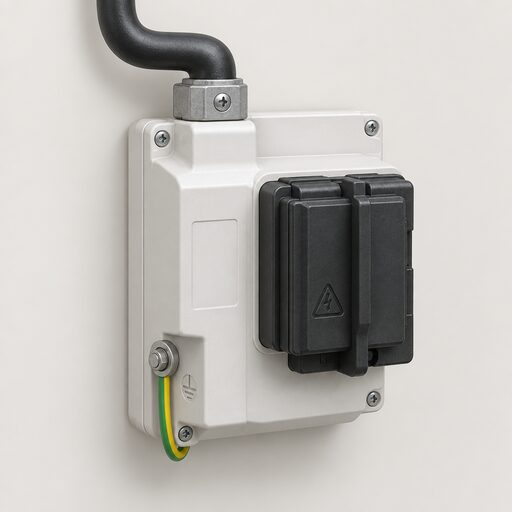
The application goes to the distribution network operator for the area, not to the electricity supplier that bills the household. The Energy Networks Association maintains a postcode lookup for finding the right operator11. For a UK Power Networks area property, the process runs through its adding more power pages.
The sequence is broadly as follows.
- Establish what the load actually is, with the electrician who will install the equipment. Your electrician will be able to assess whether this connection size is suitable for your specific residential or business needs3.
- Submit the network operator's application form for an upgrade or a new connection.
- Receive a quotation. Response times vary by route and the published figures disagree: one UK Power Networks page states the team will get back to you within 48 hours12, another states contact within three working days13, and Electricity North West promises a quote within 5 working days on its online application form3.
- Accept the quotation and agree a date.
- Complete any customer preparation, including trench and meter box if the household is doing that work.
- Network operator installs the cable and cut-out.
- Meter installation is arranged separately through the supplier.
- The supply is energised and registered against its MPAN.
Electricity North West asks that the ENA form be sent to connectionapplications@enwl.co.uk for three phase upgrades, vehicle-to-grid and load limitation scheme enquiries14. The form is the same family of document across operators, which is why installers who work across regions recognise it.
What the upgrade work involves on your property
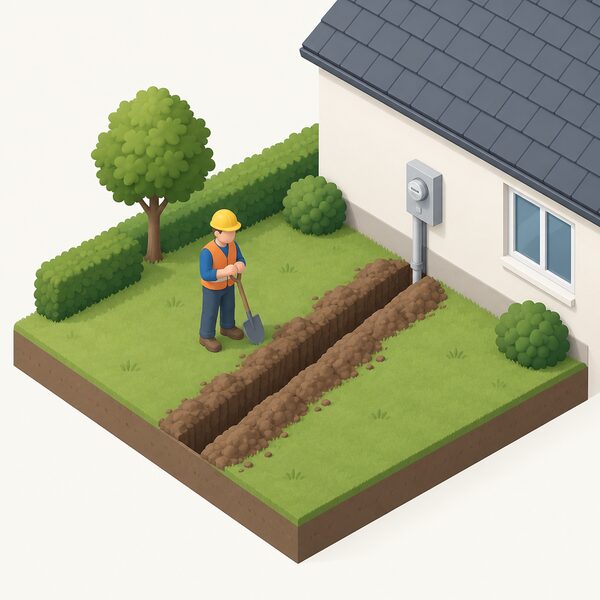
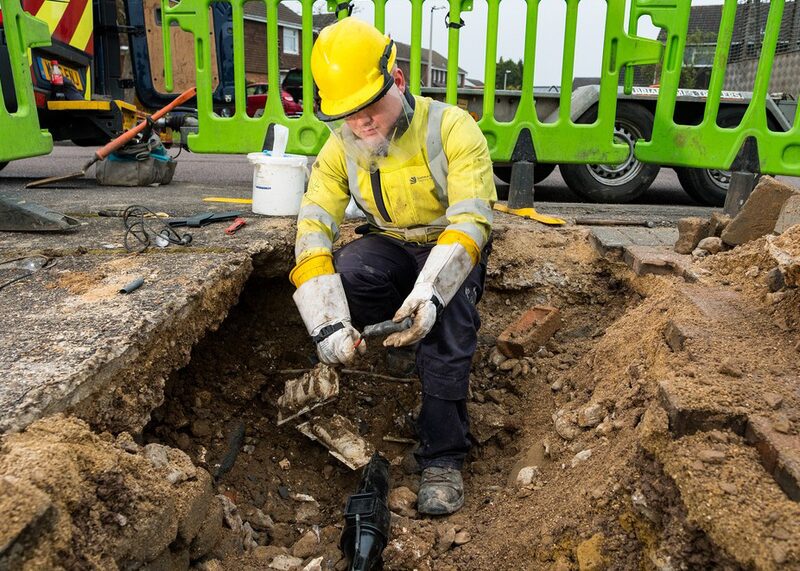
The physical work falls into two parts: what the network operator does, and what the household arranges. UK Power Networks states that if you have decided to dig the trench yourself, you would need to make sure that is ready for the cable to be installed, and the meter box must be installed where the meter is to be connected12. The same condition applies to a new connection15 and to a temporary connection, where the trench needs to be dug on your land16.
Where the household does not dig, the excavation forms part of the job. Either way, the cable route has to be agreed and the meter position fixed before work starts, because the meter box location determines where the cable terminates.
Parking is a practical constraint that catches people out. UK Power Networks states that vans need to park close to the work, and that if there are designated parking bays outside your property, it may need to apply to your council to suspend those spaces8. That application runs through the local authority and adds time to the schedule.
Inside the property, the consumer unit changes. A three-phase installation needs a board that accepts three linked breakers, and the internal distribution has to be arranged so that loads are balanced across the phases. That is electrician's work, not network operator's work, and it sits outside the connection quotation.
Who does what: the network operator, your supplier and your installer
Three parties are involved, and confusing them is the most common source of delay.
The network operator owns and maintains the physical infrastructure. A network operator is responsible for the pipes and wires that move energy18, and it is your Electricity Distribution Network Operator that is responsible for maintaining physical electricity supplies to your home or business19. The same body is responsible for fixing power cuts and paying compensation, not the energy supplier20. For a supply upgrade, the network operator is the party that quotes, schedules and connects.
The electricity supplier is the billing relationship. It is not the party that upgrades a cable, and contacting it about a three-phase connection will generally result in a redirect to the network operator.
The installer is the party that specifies the load and does the internal work. Installers routinely act for property owners in dealings with official bodies: the Boiler Upgrade Scheme is installer-led, with the installer applying for the grant on the property owner's behalf21, and it operates as an installer-led two stage application process, with the installer applying for and redeeming the voucher22. The same pattern of installer-led paperwork applies to connection applications, though the property owner's authority and details are still required.
Where a dispute arises with a network operator, the Energy Ombudsman is the escalation route, and can be reached on 0330 440 1624, pressing option 3 for heat networks when prompted23. For a power cut, the network operator is also the party that pays compensation20, and the Met Office advises on what to do in a power cut while it is ongoing24.
What three phase does for a household's independence, and what it does not
A three-phase supply increases what a property can run from its own connection. That is a real gain for a household adding an EV charger, a heat pump and battery storage together, because it removes the capacity ceiling that would otherwise force a choice between them. It also makes three-phase equipment, including some larger heat pumps and water pumps, usable without conversion.
What it does not do is reduce dependence on the grid. A three-phase connection is still a connection: the household remains reliant on the network operator's cable, the supplier's billing, and the generation mix behind the meter. It does not generate anything, store anything, or insulate the household from a power cut. The Met Office guidance on power cuts applies exactly as it did before24.
The dependence on the network operator is, if anything, more pronounced after an upgrade, because the household now has equipment that assumes three phases are present. The safety warning about single-phasing is the sharp end of that: a three-phase motor run on one phase after a phase loss is likely to be damaged, which is why a linked 3-pole or 4-pole circuit breaker is essential6.
For most households the practical answer remains a fuse upgrade to 80 or 100 amps5, which addresses the load without changing the nature of the supply. Three phase is the right answer where the equipment genuinely requires it, and the cost of £500 to £4,0001 reflects that it is a connection project rather than a fuse change.
Sources24 cited
- 10 things to make getting a heat pump easier, Nesta, 2026-02-12
- What's the difference between a single phase and three phase electricity supply, UK Power Networks, 2026-09-17
- Three phase power connection, Electricity North West, 2026-09-19
- Change in capacity, upgrade or reduce your supply: FAQs, SSEN, 2026-09-17
- Fuse upgrade, UK Power Networks, 2026-09-17
- Three phase power theory, OpenEnergyMonitor, 2026-09-17
- Building for 2050: low cost, low carbon homes, GOV.UK, 2022-12-05
- Adding more power: what's involved, UK Power Networks, 2026-09-17
- Upgrade or reduce your supply, Electricity North West, 2026-09-19
- What do you need to upgrade, UK Power Networks, 2026-09-17
- Find my network operator, Energy Networks Association
- What happens after I apply, UK Power Networks, 2026-09-17
- Permanently disconnect: what's involved, UK Power Networks, 2026-09-17
- Single EV, Electricity North West, 2026-09-20
- New electricity connection: what happens after I apply, UK Power Networks, 2026-09-17
- Temporary electricity connection: what's involved, UK Power Networks, 2026-09-17
- Replace power cable or power line, UK Power Networks, 2026-09-17
- Complain about your energy supplier or network operator, Ofgem, 2026
- What to do in a power cut, Met Office, 2026-09-20
- Get compensation if you have a power cut, Citizens Advice, 2026-09-17
- Boiler Upgrade Scheme: installers, Ofgem, 2026-09-18
- BUS PO guidance V2.3, Ofgem, 2023-09-25
- Raise a dispute, Energy Ombudsman, 2026-09-19
- Electric car charging at home, Which?, 2026-02-25
 Three-Phase MeteringYour home has a three-phase supply.
 New Electricity ConnectionWho do you contact for a new or upgraded electricity connection, and what will it cost?
 Check Supply Capacity FirstAdding a heat pump, car charger or home battery can push your electricity supply past what it can safely handle.
 Electricity Supply and WiringWill your fuse box cope with a heat pump, and will the mains supply need upgrading?
 Electrical RequirementsWill your home need a bigger electricity supply before a charge point can go in?
 Getting a New Gas ConnectionHow a household applies for a new or upgraded gas connection, who carries out the work, the quotation and contribution rules, typical timescales, and what a connection means for a home's energy independence.