

In this guide
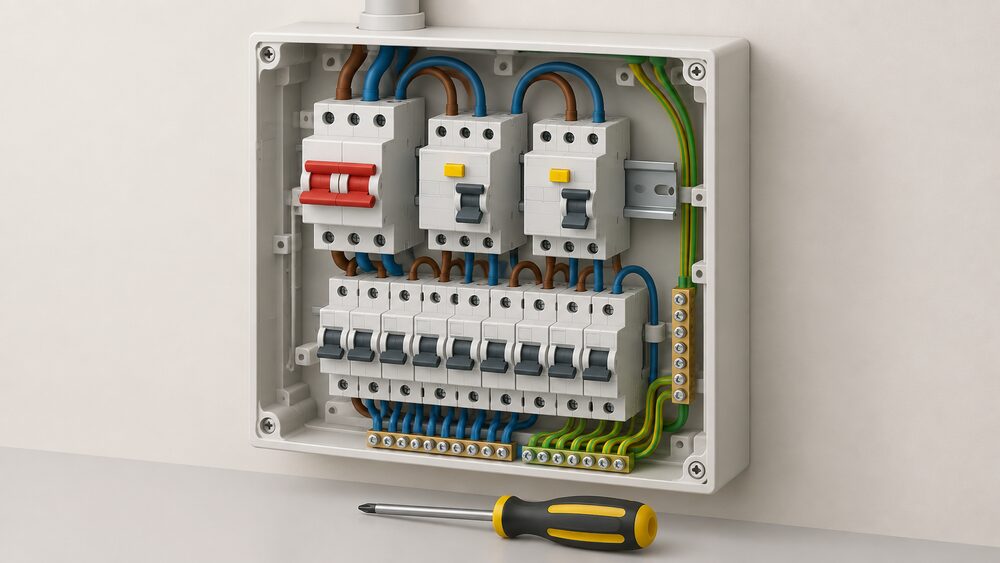
A Hager consumer unit is the enclosure at the centre of a home's electrical installation: the board that holds the main switch, the residual current devices and the miniature circuit breakers that divide the house into circuits. Hager sells these boards in the UK under several families, and the range splits by job rather than by price. The JK range covers the ordinary domestic case, the JKA Board covers accessory and sub-board work, and the HDA and TPN products cover three-phase and higher-rated distribution where a house or a small commercial unit needs more than a single-phase board can carry.
The paperwork matters as much as the metal. Hager publishes declarations of conformity for individual products, and the dates on those documents are the clearest signal of which certificate is current. The JK11004RLD, a 100A 300mA four-pole time delay RCCB kit, carries en-GB declarations dated 22 July 2026. The HDA100Z, an MCCB rated H3 x160, TM, three-pole 100A, 18kA, carries a UKCA Declaration of Conformity dated 20 March 2025 and a separate declaration in en-US dated 14 July 2026. The HNE970H, an MCCB rated H1000, three-pole, 50kA, 1000A, LSI, carries a declaration of conformity in en-US dated 14 July 2026.
For a household, the board is the point at which the grid enters the home and the point at which every future addition, solar, battery, heat pump or car charger, has to find a spare way and a protective device. It is also, in the clearest sense, the home owner's own equipment rather than the supplier's.
Hager consumer units: what the range covers
Consumer units come in five common types, and the differences between them are about how circuits are grouped and protected rather than about the enclosure itself1. The requirements for installing one are set out in BS 7671, the national standard governing wiring, and installation, replacement or repair work is work for a registered electrician rather than a householder1. That is not a formality: the board is the interface between the supply and every circuit in the house, and the protective devices inside it are sized against the cable and the load behind them.
Ownership is worth stating plainly, because it decides who pays and who is responsible. The box that houses the trip switches is the property of the home owner2. A householder therefore owns the equipment that sits between the meter and the wiring, even though the supply itself comes from a network operator and a supplier. Replacing the fuse box or consumer unit is one of the items that falls within a full rewire3, which is the point at which most homes move to a modern board with residual current protection across the circuits.
Hager's UK range is organised so that the domestic case is covered by the JK family, with the JKA Board sitting alongside it for accessory work, and the HDA and TPN products covering three-phase and higher-rated distribution. The practical question for a household is not which family exists but which one the installation needs, and that is settled by the supply type and the number of ways required.
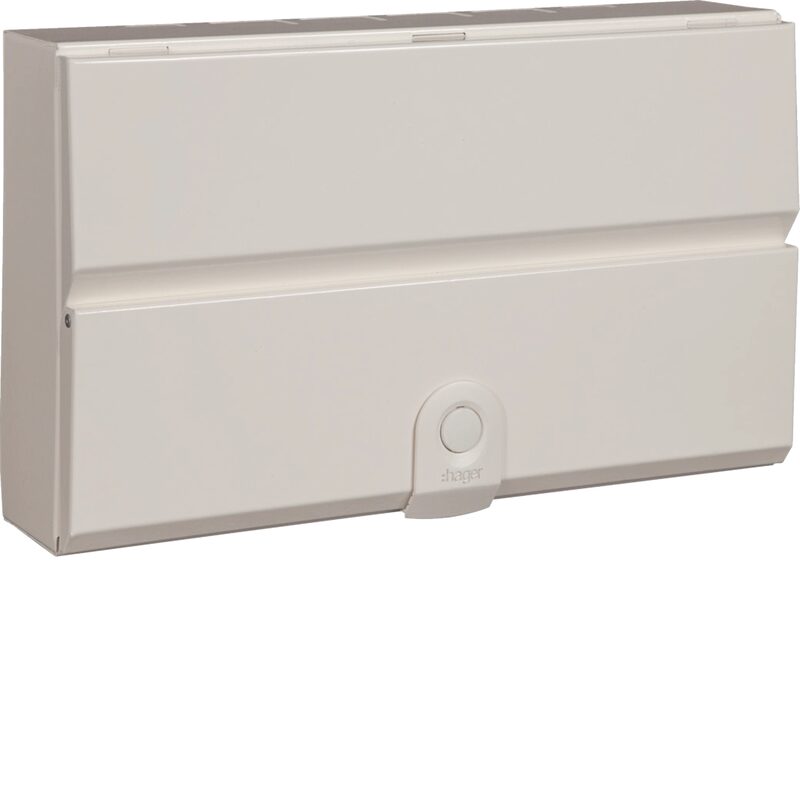
The JK range: dual RCD boards, ATS and high-integrity designs
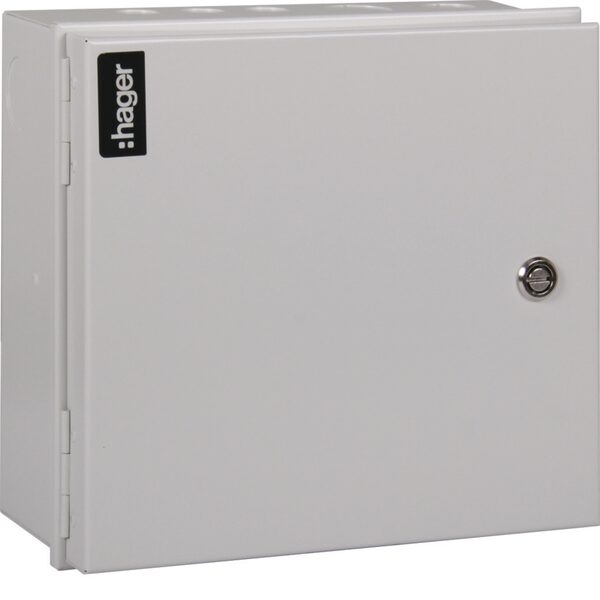
The JK range is where most domestic Hager boards sit, and the design choice inside it is how circuits are grouped. A dual RCD board splits the ways between two residual current devices, so a fault on one side does not take out the other. A high-integrity unit takes the opposite approach: it provides either circuit breakers or the combined RCD and circuit breaker protection of an RCBO for each connected circuit, without combining circuits under a single RCD1. The practical consequence is that a fault on one circuit trips that circuit alone rather than a group of them.
That distinction drives cost and convenience in opposite directions. A dual RCD board uses fewer protective devices and is cheaper to populate, but a single fault can remove lighting and power together. A high-integrity board populated with RCBOs costs more per way and takes more space, and it limits the scope of any single trip. Neither is a safety difference in the sense of whether circuits are protected; it is a difference in how much of the house goes dark when something goes wrong.
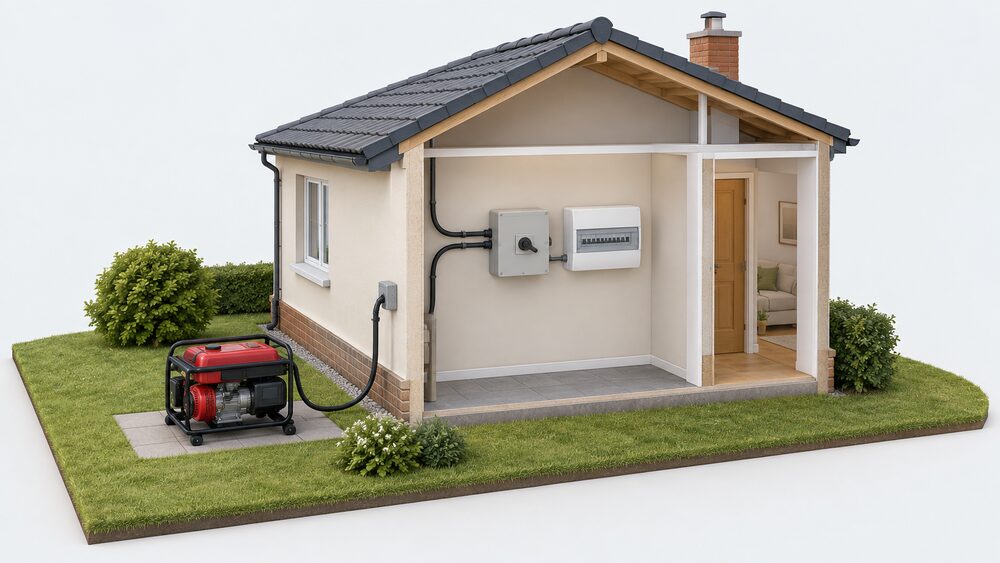
The JK range also includes the JK1125ATS, an enclosed automatic transfer switch, which Hager lists with a declaration of conformity in en-GB dated 22 July 2026. An automatic transfer switch changes the supply from one source to another without manual intervention. That is the component that matters where a household adds a standby supply or an alternative source, because it is what decides which source is feeding the board at any moment. It is a distribution product rather than a generation product, and it does not by itself make a home independent of the grid.
Accessibility is a requirement as well as good practice: consumer units should be easily accessible1. A board boxed in behind a finished wall or placed where it cannot be reached is a problem at the moment it is needed.
TPN and HDA boards: three-phase and surge-protected options
Three-phase supply is more common in UK homes than many householders assume, and it is identifiable at the board. The easiest way to check the connection is to look at the consumer unit: three circuit breakers indicate a three-phase connection4. Where a property has that supply, the distribution equipment changes accordingly, and Hager's HDA and TPN products are the part of the range that covers it.
The HDA100Z is an MCCB rated H3 x160, TM, three-pole 100A, 18kA, and it carries a UKCA Declaration of Conformity dated 20 March 2025. The four-pole HDA101Z carries a UKCA Declaration of Conformity with the same date. Both also carry a declaration of conformity in en-US dated 14 July 2026. The HNE970H, an MCCB rated H1000, three-pole, 50kA, 1000A, LSI, carries a declaration of conformity in en-US dated 14 July 2026, listed on the Irish catalogue entry for the product. The same 14 July 2026 date applies to declarations issued for the HDA101Z and for the HED400H, an MCCB rated H630, three-pole, 70kA, 400A, LSI.
Surge protection is a separate function from the transfer switch, and the figures published for home equipment are quoted in kilovolts. One maker's home power station lists 3kV surge protection, described as helping to protect a refrigerator's compressor from power surges5. That is a figure for a different product class, and it illustrates the unit rather than the Hager device. A household adding solar, a battery or an electric vehicle charger is adding electronics that a surge can damage, and the protective device for that sits in the board.
| Product | Rating | Declaration on file | Date |
|---|---|---|---|
| HDA100Z | MCCB H3 x160, TM, 3P, 100A, 18kA | UKCA Declaration of Conformity | 20 March 2025 |
| HDA101Z | MCCB H3 x160, TM, 4P, 100A, 18kA | UKCA Declaration of Conformity | 20 March 2025 |
| HDA100Z | MCCB H3 x160, TM, 3P, 100A, 18kA | Declaration of conformity, en-US | 14 July 2026 |
| HNE970H | MCCB H1000, 3P, 50kA, 1000A, LSI | Declaration of conformity, en-US | 14 July 2026 |
| JK1125ATS | Enclosed automatic transfer switch | Declaration of conformity, en-GB | 22 July 2026 |
| JK11004RLD | 100A 300mA 4-pole time delay RCCB kit | Declarations of conformity, en-GB | 22 July 2026 |
UKCA and CE declarations of conformity: what is on file and when it was issued
The marking regime behind these documents changed on a fixed date. From 1 January 2023, all products placed on the UK market for sale, excluding Northern Ireland, must meet the UKCA regime, and the CE mark is no longer recognised within the UK3. Any product placed on the market after that date needs its conformity assessment undertaken by a UK recognised notified institute listed on the UK notified laboratory database3. The UKCA mark could be applied as early as 1 January 2021 by manufacturers whose products had already been tested by a UK recognised authority, under a 12-month transition3.
The mark is not a label that can be applied at will. The CE or UKCA mark and Declaration of Conformity can only be applied to the product once specific requirements have been met, including provision of the necessary technical documentation4. Declarations of Performance, where they apply, now need to reference the new UKCA legislation document superseding (EU) 305/2011, and to reference UK designated standards rather than the EU standards previously cited in the Official Journal3.
There are live exceptions, and they matter for anyone reading a certificate. Both CE and UKCA marked meters can continue to be placed on the market in Great Britain6. Energy Related Products which carry the CE Mark can currently be sold in Great Britain if they are compliant with GB's ecodesign standards, without the need to also affix a UK Conformity Assessment marking7. The same position is restated in a later consultation: CE marked products can be sold in Great Britain if they are compliant with GB ecodesign standards, without also affixing a UKCA marking8. So a CE mark on a product is not automatically out of date, and the question is which regime the product falls under.
Standards and documentation: BS EN 60947-3 and instruction manuals
Two documents sit behind a Hager distribution product: the standard it is tested against and the manual that tells an installer how to fit it. For the enclosed fuse combination switch range, Hager lists a UK product data sheet for BS EN 60947-3 dated 22 March 2024, and instruction manuals in English dated 27 February 2024. Those dates are the ones to check when a board is being specified, because a superseded data sheet may describe a different rating or pole configuration.
The wider standards picture is worth understanding because it explains why certificates look the way they do. Conformity assessment bodies are themselves assessed against standards: the Boiler Upgrade Scheme regulations, for example, approve BS EN ISO/IEC 17065:2012, the standard for bodies certifying products, processes and services9. That is the layer above the product certificate, and it is why a declaration carries the name of the body that issued it as well as the manufacturer.
Documentation also has a compliance function beyond the product. Accredited Construction Details contain checklists which should be used by the Designer, Constructor and Building Control Body to demonstrate compliance10. For a household, the practical version of this is the paperwork pack that should survive an installation: the electrician's certificate, the board's declaration of conformity, and the manual for the devices fitted. Where a product is later recalled, the identification details on that paperwork are what allow a household to check whether its unit is affected. Recall notices identify affected units by a date code on the product rating label located on the underside of the product11, which is the same pattern of labelling used across electrical equipment.
The JKA Board: accessory boards and their certification
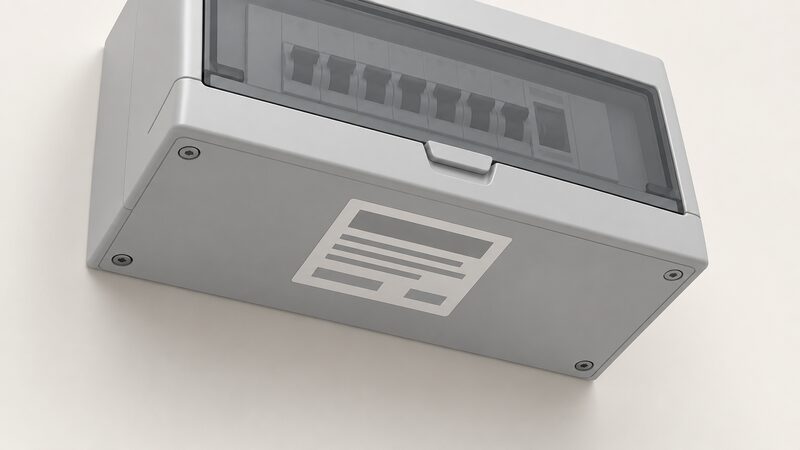
The JKA Board is Hager's accessory board, used where a main consumer unit needs a companion enclosure rather than where the whole installation is being replaced. Hager published UKCA and CE declarations of conformity for the JKA Board dated 20 December 2023, and a further declaration of conformity dated 22 July 2026. The two dates are not a contradiction: the 2023 documents were issued under the UKCA regime that took effect on 1 January 2023, and the 2026 document is a later issue for the same family.
That pattern of reissue runs across the range. Hager published en-GB declarations of conformity dated 22 July 2026 for the JK11004RLD, a 100A 300mA four-pole time delay RCCB kit, and declarations dated 22 July 2026 for the JK11004RL, a 100A 300mA four-pole RCCB incomer kit. A declaration of conformity for the JK128, a 100A 28-way A board, carries the same 22 July 2026 date. The JK1125ATS, the enclosed automatic transfer switch, also carries an en-GB declaration dated 22 July 2026. A batch of UK TPN product declarations was published on the same date.
For a household, the useful reading is that a current declaration exists for the accessory boards and the incomer kits, and that the date on the document is the way to tell a current certificate from an earlier one. Where a board was installed some years ago, the certificate that came with it may be an older issue, and the product itself has not changed as a result.
What a Hager consumer unit means for household energy independence
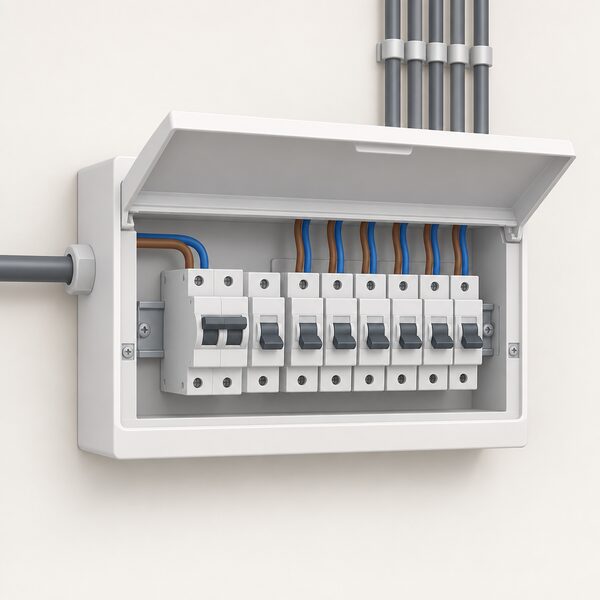
A consumer unit is the boundary of a household's electrical independence, and it is worth being exact about what it does and does not change. The board is the home owner's property2, which means the household owns the equipment that distributes power inside the home. Everything upstream of it, the network, the meter and the supply, belongs to someone else. A Hager board does not alter that relationship: it is the point at which a grid connection is divided into circuits, and it remains a grid connection.
What the board does determine is how easily a household can add its own generation and storage. Every additional circuit, whether for a solar inverter, a battery, a heat pump or an electric vehicle charger, needs a protective device and a way in the board. A high-integrity unit, with an RCBO on each connected circuit rather than circuits grouped under a single RCD1, gives more granular protection and makes it easier to isolate one addition without disturbing the rest of the house. That is a distribution decision, not an energy decision, but it shapes what can be added later.
The dependence that remains is straightforward. A household with a consumer unit and no generation is dependent on the grid for every unit of electricity it uses, and on a supplier for the price of those units. Typical domestic consumption figures used for bill comparisons are 2,700kWh for electricity and 11,500kWh for gas for a medium household12, and Ofgem's price cap figures assume 2,500kWh for electricity and 9,500kWh for gas13. Those are the volumes a board is distributing, and they are the volumes a household would need to displace to change its position.
Where a household does add generation, the connection rules apply. Customers must be able to demonstrate compliance with the requirements in the relevant document when generation is commissioned14. In Northern Ireland, the advice for homeowners is to seek independent advice on solar panels, heat pumps and other energy efficiency measures from organisations funded to provide it15. The board is where that generation lands, and the certificate for the board is part of the evidence trail.
For the wider picture of how distribution equipment sits alongside the other brands and products sold into UK homes, the manufacturers pillar sets out the field, and electrical component manufacturers covers the companies behind the devices. A comparison with another UK board maker is at Wylex consumer units, and the certification framework behind these documents is explained in manufacturer certification and approvals.
Sources15 cited
- Consumer units and fuse boxes, NICEIC, 2025-09
- Meter services FAQs, NI Networks, 2026-09-19
- All you need to know about UKCA marking, HETAS, 2025-11-17
- HPA UK statement on R290 safety zone, Heat Pump Association, 2026-05-12
- Jackery HomePower 1000 Plus v2, Jackery, 2026-09-19
- MIR approved gas and electricity meters, GOV.UK, 2025-11-06
- Extended CE marking recognition for ecodesign regulations, GOV.UK, 2025-12-09
- Extended CE marking recognition for ecodesign regulations: consultation document, GOV.UK, 2026-07-06
- Boiler Upgrade Scheme regulations: approved standards, grant categories and grant levels, GOV.UK, 2026-07-21
- Accredited Construction Details, Planning Portal, 2026
- Safeguard+ electric shower recall, Electrical Safety First, 2026-09-17
- Summary of changes to energy price cap, 1 October to 31 December 2025, Ofgem, 2025-08-27
- Energy price cap and consumer outcomes, House of Commons Library, 2026
- Connecting generation to the electricity networks, Energy Networks Association, 2026-09-17
- Support to generate your own electricity, nidirect, 2025-09-22
 Hager changeover switches and consumer units for backup powerWhich Hager changeover switch suits your home, and what size generator or inverter will it handle?
 Hager Home Battery Storage SystemsDoes Hager make a home battery, and if so what does it cost and what warranty comes with it?