
In this guide
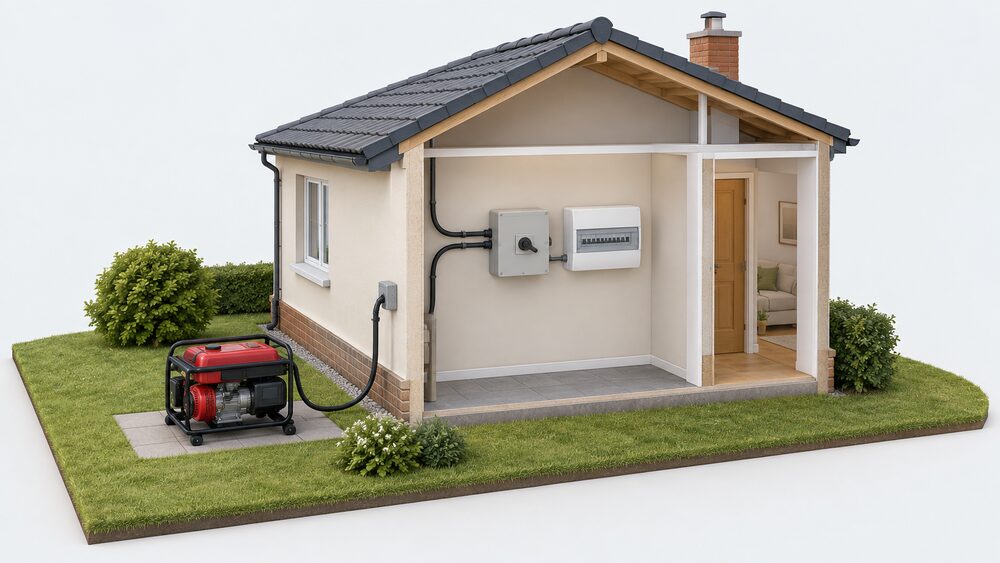
A Hager changeover switch is the piece of gear that lets a house run from a generator or an inverter instead of the grid, and then return to the grid when the supply comes back. It sits between the two sources and makes sure they are never connected to each other at the same time. That single function is what makes backup power legal and safe to install in a UK home.
Those documents are the compliance paperwork a householder or their electrician will be asked for.
The wider context matters as much as the product. A changeover switch does not generate anything. It selects between sources, and the household remains dependent on whatever is feeding it: a generator and its fuel, a battery and its inverter, or the grid. What the switch changes is whether that dependence is a single point of failure or a choice.
What a Hager changeover switch does in a backup power setup
A changeover switch performs one job: it breaks the connection to one supply before making the connection to another. In a home backup arrangement the two supplies are the grid and a secondary source, which might be a standby generator, a portable generator, or an inverter fed by solar and a battery. Without that break, the secondary source can energise the network, which is dangerous to anyone working on the lines and is the reason the practice is prohibited.
The behaviour of the secondary source is a separate matter from the switch. A hybrid inverter, for example, will automatically disconnect from the grid during a blackout and keep the home powered using solar and stored energy when paired with a battery4. Smart energy management in such systems allows seamless switching between solar, battery and grid power5. The changeover or transfer device is what makes that switching safe at the point where the two supplies meet the installation.
Automatic transfer switches exist in the market at different current ratings, with 50A and 200A models available and a built-in transformer in some designs6. The rating is the headline number because it sets what the switch can carry, and it must be matched to the supply and to the backup source.
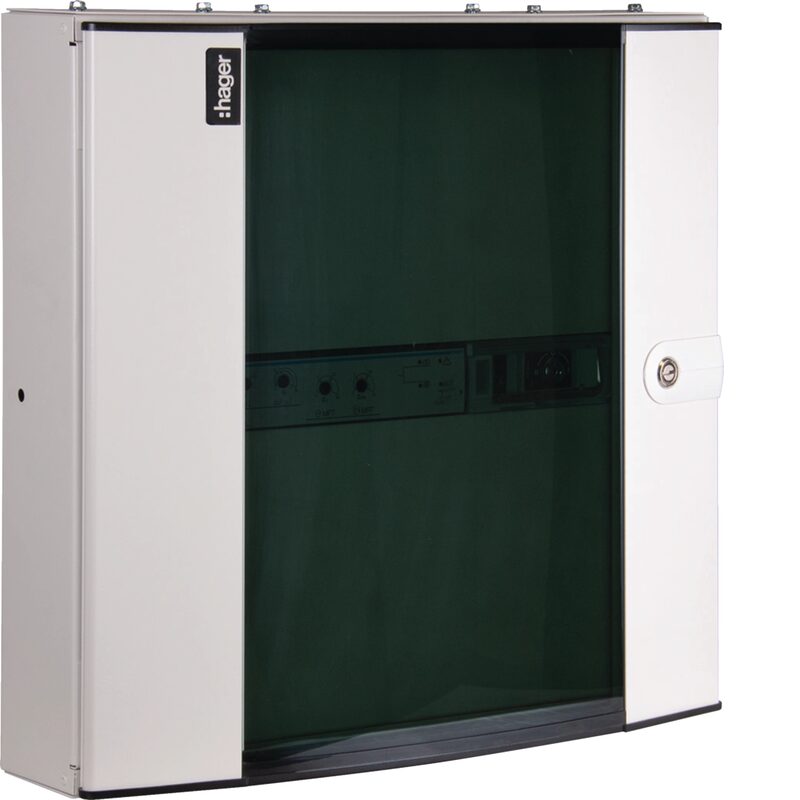
For a household, the practical effect is that the lights, the heating controls and the fridge can be moved onto a backup source without unplugging anything or running extension leads through a window. The switch is the fixed, permanent part of that arrangement. Everything upstream of it, the generator or the battery, is what actually supplies the power.
Changeover switch or transfer switch: which Hager option fits which installation
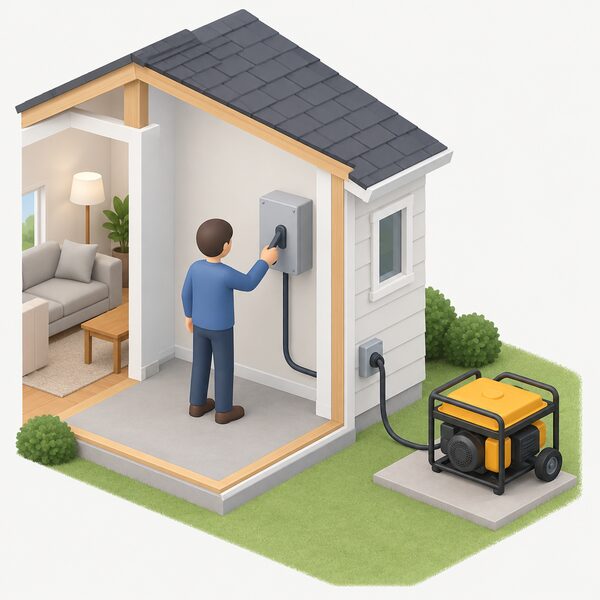
The two terms describe related but distinct devices, and the choice follows from how much of the process the household wants automated. A manual changeover switch requires a person to operate it: the supply is switched by hand when the grid fails and switched back when it returns. An automatic transfer switch does the same job without intervention, sensing the loss of supply and moving the load across.
That places it in the automatic category, and the enclosed format means it arrives as a complete unit rather than as a component to be assembled into a board. For a household that wants the backup source to take over without anyone being present, that is the relevant product type.
The manual route suits a different set of circumstances. Where the backup source is a portable generator that has to be wheeled out, fuelled and started by hand, an automatic transfer has nothing to transfer to until someone has done that work. A manual switch matches the manual nature of the source. Where the source is a permanently installed standby generator or a battery system that is always available, automatic transfer is the arrangement that delivers the benefit.
The market context is that automatic transfer switches are sold at different ratings for different sizes of installation, with 50A and 200A models available6. The correct choice depends on the rating of the incoming supply and the capacity of the backup source, and that is a calculation for an electrician rather than a householder.
There is also a distinction between a changeover switch and the isolation a hybrid inverter provides internally. An inverter that disconnects from the grid during a blackout is performing its own transfer function4. Where such a system is installed, the changeover gear may serve as a manual isolation point rather than as the primary means of switching. The two are not mutually exclusive, and the design of the installation determines which is doing the work.
Sizing and ratings: matching the switch to your supply and generator
Sizing a changeover switch means matching three things: the rating of the incoming supply, the rating of the backup source, and the load the household intends to carry. The switch must be rated at or above the current it will carry, and the backup source must be able to supply that current without being overloaded.
The generator side of the calculation has its own documentation requirements where the source is connected to the network. Where the generator is inverter connected, a copy of the harmonics report up to the 50th harmonic must also be included with the application7.
These requirements exist because a generator or inverter connected to a property can export to the network, and the network operator needs to know what is being connected. Manufacturers must always lodge their declarations of full compliance in the ENA Type Test Register for generation equipment rated below 3.68kW per phase8. That register is how the equipment's behaviour on the network is documented.
For a household, the sizing question usually reduces to what the backup source can actually deliver. A portable petrol generator, for example, typically offers two 230V 13A sockets, a 12V DC outlet and two USB ports3. Those socket ratings describe the output available, and the changeover switch and the circuits it feeds must be arranged so that the load does not exceed it.
The practical approach is to decide which circuits are essential and size the backup source to those, rather than attempting to carry the whole house. The switch rating then follows from the supply and the source, and the electrician designing the installation will confirm both.
Consumer units and TPN boards that pair with a changeover switch
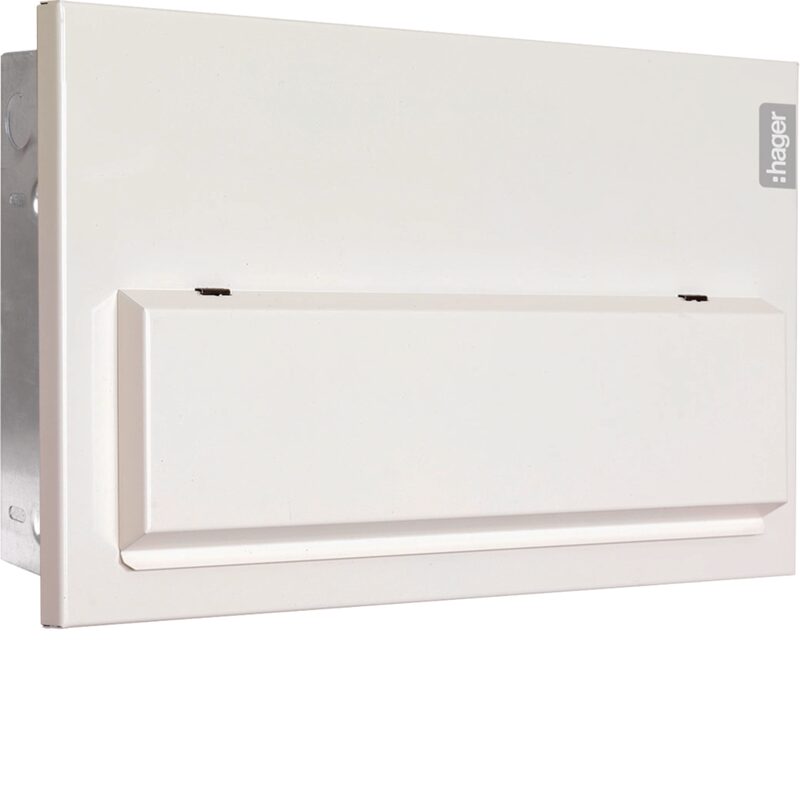
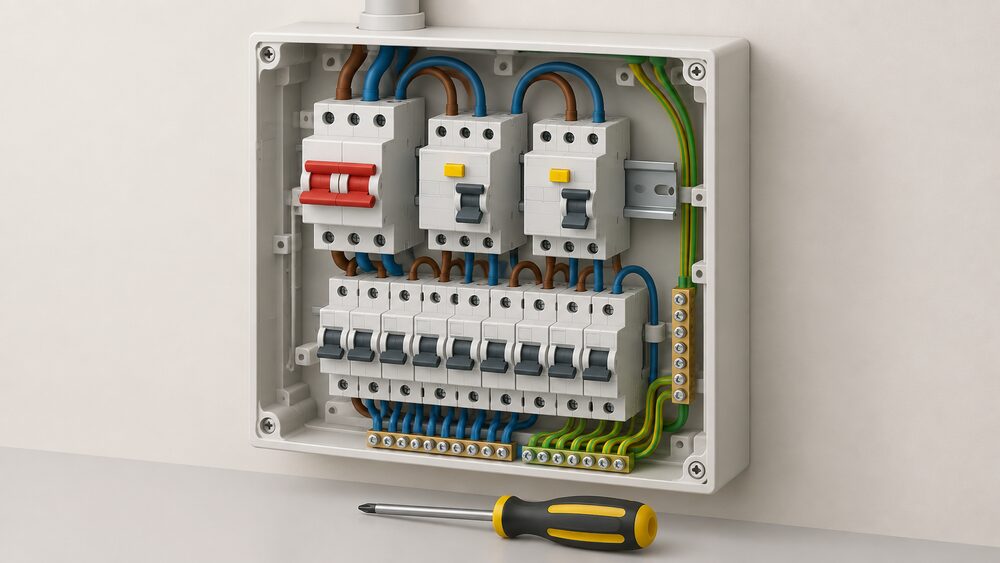
A changeover switch does not stand alone. It is part of an assembly that includes the consumer unit, the distribution board and the protective devices, and Hager's UK range covers the boards and enclosures that house them.
The IU range is a family of modular DIN rail boxes, and Hager published declarations of conformity for the range dated 28 July 2026. These are the enclosures into which modular devices are fitted, and they are the building blocks of a distribution arrangement. The JK range covers the A boards, with declarations of conformity for the JKA Board products dated 22 July 2026.
Replacing a consumer unit is a recognised part of a broader rewiring project, and rewiring a house is a significant project that should only be carried out by a qualified, competent electrician, such as one registered with NICEIC9. The consumer unit is the point at which the installation's circuits are protected and divided, and it is also the point at which a changeover arrangement is most naturally introduced.
For three-phase supplies, the TPN boards and incomer kits form the equivalent assembly. Hager lists declarations of conformity for its UK TPN products dated 22 July 2026, including a 100A 300mA four-pole RCCB incomer kit. Three-phase installations are less common in domestic settings but appear in larger properties and in premises with three-phase equipment.
The pairing question is therefore about the enclosure and the devices rather than about the switch in isolation. A changeover switch needs a board to sit in or beside, protective devices to match the supply, and an enclosure rated for the location. Hager's range covers those elements, and the declarations of conformity for each product are published on the relevant product page.
The JK1125ATS and the IU range: key products in the Hager line-up
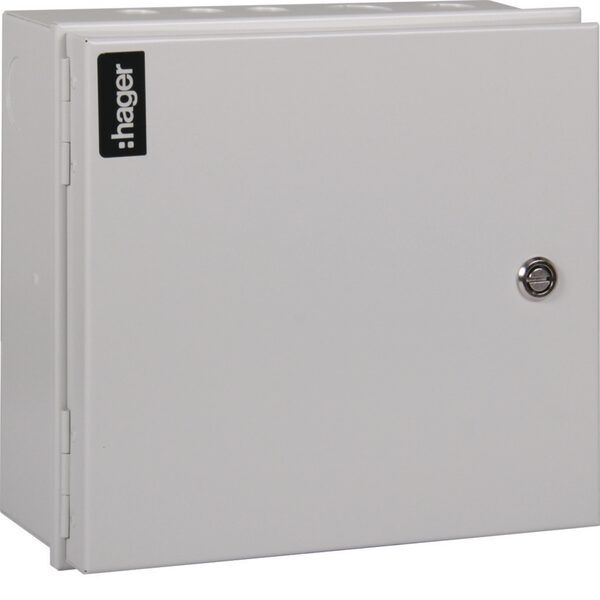
The IU range is the enclosure family: modular DIN rail boxes in a range of sizes, from two-module boxes up to larger assemblies.
| Product | What it is | Rating or size | Compliance date |
|---|---|---|---|
| JK1125ATS | Enclosed automatic transfer switch | Automatic transfer switch | 22 July 2026 |
| IU range | Modular DIN rail boxes | 2 to 5 module variants | 28 July 2026 |
| JKA Board | A board distribution | 10, 20 and 4 way variants | 22 July 2026 |
| JK066 | DIN rail box, plain | 66 module | 22 July 2026 |
| JK304H | A board with RCD | 100A, 4 way, 100A 30mA RCD | 22 July 2026 |
| JK11004RL | RCCB incomer kit | 100A, 300mA, 4 pole | 22 July 2026 |
| HAC408 | Load break switch | 4 pole | Manual dated 18 August 2026 |
The IU range includes variants with plain doors and with different module counts, and the declarations of conformity for the range are dated 28 July 2026. The JK range covers the A boards and the associated incomer kits, with declarations dated 22 July 2026. The load break switch family is documented separately, with an international installation manual dated 18 August 2026 linked from the HAC408 product page.
For a householder, the significance of these dates is that the compliance documentation is current. A declaration of conformity is the document that states a product meets the relevant standards, and its date tells you when that statement was made. Where an electrician is specifying equipment for an installation that will be inspected, current documentation matters.
The range also shows how the pieces fit together. A transfer switch, a board to mount it in or beside, protective devices, and an incomer kit for the supply side. Hager makes each element, and the declarations of conformity for each are published on the product pages.
Installation: why a qualified electrician and the manual matter
Electrical installation work must be carried out only by people who have the knowledge, skill and experience needed to avoid danger to themselves and others2. That is the general rule, and it applies with particular force to a changeover switch, because the device sits between two sources of supply and a mistake can energise a circuit that someone believes is dead.
The specific requirements reinforce the general one. It is essential to hire a registered electrician to carry out any work relating to the installation, replacement or repair of a consumer unit1. Where internal wiring is needed at a property, a qualified electrician should be hired to carry it out11. Where a supply is being altered, a qualified electrician must verify that the existing supply can handle additional electrical load before an import MPAN is requested12. Qualified electricians can move the fuse box and work on internal wiring, but not the electricity supply or the meter itself13.
The manual is the other half of the requirement. Hager links an international installation manual for its load break switches, dated 18 August 2026, from the HAC408 product page. That document sets out how the device is to be installed, and it is the reference the electrician works from. For the transfer switch and the board ranges, the product pages carry the declarations of conformity and the technical information.
An Electrical Installation Certificate signed by a competent person is the record that the work has been done and tested14. That certificate is what a householder should expect to receive, and it is the document that matters if the property is sold or if an insurer asks about the installation.
Declarations of conformity and what they cover
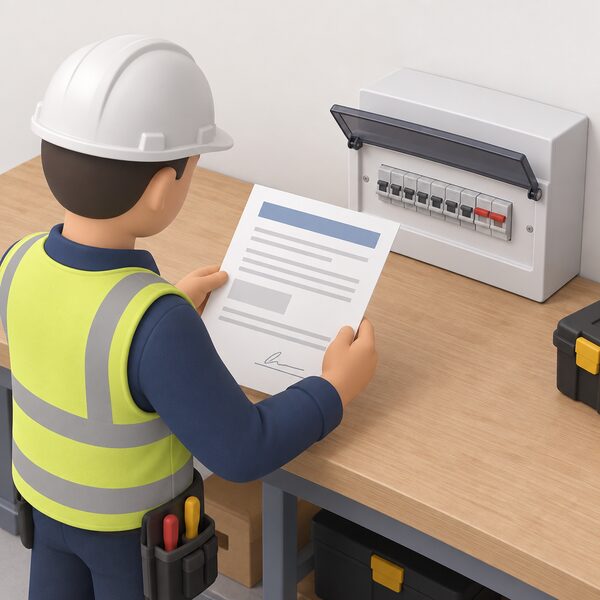
A declaration of conformity is the manufacturer's statement that a product meets the standards that apply to it. For products covered by a harmonised standard under the Construction Product Regulations, a Declaration of Performance is a legally required document, must be signed, and must be made publicly available by the manufacturer15. The declarations Hager publishes for its UK products follow that pattern: each product page carries a declaration with a date.
The dates on Hager's UK declarations cluster in late July 2026. The IU range carries declarations dated 28 July 2026. The load break switch manual is dated 18 August 2026.
What a declaration covers is the product it names, against the standards cited in the document. It is not a warranty, and it is not a statement about the installation. The installation is covered by the Electrical Installation Certificate and by the competence of the person who did the work14.
There is a separate compliance regime for generation equipment connected to the network. Manufacturers must always lodge their declarations of full compliance in the ENA Type Test Register for equipment rated below 3.68kW per phase8. Where a changeover switch is part of an installation that includes a generator or inverter, that register is where the equipment's network compliance is recorded, and it is distinct from the product's own declaration of conformity.
For a householder, the practical point is that the paperwork exists and can be checked. The declaration for a specific product is published on its product page, with a date. Where an electrician is specifying equipment, that documentation is part of what they will consider.
What owning Hager gear means for household energy independence
A changeover switch is an enabling device rather than a source of independence. It allows a household to run from a backup source, but it does not provide one. The independence it delivers is the ability to choose between supplies, and the dependence that remains is on whatever is feeding the switch at any given moment.
Where the backup source is a generator, the household remains dependent on fuel, on the generator starting, and on someone being present to connect and run it. Where the source is a battery and inverter, the household remains dependent on the battery's state of charge and on the inverter's capacity. Where the source is solar, the household remains dependent on the weather and the season. The switch makes the choice possible; it does not remove the dependence.
There is also a dependence on the network itself, even in a backup arrangement. A property with a grid connection remains connected to it, and the changeover switch is what keeps the two supplies apart. The network operator's requirements for connected generation, including the type test register and the documentation that accompanies a connection application, exist because that connection is real16.
For a household weighing the options, the position is that a changeover switch is the fixed infrastructure that makes backup power practical. It is installed once, by a registered electrician, and it remains part of the installation. What it delivers is the ability to move the house onto a second source without temporary wiring, and what it leaves in place is the dependence on that second source being available when it is needed.
The wider picture, including how backup sources compare and what each costs to run, is set out in backup power for UK homes and in the material on connecting a generator to a house. The choice between a manual and an automatic device is covered in manual changeover switch vs automatic transfer switch, and the safety rules that apply to any generator installation are in generator safety.
Sources16 cited
- Consumer units and fuse boxes, NICEIC, 2025
- Part P of the Building Regulations, Electrical Safety First, 2026
- How to buy the best generator, Which?, 2026
- Microinverter vs hybrid inverter, Solax Power, 2026
- Hybrid solar solution, LuxpowerTek, 2026
- Automatic Transfer Switch, Tigo Energy, 2026
- Documentation to send with small scale generation, NIE Networks, 2026
- Connecting generation to the electricity networks, Energy Networks Association, 2026
- Rewiring your house: an essential guide for homeowners, NICEIC, 2026
- Building Regulations, Electrical Safety First, 2026
- Moving your meter, SSEN, 2026
- MPAN only, UK Power Networks, 2026
- Cost and time to move a supply, UK Power Networks, 2026
- Electrical safety and building control, Cumberland Council, 2026
- Declaration of Performance FAQs, MIMA, 2026
- Micro-generation connections above 3.68kW per phase, SSEN, 2026
 Hager consumer units and circuit protectionWhich Hager board suits a normal house, and what changes if you need three-phase?
 Hager Home Battery Storage SystemsDoes Hager make a home battery, and if so what does it cost and what warranty comes with it?