In this guide
UK Home Energy Regulation and Policy: The Full Guide
Home energy in the UK is governed by several layers of rule rather than one rulebook. Ofgem, described by the Energy Ombudsman as "the UK energy regulator", oversees the supply market and approves the Ombudsman that handles service disputes1. Energy is a reserved matter, so the UK Government sets measures such as the Minimum Energy Efficiency Standards (MEES)2. Legislation on the energy performance of buildings is devolved in Scotland and Northern Ireland, while competition law and consumer protection law stay reserved to the UK Government3.
For a household this means the price paid for grid electricity, the standards a building must meet, the certification of an installer and the permission needed for equipment are each decided by a different body. The answer often depends on which of the four nations the home is in. This page sets out who does what and links to the detailed pages across the regulation and policy section, beginning with Ofgem, DESNZ and the Utility Regulator in Northern Ireland.
How home energy regulation works: reserved powers, devolved powers and shared schemes
Powers are divided at the outset. The Senedd's research service describes MEES as "set by the UK Government (as 'energy' is a reserved matter)"2. A Welsh Government consultation from 2014 says the same, stating that "the regulation of energy efficiency rests with the UK Government"9. Buildings are treated differently. The Scottish Government's response on EPC reform notes that legislation on the energy performance of buildings is devolved in Scotland and Northern Ireland, while competition law and consumer protection law are reserved3. A home in Edinburgh therefore shares its supply market with a home in Cardiff but falls under different building performance rules. See the pages on energy policy in Scotland and energy policy in Wales.
Some instruments are administered jointly. The UK Emissions Trading Scheme is run by the Scottish Government together with the UK Government, the Welsh Government and the Northern Ireland Executive10. Others are Acts of the UK Parliament whose reach is limited to Great Britain. The Scottish Government's Heat in Buildings Bill consultation of November 2023 records that the Energy Act 2023 "will bring welcome new consumer protections for heat network consumers across Great Britain"11. That regime is covered under heat network regulation.
The structure has changed over time. In September 2022, when it announced the Energy Price Guarantee, the UK Government committed to "fundamental reforms to the structure and regulation of energy market" through a new review of UK energy regulation12. The Spending Review 2025 presents infrastructure investment as a way to "secure its energy system and improve people's lives in every part of the UK"13. Earlier frameworks had a European origin. The UK's National Energy Efficiency Action Plan, published in April 2014, set out how the UK Government would comply with the Energy Efficiency Directive14.
Policy decisions also affect bills directly. The Welsh Government's response to Ofgem on standing charges cites the UK Government policy of supporting Energy Intensive Industries by applying a levy to the bills of other consumers15. The consultation stage is where such choices are contested, and how energy policy is made explains the process.

The main families of rule
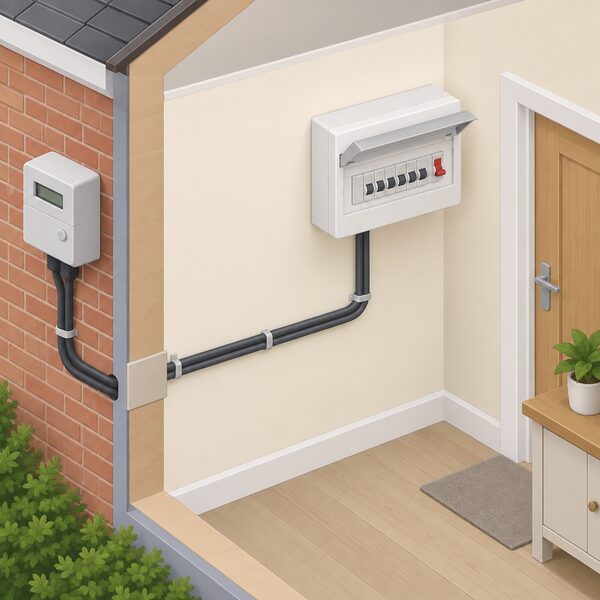
Home energy rules fall into five families. Each has its own enforcer and its own page in this section.
| Family | What it governs | Who applies it | Detailed page |
|---|---|---|---|
| Market and price rules | Supplier conduct, default tariff levels, redress | Ofgem and the Energy Ombudsman1 | Energy price cap |
| Building rules | Conservation of fuel and power, electrical work in dwellings | Building control bodies and competent person schemes16 | Building Regulations in England |
| Certification | Microgeneration installers and products | MCS18 | MCS explained |
| Planning | Whether equipment needs permission | Local planning authorities19 | Permitted development rights |
| Funded schemes | Grants, loans and tariffs | UK and devolved governments20 | Closed energy policies |
Market rules. The Spring Statement 2022 described the price cap as protecting consumers "from the rapid changes observed in the wholesale energy market in the short term". It also promised an energy security plan with measures "across hydrocarbons, nuclear and renewables"21.
Building rules. In England, Approved Document L names two types of building control body: a local authority building control body and an approved inspector16. For electrical work in homes and gardens in England and Wales, the Building Regulations set standards for installation work in dwellings. They do not set standards for the safety of appliances, but they do require fixed connections of appliances to be safe17.
Certification. MCS is "a certification scheme for microgeneration installation companies and products"18. Microgeneration itself has a statutory definition. When the definition was debated in Parliament in July 2004, the listed sources were biomass, biofuels, fuel cells, photovoltaics, water (including waves and tides), wind, solar power, geothermal sources and combined heat and power. The Secretary of State could add other sources that, in his or her opinion, would cut greenhouse gas emissions in Great Britain22.
Planning. Planning Portal guidance on domestic wind turbines carries the caveat that it "relates to the planning regime for England, the policy in Wales may differ"19.
Funded schemes. Each scheme defines what it will pay for. The Green Homes Wales loan terms cover "certain types of energy efficiency improvement measures and low carbon heating systems", which the scheme calls Eligible Measures20.
Two official statistical series record the results of these rules. UK Energy in Brief 2026, published on 30 July 2026, covers how energy is produced and used, combined heat and power, renewable energy, energy efficiency, energy prices and fuel poverty23. Energy Trends section 6 reports renewable electricity capacity, generation, load factors and feed-in tariffs capacity24. A Parliamentary Office of Science and Technology briefing notes that "other measures are being considered as part of the Energy Bill", which shows that the framework continues to change25.
What regulation costs a household: capped prices, crisis support and policy levies
The regulated price of grid electricity is the clearest cost figure. Ofgem publishes cap levels by region, payment method and meter type. Each level is shown at nil consumption, which reflects fixed charges, and at a benchmark consumption. The levels below are for 1 October to 31 December 20254.
| Region | Payment method | Single-rate, nil consumption | Single-rate, 3,100 kWh | Multi-register, nil consumption | Multi-register, 4,200 kWh |
|---|---|---|---|---|---|
| London | Standard credit | £184.86 | £983.41 | £184.70 | £1,222.12 |
| South East | Other payment method | £165.45 | £960.22 | £166.99 | £1,194.07 |
| East Midlands | Other payment method | £170.63 | £925.08 | £168.91 | £1,149.39 |
| Eastern | Prepayment | £167.73 | £926.96 | £169.16 | £1,152.98 |
| Northern | Prepayment | £208.10 | £935.81 | £205.69 | £1,151.95 |
| N Wales and Mersey | Other payment method | £243.15 | £1,061.64 | £240.90 | £1,297.15 |
The differences between regions are large. In this table, the nil consumption figure on a single-rate meter ranges from £165.45 in the South East to £243.15 in N Wales and Mersey4. A household pays the nil consumption figure whatever it generates itself, which bears directly on self-sufficiency. A second reading for the same region and period gives £1,036.55 at 3,100 kWh and £1,264.80 at 4,200 kWh, with the same nil consumption figures, and the two have not been reconciled4. For the previous quarter, 1 July to 30 September 2025, the first payment method table gives £1,038.15 for N Wales and Mersey at 3,100 kWh on single-rate metering26. An earlier Ofgem benchmark table, for a previous charge restriction period, shows £1,202.99 a year for the Eastern region at 4,200 kWh on multi-register metering27. The method is explained on the energy price cap page, and the network element is covered under electricity network regulation and charges.
When the cap alone was not judged sufficient, the state stepped in. The Energy Price Guarantee was designed so that a typical household in the United Kingdom paid around £2,500 a year from 1 October 2022. At the time, bills were estimated to rise "to as high as £6,500 before the government stepped in"8. The accompanying legislation's impact documents, which used forward prices to 12 September 2022, estimated the cost of support for the UK scheme up to April 2023 at £31bn (nominal, undiscounted)28.
Policy also adds cost. The Climate Change Committee reported that measures to deliver a cleaner, low-carbon electricity system added around £9 a month to the typical UK household energy bill in 201629. In May 2025 the Committee described "rebalancing prices to remove policy levies from electricity bills" as a key recommendation to the UK Government30. The same body estimates that heat exposure costs the UK economy £260 to £300 million per year, which is a reminder that the absence of policy carries costs as well31.
Grants and schemes in each UK nation

Most support schemes have been built for Great Britain rather than for the whole UK, and Northern Ireland has usually been handled separately. The Energy Price Guarantee shows the pattern. Official guidance says it "operated, for the most part, in the same way for households across the whole of the UK", with differences for Northern Ireland32. The published regional rates applied to England, Scotland and Wales33, while the scheme documents refer to "households across the UK"34.
| Scheme | Territorial extent | Notes |
|---|---|---|
| Energy Price Guarantee | UK, with differences for Northern Ireland32 | Regional rates published for England, Scotland and Wales33 |
| Energy Bills Support Scheme GB | England, Wales and Scotland35 | Described as applying to "all households in Great Britain"36 |
| Feed-in Tariffs | England, Wales and Scotland37 | Technologies up to 5MW Total Installed Capacity7 |
| Renewable Heat Incentive | England, Scotland and Wales38 | Closed scheme, compared with its successor under Green Gas Levy vs RHI |
| Green Gas Support Scheme | England, Scotland and Wales39 | |
| Home Energy Scotland Grant and Loan | Scotland40 | Open to all domestic owner-occupiers |
| Green Homes Wales | Wales20 | Loans for eligible efficiency measures and low carbon heating |
Scotland. The Home Energy Scotland Grant and Loan Scheme "is open to all domestic owner-occupiers in Scotland"40. It provides grants and loans to install clean heat and energy efficiency measures41. Scottish Ministers also have a say in Great Britain schemes. The 2021 draft Heat in Buildings Strategy said the replacement for the RHI, then called the Clean Heat Grant, was "expected to be available GB-wide, subject to the consent of UK and Scottish Ministers"42.
Wales. The Development Bank of Wales runs the Green Homes Wales loan scheme, which is limited to its defined Eligible Measures20. Where guidance is written for England, Welsh householders should note the usual caveat. Planning Portal guidance that refers to MCS states that it "relates to the planning regime for England, the policy in Wales may differ"43.
England. England depends on the Great Britain schemes listed above. The Climate Change Committee has published the view that England lacks a comprehensive retrofit scheme, which is discussed in the final section of this page.
Northern Ireland. None of the Great Britain schemes in the table extends to Northern Ireland. The relevant bodies are described on the pages for the Utility Regulator and Building Regulations in Northern Ireland.
Ambitions for universal support have existed for years. In February 2009 the Climate Change Committee welcomed a government plan under which "every household in Britain will receive expert, targeted help to reduce their fuel bills" and access low-carbon heat and power44. Schemes that were later closed or never delivered are recorded under closed energy policies. Current targeted support is described under fuel poverty policy.
The rules on the statute book: energy performance of buildings
The Energy Performance of Buildings regulations for England and Wales, which underpin EPCs, show how a home energy rule is made, amended and limited by geography.
| Instrument | Key point |
|---|---|
| Energy Performance of Buildings (Certificates and Inspections) (England and Wales) Regulations 2007 | The earlier regime, brought into force in stages "in accordance with regulation"45 |
| Energy Performance of Buildings (England and Wales) Regulations 2012 | Laid before Parliament on 19th December 201246; in force from 9th January 20136 |
| Amendment Regulations 2013 | Made under sections 9(2), 40(1) and 74 of the Energy Act 2011; apply to England and Wales and also amend the Building Regulations 201047 |
| Amendment Regulations 2022 | Amend the 2012 Regulations (S.I. 2012/3118)48 |
| Amendment Regulations 2024 | Amend the 2012 Regulations in relation to data sharing49 |
The legal basis has changed since the UK left the European Union. The 2012 Regulations were made under section 2(2) of the European Communities Act 1972 and section 74 of the Energy Act 201146. The 2024 amendment was instead made under section 250(1), (3), (4) and (5) of the Energy Act 202350. A House of Commons Library briefing on that Act confirms that regulations made under the new powers "would apply to England and Wales"51. The government's post-implementation review for 2018 to 2023 carries the same territorial label52.
The geography matters. Building performance legislation is devolved in Scotland and Northern Ireland3, so a Scottish EPC is issued under a different regime. The Scottish details are covered under EPC validity in Scotland. The wider reform programme is covered under EPC regulations and reform and the Home Energy Model. MEES remains a matter for the UK Government because energy is reserved2, and the enforcement position is set out under penalties for letting below EPC E.
Electrical work in dwellings
Welsh Government guidance sets out the position on electrical work in homes and gardens in England and Wales17:
- Most work requires either an installer registered with a competent person scheme or approval from a building control body.
- Repairs, replacements and maintenance do not need to be reported.
- Extra power points, lighting points or other alterations to existing circuits do not need to be reported, except in a kitchen or bathroom, or outdoors.
- Safety can be checked in either of two ways: by an electrician registered with a competent person scheme, or by notifying the building control section of the local authority.
The detail is covered under electrical safety regulation and competent person schemes. The parallel regime for gas is covered under gas safety regulation.
Approval, certification and size thresholds for installed equipment
Home energy equipment is assessed against the building first and then against the scheme, if any, that is paying for it.
Building control. In England the building control body is either the local authority's building control body or an approved inspector16. Guidance from a roofing manufacturer notes that "for smaller projects, a building notice can be submitted", rather than a full application53. Where the installer belongs to a competent person scheme, the work is self-certified and no separate application is needed17. Scotland uses a different system, described under building standards in Scotland.
Certification. Ofgem's guidance describes MCS as aiming "to ensure consistent standards and provide confidence to consumers". It directs householders to MCS about problems with the installation process, the installer, or the MCS certificate or product54. Under the Boiler Upgrade Scheme, MCS may carry out additional checks, and the installer guidance says "property owners should aim to respond within seven days"18.
The limits of certification are stated plainly in an official report on the heat pump transition dated May 2026:
"MCS requires installers to provide a design-stage prediction of system efficiency, not verify actual performance."
The same report states that "MCS does not require remediation of systems that are underperforming relative to their design" and that third party non-modulating controls are not prohibited55. For a household, certification therefore governs how a system is designed and installed. It does not govern the efficiency the system later achieves. How to verify a certificate is explained under checking an MCS certificate. Other certification routes are covered under MCS vs Flexi-Orb and installer schemes and consumer codes.
Size thresholds. Schemes set their own capacity limits. The Feed-in Tariff scheme covered "small-scale renewable and low-carbon technologies up to a Total Installed Capacity (TIC) of 5MW" in England, Wales and Scotland7. That is far above the scale of any domestic roof. Planning limits on size and position are separate again, and they differ by nation19. Examples include solar panel roof protrusion and heat pump planning in Scotland.
The bodies a household deals with

No commercial brands sell regulation. This section describes the organisations a householder is most likely to deal with, without ranking them.
Ofgem and the supply market
Ofgem is the energy regulator. It approves the Energy Ombudsman's role in service disputes1. Its price cap is the consumer protection most households meet day to day21. Its wider duties are set out on the Ofgem page and under supplier licensing and supplier failure. On the policy side, the Climate Change Committee noted in March 2022 that the Government was pursuing supply-side obligations "on boiler and heat pump manufacturers and potentially energy companies" to deliver a certain number of low carbon heat installations each year56.
The Energy Ombudsman
The Energy Ombudsman is part of the Trust Alliance Group. Its predecessor, Ombudsman Services, was a not-for-profit organisation established in 2002. It is free to consumers. It is funded by the suppliers signed up to its scheme, which pay a fee for each case reviewed regardless of the outcome1. It handles disputes with an energy supplier, energy broker, network operator, Green Deal provider or heat network supplier. Heat network disputes have been covered since 1st April 2025, and disputes with a number of flexibility service providers since 8th January 202657. Network operator disputes are limited to loss of service or a problem with a connection or repair57.
A dispute proceeds in this order:
- The consumer complains to the supplier first, and the supplier's name must match the company name on the account holder's bill58.
- At least 8 weeks pass without resolution, or the supplier issues a deadlock letter58.
- The dispute is registered by searching for the supplier's name on the Ombudsman's site59, within 12 months of any deadlock letter1.
- The consumer has up to 14 days to upload evidence, including the date the complaint was first raised1.
- The Ombudsman states that, on average, most disputes are resolved within 6 weeks of receiving evidence from both parties5.
- Once the consumer accepts the resolution, the supplier must implement it within 28 days1.
| Remedy or limit | Detail |
|---|---|
| Maximum award, energy suppliers, heat networks and energy networks | Up to £10,000 domestic, up to £20,000 small business5 |
| Most common financial award | Around £50, a Time and Trouble Award1 |
| Other outcomes | Practical action such as crediting or cancelling an account or changing a tariff, and an apology5 |
| What it cannot do | Punish companies, dictate how they operate, or issue fines5 |
Small businesses qualify if they have fewer than 50 employees and an annual turnover of at most £6.5 million or a balance sheet total of £5.0 million. Microbusinesses are defined by annual consumption of not more than 100,000 kWh of electricity or 293,000 kWh of gas1. The full route is covered under energy complaints and redress and the heat network ombudsman page.
Certification and standards bodies
MCS handles problems with an installer, an installation or a certificate54. Related bodies have their own pages: standards bodies, TrustMark, RECC, Gas Safe Register, Kiwa and the BSI Kitemark. Product markings are covered under product standards and markings.
What regulation does for a home's energy independence
Official policy treats energy independence as a national aim. The British Energy Security Strategy of April 2022 opens with this sentence:
"This strategy sets out how Great Britain will accelerate homegrown power for greater energy independence."
The strategy describes homegrown energy as central to "weaning Britain off expensive fossil fuels, which are subject to volatile gas prices set by international markets"59. That concerns independence for the nation as a whole. The rules affect an individual household in narrower ways.
What the rules provide. The price cap limits a household's exposure to short-term wholesale price swings21. Redress is free and binding on the supplier once accepted1. Certification sets a common standard for microgeneration installers and products54. Past tariff schemes paid small generators in England, Wales and Scotland37. What the framework permits on a single property is covered under regulation and energy independence.
What dependence remains. A home that generates its own electricity still pays the cap's nil consumption element while it keeps a grid connection. In the table above that element ranged from £165.45 to £243.15 a year, depending on region and payment method4. MCS certifies a design-stage prediction of efficiency and not the performance later delivered, and it does not require underperforming systems to be remediated55. Policy levies add to electricity bills, and the Climate Change Committee has recommended that they be removed30. Support schemes open and close on a government timetable, and their geography excludes Northern Ireland more often than it includes it37.
Where advisers see gaps. In March 2022 the Climate Change Committee judged that "the policies needed to drive improvements in energy efficiency in homes that are not fuel poor are currently inadequate"56. A Committee-published policy comparison states flatly: "England needs a comprehensive home energy retrofit scheme."60 Concern about consumer protection is long-standing. In October 2015 the UK Government commissioned Dr Peter Bonfield to chair the independent review of consumer advice and protection that became Each Home Counts61. On resilience, the Committee recommended in February 2023 that the need for investment in adapting to climate change be written into the mandates of all relevant regulated industry regulators, including energy62. On alternatives to electrification, its 2019 assessment called hydrogen "a credible option to help decarbonise the UK energy system" but said its role depended on early Government commitment63. The current position is set out under hydrogen heating policy.
Taken together, regulation shapes how a household depends on the grid, suppliers and certifiers more than it removes that dependence. The long-term direction is set out under climate targets and carbon budgets, the Future Homes Standard and the zero emission vehicle mandate.
Sources63 cited
- Energy Ombudsman FAQs, Energy Ombudsman
- Decarbonising private housing, Senedd Research
- EPC reform consultation: government response, Scottish Government, 2025-01-21
- Energy price cap levels, 1 October to 31 December 2025, Ofgem, 2025
- What to expect, Energy Ombudsman
- The Energy Performance of Buildings (England and Wales) Regulations 2012, legislation.gov.uk, 2013-01-09
- Guidance for FIT Generators, version 18, Ofgem
- Government introduces new Energy Prices Bill, GOV.UK, 2022-10-11
- Development of an energy efficiency strategy for Wales, Welsh Government, 2014-10-15
- Climate change policy, Scottish Government
- Delivering net zero for Scotland's buildings: Heat in Buildings Bill consultation, Scottish Government, 2023-11
- Government announces Energy Price Guarantee, GOV.UK, 2022-09-08
- Spending Review 2025, GOV.UK, 2025-06-30
- The UK's National Energy Efficiency Action Plan and Building Renovation Strategy, GOV.UK, 2014-04-30
- Ofgem call for input on standing charges: Welsh Government response, Welsh Government, 2024-02-15
- Approved Document L, Volume 1: Dwellings, GOV.UK
- Building regulations: electrics, Welsh Government
- Boiler Upgrade Scheme guidance for installers, version 5, Ofgem, 2026-04-28
- Wind turbines: planning permission, Planning Portal
- Green Homes Wales loan standard terms and conditions, Development Bank of Wales
- Spring Statement 2022, GOV.UK, 2022-03
- Microgeneration debate, House of Commons, UK Parliament (Hansard), 2004-07-13
- UK energy in brief 2026, GOV.UK, 2026-07-30
- Energy Trends section 6: renewables, GOV.UK
- POSTnote 699, Parliamentary Office of Science and Technology
- Energy price cap levels, 1 July to 30 September 2025, Ofgem, 2025-07-01
- Benchmark maximum charges for charge restriction period 13a, Ofgem, 2025
- Energy Prices Bill supporting document, UK Parliament, 2022-09-12
- UK climate action has reduced emissions without increases in household energy bills, Climate Change Committee, 2016
- Scotland's Carbon Budgets, Climate Change Committee, 2025-05-21
- The Seventh Carbon Budget, Climate Change Committee, 2025-02-26
- Energy Price Guarantee up until 30 June 2023, GOV.UK
- Energy Price Guarantee: regional rates, GOV.UK, 2022-10-07
- Energy Price Guarantee scheme documents, GOV.UK, 2022-10-31
- Energy Bills Support Scheme: payments made by electricity suppliers, GOV.UK, 2022-10-20
- West Midlands residents urged not to miss out on energy bill support, West Midlands Combined Authority, 2023-02-22
- Feed-in Tariff annual report, scheme year 14, Ofgem
- RHI monthly deployment data: January 2021, GOV.UK, 2021-02-18
- Carbon Budget Delivery Plan, GOV.UK, 2023-03-30
- Heat in Buildings progress report 2025, Scottish Government, 2025-10-02
- Heat in Buildings progress report 2024, Scottish Government, 2024-10-10
- Draft Heat in Buildings Strategy consultation, Scottish Government, 2021-02
- Heat pumps: the Microgeneration Certification Scheme, Planning Portal
- CCC welcomes government plans to improve energy efficiency in homes, Climate Change Committee, 2009-02-12
- The Energy Performance of Buildings (Certificates and Inspections) (England and Wales) Regulations 2007, legislation.gov.uk, 2007-03-23
- The Energy Performance of Buildings (England and Wales) Regulations 2012, as at 1 April 2021, legislation.gov.uk, 2012-12-19
- The Energy Performance of Buildings (England and Wales) etc. (Amendment) Regulations 2013, legislation.gov.uk, 2013-01-09
- The Energy Performance of Buildings (England and Wales) (Amendment) Regulations 2022, legislation.gov.uk, 2022-03-31
- The Energy Performance of Buildings (England and Wales) (Amendment) Regulations 2024, as made, legislation.gov.uk, 2024-05-14
- The Energy Performance of Buildings (England and Wales) (Amendment) Regulations 2024, PDF, legislation.gov.uk
- Commons Library briefing CBP-9865, House of Commons Library, 2023-09-26
- Energy Performance of Buildings Regulations 2012: post-implementation review 2018 to 2023, GOV.UK
- Understanding building regulations, Metrotile, 2025-03-25
- Domestic RHI: who to contact, Ofgem
- Heat pump transition report, GOV.UK, 2026-05
- Taking stock of the UK Government's Heat and Buildings Strategy, Climate Change Committee, 2022-03-09
- How we can help, Energy Ombudsman
- Raise a dispute: eligibility checklist, Energy Ombudsman
- Raise a dispute, Energy Ombudsman
- British energy security strategy, GOV.UK, 2022-04-07
- Climate policy that cuts costs: international policy comparison, Climate Change Committee
- Energy Efficient Scotland: route map, Scottish Government
- A lack of leadership is preventing essential investment to prepare the UK for climate change, Climate Change Committee, 2023-02-01