

In this guide
Energy supply, the price cap and supplier licensing are not devolved to Wales. What the Welsh Government does control, and what therefore shapes a Welsh household's energy costs and its scope for self-supply, is building regulations, planning, social and rented housing standards, fuel poverty programmes and a set of Wales-only funding schemes. Nest, delivered under Welsh Government Warm Homes, is the long-standing route to free measures for lower-income households, with an eligibility test that includes an energy performance certificate rating of 54 (E) or less, or 68 (D) or less where a household member has an eligible health condition1. Green Homes Wales, a Welsh Government initiative managed by the Development Bank of Wales, supports installation of certain energy efficiency measures and low carbon heating systems in domestic properties in Wales2.
Welsh homes sit at the centre of the devolved policy effort because of their share of emissions, and the published figures measure that share in more than one way. A Welsh assessment puts new and existing homes at 20% of greenhouse gas emissions3, while a Welsh case study describes homes as responsible for 27% of all energy consumed and 15% of all demand-side greenhouse gas emissions4. The two figures count different things, one emissions and one energy consumed, and are not interchangeable. What follows sets out which levers Welsh ministers hold over those homes, which remain with Ofgem and UK ministers, and what the schemes and standards in force actually offer a household in Wales.
On price, the limit of devolution is explicit. The Welsh Government has called for the UK Government to take action to support households where the energy price cap mechanisms do not provide sufficient protection against rising prices5, and a proposed Welsh public energy company would not directly set household energy prices6. Welsh policy can change the building, the grant and the planning permission. It cannot change the tariff.
What the Welsh Government controls over home energy policy
The devolved settlement leaves supply regulation with Ofgem and UK ministers, and gives Welsh ministers the levers that sit on the building and the household. Welsh Government publishes its own help with home energy bills for people living in Wales12, and home energy efficiency support in Wales is delivered by the government of Wales rather than by the UK department13. That split matters in practice: a household in Wales looking for retrofit funding is directed to Welsh schemes, while the price cap that sets its unit rates is not a Welsh instrument at all.
Where a UK-wide payment is made but the design is left to Wales, the split shows clearly. On heating oil support, it was stated in the House of Commons that it will be for the Welsh Government to design the scheme that it will use to roll that out, possibly through existing schemes or something different14. Welsh Government has separately reported thousands of Welsh households getting help with oil and LPG heating costs, through Nest Warm Homes, which offers free energy efficiency advice and improvements to low-income Welsh households15.
Welsh ministers also use planning and generation powers directly. Since the Welsh Government's 2021 moratorium on large energy from waste plants, that moratorium has applied to plants above 10 MW16. On heat networks, the Welsh Government said it would review the zoning powers in the Energy Bill and consider the benefits of adopting a similar approach in Wales17, a decision that determines whether Welsh households can be connected to a zoned network in the way heat network regulation sets out elsewhere. A ban on fossil fuels to heat newly built social homes was announced by the Welsh Government18.
For a household, this is the practical boundary of Welsh energy sovereignty: Wales can require and fund a better building and can decide what may be built where, while the price of the electricity flowing into it is set under the UK framework and the energy price cap.
The Welsh energy framework and the plans that sit inside it
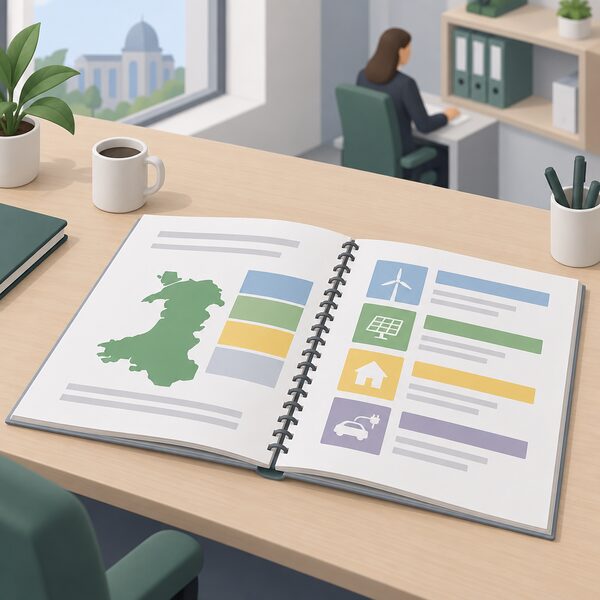
Welsh energy policy is assembled from several documents rather than a single Act. A national energy plan was to be created by 2024, and by 2025 the Welsh Government was to present a vision for energy in Wales to 2050, including detail on renewable energy production and grid development19. The National Energy Plan for Wales is intended to set out the energy system changes required to achieve net zero by 2050 while delivering a secure and affordable energy system in Wales20. Its inputs include the Future Energy Grids in Wales project, regional energy strategies, the emerging heat strategy and the energy targets10.
The draft heat strategy for Wales was consulted on with six objectives: an enabling framework supporting a just transition; energy networks shaping the future of heat supply; homes with affordable warmth for all; business supporting the local economy to flourish; industry fostering innovation and investment; and public services leading by example21. It supports the decarbonisation of homes, industry and businesses in line with statutory responsibilities by 205022. A significant technology ruling sits inside the same policy area: off-gas areas will not use hydrogen16, which narrows the realistic options for rural Welsh homes and aligns with the wider hydrogen heating policy position.
Ownership is a distinct Welsh strand. The target is for at least 1.5GW of renewable energy capacity to be locally owned by 2035, excluding heat pumps10, expressed elsewhere as an aspiration of 1.5 GW of local ownership of renewable electricity and heat capacity in Wales by 203519. The Welsh Government has pledged to expand renewable energy generation by public bodies and community groups in Wales by over 100 MW by 202623, and has a policy for all new energy projects to have at least an element of local ownership19. The Welsh Government Energy Service supports renewable energy projects in Wales from the concept stage through to financial close and completion20.
Progress is tracked through the Energy Generation in Wales reports, which are intended to provide a clear and transparent picture of Wales's relationship with energy and act as a consistent measure against Welsh Government energy and climate change targets24.
Warm Homes and Nest: who qualifies and what is funded
Welsh Government Warm Homes, which includes the Nest scheme, supports people in Wales living on a lower income who receive a means tested benefit or live with a respiratory, circulatory or mental health condition25. Eligible households can get free energy advice and a suite of home energy efficiency improvements26, described in a later statement as a bespoke package of measures to insulate and decarbonise their home27. The scheme also acts as an emergency route: it is designed to help households facing an immediate risk to their health and wellbeing due to a lack of essential heating or hot water, and can fund replacement of a boiler or electric storage heaters to ensure a safe and reliable heating system7.
The property test is numerical. Nest requires that the home has an EPC rating of 54 (E) or less, or 68 (D) or less where someone in the household has an eligible health condition1. Broader guidance describes the scheme as offering free energy upgrades for houses with a poor EPC rating28. How that rating is produced is covered under EPC regulations and reform.
| Element | Detail | Source |
|---|---|---|
| Delivery body | Welsh Government Warm Homes | 1 |
| Applicant test | Lower income with a means tested benefit, or a respiratory, circulatory or mental health condition | 25 |
| Property test | EPC 54 (E) or less, or 68 (D) or less with an eligible health condition | 1 |
| Funded | Free energy advice, insulation and decarbonisation measures, boiler or storage heater replacement | 7 |
| Funding, 2022-23 | £26.9m for the Warm Homes Programme, Nest Scheme | 8 |
| How to check eligibility | Call Nest free on 0808 808 2244 | 7 |
A demand-led successor has been consulted on, building on free energy efficiency measures and in-home advice for eligible households29. The new Warm Homes Programme will take over from Nest as the Welsh Government's primary mechanism to tackle fuel poverty30. Its intention is to take a fabric, worst and low carbon first approach, delivering measures to improve the energy efficiency of the least thermally efficient low-income households in Wales9, focused on households least able to pay for improvements themselves in the owner occupier, private rented and housing co-operative sectors9. The long-term ambition is to improve the energy efficiency of Welsh homes, ensuring only the energy needed is used, keeping homes comfortably warm at an affordable cost9.
Local authorities sit in the delivery chain. One Welsh council's private sector housing renewal policy expects capital funding for energy efficiency and fuel poverty reduction measures to come through Welsh Government Warm Homes funding and schemes available through utility companies31, so a household may meet the scheme through its council rather than directly.
Green Homes Wales: loan support beyond the means test
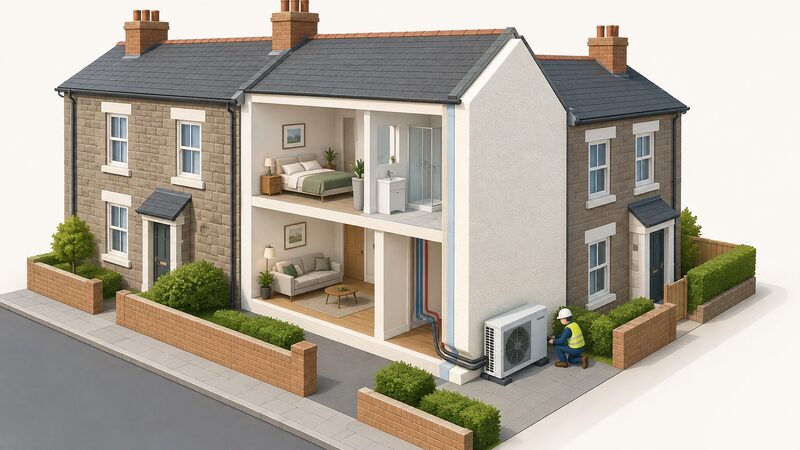
Green Homes Wales is a Welsh Government initiative managed by the Development Bank of Wales2. The scheme supports the installation, in domestic properties located in Wales, of certain types of energy efficiency improvement measure and low carbon heating system32, and is intended to help households across Wales implement energy and carbon-saving measures which can lower both energy consumption and energy bills33. Ventilation systems are eligible for loan funding support where insulation is being installed, or where additionally recommended by the Retrofit Coordinator2, which reflects the ventilation duty that attaches to fabric work and the role set out in the PAS retrofit standards.
The distinction matters for a household planning work. Nest is grant-funded and means tested; Green Homes Wales is a loan scheme available for eligible measures in Welsh domestic property. A loan leaves the household with a repayment obligation, so the independence gained from lower bills is set against a fixed financial commitment.
Fuel poverty and the risk in switching fuels
The Welsh aim is that by 2035 no more than 5% of all Welsh households live in fuel poverty and no households are in persistent or severe fuel poverty9. Measured against that, the starting point is difficult. Modelled estimates for Wales record 22% of households in social housing and 23% of dwellings with central heating as fuel poor34. A parliamentary briefing records 53% of households using electricity for heating in fuel poverty35. A Welsh housing decarbonisation study states that almost a quarter of Welsh households experience fuel poverty36, while the Climate Change Committee's Wales work cites 14% of Welsh households in 202137. The documents use different definitions and dates, and the figures should not be read as a trend.
Modelled estimates for Wales are produced using the Building Research Establishment Domestic Energy Model, BREDEM 2012 version 1.134. Definitions differ across the UK, as fuel poverty policy sets out.
This is why the fabric first sequencing is not presentational. The Welsh Government said it would prioritise low carbon heat as part of the next iteration of the Warm Homes Programme to support households in fuel poverty in owner-occupied and private rented homes17, but paired with fabric improvement rather than ahead of it. For a household, the independence gained by leaving the gas grid is real only if the fabric can be heated at electricity prices.
New homes: staged clean energy standards
Welsh Government proposed the introduction of tough new standards on new homes, to be implemented in stages over five years, covering energy efficiency, low carbon heating and energy generation such as photovoltaic panels, heat pumps or district heat networks38. The associated Part L work used the basis of introducing a world-leading performance standard incorporating low-carbon heat in new homes by 20253. A ban on fossil fuels to heat newly built social homes followed18.
The Part L review consultation set four metrics for new homes: a primary energy target, a CO2 emission target, minimum fabric standards and a householder affordability rating39. The fourth is distinctively Welsh and directly addresses the fuel poverty risk above. Notional specification and policy changes under Part L in Wales included improved fabric, PV, wastewater heat recovery, air tightness tests for all new homes, removing the fuel factors, and self-regulating devices in all new homes3.
Social housing carries the sharpest targets. The Welsh Government committed to building 20,000 high quality, low carbon homes for rent over the next five years40, repeated as 20,000 low carbon social homes for rent over five years18. The draft heat strategy proposed that all new social housing must have an energy pathway in place to achieve EPC A by 2033, or by a later date the Welsh Government has authorised17. The Welsh Housing Quality Standard 2023 underpins the commitment to decarbonise housing in Wales to meet legally binding climate targets in 205041, and Welsh strategy has long required all housing owned by local authorities to meet the Welsh Housing Quality Standard42. Those obligations are compared across the nations in housing quality standards for social and rented homes. Welsh strategy also commits to support new technology like smart meters in family homes42.
Welsh Building Regulations: ventilation and energy documents
Building regulations are made for Wales separately, and the approved documents differ from the English set described in Building Regulations in England. The Building Regulations etc. (amendment) (Wales) Regulations 2022 cover energy efficiency, ventilation and overheating43. Approved Document F, Ventilation, Volume 1: Dwellings is the 2022 edition in Wales43, setting standards for ventilation in new dwellings44. Approved Document O, 2022 edition (Wales), sets standards for reducing overheating risk in new residential buildings45. Approved Document L Volume 1: Dwellings gives practical guidance on ways of complying with the energy efficiency requirements of the Building Regulations 201046, and the 2026 edition gives guidance for building work carried out in Wales47. Approved Document L2B was also approved and issued by Welsh Ministers for the purpose of providing practical guidance48.
The energy efficiency requirements apply to the erection or extension of, and any work to or in connection with, a building that is a roofed construction having walls, uses energy to condition the indoor climate, and does not fall within an excluded category49.
Notification duties are specific. For new dwellings, the building control body must be notified once the work is complete of the as-built target primary energy rate, dwelling primary energy rate, target emission rate, dwelling emission rate, target energy use intensity, dwelling energy use intensity, fabric performance values and a list of specifications47. Not later than five days after the work has been completed, the person carrying out the work must give the local authority the as-built notice or a certificate from an accredited energy assessor47. Where a system for on-site generation of electricity is installed, sufficient information about the system and its operation and maintenance requirements must be provided to the owner not later than five days after completion46. In Wales, regulation 25A requires that, not later than the beginning of the day before the day on which the work starts, the building control authority is given notice that the analysis has been undertaken, is documented and the documentation is available for verification, for work that is not higher-risk building work49.
Ventilation when energy work is done to an existing home
The rule that catches retrofit is short. Under the 2022 Welsh amendment regulations, where Part L work is carried out, the ventilation in the building must comply with the standard set out in Part F of Schedule 1 or it must be no worse than before43. Insulating or airtightening a home therefore brings a ventilation duty with it, and this is why Green Homes Wales makes ventilation systems eligible for funding where insulation is being installed or where the Retrofit Coordinator recommends it2.
Welsh guidance is explicit that intermittent extract fans should be fitted in all wet rooms50. An illustrative natural ventilation package for an existing dwelling comprises 12 background ventilators of 5000mm2 slot type in the head of the window, one 15 l/s intermittent fan in the bathroom, one 30 l/s intermittent fan in the utility room, and reconfiguration of the existing kitchen canopy to duct to outside3.
Background ventilator sizes in Welsh guidance:
| Situation | Equivalent area | Source |
|---|---|---|
| Replacement windows, habitable rooms, existing ventilator size unknown | minimum 8,000 mm2 | 50 |
| Habitable rooms, dwellings with multiple floors | 10,000 mm2 | 50 |
| Habitable rooms, single-storey dwellings such as flats | 12,000 mm2 | 50 |
| Habitable rooms, mechanical extract ventilation in new dwellings | increased from 2500mm2 to 5000mm2 | 3 |
For a household, ventilation is the point where an efficiency gain can turn into a moisture or air quality problem if it is skipped, and the regulations treat it as part of the same job rather than an optional extra.
Permitted development for home energy measures in Wales
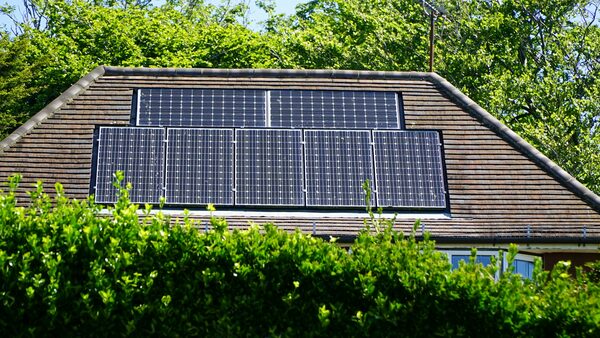
Permitted development in Wales is governed by Welsh orders amending the Town and Country Planning (General Permitted Development) Order 1995. The Town and Country Planning (General Permitted Development) (Amendment) (Wales) Order 2019, 2019 No. 330 (W. 80), includes provision for minor operations: recharging electric vehicles, a schedule on installation of devolved associated lines and a schedule substituting Part 2451. It is available only in its original format as originally made51. An earlier Welsh amendment order, 2013 No. 1776 (W. 177), also applies in Wales52.
For solar, permitted development rights are applicable in Wales for installations where capacity does not exceed 50kW for the generation of electricity or 45kW for the production of heat11. Guidance on solar panels and permitted development notes that in many cases, even in conservation areas, homes can have solar panels without requiring planning permission from the council under permitted development53; that guidance is from an English authority and the Welsh orders govern in Wales. Conservation area and listed building consents are dealt with separately, in listed buildings and conservation areas, and rights can be withdrawn by an Article 4 direction.
Heat pumps are the acknowledged gap. The draft heat strategy states that the current permitted development rights related to heat pumps are a barrier to heat pump installation rollout54. For a Welsh household, that is a live constraint on the most direct route off gas, and it sits alongside the wider position set out in permitted development rights for home energy equipment. At the larger scale, Welsh work on renewables has suggested a size threshold for permitted development for renewable energy developments, for example 5MW19.
Planning policy: renewables, fossil fuels and local benefit
Welsh planning policy is being used to pull in two directions at once: opening ground for renewables and closing it to fossil heat. The Welsh Government said it would consult on introducing planning policy that restricts fossil fuel heating in new developments, with a firm date communicated as a ban17. On the supply side, a recommendation to Welsh Government was to provide support to local authorities, including ministerial directive and updated guidance, to develop a local planning policy environment to support delivery of more renewables19.
The renewable electricity ambition is framed as continuing to keep pace with consumption after 203510, with the stated aim to maximise local ownership, retaining economic and social benefits in Wales10. Welsh domestic heat demand assumptions in the official generation statistics draw on Energy Use in Wales, 202116. Welsh statistics for total domestic energy use are not consistent between documents: one gives 15.7 TWh for heat and another 6.7 TWh, and the point is unresolved, so neither figure should be treated as settled.
How Wales differs from England and Scotland
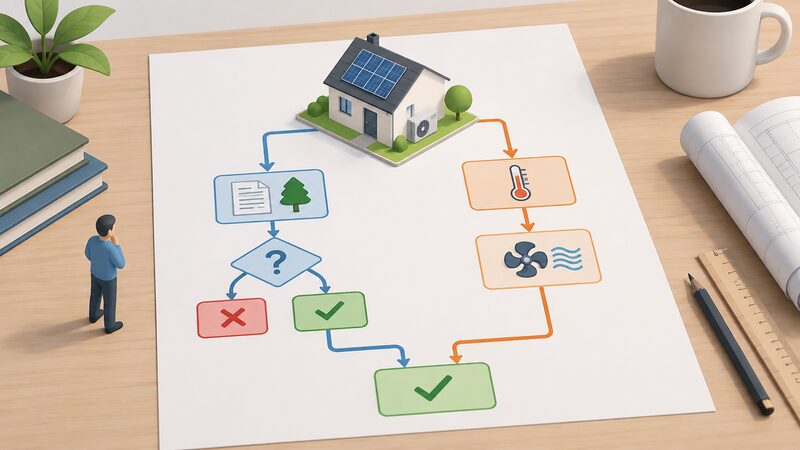
The clearest differences are structural rather than rhetorical. Wales writes its own approved documents, and Approved Document F Volume 1 in Wales is the 2022 edition with Welsh ventilator sizes43, while England's approved documents and competent person exemptions run separately: in England a building control body does not need to be notified for certain services or fittings if the owner employs an installer registered with a relevant competent person scheme designated in the regulations, including fuel-burning appliances or replacement windows55. Scotland operates a building warrant system entirely, described in Scottish building standards, and Scottish new build heat rules are covered in the New Build Heat Standard.
On funding, Wales runs Nest and Green Homes Wales rather than the English scheme set, and UK-wide guidance points households in Wales to the Welsh Government rather than to a UK portal13. Targets differ too: Wales aims at no more than 5% fuel poverty by 20359, at EPC A pathways for new social housing by 203317, and at 1.5GW of locally owned renewable capacity by 2035 excluding heat pumps10. A Welsh case study frames the decarbonisation programme as requiring Welsh homes to have reduced carbon demand by 80% by 20504. The comparable English trajectory is set out under the Future Homes Standard, and the wider budget framework under carbon budgets and net zero targets. A parallel account of the Scottish settlement is given in energy and buildings policy in Scotland.
What does not differ is where the bill comes from. A Welsh household can be taken to a higher fabric standard, given a funded heating system and granted permission more easily, and still buys its electricity from a supplier licensed and price-capped under UK rules. Welsh policy raises the floor under the building; the rest is covered in UK home energy regulation and policy.
Sources55 cited
- Home energy efficiency and the Nest scheme, Bridgend County Borough Council, 2026
- Green Homes Wales, Development Bank of Wales, 2026
- Part L Wales impact assessment, domestic existing and new build, Welsh Government, 2022-04
- Optimised Retrofit Programme case study: resident engagement, Welsh Government, 2024-03
- Written statement: rising energy costs, Welsh Government, 2026-03-12
- Shape plans for a new clean energy company owned by Wales, Business Wales, 2026-09-07
- Get help with unexpected costs such as food and heating, Welsh Government, 2026-04-15
- Warm Homes Nest scheme annual report 2022 to 2023, Welsh Government, 2023-11-30
- New Warm Homes Programme policy statement, Welsh Government, 2023-06-15
- Renewable energy deep dive: biannual recommendations update, Welsh Government, 2023-04-27
- Permitted development rights and solar photovoltaic and thermal panels, Welsh Government, 2016-09
- Getting help if you cannot afford your energy bills, Ofgem, 2026
- Help with energy bills research briefing, House of Commons Library, 2026
- Heating oil support debate, Hansard, 2026-03-16
- Thousands of Welsh households get help with oil and LPG heating costs, Welsh Government, 2026-03-31
- Energy Generation in Wales 2023, Welsh Government, 2025-02
- Draft heat strategy for Wales, Welsh Government, 2023-08
- £150 million for insulation, clean energy and carbon reduction in social homes, Welsh Government, 2021-11-02
- Preparing Wales for a renewable energy 2050, Welsh Government, 2023-10
- Welsh Government response to each recommendation, Welsh Government, 2024-06-14
- Draft heat strategy for Wales consultation, Welsh Government, 2023-08-16
- Written statement: consultation on a heat strategy for Wales, Welsh Government, 2023-08-16
- Energy Generation in Wales 2021, Welsh Government, 2022-10
- Written statement: Energy Generation in Wales 2020 report, Welsh Government, 2022-06-30
- Nest: a scheme to make your home warmer and more energy efficient, Isle of Anglesey County Council, 2026
- Your essential guide to heat pumps, Climate Action Wales, 2025-02-20
- Written statement: tackling fuel poverty, Welsh Government, 2025-01-27
- Home energy efficiency briefing, UK Parliament POST, 2026-06-25
- A future demand-led fuel poverty scheme to succeed Warm Homes Nest, Welsh Government, 2016-07-27
- New Warm Homes Programme children's rights impact assessment, Welsh Government, 2024-03-08
- Private sector housing renewal and adaptations policy, Swansea Council, 2026
- Green Homes Wales loan standard terms and conditions, Development Bank of Wales, 2026
- Written statement: Green Homes Wales scheme, Welsh Government, 2024-10-17
- Fuel poverty modelled estimates for Wales, October 2024, Welsh Government, 2025-10-16
- Fuel poverty research briefing CBP-9838, House of Commons Library, 2024
- Homes of Today for Tomorrow: Decarbonising Welsh Housing 2020-2050, Welsh Government, 2024-02
- Wales fourth carbon budget, Climate Change Committee, 2021
- All new homes in Wales to be heated and powered by clean energy sources, Welsh Government, 2020-01-20
- Summary of responses: building regulations Part L review, Welsh Government, 2021-03
- No more fossil fuels to heat new homes, Welsh Government, 2021-08-17
- Welsh Housing Quality Standard 2023 integrated impact assessment, Welsh Government, 2024-08-02
- Energy Efficiency in Wales: a strategy for the next 10 years, Welsh Government, 2016
- The Building Regulations etc. (amendment) (Wales) Regulations 2022 circular, Welsh Government, 2022-05-24
- Approved Document F Volume 1 frequently asked questions, GOV.UK, 2022-06-15
- Approved Document O (Wales) overheating FAQs, Welsh Government, 2024-05-14
- Approved Document L Volume 1 consultation version, Welsh Government, 2025-08
- Approved Document L Volume 1, 2026 edition, Welsh Government, 2026-04
- Building regulations Part L and F review stage 2A: Approved Document L2B, Welsh Government, 2020-11
- The Building Regulations 2010, Part 6, legislation.gov.uk, 2026
- Building regulations Part L and F review stage 2A: Approved Document F, Welsh Government, 2020-11
- Town and Country Planning (General Permitted Development) (Amendment) (Wales) Order 2019, legislation.gov.uk, 2019
- Town and Country Planning (General Permitted Development) (Amendment) (Wales) Order 2013, legislation.gov.uk, 2013
- Solar panels and permitted development, London Borough of Richmond upon Thames, 2026-07-06
- Draft heat strategy for Wales, consultation page, Welsh Government, 2023-08-16
- Approved Document L Volume 1, 2021 edition incorporating 2023 amendments, GOV.UK, 2023
 The Full Rules and Regulation GuideConfused about who actually decides what you pay for gas and electricity, or why rules differ in Scotland and Wales?
 Home Energy Planning WalesSolar panels and heat pumps often need no planning permission in Wales, but the rules differ from England.
 Welsh Housing Quality StandardWhat does the Welsh Housing Quality Standard mean for your home if you rent from a council or housing association in Wales?
 Building Regulations WalesIf you are building or extending in Wales, the rules are not the same as in England.
 Welsh Building Regs InsulationDo insulation or glazing rules in Wales differ from England?
 Energy Supply in WalesWales makes more electricity than it uses, but how much of it comes from renewables, and will that reach all of it by 2035?