
In this guide
The energy label on a washing machine, tumble dryer, fridge or air conditioner is a legal document, not marketing. It gives an indication of the energy efficiency and other key features of a product to help a householder make an informed choice when buying1. Products are rated from A to G in terms of energy use, with A being the most efficient and G the least efficient2. The letter is the visible end of a calculation: for a washing machine, the rating is based on kWh per 100 cycles at an eco-wash setting1.
Behind the label sits a second layer of law. Ecodesign rules set the minimum performance a product must reach before it can be sold at all, and they aim to increase producer responsibility, reduce energy usage and electrical waste, and enable consumers to identify the most energy efficient products on the market3. The two work together: the label tells a buyer where a model sits, and ecodesign removes the worst models from the shelf.
For a household, this is one of the few areas of energy policy that acts directly on the meter without any installation, grant or installer. A more efficient appliance draws less electricity for the same task, which reduces the amount bought from a supplier and the exposure to whatever the price of that unit happens to be. What it does not do is remove the dependence: the appliance still runs on grid electricity, still needs a supplier, and its performance still depends on how it is used and on the programme selected.
What the energy label shows and what the rating means
The label exists to compress several different measurements into one comparable panel. Its stated purpose is to give an indication of the energy efficiency and other key features of products to help a buyer make an informed choice when making a purchase1. That wording matters: the label is a comparison tool across models of the same type, not a prediction of a household's bill.
The rating itself is a band, and the band is derived from a normalised score rather than from raw consumption. The same logic appears in building certificates, where ratings run on a scale of 1 to 100 and are split into bands from A to G7. On products the scale is presented as A to G directly, with A the most efficient and G the least efficient2. The underlying index is normalised so that a given letter means a defined level of efficiency relative to a reference, which is why the letter can be compared between two machines of similar capacity but not between a small and a large one.
The label also carries figures that are not the headline letter. For products covered by the heating and cooling labelling rules, the sound power level, indoor or outdoor where relevant, must be stated on the energy label8. Water use, spin performance and programme duration appear on washing machine labels alongside the energy figure, and the duration of the eco 40-60 programme is recorded in hours and minutes at rated washing capacity, at half of it and at a quarter4.
For energy independence, the label is a purchasing decision made once that then applies for the life of the appliance. It reduces the units a household must buy, but it does not change where those units come from. The dependence on a supplier and on the grid remains exactly as it was.
The A to G scale: how the rating is explained
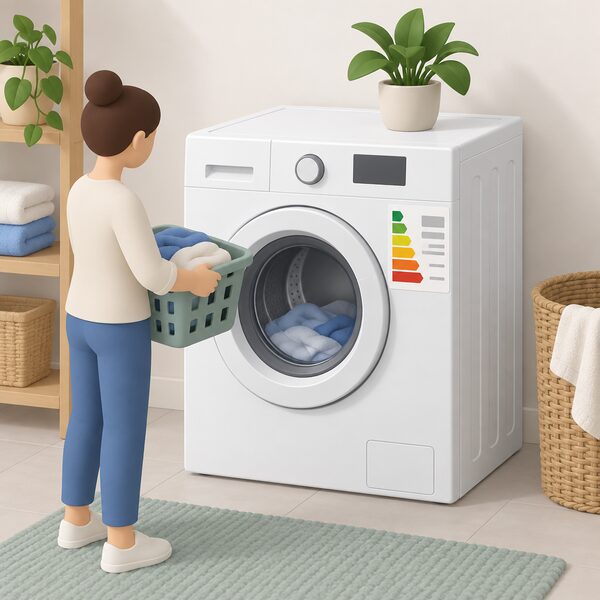
The A to G scale is now the common language of both product labels and building certificates, and the two are often confused. On products, energy labels rate products from A to G in terms of energy use, with A being the most efficient and G being the least efficient2. On buildings, the Energy Performance Certificate rates a property from A to G, with G being the least energy efficient9. The letters look identical; the things being measured are not.
The building scale has its own history. Energy performance ratings have been expressed on a scale of A+ to G, or A to G in the case of a dwelling, with G representing the least energy efficient rating10. That A+ band was a consequence of appliances and buildings outgrowing the original A, and it is the reason the product scale was later rescaled: once everything clustered at the top, the top stopped discriminating.
In Scotland the building side has been rebuilt around different measures. The Energy Efficiency Rating on a domestic EPC provides an A to G band and a numerical 1 to 100 rating based on the cost to run the dwelling normalised to the floor area11. Non-domestic certificates in Scotland use an Energy Performance Rating that displays an A to G rating and a 1 to 100 value based on the calculated emissions for the building in kg CO2/m2/year11. A new EPC rating system for domestic buildings is intended to give clearer information on the fabric energy efficiency of a property, the emissions, efficiency and running costs of its heating system, and the cost of energy to run the home to standardised conditions12.
For a householder, the practical point is that an A on an appliance label and an A on an EPC are not the same claim and cannot be traded against each other. The appliance letter describes one product under one test; the building letter describes a whole dwelling under a modelled set of assumptions. Both are useful, and neither substitutes for the other.
Why a bigger A-rated appliance can still use more energy
This is the most common misreading of the label, and it follows directly from how the bands are built. An appliance with a low energy rating is less efficient than one with a high rating1. That is a statement about efficiency, which is energy per unit of work, not about total energy. A large A-rated appliance can consume more electricity in absolute terms than a small B-rated one, because it is doing more work: more litres washed, more clothes dried, more volume cooled.
The label's own figures make this visible. A washing machine's rating is based on kWh per 100 cycles at an eco-wash setting1, and the measurement is taken at rated capacity, at half of the rated capacity and, where relevant, at a quarter of it4. A machine with a larger drum therefore reports its consumption across larger loads. The efficiency index can be excellent while the annual consumption figure is higher than that of a smaller machine.
The same principle applies to choosing by size. Official guidance on choosing energy efficient appliances is to look out for the energy ratings label and think about the size of the appliance that you need2. Size is the variable the household controls; the letter is the variable the manufacturer controls.
There is a limit to how far this can be pushed. Efficiency still matters within a given size and type, and the ecodesign floor removes the least efficient models entirely. But the label is a relative measure, and reading it as an absolute running cost for a specific home is a mistake the scale itself invites.
How the rating is measured: the eco 40-60 programme and EEI formula
The measurement regime is what makes the letters comparable, and it is set in law rather than by manufacturers. For household washing machines, the eco 40-60 programme shall be used for the measurement and calculation of the energy consumption, Energy Efficiency Index and other parameters4. For household washer-dryers, the wash and dry cycle is used for the measurement and calculation of the energy consumption and Energy Efficiency Index4.
The capacity at which measurements are taken is also specified. When measuring the parameters for the eco 40-60 programme and for the wash and dry cycle, the highest spin speed is used, and readings are taken at rated capacity, at half of the rated capacity and, where relevant, at a quarter of the rated capacity4. There is an exception: for household washing machines with a rated capacity lower than or equal to 3 kg, and for household washer-dryers with a rated washing capacity lower than or equal to 3 kg, measurement is at rated capacity only4.
The Energy Efficiency Index itself is a normalised score, and the same normalisation logic appears in the building regime, where the Energy Efficiency Rating is expressed as a normalised 1 to 100 score13. Normalisation is what allows a single letter to stand for a defined efficiency level across different machine sizes and types.
| Parameter | How it is measured | Source |
|---|---|---|
| Washing machine energy | kWh per 100 cycles at an eco-wash setting | 1 |
| Test programme, washing machines | eco 40-60 | 4 |
| Test programme, washer-dryers | wash and dry cycle | 4 |
| Capacities tested | rated, half, and where relevant a quarter | 4 |
| Small machines (3 kg or less) | rated capacity only | 4 |
| Programme duration unit | hours and minutes | 4 |
For a household, the practical consequence is that the label figure is reproducible. Two machines tested to the same programme at the same capacities can be compared on the label, and the comparison holds because the test does not vary. What the test cannot capture is how the machine is actually loaded, which programme is selected, and how often it runs.
What else the label covers: water use, noise, spin and programme duration
Energy is only one of the figures on the panel, and for some households the others matter more. Programme duration is recorded in hours and minutes at rated, half and quarter capacity for the eco 40-60 programme4, which is the figure behind the common complaint that the most efficient cycle is also the longest.
Noise is regulated separately and appears on the label for the products it covers. The regulation requires the sound power level, indoor or outdoor where relevant, to be stated on the energy label for products covered by the heating and cooling rules and limited to 70 kW rated capacity8. Enforcement has a tolerance built in: measured values shall not be more than 2 dB higher than the rated value declared by the manufacturer8. That tolerance is a market surveillance allowance, not a promise to the buyer, and it means a declared figure and a measured figure can legitimately differ by a small margin.
For tumble dryers, the noise and repairability picture is being rebuilt. The reform involves reforming the current household tumble dryers energy efficiency and condensation efficiency scales, and introducing a new acoustic airborne noise emission and repairability index scale5. The Create an Energy Label service on GOV.UK has been updated to reflect the nested energy efficiency label icon facing left prior to publication9.
"The regulation requires the sound power level(s), indoor and/or outdoor where relevant, to be stated on the energy label"
The label therefore carries a small specification sheet: energy, water, spin, duration and, where applicable, noise. Each figure is measured to a defined method, and each is a comparison between models rather than a prediction for a home. For energy independence the effect is indirect but real: a machine that spins more effectively extracts more water, and a dryer that has less water to remove uses less electricity to finish the job.
Ecodesign rules: repairability, spare parts and off-mode requirements
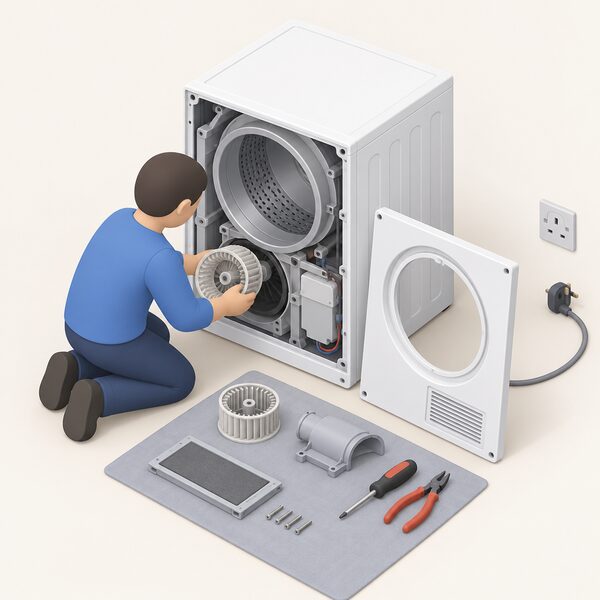
Ecodesign is the layer beneath the label. The Ecodesign for Energy-Related Products and Energy Information Regulations 2021 aim to increase producer responsibility, reduce energy usage and electrical waste, and enable consumers to identify the most energy efficient products on the market3. That third aim is the bridge to the label: the same regime that sets minimum performance also requires the information that lets a buyer compare.
Repairability has moved to the centre of the rules. For household tumble dryers, a range of circular economy measures is intended to promote repair and maintenance for end-users and to incentivise resource efficiency in the design and manufacturing of the dryers, including improvements to the technical documentation provided to consumers and new requirements on the availability of spare parts5. The repairability requirements are expected to improve product durability, reparability and end-of-life management, and manufacturers are to be required to design tumble dryers to facilitate material recovery and recycling at the end of their life cycle9.
Off-mode and standby draw is regulated alongside efficiency. The rules set stricter requirements on products when in off-mode or standby mode5. This is the power an appliance takes while it is plugged in but not working, and it accumulates across every always-on device in a home.
| Ecodesign measure | What it requires | Source |
|---|---|---|
| Minimum performance | Removes least efficient models from sale | 3 |
| Spare parts | Availability requirements on manufacturers | 5 |
| Repairability | Durability, reparability, end-of-life management | 9 |
| Material recovery | Design to facilitate recovery and recycling | 9 |
| Off-mode and standby | Stricter limits on non-working draw | 5 |
Marking recognition is also in flux. The Ecodesign for Energy Related Products Regulations 2010 are to be amended to extend the existing CE recognition mechanism to cover products regulated under the Ecodesign for Sustainable Products Regulation10, following an earlier move establishing indefinite recognition of CE marking for 21 product regulations, including the 2010 Ecodesign Regulations11. For a household this affects which mark appears on a product, not how well it performs; the product markings and standards page covers that distinction.
Repairability is where ecodesign touches independence most directly. An appliance that can be repaired and supplied with parts stays in service longer, which spreads its manufacturing energy over more years and reduces the frequency of replacement. It does not reduce the electricity the machine draws, but it reduces how often a household has to buy a new one.
Minimum energy performance standards and what is being phased out
Minimum energy performance standards are the hard floor: a product that does not meet them cannot be sold. The clearest current example is household tumble dryers. Proposals would raise the Minimum Energy Performance Standards of household tumble dryers being sold on the GB market, phasing out less efficient air-vented, gas-fired and condenser household tumble dryers and enabling only the most efficient heat pump household tumble dryers5. The same package would raise the minimum condensation efficiency standards to 80%, which is intended to protect consumers from products which have a risk5.
The distinction between a label and a standard is worth holding onto. The label ranks what is on sale; the standard decides what may be on sale at all. A household that ignores the label entirely still benefits from the standard, because the worst-performing models are no longer in the shops.
The same structure applies in other regulated product areas. Solid fuel appliance categories carry minimum efficiency figures: category J5, an independent boiler burning wood, pellets or chips, must reach 75% at nominal load and 70% at part load on gross calorific value, while category E4, a dry room heater or pellet stove, must reach 65% at part load and 70% at nominal load14.
For a household, minimum standards are the part of this regime that requires no decision at all. They raise the floor of the market, and the household's independence improves by default rather than by choice.
Air-conditioning: the 12kW threshold and inspection rules

Air conditioning is regulated on a different axis from white goods: not by a label band but by an inspection duty that falls on the person responsible for the system. All air conditioning systems with an effective rated output of more than 12 kW must be regularly inspected by an energy assessor15. The legislation is explicit: this Part applies to air-conditioning systems with an effective rated output of more than 12kW6.
The threshold is defined precisely. Effective rated output means the maximum calorific output specified and guaranteed by the manufacturer of the system as being deliverable during continuous operation while complying with the useful efficiency indicated by the manufacturer6. It is a manufacturer's declared figure, not a measurement taken on site.
The inspection timetable has several entry points. For a system with an effective rated output of more than 12kW, the first inspection deadline was 4 January 2011; for a system of more than 250kW, it was 4 January 2009; and where the system was first put into service on or after 1 January 2008, the deadline is the last day of the period of five years beginning with the date on which the system was first put into service6. Thereafter the system must be inspected by an energy assessor at regular intervals not exceeding five years6.
| System | First inspection deadline | Source |
|---|---|---|
| More than 12kW output | 4 January 2011 | 6 |
| More than 250kW output | 4 January 2009 | 6 |
| First put into service on or after 1 January 2008 | Last day of five years from first service | 6 |
| Ongoing | Intervals not exceeding five years | 6 |
The report has defined content. It must include an assessment of the air-conditioning efficiency and the sizing of the system compared to the cooling requirements of the building, and contain appropriate advice on possible improvements to the system, replacement of the system and alternative solutions6. The relevant person must keep the most recent inspection report made by an energy assessor6.
Where the responsible person changes and the new one is not given any inspection report, the new relevant person must ensure that the system is inspected within three months of the day on which they become the relevant person6. That is the answer to the property-transfer question: the duty follows the person, and a missing report triggers a fresh inspection rather than a gap.
The wider European framework set the direction, requiring that larger air-conditioning systems in buildings are inspected from an energy efficiency point of view, and the same framework applies regular inspections to the accessible parts of air-conditioning systems, or of systems for combined air-conditioning and heating, with an effective rated output over 70 kW in non-residential buildings16. That 70 kW figure is itself a change: the threshold was moved from systems with an effective rated output of over 12 kW to an effective rated output of over 70 kW16. The 12 kW line still governs the domestic and smaller non-domestic end of the market, where air-conditioning systems with an effective rated output of more than 12 kW must be regularly inspected by an energy assessor16, and where air-conditioning systems with a total effective output rating of less than 12 kW are exempt from the inspection requirement16.
For a household, the threshold means most domestic cooling sits outside the inspection regime entirely. A single split system for a living room is well below 12kW, so the duty does not bite. Where it does bite, in larger homes or mixed-use buildings, the obligation is on the person responsible for the system, and the report is a document that must be kept and passed on.
Where the UK and EU rules now diverge
The label and ecodesign regime was built on EU regulations and has been retained in UK law with amendments since. The clearest live divergence is in marking. The UK has consulted on amending the Ecodesign for Energy Related Products Regulations 2010 to extend the existing CE recognition mechanism to cover products regulated under the Ecodesign for Sustainable Products Regulation10, having earlier established indefinite recognition of CE marking for 21 product regulations, including the 2010 Ecodesign Regulations11. The UKCA and CE marking page sets out what that means for products sold here.
The product rules themselves remain closely aligned in substance, because the technical annexes that define test programmes and indices were carried across. The eco 40-60 programme, the wash and dry cycle for washer-dryers, and the capacity points at which measurements are taken are all set out in retained legislation4. The divergence is in governance and in the pace of reform rather than in the arithmetic of the label.
There is a second divergence in how the wider efficiency regime treats buildings, which bears on appliances indirectly. Minimum energy efficiency standards for domestic private rented property rest on the 2018 Minimum Level of Energy Efficiency standard at EPC band E17, defined in legislation as an energy performance indicator of band E18. In Scotland, proposals would require a minimum energy efficiency standard to be met before the end of 2028 for the private rented sector19, with draft regulations coming into force on 1 April 2028 and the prohibition on letting sub-standard properties applying from that date20. The UK government has set out preventing landlords from renting out homes under an energy performance certificate rating of C or equivalent21.
For a household, the divergence matters at the point of buying and at the point of renting. The appliance label is the same document across Great Britain, while the building standards that surround it differ by nation. The energy regulation and policy pillar sets out how those strands fit together.
Sources21 cited
- Energy and rating labels, Electrical Safety First, 2026-09-19
- Choosing energy efficient products, nidirect, 2025-04-09
- Ecodesign for Energy-Related Products and Energy Information Regulations 2021, House of Commons Library, 2026-09-17
- Ecodesign requirements for household washing machines and washer-dryers, Annex IV, legislation.gov.uk, 2019-03-11
- Raising product standards for household tumble dryers, Department for Energy Security and Net Zero, 2025-07-17
- Energy Performance of Buildings (England and Wales) Regulations 2012, Part 4, legislation.gov.uk, 2026-09-17
- Energy Performance Certificates, House of Commons Library, 2026-09-17
- Air source heat pump noise and permitted development rights in Wales, Welsh Government, 2023-12-13
- Raising standards for household tumble dryers: government response, Department for Energy Security and Net Zero, 2026-03-24
- Extended CE marking recognition for ecodesign regulations, Department for Energy Security and Net Zero, 2026-07-06
- Extended CE marking recognition for ecodesign regulations: consultation document, Department for Energy Security and Net Zero, 2024-05
- Reforming energy performance certificates, Scottish Government, 2025-01-21
- Technical annex for chapter 2: what EPCs measure, Department for Energy Security and Net Zero, 2026-03-09
- Approved Document L, Conservation of fuel and power, Volume 1, Department for Levelling Up, Housing and Communities, 2026-09-17
- Trading standards guidance: other consumer problems, Isle of Anglesey County Council, 2025-09
- Energy Performance of Buildings Directive 2002/91/EC, legislation.gov.uk, 2026-09-17
- Minimum energy efficiency standards, Carmarthenshire County Council, 2026-09-20
- Energy Efficiency (Private Rented Property) (England and Wales) Regulations 2015, regulation 22, legislation.gov.uk, 2026-09-17
- Energy efficiency in homes, Scottish Government, 2028
- Draft Energy Efficiency (Domestic Private Rented Property) (Scotland) Regulations 2026, Scottish Government, 2025-06
- Accelerating to net zero: government response to the CCC progress report, Department for Energy Security and Net Zero, 2024-12-17
 EPC StatisticsHow energy efficient are UK homes, and is it getting better?
 Product RecallsHow recalls and safety notices work for energy equipment in UK homes, who issues them, how to check a product, and what replacement, repair and refund routes exist.
 Product Markings and StandardsExplains what conformity markings and voluntary quality marks on home energy products actually mean, who issues them and what testing sits behind each.
 The Full Where to Start GuideWhich home improvements actually cut your bills, and which should you do first?
 Housing Stock Data for EnglandHow energy efficient are English homes, and how many have insulation or low carbon heating?
 Read an EPCA walk through each part of an EPC: the A to G rating and potential rating, the estimated costs, the fabric and heating assumptions and the recommendation table, plus what the assessor did and did not inspect and how the rules differ across the UK.