

In this comparison
The gap between new build and older housing stock is the single clearest signal in the EPC data. In the quarter January to March 2026, 87% of new dwellings in England were given an A or B rating, an increase from 86% in the same quarter a year earlier, while 88% of existing dwellings were given a C or D rating1. Over the past year, 87% of new build EPC registrations were rated A or B, against 5% of existing homes2.
That is not a small difference in the middle of the scale. It is two separate distributions: most new homes cluster at the top, most older homes cluster two or three bands below. The consequences run through energy bills, carbon emissions, mortgage lending policy and the regulatory timetable now bearing down on landlords.
What an EPC rating is and how the A to G scale works
An Energy Performance Certificate rates how energy efficient a building is, with ratings from band A (very efficient) to band G (inefficient)5. The certificate is produced using standard information about buildings, so that buyers and tenants can compare energy efficiency and likely heating and lighting costs before entering a contract6. Ratings can range from "A" (very efficient) to "G" (very inefficient), and the EPC rates a property from A to G, with G being the least energy efficient7.
Alongside the headline band, a domestic EPC carries a rating on a scale of 1 (Very Poor) to 5 (Very Good) for each feature assessed8. The certificate is a snapshot of the dwelling as assessed, not a live measurement: it models the home under standardised conditions rather than reporting what the household actually consumes.
The scale is deliberately coarse. Ofgem's archetype work notes that dwellings span the whole range of EPC ratings, from A through to G, which is why the same band can cover a wide spread of real performance9. A home at the top of band C and one at the bottom of band C can differ materially in running costs while carrying the same letter.
The distribution across the stock is heavily weighted to the middle. Over the past year, only 5% of EPC registrations for existing homes achieved the top ratings of A or B, while 41% were rated at D or below2. That is the baseline against which any new build comparison has to be read.
New builds versus older homes: the headline gap

The headline comparison is stark and consistent across sources. Newer homes have much higher ratings, while older homes, converted flats and bungalows have the lowest average ratings10. The pattern holds whether the measure is the share reaching A or B, the share falling to D or below, or the median score.
In England in the quarter January to March 2026, 87% of new dwellings were given an A or B rating, an increase from 86% in the same quarter of 2025, while 88% of existing dwellings were given a C or D rating, compared with 12% of new dwellings1. In Wales in the same quarter, 92% of new domestic properties received an energy efficiency rating of A, the highest band1.
The independent figures from the Home Builders Federation align closely. Over the past year, 87% of new build properties were rated as A or B, and just 3% were assessed at D or lower2. For existing homes, 41% of EPC registrations were rated at D or below2.
The energy consequences of that spread are large. EPC D rated homes, which the HBF describes as most existing homes, used 46% more energy overall and 61% more gas than EPC A and B rated homes, and spent 27% more on their energy bill overall and 53% more on their gas bill2. EPC F and G rated homes used 68% more energy overall and 88% more gas, and had 74% higher CO2 emissions, than EPC A and B rated homes2. EPC D rated homes had 50% higher CO2 emissions than EPC A and B rated homes2.
For a household, the practical reading is that the letter on the certificate is a proxy for a running-cost difference that shows up every month, not a one-off at purchase. For energy independence, a higher band means less exposure to whatever the unit price of gas and electricity does next, because the home needs fewer units to reach the same internal temperature.
Why new builds score higher: a median of 84 points
New dwellings in England reached a median EPC score of 84 in the five-year period to March 2025, up from a median score of 82 in the five-year period to March 20133. A median of 84 sits inside band B. The improvement over twelve years is real but modest, which suggests the bulk of the new build advantage comes from building to current standards rather than from year-on-year gains.
The average new build home, rated EPC A or B, produces up to 42% fewer carbon emissions than the least efficient homes2. That figure is the HBF's own framing of its sector's performance, and it compares the best new stock against the worst existing stock rather than against the average older home.
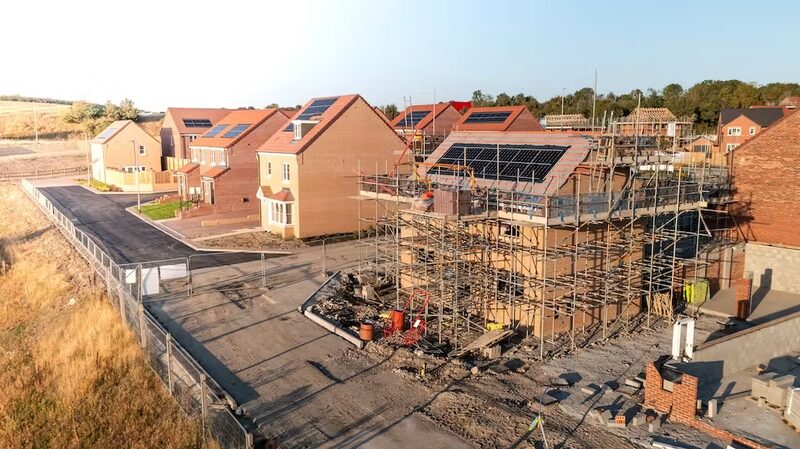
The regulatory floor explains much of the clustering. It is a legal requirement for all new build domestic dwellings in England and Wales to have an EPC when completed11. Because the certificate is mandatory at completion, the new build data is close to a census of what is being built, rather than a sample of homes that happened to change hands or change tenancy.
Volume matters for how the statistics read. In the 12 months to March 2026, 204,000 EPCs were lodged for new dwellings in England, a 2% increase on the previous year1. In the first quarter of 2026 alone, 48,000 EPCs were lodged for new dwellings in England, a 6% increase on the same quarter of 2025, and the total for England and Wales rose 7% to 50,0001. Wales recorded 2,000 EPCs for new dwellings in the quarter, a 43% increase1.
Where older homes can still score well
The band is not fixed by age. Around a quarter of gas consuming properties built before 1945 have the highest EPC ratings A to C, compared with around 95% among properties built to later standards12. That quarter is the evidence that retrofit works: a pre-1945 home can reach the top half of the scale.
The route there is fabric first, then heating. The Scottish Government's review of retrofit assessment found that EPC ratings do not always capture the true efficiency of a retrofit, and that measures like PV panels or air-source heat pumps may improve an EPC score but fail to address fundamental building issues such as poor insulation or moisture risks13. A high band achieved by adding generation without treating the building fabric is a weaker result than the letter suggests.
The distribution of existing stock also shows how much of it sits just below the threshold that policy now targets. In England in April to June 2025, 87% of existing dwellings were given a C or D energy efficiency rating, compared with 11% of new dwellings14. A large share of the stock is therefore one band away from the C that rental regulation is moving towards, and one band above the E and below that fuel poverty schemes tend to target.
For households in Wales, the New Warm Homes Programme uses an EPC rating of E and below as its eligibility threshold15. That is a different cut from the C target applied to the private rented sector, and it illustrates that the same certificate is read differently depending on which scheme is doing the reading.
What a low rating means for mortgages, value and saleability

An EPC is required when a dwelling is constructed, converted, sold or let, and must be provided when a building is advertised for sale or for let to a new tenant3. When a building is advertised for sale, the EPC rating must be included in the property advertisement17. In Scotland, an EPC is required as part of the Home Report17.
Lenders are not presently obliged to check a band before lending. The UK Government has consulted on proposals to require lenders to disclose the average EPC performance of properties in their mortgage portfolios, with a voluntary target of a portfolio average of EPC C by 203018. That is a portfolio-level disclosure proposal, not a per-property lending rule, and it is a proposal rather than an enacted requirement.
The regulatory pressure on the private rented sector is firmer. Government policy is to set long-term regulatory standards to upgrade privately rented homes to EPC band C by 20285. A 2025 consultation proposed allowing properties with a current EPC C to be recognised as compliant under the future standard until the EPC expires19. An earlier consultation covered raising the minimum standard for privately rented homes to an EPC Energy Efficiency Rating of C and an Environmental Impact Rating of C20.
For social housing, the Government is considering setting a long-term regulatory standard to improve social housing to EPC band C, subject to consultation5. For owner occupiers, no equivalent minimum standard applies at present.
Limits of EPCs: what the assessment misses
The Committee on Climate Change has been direct about the metric's shortcomings. The ratings on EPCs are an important policy tool, used to define standards and targets for reducing emissions from homes, but they are poorly suited to that role21. The current EPC rating metrics do not accurately incentivise the energy efficiency and heating solutions required to deliver Net Zero homes22.
"The ratings on EPCs are an important policy tool, used to define standards and targets for reducing emissions from homes"
The Committee's recommended remedy is procedural as well as technical: reforms to EPC rating metrics should be applied alongside wider improvements to the EPC system to improve the quality of assessments and use of data21. A new metric on its own, applied to the same assessment process, would carry the same weaknesses.
The assessment also models rather than measures. An EPC is produced using standard information about buildings, which is what makes certificates comparable between properties, but it also means the certificate describes the dwelling under assumed conditions rather than the household's actual consumption6. Two identical homes with very different occupancy will carry the same band.
For a household weighing a retrofit, the practical implication is that the certificate is a guide to the building, not a guarantee of the bill. A measure that lifts the band may or may not deliver the running-cost reduction the band implies, and the retrofit assessment review is explicit that some measures improve the score without addressing the underlying fabric13.
How long an EPC lasts and when to get a new one
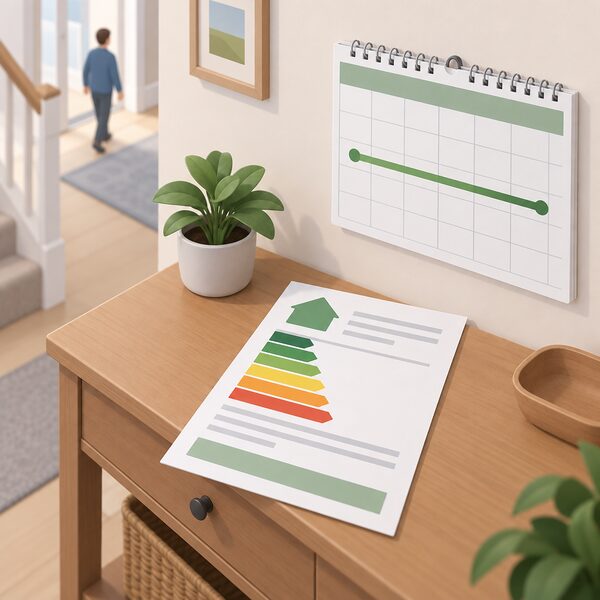
An EPC is valid for a maximum of ten years, or until another EPC is commissioned for the same building, whichever is sooner4. EPCs are valid for 10 years, and ratings are valid for 10 years3. A new EPC does not need to be produced when the previous certificate's 10-year validity period expires, unless the property is being sold or let to a new tenant24.
Different schemes set their own, shorter windows. For the Domestic RHI, the EPC had to be less than 24 months old when the application was submitted, even where the household already held an older EPC25. For the Feed-in Tariff, an EPC was "valid" if it was issued before, but not more than 10 years before, the commissioned date of the PV installation, and was the most recent EPC issued for the relevant building26. The Boiler Upgrade Scheme guidance refers to an EPC that is no more than 10 years old27.
Scotland has consulted on shortening the validity period. A reduction of the validity period of EPCs from 10 to five years was proposed to ensure consumers have more up-to-date information, for new EPCs issued after the new EPC regulations come into force28. That change is not in force across the UK.
Reforms ahead: rental targets and methodology changes
The reform programme has two strands: new metrics, and new standards that use them. The Scottish Government has set out plans to reform EPCs by introducing new ratings, redesigning the certificates, and improvements to the operational infrastructure29. The proposed new rating system for domestic and non-domestic properties would give improved information on a property's energy efficiency and the emissions and performance of the heating system, plus a new heat retention rating considering installed energy efficiency measures30.
Scotland's domestic reforms would cover the fabric energy efficiency of a property, the emissions, efficiency and running costs of its heating system, and the cost of energy to run the home to standardised conditions31. The Home Energy Model and the Simplified Building Energy Model are the calculation methodologies for domestic and non-domestic buildings respectively, used to calculate the new ratings16.
On standards, the direction of travel is a C. Government policy is to set long-term regulatory standards to upgrade privately rented homes to EPC band C by 20285. The Government's preferred option in the 2021 consultation was to require landlords to ensure that domestic properties for rental meet EPC C standards, at a minimum for new tenancies from 1 April 2025 and for all tenancies by 1 April 202832. Those dates have since been overtaken by the 2028 and 2030 framing.
The timetable now most often cited is 2030. The Government is tightening EPC standards so all private rented homes in England and Wales reach at least C by 2030. Commercial rentals face separate targets of C by April 2027 and B by April 2030. Reforms to EPC regulations and the information displayed on certificates are planned for 2027.
For a household, the reform programme matters because the letter on a certificate may not mean the same thing in a few years. A home assessed under the current methodology may be reassessed under a new one, and the new rating will weigh heating system emissions and heat retention differently from the present metric. The Committee on Climate Change's condition, that metric reform should sit alongside wider improvements to assessment quality and data use, is the test of whether the next generation of certificates is more useful than the present one21.
Sources32 cited
- Energy Performance of Buildings Certificates, January to March 2026, England and Wales, GOV.UK, 2026
- Watt a Save 2026, Home Builders Federation, 2026-02-02
- Energy efficiency of housing in England and Wales, Office for National Statistics, 2025-10-28
- EPC guidance for trading standards, Isle of Anglesey County Council, 2025-09
- Energy Performance Certificates, House of Commons Library, 2026-09-20
- Energy Performance Certificates, nidirect, 2026-02-26
- ECO4 scheme, Derbyshire County Council
- Technical annex for chapter 2: what EPCs measure, GOV.UK, 2026-03-09
- Ofgem archetypes update 2024, Ofgem, 2024-02
- Energy performance of buildings certificates, House of Commons Library, 2026-09-17
- Energy Performance of Buildings Certificates change note, GOV.UK, 2025-07-31
- National Energy Efficiency Data Framework: NEED report summary of analysis 2026, GOV.UK, 2026-06-11
- Review of retrofit assessment in Scotland, Scottish Government, 2025-06-06
- Energy Performance of Buildings Certificates, April to June 2025, England and Wales, GOV.UK, 2025-07-31
- New Warm Homes Programme policy statement, Welsh Government, 2023-06-15
- Energy Performance of Buildings (Scotland) Regulations 2025 update, Scottish Government, 2025-10-10
- Energy Performance Certificates guide: buildings for sale, Scottish Government, 2026-08-24
- Heat in Buildings Strategy, Scottish Government, 2021-02
- Improving the energy performance of privately rented homes: 2025 update, GOV.UK, 2025-02-07
- Minimum energy efficiency standard for privately rented homes consultation, Environmental Audit Committee, 2021-04-30
- Letter on reform of domestic EPC rating metrics to Patrick Harvie MSP, Committee on Climate Change, 2026-09-19
- Letter on reform of domestic EPC rating metrics to Lee Rowley MP, Committee on Climate Change, 2026-09-19
- Edinburgh Local Heat and Energy Efficiency Strategy, City of Edinburgh Council, 2023-12
- Energy Performance Certificates guide: buildings for let, Scottish Government, 2023-11-29
- Domestic Renewable Heat Incentive essential guide, Ofgem, 2024-06
- Guidance for Feed-in Tariff generators, Ofgem, 2026-04-01
- Boiler Upgrade Scheme guidance for installers, Ofgem, 2026-07-02
- EPC reform consultation: government response, Scottish Government, 2025-01
- EPCs are changing, Scottish Government, 2026-08-24
- Scoping consultation on the Heat Energy Efficiency Technical Suitability Assessment, Scottish Government, 2025-06-06
- Reforming Energy Performance Certificates, Scottish Government, 2025-01-21
- Energy efficiency of privately rented homes, Environmental Audit Committee, 2021-04-30
 New Build Energy PerformanceHow energy efficient are new build homes compared with older ones?
 Efficiency of UK HomesMost UK homes now score better on energy than they did a decade ago, but older houses still lag well behind new builds.
 The New Build Performance GapWhy does a new build use more energy than its rating promises?
 Energy Performance CertificatesAn Energy Performance Certificate rates how energy efficient your home is, from A down to G.
 Housing Stock and EPCsHow energy efficient are Scottish homes, and how many reach a good rating?
 Home Energy AssessmentsWhich home energy check do you actually need?