

In this guide
The Boiler Upgrade Scheme gives upfront capital grants towards heat pumps and, in limited circumstances, biomass boilers, in properties in England and Wales only1. Eligibility turns on four things: where the property is and what kind of property it is, what heating system is being replaced, which technology is being installed and to what standard, and whether the property has already had public money for low carbon heat. The scheme is installer-led, so an MCS certified installer applies to Ofgem on the owner's behalf and the grant is deducted from the quote rather than paid to the household2.
The headline grant is £7,500 for eligible properties, with an uplifted grant of £9,000 for eligible off-gas grid properties installing an air-to-water or ground source heat pump, available for applications properly made on or after 21 July 2026 and in place until 31 March 20273. Only one grant is available per property, and only one voucher can be redeemed per property4.
The single biggest change for householders is that, from 28 April 2026, properties are no longer required to have a valid Energy Performance Certificate to apply3. That removes the old insulation-recommendation hurdle that blocked many applications, though older guidance pages and third-party summaries still describe the previous position. The scheme has also been extended to 20303.
What the scheme is and who administers it
The Boiler Upgrade Scheme is a government scheme providing upfront grants to reduce the cost of installing heat pumps and biomass boilers in homes and non-domestic buildings1. It is administered by Ofgem, which issues and redeems the vouchers, while the underlying policy and eligibility criteria sit with the Department for Energy Security and Net Zero2. Grant categories and values are approved by the Secretary of State under Regulation 13 of the Boiler Upgrade Scheme (England and Wales) Regulations 20226.
The scheme opened for applications on 23 May 2022, with vouchers issued from that date on eligible technologies installed from 1 April 20222. It replaced the Domestic Renewable Heat Incentive, which paid participants over seven years rather than at the point of installation; the Domestic RHI closed to new applicants as the Boiler Upgrade Scheme opened8.
Its purpose is narrow and worth stating plainly: it is a capital subsidy to replace fossil fuel heating with low carbon heating, with a focus on off-gas grid homes9. It is not a fuel poverty scheme, it carries no income or benefits test, and it does not fund insulation. Households looking for help on those grounds are directed to the Energy Company Obligation and the other routes set out on the home energy grants pillar.
Grant amounts: £7,500, and £9,000 off the gas grid
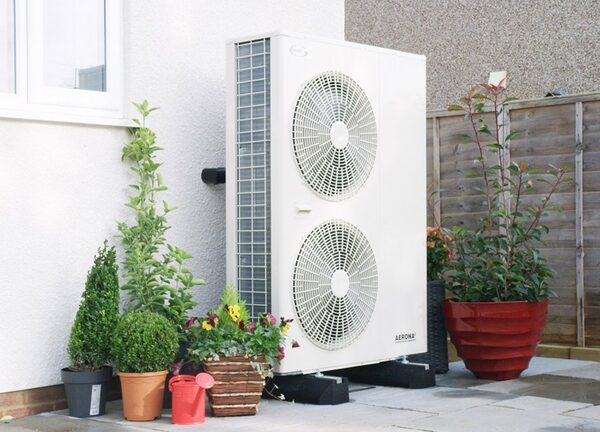
| Grant | Technology | Condition | Source |
|---|---|---|---|
| £7,500 | Eligible heat pump or biomass boiler | Property does not qualify for the uplift3 | 3 |
| £9,000 | Air-to-water or ground source heat pump | Eligible off-gas grid property, applications on or after 21 July 20263 | 3 |
| £7,500 | Exhaust air-to-water heat pumps | Stated as eligible for the £7,500 grant7 | 7 |
The uplifted £9,000 value applies where the previous heating system being replaced was fuelled by oil or liquefied petroleum gas, and Ofgem's own scheme statistics describe it as £9,000 towards an air-to-water or ground source heat pump for eligible off-grid properties heated by LPG or oil3. Properties that do not meet the uplift conditions may still be eligible for a grant of £7,5003. The uplift is time-limited: it will be in place until 31 March 20273.
Whichever value applies, the money never reaches the household as cash. The grant is applied upfront as a discount to the cost of the installation and is paid to the installer, and installers must deduct the full grant value from the quote before any payment is made by the property owner10. That is a consumer protection as much as an administrative choice: it removes the risk of a household paying in full and waiting for reimbursement. A fuller treatment sits on the grant amount page.
Published grant values for some categories vary between scheme notices, with £5,000 and £2,500 figures appearing alongside £7,500. The April 2026 installer guidance, the most recent statement, sets £7,500 as the standard grant for eligible properties that do not qualify for the uplift, and £9,000 for eligible off-gas-grid properties replacing oil or LPG heating3.
Which properties qualify: location, tenure and building type
Only properties in England and Wales are eligible3. There is no equivalent route in Scotland or Northern Ireland under this scheme, and households there should look to home energy grants in Scotland and Northern Ireland instead. This is a hard territorial limit written into the regulations, not an administrative preference.
Both domestic and non-domestic properties may be eligible, and both residential and non-residential buildings can qualify, although air-to-air heat pumps are eligible only in residential properties10. Eligible property types include, but are not limited to, owner-occupied homes, properties rented out to tenants, second homes and holiday homes11. Guidance has also addressed park homes, churches, and related structures such as an annex or swimming pool11.
- Included: owner-occupied homes, private rented properties, second homes, holiday homes, park homes11
- Excluded: social housing, including shared ownership properties10
- Excluded: most new build properties13
- Excluded: any property already given government funding or support for a heat pump or biomass boiler13
The social housing exclusion is absolute and captures shared ownership, which catches out buyers who consider themselves owner-occupiers10. Social landlords have a separate route through the Warm Homes: Social Housing Fund. The position for landlords and second home owners is set out in more detail on landlords and second homes, and the social housing question on social housing and the scheme.
For a household weighing independence, the tenure rules matter: a private tenant cannot drive this themselves, because the grant attaches to the property and the application is made for the owner.
The replacement rule: what the existing heating system must be
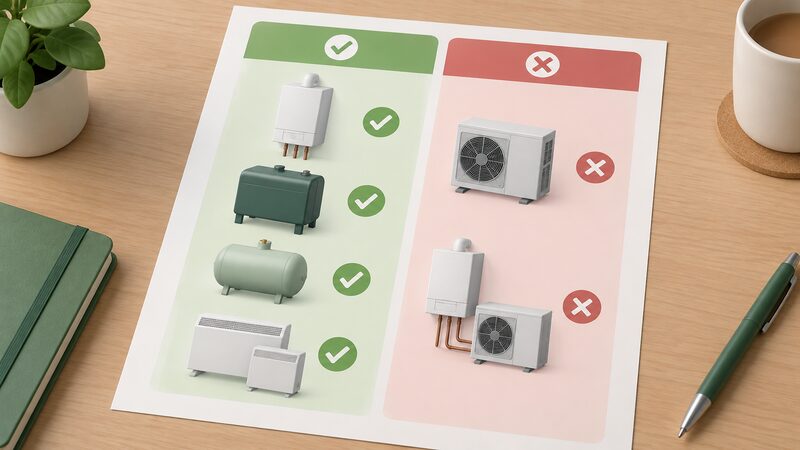
The installation must replace an existing fossil-fuel or electric heating system4. Ofgem's guidance sets out two acceptable categories for the system being replaced: a fossil fuel heating system such as gas, oil or LPG, or an electric heating system excluding existing heat pumps10. The same formulation has run through the guidance since at least 202314.
The practical effect is a set of clear exclusions. A property already heated by a heat pump cannot use the scheme to fund a replacement heat pump. Consumer guidance describes replacement low carbon heat systems as ineligible, alongside hybrid systems15. So the scheme funds a fuel switch, not an upgrade within the low carbon estate, and a failed or ageing heat pump is the owner's problem.
Electric heating counts, which is often missed. A home on storage heaters or direct electric panel heaters is replacing an electric heating system and is within scope, even though no fossil fuel is displaced at the property. What such a home gains is efficiency rather than a change of fuel.
For the higher £9,000 grant, the fuel of the previous system is decisive: it must have been oil or LPG, in an eligible off-gas grid property3. A mains gas home switching to a heat pump therefore falls into the £7,500 band. Whether a gas boiler qualifies at all is addressed on gas boiler eligibility.
Which technologies qualify, and which do not
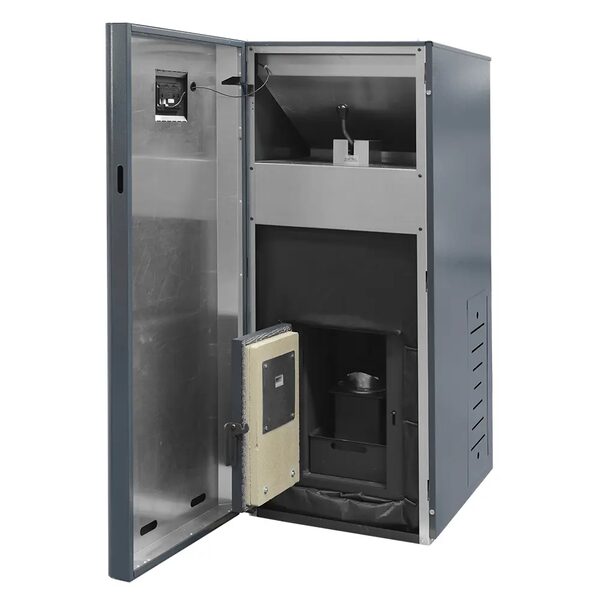
Eligible technologies are air-to-water heat pumps, air-to-air heat pumps, ground source heat pumps including water source heat pumps and shared ground loops, and biomass boilers3. Residential and non-residential properties are both eligible for air-to-water heat pumps, ground source heat pumps and biomass boilers; air-to-air heat pumps are restricted to residential properties3. Exhaust air-to-water heat pumps are stated as eligible for the £7,500 grant7.
Biomass sits in a narrower box. Biomass boilers are only eligible in limited circumstances and are subject to additional location and air-quality requirements12. They may only be installed in properties in rural areas, and an emissions certificate must show that particulate matter did not exceed 30g/GJ net heat input and NOx did not exceed 150 g/GJ net heat input3. Biomass boilers are also not eligible for self-builds16. The detail is set out on biomass requirements.
Hybrids are out. No grant is available for a hybrid heat pump system, for example a combination of gas boiler and air source heat pump17. Consumer guidance puts it more broadly, excluding any combination of a boiler and an electric heat pump, whether split or integrated and whether on or off the gas grid15. See hybrid heat pumps and the grant.
Supplementary heating is a separate question from hybrids. From 28 April 2026, funded heat pumps can be installed alongside supplementary heating appliances provided those appliances are not fossil fuel based3. A biomass boiler may be retained alongside a funded heat pump as supplementary heating, but cannot be used to meet the heating demand requirement18. Biomass boilers funded through the scheme cannot themselves be installed alongside supplementary heating appliances7.
A broader consultation has referred to supporting heat pumps, biomass boilers and heat batteries in homes and non-domestic buildings19; heat batteries are not among the technologies listed as eligible in the current installer guidance.
New builds and self-builds: where they stand
New build properties are not eligible, with a carve-out for certain self-builds20. Properties that the developer is still building are excluded outright17. A household that moves into a finished new build fitted with a fossil fuel boiler may be able to get a grant for a heat pump under the scheme, because it is then replacing a fossil fuel system in an existing property17.
The self-build test has two limbs, consistently stated across scheme statistics and guidance:
- The property was built mainly using the labour or resources of the first owner, that is, the owner or original owner built it themselves or paid a builder to build it21.
- It has never been owned by a business or organisation13.
Two further restrictions apply. Self-build properties are only eligible for funding for heat pumps, not biomass boilers3. And where a property is exempt from the insulation requirements, earlier guidance required a valid EPC to be submitted at voucher application stage11; that sits alongside the April 2026 removal of the general EPC requirement, and the documents are not written to the same date.
The self-build route is the one point at which the scheme funds heat in a property with no prior heating system to displace, and it is deliberately narrow: it exists so that people building their own homes are not pushed towards a gas boiler to stay eligible for anything.
The EPC and insulation position
From 28 April 2026, properties are no longer required to have a valid Energy Performance Certificate to apply3. This implements a stated intention to amend the eligibility criteria to relax the EPC requirement from 2026/27 onwards, adopting a hybrid model, which had been consulted on in April 202523.
This is the most consequential change for households, because under the previous rules a valid certificate was needed and an outstanding loft or cavity wall insulation recommendation on that certificate could stop an application. Redemption evidence under the old model included, where applicable, a valid EPC with no insulation recommendation, or evidence that loft or cavity wall insulation could not be installed25. That machinery is what has now been relaxed.
Separate funding already received for energy efficiency upgrades such as insulation, doors or windows does not prevent an application27. The interaction between an EPC recommendation and a grant is covered on the EPC insulation requirement.
Insulation still matters physically even where it no longer matters administratively: a heat pump must meet the full space heating and hot water demands of the property, and a poorly insulated fabric raises the flow temperature and the running cost. Removing the certificate requirement lowers the paperwork barrier, not the building physics.
System requirements: capacity limits, efficiency and MCS
Every heating system installed under the scheme must meet the relevant MCS standards approved and published by the Secretary of State3. Installers must be MCS certified and meet the MCS standards1, and installations must be delivered by an MCS installer using MCS certified products, installed to MCS standards28. The requirement runs across installer, product and installation; see MCS-certified installers.
| Requirement | Limit or standard | Applies to |
|---|---|---|
| Capacity | 45 kWth | Individual heat pump system3 |
| Capacity | 70 kWth | Multi heat pump system3 |
| Capacity | 300 kWth total | Shared ground loop systems, each connected heat pump not exceeding 45 kWth3 |
| Capacity | 45 kWth | Individual biomass boiler system3 |
| Efficiency | In situ SCOP of at least 2.8 | Air-to-water and ground source heat pumps3 |
| Emissions | Particulate matter not exceeding 30g/GJ, NOx not exceeding 150 g/GJ net heat input | Biomass boilers3 |
| Sizing | Capable of meeting the full space heating and hot water heating demands of the property | Heat pumps and biomass boilers29 |
The 45 kWth ceiling covers the overwhelming majority of homes; the limits bite mainly on large non-domestic buildings and shared ground loop arrays. The seasonal coefficient of performance floor of 2.8 is an in situ figure, meaning it reflects the designed installation rather than a laboratory rating, and it is what prevents grant money funding a poorly designed high-temperature system.
The full-demand rule is the other design constraint worth understanding. A funded system must be sized to heat the property and its hot water on its own, which is why hybrids and demand-sharing arrangements fall outside the scheme, and why a retained biomass boiler cannot be counted towards the requirement18.
How the installer-led application works
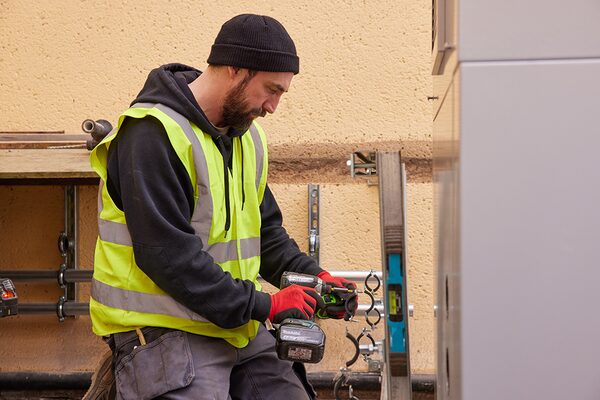
The scheme is installer-led and a property owner cannot apply personally10. An MCS certified installer creates a Boiler Upgrade Scheme installer account on Ofgem's website and applies for, and redeems, vouchers on behalf of property owners30. It is the installer's responsibility to ensure the application meets the eligibility criteria16.
There are two stages: a voucher application, then a voucher redemption application3. In sequence:
- The installer discounts the full grant value from the quote before any payment is taken from the property owner2.
- The installer applies to Ofgem for a grant voucher2.
- Ofgem issues the voucher20.
- The installer submits the redemption application after installation and commissioning20.
- The installer receives the grant payment20.
Vouchers for air-to-water heat pumps, air-to-air heat pumps and biomass boilers are valid for three months; ground source heat pump vouchers are valid for six months, reflecting the longer groundworks7. Where a system has already been commissioned, a retrospective application is permitted provided it is properly made within 120 days of the commissioning date12. Redemption evidence includes the MCS certificate number, the voucher number, details of the technology installed, a biomass emission certificate where applicable, and installer confirmation of accuracy25. The redemption deadline is covered on voucher redemption, and the process in full on how the application works.
The scheme is not a large-installer preserve: in Scheme Year 1, to 31 March 2023, 148 installers submitted a single application each31.
Interaction with other funding
Funding from the Boiler Upgrade Scheme and the Energy Company Obligation cannot be blended for the same measure or be included within an ECO4 project32. Ofgem's guidance for homeowners and tenants states the point from the other direction: funding for measures delivered under ECO4 must not be blended with funding from other government schemes or grants, including but not limited to the Warm Home Discount, the Boiler Upgrade Scheme, the Social Housing Decarbonisation Fund and the Home Upgrade Grant33.
A household therefore chooses a route rather than stacking. The comparison is drawn out on Boiler Upgrade Scheme vs ECO4 and which route for a heat pump.
The prior-funding exclusion is separate and permanent: a property is not eligible if a previous grant has already been received for installing a heat pump or biomass boiler at the same address, and properties with previous public funding for a heat pump or biomass boiler are excluded3. Only one grant, and one redeemed voucher, is available per property17. Funding already received for insulation, doors or windows does not count against an application27.
Scheme duration and budget

As of 28 April 2026, the scheme has been extended to 20303. The guidance update summary records that extension as replacing an earlier statement that the scheme ran to 202818, and the Government confirmed funding for further years up to 2029/30 through the Warm Homes Plan in January 20265. A published closing date of 30 December 2029, 11:59pm also appears2, and independent guidance still describes a 2022 to 2028 run15. These end points are inconsistent; the April 2026 installer guidance is the most recent.
The scheme had an initial budget of £150m per financial year for 2022 to 20253. A parliamentary briefing records a budget of £295 million for 2025/26, with 2024/25 funding increased by £30 million35; other figures in circulation differ, and that conflict is unresolved. One operational point matters more than the headline number: unspent budget is not carried over to the next scheme year20. Demand within a year, not a running total, determines whether the money is used.
What a grant does, and does not do, for energy independence
By offering upfront grants, the scheme makes heat pumps and biomass boilers more affordable and appealing to households8. A household that takes one moves its space heating and hot water off a delivered or piped fuel and onto electricity, ending a relationship with an oil supplier or LPG tanker, and it is those homes that the £9,000 uplift is aimed at3. Removing a gas connection removes a standing charge and a second supplier relationship. Off the gas grid, the gain is sharper still: no deliveries, no tank, no exposure to a delivered-fuel price.
The dependencies that remain should be stated as firmly. A heat pump is an electrical load, so the household exchanges dependence on a fuel supplier for dependence on the grid and an electricity tariff, and the in situ SCOP floor of 2.8 means roughly a third of the delivered heat still comes from purchased electricity at minimum3. Biomass replaces one delivered fuel with another, and is restricted to rural properties with an emissions certificate3. The grant itself is a one-off: one per property, with no repeat when the system reaches end of life17. And the scheme cannot be driven by the occupier alone where the occupier is not the owner.
The scheme also does nothing for the fabric. With the EPC requirement removed, nothing in the rules now obliges a household to address insulation before installing3, which makes fabric work a separate decision taken on its own merits through routes such as the Great British Insulation Scheme. The wider picture of how grants interact with self-sufficiency is set out on grants and energy independence.
Sources35 cited
- Boiler Upgrade Scheme, Ofgem, 2026-09-17
- Boiler Upgrade Scheme grant listing, Find a Government Grant, 2026-09-18
- Boiler Upgrade Scheme guidance for installers v5.1, Ofgem, 2026-07-02
- Boiler Upgrade Scheme: installers, Ofgem, 2026-09-17
- Boiler Upgrade Scheme statistics, July 2026, DESNZ, 2026-08-27
- Notice of approved grant categories and values, GOV.UK, 2026-07-21
- Boiler Upgrade Scheme guidance for installers v5, Ofgem, 2026-04-28
- Domestic RHI annual report, scheme year 11, Ofgem, 2025-07
- ECO4 delivery guidance v1, Ofgem, 2022-10-14
- Boiler Upgrade Scheme guidance for property owners v5, Ofgem, 2026-04-28
- Boiler Upgrade Scheme property owner guidance v2.3, Ofgem, 2023-09-25
- Boiler Upgrade Scheme guidance for property owners v5 draft, Ofgem, 2026-03-25
- Check if you're eligible for the Boiler Upgrade Scheme, GOV.UK, 2026-09-17
- Boiler Upgrade Scheme guidance for installers v2.1, Ofgem, 2023-05-18
- Boiler Upgrade Scheme, RECC, 2026-09-17
- Summary of updates to BUS guidance for property owners v4.1, Ofgem, 2024-11-11
- What you can get from the Boiler Upgrade Scheme, GOV.UK, 2026-09-17
- Summary of updates to BUS guidance for installers v5, Ofgem, 2026-04
- Reforming consumer protection for home upgrade schemes, GOV.UK, 2026-06-17
- Boiler Upgrade Scheme quarterly report issue 14, Ofgem, 2025-11-26
- Boiler Upgrade Scheme quarterly report issue 15, Ofgem, 2026-02-27
- Summary of updates to BUS guidance for property owners v2.4, Ofgem, 2023-12
- Amendments to the Boiler Upgrade Scheme: government response, DESNZ, 2025-11
- Boiler Upgrade Scheme and certification requirements consultation, GOV.UK, 2025-04-30
- Administration of the Boiler Upgrade Scheme: consultation, Ofgem, 2021-12
- Home and business grants, schemes and advice, East Herts Council, 2026-09-17
- Grants for a new boiler, Wrexham Council, 2025-11-14
- MCS outreach reveals high satisfaction rates for BUS installations, MCS, 2026-02-02
- Boiler Upgrade Scheme installer guidance, Ofgem, 2022-07-21
- Boiler Upgrade Scheme for installers, MCS, 2026-07-21
- Boiler Upgrade Scheme annual report 2022 to 2023, Ofgem, 2023-07-31
- ECO4 delivery guidance v3.2, Ofgem, 2025-12-08
- ECO: homeowners and tenants, Ofgem, 2026-09-17
- Boiler Upgrade Scheme annual report 2024 to 2025, Ofgem, 2025-07
- Boiler Upgrade Scheme research briefing, House of Commons Library, 2026-09-17
 Grants and Energy IndependenceCan you get a grant for solar panels or a battery?
 The Full Boilers and Heating GuideWhich boiler suits your home, and when is it worth swapping the old one?
 The Full Grants and Schemes GuideWhich grants can you actually get right now, and how do you apply for them?
 Replacing a Gas or Oil BoilerSwapping a gas, oil or LPG boiler for a heat pump changes how your home is heated and how much it costs.
 Financing an InstallationPaying monthly for a boiler, solar panels, battery or heat pump sounds simple, but who actually lends you the money and what happens if the work goes wrong?
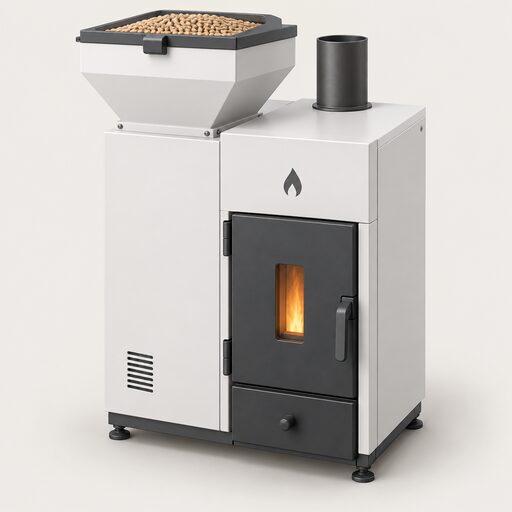 Biomass Boilers and StovesHow pellet and log biomass boilers and room stoves work in UK homes: the £5,000 Boiler Upgrade Scheme grant and its rural, off-gas-grid conditions, emissions limits, smoke control area law, fuel sourcing and the practical demands of storage and maintenance.