
In this guide
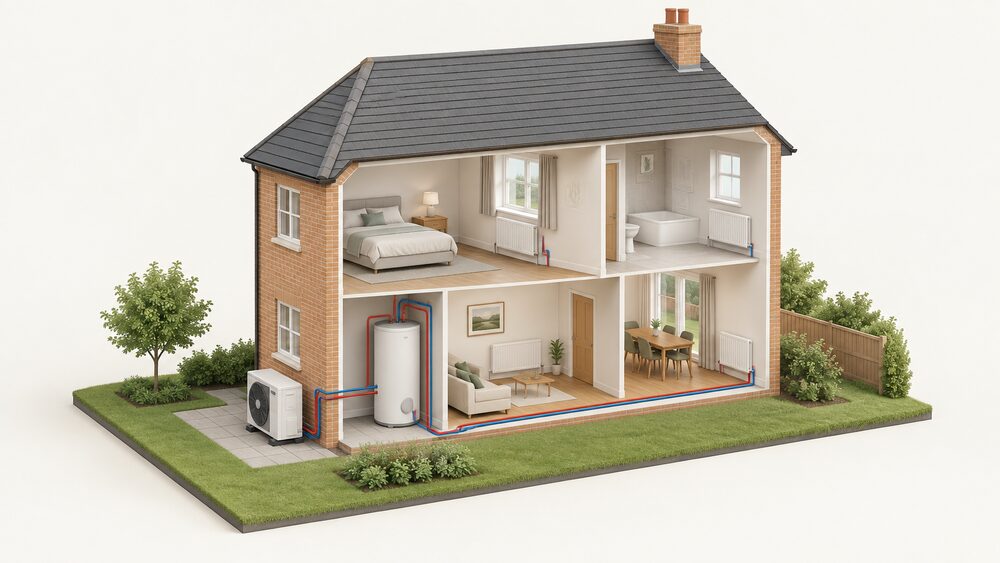
An air source heat pump heats a home by taking warmth from the outside air and using it for heating and hot water1. It does not burn anything. A fan draws outdoor air across a heat exchanger, a refrigerant absorbs heat from that air at low temperature, a compressor raises the temperature of the refrigerant, and the heat is passed either into the water of a wet central heating system or directly into indoor air. The certification body describes the machine as working like a fridge in reverse, absorbing heat from the outside atmosphere and transferring it at low temperature to the pump compressor2.
The practical headline figures are these. A UK air source heat pump typically achieves a coefficient of performance of around 3.0, or 300% efficient, meaning it produces roughly three times more heat energy than the electrical energy it consumes3. It can still extract heat from the air when the outdoor temperature is as low as minus 15 degrees Celsius5. The Boiler Upgrade Scheme pays £7,500 towards the cost and installation of an air source heat pump6. Units create between 40 and 60 decibels on average, a similar noise level to a dishwasher or microwave7, and in most cases installing one at a house in England is permitted development8.
For household energy independence, the direction of travel is clear but partial. A heat pump removes the gas connection and the gas supplier from the heating of the home. It replaces them with a larger electricity demand, which means a continuing relationship with an electricity supplier, the distribution network and, for the best running costs, a specific type of tariff. It is a shift of dependence from an imported fuel to the grid, not an escape from supply altogether.
What an air source heat pump is and how it works
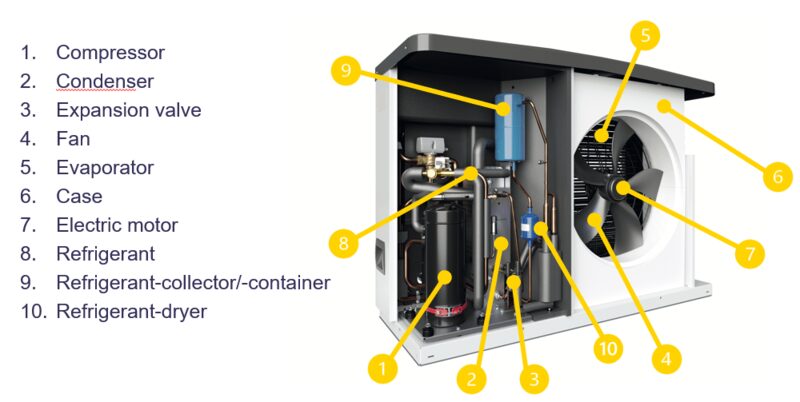
The operating principle is simple to state: the unit absorbs heat from outside air to provide heating11. Outside air contains usable energy even when it feels cold, because the refrigerant inside the machine boils at a far lower temperature than the air around it. The refrigerant evaporates, the compressor squeezes the vapour and raises its temperature, and a second heat exchanger releases that heat into the house before the refrigerant expands and the cycle repeats. Electricity drives the compressor and the fans; the heat itself is harvested, not generated.
This is why efficiency is expressed above 100%. A machine with a COP of 3.0 produces three times more heat energy than the electrical energy it consumes4. The energy balance is not free energy: the extra comes from the air.
The same principle underlies the other heat pump families. A ground source heat pump draws heat from buried pipework, and a water source heat pump is defined in legislation as a heat pump where the collecting medium is water. Air source units are by far the commonest domestic type in the UK, and government statistics describe them plainly as pumps that extract heat from the outside air to heat your home and water12. What distinguishes them is that the heat source is free, unlimited and needs no excavation, and that its temperature swings with the weather.
Air to air and air to water: two different machines
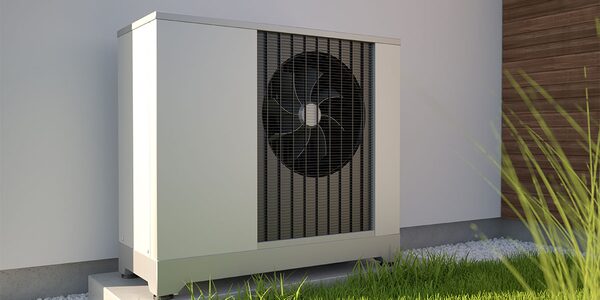
Air source heat pumps are classified as either air to air or air to water depending on whether the heat distribution system in the building uses air or water5. The distinction decides almost everything else about the installation.
| Air to water | Air to air | |
|---|---|---|
| Delivers heat to | Water in a wet central heating system13 | Warm air circulated by fans5 |
| Emitters | Radiators, underfloor heating, hot water cylinder14 | Fan coil units or indoor "blowers"15 |
| Domestic hot water | Can heat water as well as the home2 | Does not produce hot water; a separate system is needed4 |
| Cooling | May provide water cooling where supported16 | Can both heat and cool air15 |
| Boiler Upgrade Scheme | £7,5006 | £2,50017 |
Air to water is the mainstream UK retrofit: it reuses the existing pipework and emitters, feeds a cylinder for hot water, and is the configuration most grant and incentive rules are written around. Consumer guidance for the Renewable Heat Incentive put it flatly: "The system must be air to water heating, air to air is not eligible"18. Air to air systems cannot generally be used to heat larger homes and do not heat water for showers and taps, so a separate water heating system is required19. Their advantage is fast, zonal heat and cooling in the same box. The comparison is covered further on air-to-air vs air-to-water heat pumps.
Efficiency: around 300% in UK practice, and what COP means
The coefficient of performance is the ratio of heat delivered to electricity consumed at a given moment. In the UK this is generally around 3.0, or 300% efficient, but it can be higher or lower depending on the set-up3. Seasonal figures, SCOP and SPF, average that ratio across a heating season and are the number that matters for bills; the mechanics are set out in heat pump efficiency: COP, SCOP and SPF explained.
Three things drive the number. The first is the temperature lift: the gap between the outdoor air and the water temperature the system must deliver. A system running radiators at a low flow temperature works less hard than one pushing hot water to undersized emitters. The second is outdoor air temperature, which falls exactly when demand rises, so seasonal performance is always below the best-case bench figure. The third is the quality of installation and commissioning, including correct sizing, balancing and control settings.
Published independent figures disagree on how high a well-installed unit can reach. Test-based coefficients of performance of 4.3 and of 3.9 have both been reported for air source units, and those documents disagree. The prudent planning figure remains the around 3.0 seasonal value3. A household's own result sits somewhere in that range depending on the fabric of the house and the flow temperature the system can run at. Real-world UK monitoring is discussed in how heat pumps actually perform in UK homes.
Cost and the Boiler Upgrade Scheme grant

The Boiler Upgrade Scheme gives £7,500 off the cost and installation of an air source heat pump6. That figure was raised from £5,000 to £7,500 in October 202320. Government has committed £2.7bn in funding to 2030 to cover £7,500 towards the cost and installation of ground and air source heat pumps, including water source heat pumps21. Installation prices themselves are installer-quoted and vary with the house, the emitters and the cylinder, so no single published price applies; see how much does a heat pump cost in the UK? and how much does a heat pump cost with a Boiler Upgrade Scheme grant?.
Grant values and voucher validity periods differ by technology:
| Technology | Voucher validity | Grant |
|---|---|---|
| Air to water heat pump | 3 months | £7,50017 |
| Air to water heat pump, off gas grid property replacing oil or LPG | 3 months | £9,00017 |
| Air to air heat pump | 3 months | £2,50017 |
| Ground source heat pump | 6 months | £7,50017 |
Property owner guidance confirms the same split: redemption within three months for air to water heat pumps, air to air heat pumps and biomass boilers, and within six months for ground source heat pumps22. Separately, air source heat pumps qualify for a lower rate of VAT as an energy saving material23.
Grant routes differ across the UK nations, with separate Scottish and Welsh support arrangements; heat pump grants and funding across the UK sets out the position in each.
Running costs: when it beats a gas boiler and when it does not
Government guidance states that running costs for heat pumps are typically lower when compared to those of traditional gas boilers, while noting that this depends on the system24. The size of any advantage depends almost entirely on the price paid per unit of electricity against the price paid per unit of gas, and on the seasonal efficiency actually achieved.
The headline saving comes with conditions attached. Dr Jan Rosenow of the Regulatory Assistance Project is quoted by consumer testing body Which? as follows:
"A household could save more than 50% on running costs with a heat pump compared to a gas boiler."
That claim requires a high quality installation, high efficiency and a heat pump tariff7. Energy Saving Trust research likewise finds that switching to a heat pump time-of-use tariff reduces running costs significantly, and that a heat pump can cost less to run than a gas boiler on such a tariff1. The converse follows: on a flat standard electricity tariff, with a mediocre seasonal efficiency and high flow temperatures, the saving can disappear. For air to air systems at current energy pricing, costs are likely to be lower than using an oil boiler and similar to a gas boiler or an air to water heat pump on a standard electricity tariff25.
For independence, the tariff dependency is the point to note. The best heat pump running costs in the UK are currently tied to particular time-of-use electricity products, which means the household is choosing a supplier relationship as much as a machine. Pairing with generation and storage shifts some of that back; see heat pump running costs and should I get solar panels and a battery with my heat pump?.
Sizing and suitability: emitters, insulation and the house itself
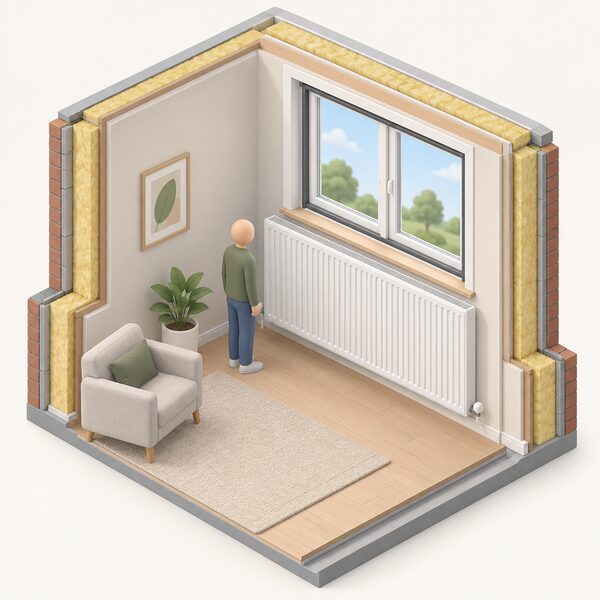
A heat pump delivers heat at a lower temperature than a gas boiler, so it needs more emitter surface to deliver the same heat into a room. Air to water units are best suited to underfloor heating systems, or large radiators with a greater surface area, and work best in well insulated homes with effective insulation and draught-proofing26. Heat is distributed through radiators, underfloor heating or a hot water tank depending on the set-up14.
That drives the survey work. Emitter sizing follows from a room-by-room heat loss calculation, which also fixes the output of the unit; both are covered in heat pump sizing and heat loss calculations and radiators, underfloor heating and emitters for a heat pump. Oversizing wastes money and causes short cycling; undersizing leaves the house cold on the coldest days, which is when the air source is weakest.
Insulation and draught-proofing matter twice over: they cut the heat the system must supply, which allows a smaller unit and smaller emitters, and they let the system run at a lower flow temperature, which raises the seasonal efficiency directly. Not every house needs a full retrofit first, and the trade-offs are set out in can you fit a heat pump without insulating the house first? and which homes suit a heat pump.
Air to air imposes a different constraint. Because it heats by circulating warm air through indoor units, heat does not travel well between closed rooms, which is part of why these systems cannot generally be used to heat larger homes19.
Noise, siting and the outdoor unit
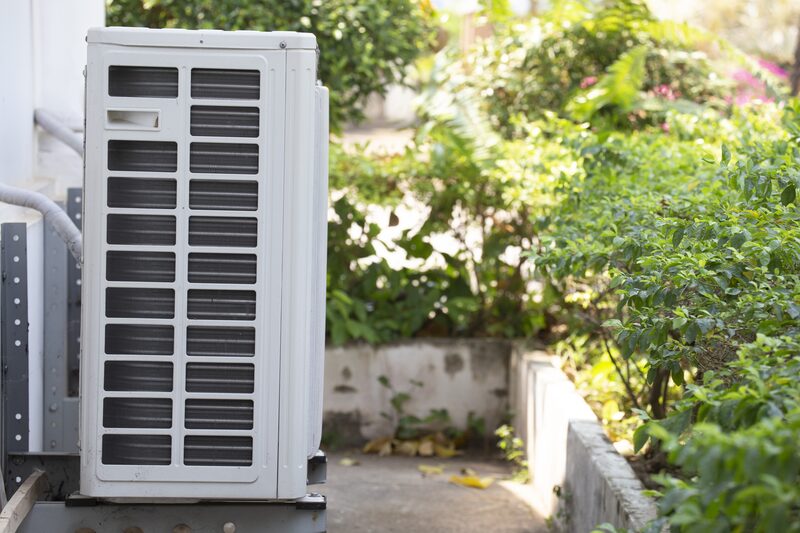
The external fan units can generate a considerable level of noise27, and the fan and the compressor are the main sound sources in air source heat pumps10. In absolute terms, units create between 40 and 60 decibels on average, comparable to a dishwasher or microwave7, and government material states that heat pumps are located outside and are typically quieter than gas boilers28.
Planning control turns on a calculated figure rather than a measured one. Guidance states that noise levels for an air source heat pump on its own must stay at or below 42 decibels from a metre distance away from any habitable room9, and that the UK legal noise limit for heat pumps is 42 decibels29. Documents disagree on the precise assessment point: one formulation is one metre from a habitable room, another is one metre from the centre of a neighbour's habitable room window. Where a unit exceeds the Microgeneration Certification Scheme standards and permission is needed, a condition may require that noise emitted does not exceed 37 dB LAeq at any time, measured at the boundary with any neighbouring residential property30. The assessment method itself is explained in MCS 020: the heat pump noise assessment.
Siting rules follow. Under permitted development, all parts of the air source heat pump must be at least one metre from the property boundary9, the outdoor unit should be no bigger than 0.6 cubic metres27, and the unit should, so far as practical, be sited to minimise its effect on the external appearance of the building and the amenity of the area31. Where an application is needed, authorities expect details of location, design and appearance, noise and vibration, and the efficiency of the unit11. Noise from the outdoor unit of an air to air heat pump is likely to be the same as from an air to water heat pump25. Practical clearances are covered in where a heat pump outdoor unit can go and the wider question in how noisy is a heat pump?.
Permitted development: where planning permission is still needed
In most cases, installing an air source heat pump at a house in England is permitted development8, subject to conditions including that the unit is located within the property and meets permitted development size and location limits8, and that it complies with the Microgeneration Certification Scheme Planning Standards (MCS 020) or an equivalent standard32. Permitted development rights allow installation on detached houses or blocks of flats without an application, subject to those limits27.
Permission is needed where:
- The installation does not meet permitted development rules, or the property is listed, or it sits in a conservation area with restrictions, or the unit would be in a prominent position such as the front of the property, or there would be an unacceptable impact on neighbours through noise or visual intrusion8.
- The unit would be on a pitched roof, or less than one metre from the edge of a flat roof33.
- It is not the first installation: only the first air source heat pump is permitted development, and additional units at the same property require planning permission9. One existing heat pump on a non-detached dwelling or block of flats, or two on a detached house, triggers an application33.
- The building is non-domestic. Permitted development rights for small scale renewables do not extend to non-domestic buildings such as offices, schools, industrial premises and agricultural buildings27.
Rules for flats and shared buildings are more restricted, and planning permission is more likely to be required8. The nations differ. In Scotland, Class 6H permits the installation, alteration or replacement of an air source heat pump on a dwelling or within its curtilage, on the condition that the pump is used only for providing domestic heating or hot water36; a consultation proposed removing the restriction requiring the pump to be 100 metres or more from the curtilage of another dwelling. In Northern Ireland, Part 2 Class G removes permitted development where any part of the pump would be installed within one metre of the boundary of the curtilage of another dwelling house37. Planning Portal guidance for England states the unit must not be used solely for cooling purposes38, and Welsh guidance requires that the pump be for heating purposes or heating and cooling. Detail by nation is set out in the planning pages for England, Scotland, Wales and Northern Ireland. Ground source and water source heat pumps on domestic premises are usually permitted development and do not normally need an application, although listed building consent may still be required24.
Installation, certification and servicing
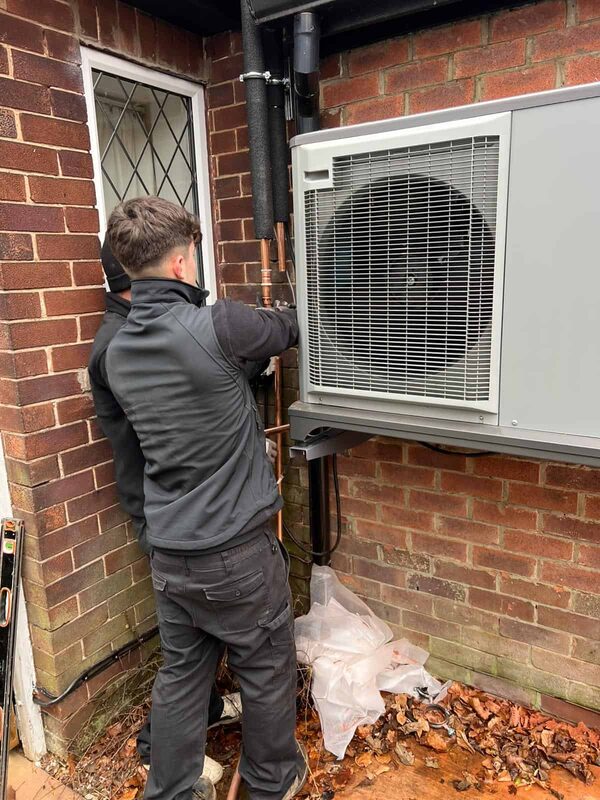
Energy Saving Trust advises getting quotes from certified installers accredited through the Microgeneration Certification Scheme1. Building regulations guidance for dwellings requires simply that the person carrying out the work is suitably competent39. The workforce is not large: around 930 air source heat pump installation companies are accredited by MCS, and of these around 600 also install ground source heat pumps40.
The physical work is short by retrofit standards. One documented case describes a heat pump installed in three days by a team of accredited installers, involving plumbers and electricians41. What takes longer is the survey, the heat loss calculation, any emitter and cylinder changes, and the grant paperwork. The sequence is set out in heat pump installation: the process from survey to handover.
Where things go wrong, the complaint route runs through the installer and then the scheme. Official guidance states that if the complaint is not resolved, the MCS Administrator can be approached and will advise how to make a complaint about the MCS installer42. MCS also operates a Find an Installer tool, which is being extended to cover certified air to air installers once that part of the scheme is ready15.
For maintenance, the certification body suggests it is a good idea to schedule a yearly check-up with a professional2. Annual servicing is also commonly a manufacturer warranty condition, so the record has value beyond the mechanical check; see heat pump servicing and maintenance.
Lifespan, ownership and what independence a heat pump actually buys
Reported lifespans differ. MCS states that on average an air source heat pump lasts up to 20 years2, while a report for the Welsh Government works on the basis that the lifespan of units is approximately 25 years10. Those documents disagree, and the shorter figure is the safer planning assumption for a household budgeting a replacement. Component life within that period is not uniform: fans, circulation pumps and controls are consumables in a way that the sealed refrigerant circuit is not. What is the lifespan of an air source heat pump? goes into the detail.
Ownership is outright: the householder owns the machine, and the grant is paid to reduce its price rather than to buy a stake in it. That is a stronger position than a lease or a service contract. What remains is a set of dependencies a buyer should see clearly:
- The grid. Heating moves onto electricity, and the house draws more of it, particularly on the coldest days. Some homes need a supply or fuse upgrade, covered in electricity supply, fuses and wiring for a heat pump.
- A supplier and a tariff. The evidence that a heat pump beats a gas boiler on running costs leans heavily on a heat pump time-of-use tariff1.
- The manufacturer. Spares, firmware and warranty support for a 20 year machine depend on the maker still being in business and still supporting the model.
- Controls and, in many cases, an app. Smart control is what makes time-of-use tariffs pay; see heat pump controls, weather compensation and smart operation.
- An installer base. With around 930 accredited air source installation companies40, service capacity is a real constraint in some areas.
Against that, the gains are substantial. The house stops burning imported gas or oil for heat. Every unit of electricity it uses to run the pump buys roughly three units of heat3, so a given amount of self-generated or stored electricity goes three times further through a heat pump than through a direct electric heater. Heat is harvested from air that costs nothing and can be drawn on down to minus 15 degrees Celsius5. That is the case for the technology, set out at more length in heat pumps and household energy independence and across the wider heat pumps guide.
Sources42 cited
- Air source heat pumps, Energy Saving Trust, 2026-07-16
- Air source heat pumps for consumers, MCS, 2026-07-24
- Air source heat pump costs and savings, Which?, 2026-04-14
- An introduction to heat pumps, Which?, 2025-09-22
- Air source heat pumps, Electricity North West, 2026-09-19
- Boiler Upgrade Scheme, Find a Government Grant, 2026-09-18
- Heat pumps vs boilers, Which?, 2025-09-22
- Air source heat pumps: planning advice, Westmorland and Furness Council, 2026-09-17
- Building regulations and renewables guidance, Bedford Borough Council, 2026-09-17
- ASHP noise and permitted development rights in Wales, phase 1 report, Welsh Government, 2023-12-13
- Air source heat pumps and planning, London Borough of Hammersmith and Fulham, 2026-09-17
- DESNZ Public Attitudes Tracker: heat and energy use in the home, summer 2025, DESNZ, 2025-10-28
- ECO4 new measures and products guidance, Ofgem, 2026-03-26
- How heat pumps work: a guide for homeowners, NICEIC, 2025-09-17
- Air to air heat pumps, MCS, 2026-07-24
- Domestic RHI eligible heating systems, Ofgem, 2026-09-17
- Boiler Upgrade Scheme guidance for installers, Ofgem, 2026-07-21
- RHI guidance for consumers, RECC, 2026-09-17
- Heating your home with renewable energy, Which?, 2025-09-22
- Heat pump grants increased by 50 per cent, GOV.UK, 2023-10-23
- Carbon Budget and Growth Delivery Plan: heat and buildings factsheet, GOV.UK, 2026-06-23
- Boiler Upgrade Scheme guidance for property owners, Ofgem, 2026-03-25
- Tax on shopping: energy saving products, GOV.UK, 2026-09-17
- What impact can heat pumps have in domestic heating today, GOV.UK, 2023-11-21
- Air to air heat pumps: common questions on air conditioning, Nesta, 2026-06-24
- Air source heat pumps guide, Uswitch, 2026-01-06
- Fact sheet 5: air source heat pumps, Pendle Borough Council, 2026-09-17
- Heat pumps explained: experts answer your questions, GOV.UK, 2024-03-28
- Air and ground source heat pumps: retrofit guidance, Croydon Council, 2026-09-17
- Air source heat pumps: householder planning advice, Central Bedfordshire Council, 2026-09-17
- Air source heat pump guide, Eastleigh Borough Council, 2025-05
- Planning guidance: heat pumps, London Borough of Richmond upon Thames, 2026-04-22
- Heat pumps, New Forest District Council, 2026-09-17
- Air source heat pumps, Cornwall Council, 2026-09-17
- Improving energy saving and sustainability in conservation areas and listed buildings, Brighton and Hove City Council, 2026-09-17
- Circular 1/2024: householder permitted development rights, Scottish Government, 2024-05-28
- Planning (General Permitted Development) Order (Northern Ireland) 2015, Part 2, legislation.gov.uk, 2026-09-17
- Planning permission: air source heat pumps, Planning Portal, 2026-09-17
- Approved Document L, Volume 1: Dwellings, Ministry of Housing, Communities and Local Government, 2026
- Environmental Audit Committee report on heat pumps, UK Parliament, 2026-09-20
- Stephen, Dina and Layla's air source heat pump, Energy Saving Trust, 2024-03-11
- Dispute resolution, Ofgem, 2026-09-17
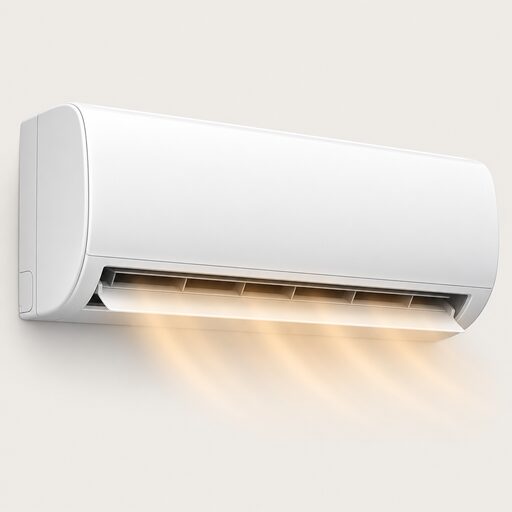 Air-to-Air Heating and CoolingAir-to-air heat pumps deliver warm air through indoor fan units rather than hot water to radiators.
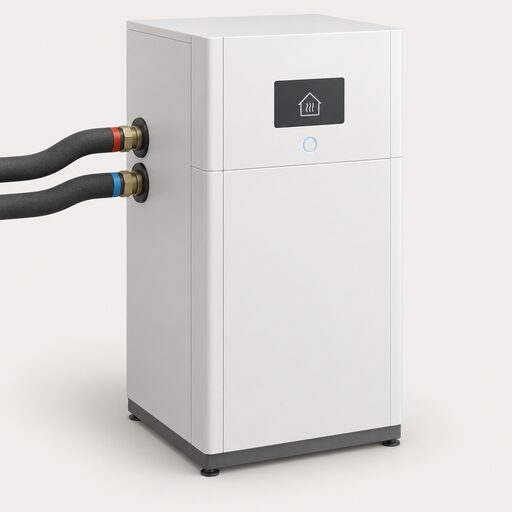 Ground Source Heat PumpsA ground source heat pump takes warmth from the ground to heat your home and water.
 Ground Source Heat Pump CostWhat a ground source heat pump costs in the UK, splitting groundworks and drilling from the heat pump and internal works, and how the £7,500 Boiler Upgrade Scheme grant and the £9,000 off-gas-grid uplift change the figure.
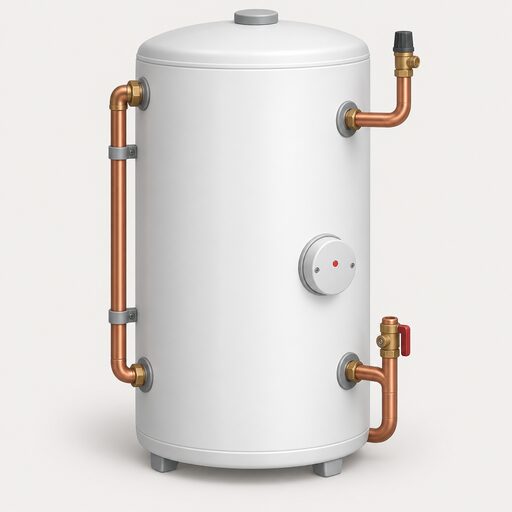 Air-to-Water Wet SystemsAir-to-water heat pumps feed radiators, underfloor heating and a hot water cylinder, and are the most common domestic heat pump in the UK.
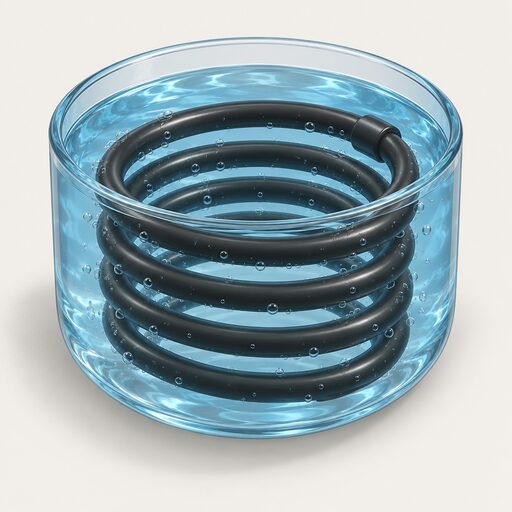 Water Source Heat PumpsYour home sits near a river, lake or the sea.
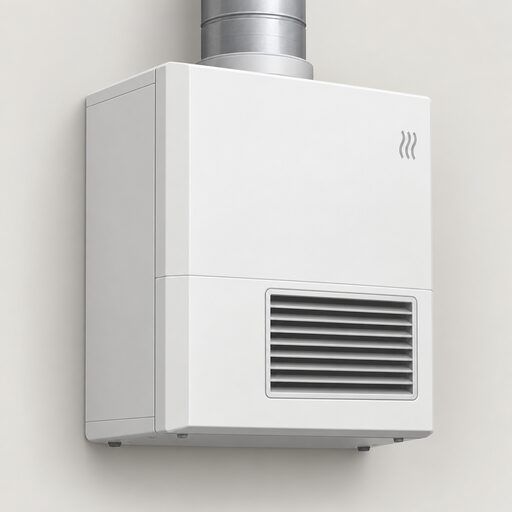 Exhaust Air Heat PumpsHow exhaust air heat pumps recover heat from air extracted by a home's ventilation system to provide heating, hot water and ventilation from one indoor appliance, and the capacity limits that follow from the ventilation rate.