
In this guide
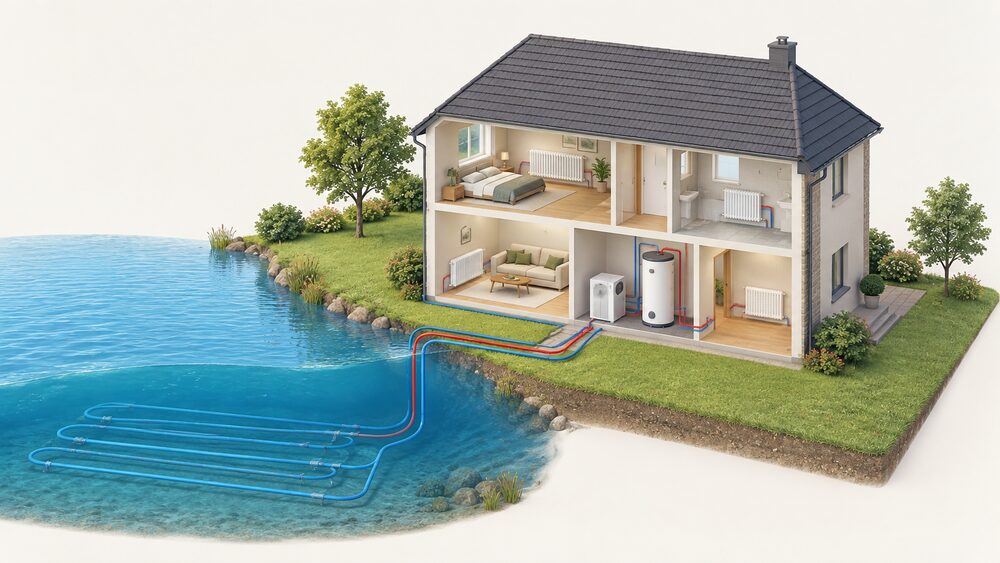
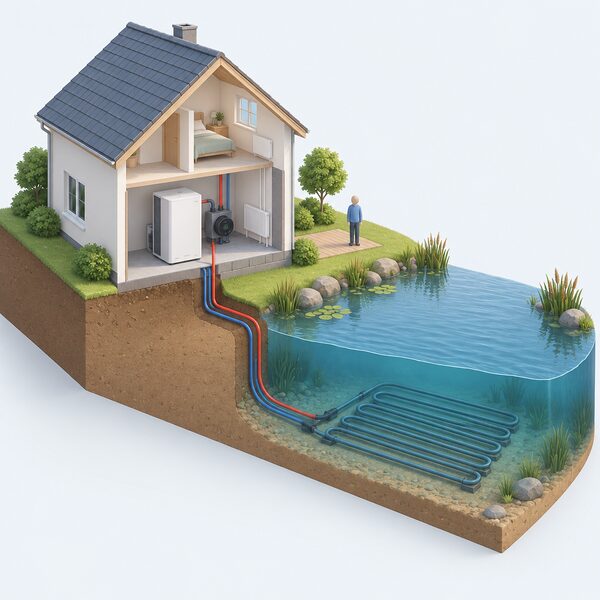
A water source heat pump is, in the words of the permitted development legislation, "a heat pump where the collecting medium is water"1. It extracts heat from a water source and suits buildings near a body of water2. That source can be ground water, surface water, or sea or sewage water3. The heat is raised to a useful temperature using a liquid refrigerant, compressor and evaporator arrangement, then transferred to a hot water tank which feeds the heating distribution system in the house4.
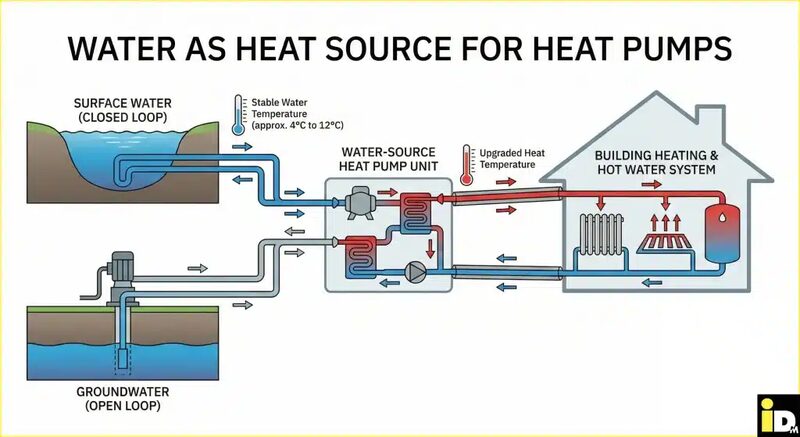
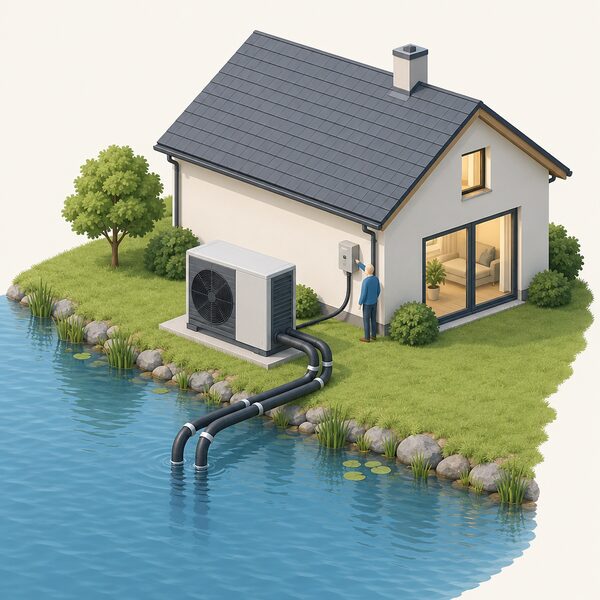
There are two families of system. Closed loop systems rely on a submerged pipe network; open loop systems draw water through the heat pump itself6. Open loop systems move large volumes of water through the heat exchanger, more than might be possible with a closed loop system, and as a result are often more efficient than equivalent ground or air source heat pumps, though with higher operation and maintenance costs7. Because groundwater stays at a steady temperature even in winter, water source systems perform similarly to ground source heat pumps6.
For most households the binding question is not the technology but the site. A property within around 100 metres of water is likely to be suitable9; almost every other property is not. Installation on domestic premises is usually permitted development in England10, but an open loop scheme requires Environment Agency approval11, and the Boiler Upgrade Scheme in England and Wales treats water source heat pumps as ground source heat pumps, worth a grant of 7,500 pounds12.
What the machine actually does
The physics is the same as any other heat pump. A refrigerant circuit uses an evaporator, a compressor and a condenser to lift low-grade heat to a temperature usable for heating, and passes it to a hot water tank feeding the distribution system4. In a water source machine the collecting medium is water rather than air or a buried ground loop1. A water source system in the wider sense is made up of reverse cycle heat pump units interconnected by a water loop14.
Because it takes heat from a body of water rather than from outside air, the source temperature does not swing with the weather in the way an air source heat pump source does. Official modelling for ground and water source heat pumps assumes the source temperature is constant and equal to the annual average air temperature15. That assumption is why these machines hold their efficiency through the coldest part of the heating season, when demand is highest and an air source unit is working hardest against a cold source.
What that buys the household is heating and hot water for the home from an electrically driven machine7, with the same distribution kit any wet system needs: emitters sized for a lower flow temperature and a cylinder for domestic hot water. The dependence that remains is electrical. A water source heat pump moves heat, it does not create it, and every unit of that movement is bought from the grid or from on-site generation. It also depends on continued access to the water body, which is rarely wholly within the householder's gift.
Open loop or closed loop: which system fits which site
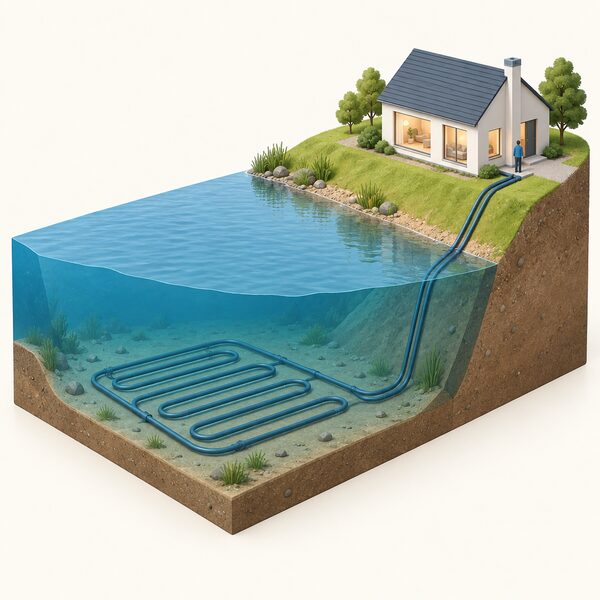
The two designs answer different sites, and the choice is usually made by what water is available rather than by preference.
| Closed loop | Open loop | |
|---|---|---|
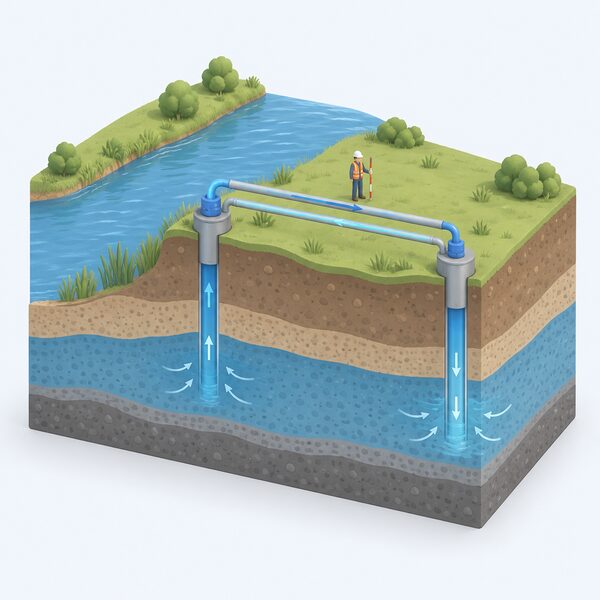
| How it works | Sealed pipes filled with anti-freeze fluid submerged under the water7 | Water pumped from the source directly through the heat pump, heat extracted via the refrigeration cycle16 |
| Typical water body | Lakes, lochs or large ponds7; a lake, loch, river or large pond near the home7 | Boreholes near rivers or areas with suitable geological conditions7 |
| Water returned | None taken or returned; fully sealed17 | Cooled water returned to a separate borehole7 |
| Flow through exchanger | Limited by the loop | Large volumes, more than might be possible with a closed loop7 |
| Efficiency | Comparable with ground source8 | Often more efficient than equivalent ground or air source systems7 |
| Running and maintenance | Lower | Higher operation and maintenance costs7 |
| Consents | Can qualify for an exemption if fully sealed and compliant17 | Environment Agency approval required11 |
A closed loop is the simpler proposition. Nothing is abstracted, nothing is discharged, and the exemption regime for closed loop ground source heating and cooling systems is written for a system that is fully sealed, does not take water from the environment and does not discharge water or fluids to the environment17. Draft exemption conditions state that the system "must be closed loop only and have no discharge of pollutants other than transfer of heat to the environment" and "must not cause pollution of surface water or groundwater"18. Those draft conditions are marked as draft, with an effective date not yet set, so they are not yet the operative rules.
Closed loops are also forgiving on topography. For closed-loop systems it does not matter if the property is at a higher elevation than the water, because the closed circuit means there are no additional pumping requirements9. An open loop system, by contrast, has to lift real water to the surface and dispose of it afterwards, which is both a pumping cost and a regulatory matter.
Efficiency: steady source, strong seasonal performance
Efficiency is expressed as a seasonal coefficient of performance: units of heat delivered per unit of electricity. The most energy efficient heat pump models on the market can achieve a maximum SCOP of 5 or more, which is 500 per cent more heat than the electricity consumed in ideal conditions16. More typically, an efficient heat pump is somewhere between 300 and 400 per cent efficient, with some achieving over 400 per cent19. Welsh government material puts heat pumps at up to 3 times more efficient than other heating systems20.
Water source machines sit at the upper end of that spread for a structural reason rather than a marketing one: the source is stable. Even during winter, groundwater remains at a steady temperature, making water source heat pumps an efficient renewable heat source throughout the year6, and they perform similarly to ground source heat pumps because of that consistency of temperature8. Open loop configurations are often more efficient than equivalent ground or air source heat pumps7, because the large water flow through the heat exchanger keeps the source side warm.
Real installations land below laboratory bests. A domestic water sourced installation in Cirencester recorded a heating SCOP of 4.2 at a 35 degree flow temperature21. That is a useful number to hold, because it shows the dependence of efficiency on flow temperature: 35 degrees is underfloor territory, and the same machine feeding undersized radiators at a higher flow temperature will return less. The relationship is explained further under heat pump efficiency and radiators and emitters.
The floor is set by the grant scheme rather than by physics. Boiler Upgrade Scheme eligibility requires a minimum SCOP of 2.8 for air-to-water and ground source heat pumps13, and scheme guidance states plainly that "Heat pumps must have a seasonal coefficient of performance (SCOP) of at least 2.8"22.
Where a water source heat pump fits: the site decides

The site requirement is the single hardest filter. Any property near water, within around 100 metres, is likely to be suitable for a water-source heat pump9. Beyond that, pipe runs and pumping losses erode the advantage the stable source gave in the first place.
The main requirement for a closed loop system is an appropriate body of water near the home: a lake, loch, river or large pond7. Not every stretch of water qualifies. Coils need to be in a water source meeting the minimum conditions necessary for quality, depth and volume14. A shallow pond that draws down in summer, or one that freezes through, does not meet those conditions, and neither does a watercourse too small to absorb the heat extracted from it without measurable cooling.
Open loop schemes shift the question underground: they are used with boreholes near rivers or in areas with suitable geological conditions7. That means an aquifer capable of yielding the required flow and accepting the cooled return water. Typical ground source boreholes run somewhere between 75 and 200 metres deep23, which indicates the scale of drilling involved on a comparable site; ground loops and boreholes covers that work in detail.
The installer will assess the suitability of the site before any installation takes place7. Alongside the water, the assessment covers the house: the decision between system types turns on space, budget and efficiency24, and a heat loss calculation determines the size of machine needed, as set out under heat pump sizing. Ownership and access to the water are a further practical filter; riparian rights, third party land and shared water bodies all have to be settled before design begins.
Permissions and consents: planning, permits and abstraction
Planning and environmental permission are two separate matters, and a water source scheme can clear one and fail the other.
On planning, the Planning Portal is explicit: the installation of a ground source heat pump or a water source heat pump on domestic premises is usually considered to be permitted development, not needing an application for planning permission10. In Wales, permitted development rights permit the installation, alteration or replacement of a ground source heat pump or water source heat pump within the curtilage of a dwellinghouse27. In England the relevant rights sit in Part 14 (Renewable Energy) of the Town and Country Planning (General Permitted Development) (England) Order 201528. Installation within the curtilage, meaning the garden or grounds, of a house or block of flats does not require planning permission, but listed building consent may be required if the property is listed29.
Those rights are not unconditional. Permitted development rights may be removed through a planning condition, an Article 4 Direction or another restriction30. Renewable measures on a listed building may be acceptable but will require listed or planning consent31. Country by country differences are set out on the planning pages for England, Scotland, Wales and Northern Ireland.
Environmental consent is the separate hurdle, and the one that decides open loop schemes. Open loop systems require Environment Agency approval11. More broadly, official guidance states that if you are installing a new ground source heat pump after 1 October 2023 you may need to get a permit from the Environment Agency10. A closed loop system may instead fall under the exemption for closed loop ground source heating and cooling systems, which applies to a system that is fully sealed, does not take water from the environment, does not discharge water or fluids to the environment, and meets all the exemption conditions17.
Water quality, wells and boreholes: what the survey must show
A survey for a water source scheme is doing three jobs: proving the resource, proving the return path, and proving the water will not harm the plant or the environment.
For a closed loop, the test is that the coils sit in a water source meeting the minimum conditions necessary for quality, depth and volume14. Volume matters because the loop rejects cold into the water body; depth matters because the loop must stay submerged in all conditions; quality matters because fouling and abrasion shorten the life of submerged pipework.
For an open loop, the survey has to establish that a borehole near the river, or the local geology, will yield sufficient water and that the cooled water can be returned to a separate borehole7. The regulatory test that frames all of this is that the system must not cause pollution of surface water or groundwater18.
Scheme rules add a performance test that the survey must underwrite. Under Boiler Upgrade Scheme guidance, the heat pump "must provide both space and hot water heating and be capable of meeting the full space heating and hot water heating demands of the property"22. For a water source design that means the water resource must support the design load on the coldest day, not merely on an average one.
Heating, hot water and cooling in the home
Inside the house, a water source heat pump behaves like any other wet heat pump. HMRC guidance describes these systems as transferring energy from natural heat stored in a body of water to heat the home and domestic hot water32. Energy Saving Trust puts it the same way: a water source heat pump uses the heat energy from water to provide heating and hot water for the home, with reliable performance throughout the year7.
Hot water is produced by heating water stored in a cylinder, ready for taps and showers33. That cylinder is not optional for a system expected to meet the whole demand, and the coil sizing and recovery behaviour are covered under hot water cylinders for heat pumps. The heat produced by a ground source heat pump is at a lower temperature than other forms of heating, and such systems work best with underfloor heating, which requires lower flow temperatures than radiators34; the same emitter logic applies to a water source machine, as the 4.2 SCOP at 35 degrees recorded at Cirencester shows21.
Cooling is possible in principle. A heat pump is a device that can provide heating, cooling and hot water for buildings3, and fixed air source heat pumps "can be reversed so that they can draw heat from inside a building, thus providing cooling during the summer as well as indoor heating for colder periods of the year"35. Scheme rules for eligible heating systems recognise that heat pumps do not have to provide domestic water heating to be eligible but may do so, and that they may also provide water cooling36. Whether cooling is available on a given installation depends on the model and on the emitters; using a heat pump for cooling sets out the practical constraints, including condensation on underfloor circuits.
Cost: what published figures exist and what drives the total
No published national price exists for domestic water source installations specifically. What the record gives is the cost of the nearest comparable technologies, and the reasons a water source job differs from them.
| System | Published cost figure | Source and date |
|---|---|---|
| Ground source heat pump | More than 10,000 pounds | Local authority guidance, 202611 |
| Ground source heat pump, 6 to 15 kW | 10,000 to 25,000 pounds | Centre for Alternative Technology, June 202537 |
| Air source heat pump, 6 to 10 kW | 6,000 to 10,000 pounds | Centre for Alternative Technology, June 202537 |
| Air source heat pump | 10,000 pounds or more | Local authority guidance, 202611 |
| Air source heat pump, including VAT, labour and the Boiler Upgrade Scheme grant | around 6,500 to 11,500 pounds | GOV.UK, 28 March 202438 |
A ground source installation is around twice the cost of an air source heat pump installation23, because the collector is a civil engineering job rather than a bolted-down box. A water source scheme carries the same shape of cost: the heat pump is one line, and the collector, whether submerged coils or a pair of boreholes, is another. Open loop schemes add abstraction and discharge infrastructure, pumping plant, and the higher operation and maintenance costs that go with moving raw water through the system7.
Because there is no published UK price for domestic water source installations, prices are installer-quoted and no range should be inferred from the table above for a water source job. The comparable costs of the adjacent technologies are set out under heat pump cost and ground source heat pump cost.
Grants, VAT relief and what the electricity costs
Water source heat pumps are named in both the grant regime and the VAT regime.
The Boiler Upgrade Scheme lists "Ground source heat pumps (including water source heat pumps and shared ground loops)" as eligible technology39, and scheme statistics record a grant of 7,500 pounds towards a ground source heat pump including water source heat pumps and those on shared ground loops12. Installer guidance from 21 July 2026 confirms the ground source heat pump grant value at 7,500 pounds40. Eligibility requires the 2.8 SCOP minimum and full space heating and hot water provision13. Heat pump grants covers the equivalent schemes elsewhere in the UK.
On VAT, water-source heat pumps are listed in the energy-saving materials relief published on 11 January 202441, and HMRC guidance confirms that the relief extends to water source heat pumps, electrical battery storage and smart diverters42. The relief applies where the equipment is installed in, or in the curtilage of, residential accommodation or buildings intended for use solely for a relevant charitable purpose42. Air-source and ground-source heat pumps likewise qualify for a lower rate of VAT43, and grant-funded work covered includes the installation of heating appliances and the installation, repair and maintenance of renewable source heating systems43. HMRC guidance notes that water source heat pumps revert to the reduced rate after the temporary zero rate32. Energy Saving Trust, responding to the Treasury consultation on 8 October 2025, said of the technology:
"we see no reason why this technology should be excluded from the 0% VAT relief"
Running costs depend on the house and the tariff. One worked ground source example at a coefficient of performance of 4.0 gives an annual electricity cost for heating and hot water of 587.82 pounds, rounded to 588 pounds, from April 202634. As an indication of the demand these systems are expected to meet, the former domestic Renewable Heat Incentive applied a heat demand limit of 30,000 kilowatt hours a year to ground and water source heat pumps44. Ground source systems give lower running costs than an equivalent air source system but cost more to install24; the same trade sits behind a water source design. More on tariffs and consumption is at heat pump running costs.
How water source compares with air source and ground source
| Water source | Ground source | Air source | |
|---|---|---|---|
| Heat source | Ground water, surface water, sea or sewage water3 | Heat from the ground outside33 | Warmth from the outside air45 |
| Source stability | Groundwater steady even in winter6 | Constant, equal to annual average air temperature15 | Varies with weather |
| Relative efficiency | Similar to ground source8; open loop often better than either7 | Lower running costs than equivalent air source24 | Usually the least expensive to install24 |
| Install cost | Installer-quoted, no published UK domestic figure | Around twice an air source installation23 | 6,000 to 10,000 pounds at 6 to 10 kW37 |
| BUS grant | 7,500 pounds as ground source12 | 7,500 pounds40 | Separate air source rate |
| Life | Around 20 years with maintenance6 | Around 20 years with maintenance6 | Up to 20 years on average |
| Site constraint | Water within around 100 m9 | Land or borehole space | Outdoor space with good air flow45 |
The practical reading is that water source occupies a narrow but strong position. It matches or beats ground source on efficiency because the source is both stable and, in an open loop, abundant7. It is beaten by air source on simplicity: an air source unit is a bit larger than a domestic washing machine46 and needs only somewhere outside the home where a unit can fit to a wall or on the ground, with space around it for good air flow45. A water source scheme needs a water body, a survey, and in the open loop case a regulator's approval.
Deployment is expected to remain modest. Official innovation analysis projects a 2-fold deployment increase for water source heat pumps at the medium innovation level and a 3-fold increase at the high innovation level by 2050 compared with the all low Minimally Constrained case, and a 5 to 8-fold increase in High Hydrogen scenarios, with cumulative cost savings reaching 17.8 billion pounds in 2050 at the high innovation level in the High Diversification scenario, against 8.7 billion pounds in Minimally Constrained and 7.4 billion pounds in the High Hydrogen scenario47.

What it does, and does not do, for energy independence
A water source heat pump replaces a fuel with a flow. It removes the gas, oil or LPG delivery from the house and substitutes electricity, at a seasonal efficiency that in a well matched system was recorded at 4.2 in one UK domestic case21, and must be at least 2.8 to attract the grant13. Because the water source holds its temperature through winter6, the efficiency the household is quoted is closer to the efficiency it gets in January, which is not always true of air source.
What remains is real. The machine runs on grid electricity, and the running cost is whatever a kilowatt hour costs on the day. The water body is a third party asset in most cases, and an open loop scheme depends on a permit from the Environment Agency that is granted, not owned11. The hardware is a manufacturer's product with a service life of around 20 years given regular, scheduled maintenance and proper care6, after which the heat pump is replaced even if the collector is not. Pairing with on-site generation, discussed under heat pumps and energy independence, shifts some of the electrical dependence but does not remove it.
For the small number of homes with suitable water within around 100 metres9, the technology delivers the most stable source a heat pump can have. For everyone else, the constraint is not the machine, and the choice lies between ground source and air source systems, or the wider options set out across the heat pumps guide.
Sources47 cited
- Permitted development: Part 14 Renewable Energy, legislation.gov.uk
- Heat pumps, nidirect, 24 February 2025
- About heat pumps, EHPA, 24 April 2026
- Heat pumps: home energy generation, Planning Portal
- Response to the Treasury consultation on VAT relief for energy-saving materials, Energy Saving Trust, 8 October 2025
- Ground and water source heat pumps, MCS, 9 June 2026
- Water source heat pumps, Energy Saving Trust, 24 April 2024
- Research on electricity network constraints and the New Build Heat Standard, Scottish Government, 7 October 2021
- My property and heat pumps, Renewables First, 23 March 2026
- Heat pumps: common projects, Planning Portal
- Air and ground source heat pumps, Croydon Council
- Boiler Upgrade Scheme statistics, July 2026, DESNZ, 27 August 2026
- Boiler Upgrade Scheme: information for installers, Ofgem
- Water source heat pumps, HIES Scheme, 30 November 2021
- Home Energy Model: heat pump methodology, DESNZ, January 2026
- How heat pumps work: a guide for homeowners, NICEIC, 17 September 2025
- Closed loop ground source heating and cooling systems: exemption conditions, GOV.UK, 2 October 2023
- Draft exemption conditions for closed loop ground source heat pump activities, Defra
- Living with a heat pump, Home Energy Scotland, February 2024
- Your essential guide to heat pumps, Welsh Government, 20 February 2025
- Case study: domestic water sourced heat pump, Renewables First, 16 February 2026
- Boiler Upgrade Scheme property owner guidance, Ofgem, 25 September 2023
- How ground source heat pumps work, Which?, 20 April 2026
- Air source heat pumps vs ground source heat pumps, Energy Saving Trust, 16 July 2026
- Building regulations and renewables guidance, Bedford Borough Council
- Approved Document L Volume 1 consultation version, Welsh Government, August 2025
- Planning permission: heat pumps, Welsh Government
- Planning guidance: heat pumps, Richmond Council, 22 April 2026
- Heat pumps, New Forest District Council
- Air source heat pumps: planning advice, Cornwall Council
- Making alterations to a listed building, Bristol City Council
- VAT: energy-saving materials, water source heat pumps, HMRC
- Ground source heat pumps, Energy Saving Trust, 16 July 2026
- Ground source heat pump costs and savings, Which?, 8 May 2026
- VAT: energy-saving materials, air source heat pumps, HMRC
- Domestic RHI eligible heating systems, Ofgem
- Heat pumps information, Centre for Alternative Technology, 27 June 2025
- Heat pumps explained: experts answer your questions, GOV.UK, 28 March 2024
- Boiler Upgrade Scheme guidance for installers v5, Ofgem, 28 April 2026
- Boiler Upgrade Scheme guidance for installers v5.1, Ofgem, 21 July 2026
- VAT energy saving materials relief, GOV.UK, 11 January 2024
- VAT: energy-saving materials, scope of the relief, HMRC
- Tax on shopping: energy-saving products, GOV.UK
- Domestic RHI essential guide, Ofgem, June 2024
- Air source heat pumps, Energy Saving Trust, 16 July 2026
- Fact sheet 5: air source heat pumps, Pendle Borough Council
- Energy Innovation Needs Assessment 2025: heat and buildings, DESNZ
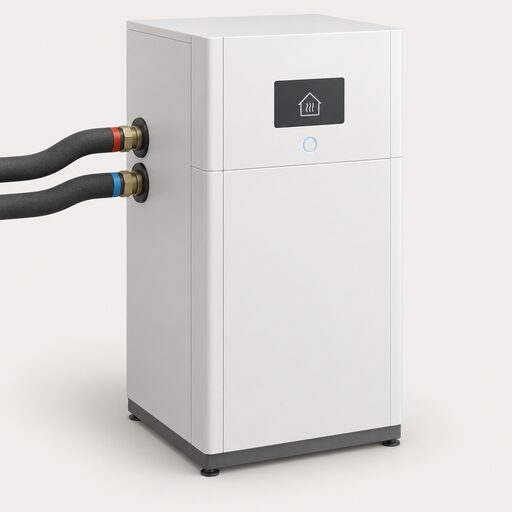 Ground Source Heat PumpsA ground source heat pump takes warmth from the ground to heat your home and water.
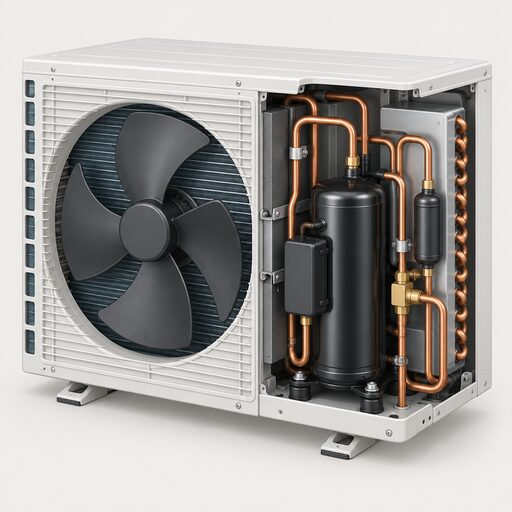 Air Source Heat PumpsHow an air source heat pump takes heat from outdoor air, the difference between air-to-air and air-to-water systems, typical efficiency, the £7,500 Boiler Upgrade Scheme grant, noise and planning limits, and what ownership means for a household's energy independence.
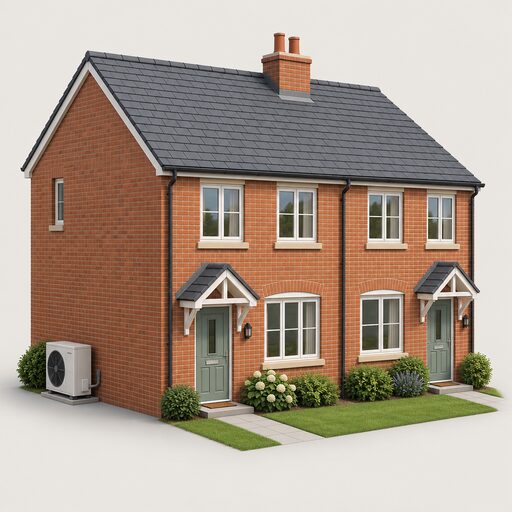 Which Homes Suit a Heat PumpMost UK homes can have a heat pump fitted, so the real question is whether yours makes it easy or expensive.
 The Full Heat Pumps GuideWill a heat pump keep my house warm in winter, and what does one cost to buy and run?
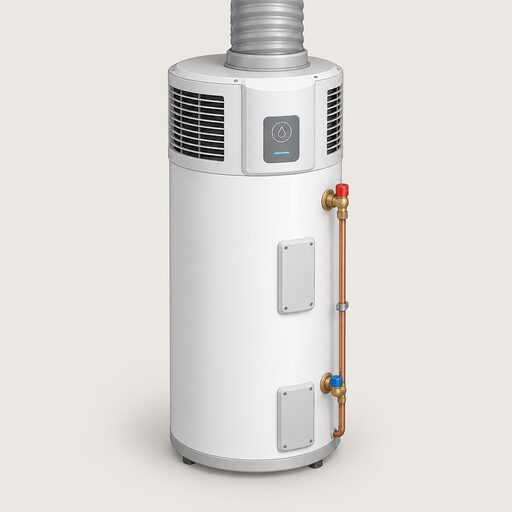 Hot Water Heat PumpsA hot water heat pump heats only the water in your cylinder, using air instead of a boiler flame.
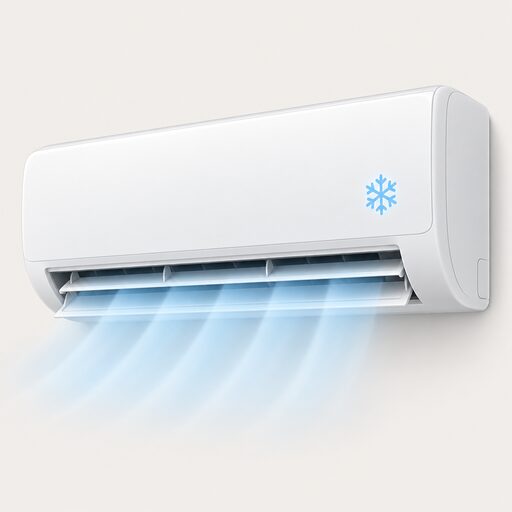 Using a Heat Pump for CoolingCan a heat pump cool your home in summer as well as heat it in winter?