
In this guide
Domestic heat pumps in Wales benefit from permitted development rights, which means that in most cases no planning application is needed to install one1. The rights cover air source, ground source and water source units, and they come with conditions on siting, on the number of units and on noise. Where those conditions are met, a household can proceed without the cost and delay of a full application.
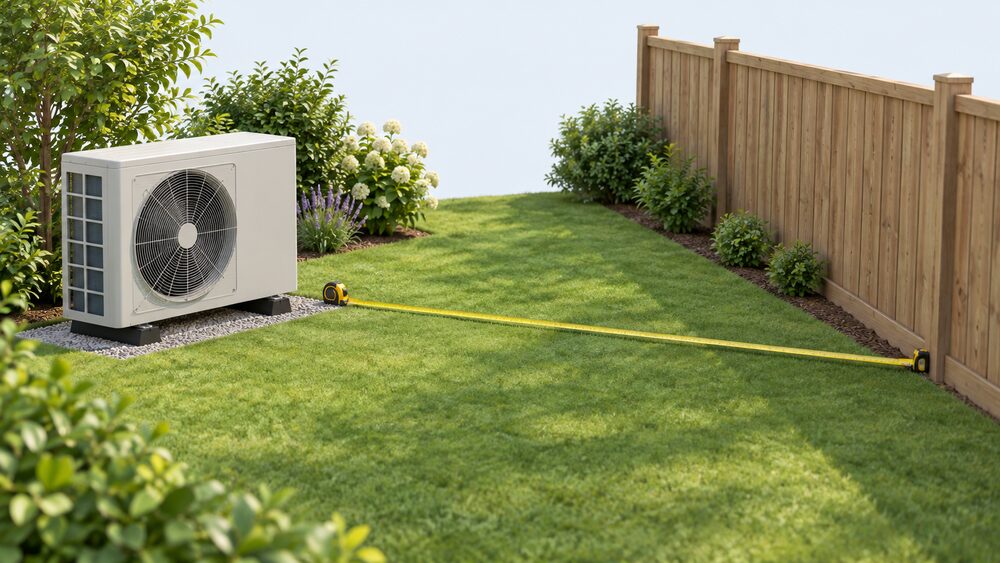
The conditions are where Welsh rules part company with the English ones. Wales requires a minimum 3 metre distance between an air source heat pump and the boundary of any neighbouring property, a rule the Welsh Government describes as intended to reduce noise pollution potential2. England's equivalent regime uses a 1 metre boundary distance, which is the origin of most of the confusion about a "1 metre rule" in Wales3.
Noise is the binding constraint in practice. Installations under permitted development must comply with MCS 020 a), the Microgeneration Certification Scheme sound calculation standard, and the calculation produces a pass or fail against a permitted development noise limit of 42.0 dB(A) at the nearest neighbouring assessment position4. The Welsh Government has itself identified noise as one of the factors blocking widespread domestic air source heat pump deployment in Wales4.
Permitted development rights in Wales: what changed and when
Permitted development rights are a national grant of planning permission for specified minor works. For heat pumps they remove the need for an application, provided the installation stays inside the conditions attached to the right. The Welsh Government's own heat strategy identified the permitted development rights related to heat pumps as a barrier to heat pump installation rollout, which is why the rules have been under review8.
The existing permitted development rights in Wales were last reviewed in 20199. A consultation opened on 8 April 2025 seeking views on proposed changes to various permitted development rights in Wales, covering air source heat pumps alongside off-street parking electric vehicle charging units, temporary camp sites, development by statutory undertakers for electricity, emergency affordable housing and meanwhile uses, and the definition of major development10. The same consultation also covered the introduction of permitted development rights for reverse vending machines10.
The direction of travel is towards loosening the rules rather than tightening them, because the Welsh Government has a target of installing 580,000 heat pumps in Wales by 20356. That target is drawn from the Climate Change Committee's Balanced Pathway projections for the numbers Wales needs by 20356. Progress against it has been slow: energy generation statistics record 22,000 heat pumps in Wales by 2023, across 22,067 installed projects7. In 2021 the figures recorded 11,171 heat pump projects with 122 MW of heat capacity and 199 GWh of estimated generation, with 2,073 new heat pump projects that year adding 21 MW of electrified heat11.
The gap between 22,000 installed units and a 580,000 target explains the policy pressure. Planning rules are one of the levers, and the noise evidence base is another. The Welsh Government published both the Phase 1 and Phase 2 reports of its Air Source Heat Pump Noise and Permitted Development Rights in Wales work on 11 January 20242.
When planning permission is still required
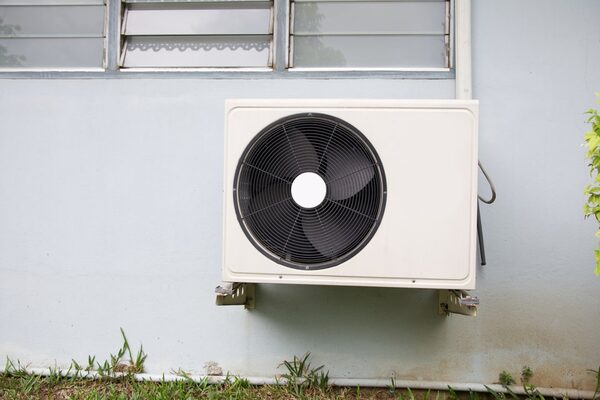
Permitted development is a default, not a guarantee. Several categories of installation fall outside it and need a full application.
- Listed buildings. Planning permission and listed building consent are both required for a heat pump on a listed building12.
- Scheduled monuments. Installations on a scheduled monument are not permitted under the rights13.
- Conservation area positions. A unit cannot go on a wall or roof fronting a highway within a conservation area, and cannot sit nearer to any highway bounding the property than the nearest part of the building1.
- More units than the right allows. More than two air source heat pumps on a detached dwelling, or more than one on any other dwelling, requires permission5.
- Noise non-compliance. Where the MCS 020 a) calculation fails, a planning application is required13.
- Removed rights. Permitted development rights may be removed through a planning condition, an Article 4 Direction or another restriction14.
Building Regulations are a separate matter and apply regardless of the planning route. Installation of either a ground source or air source heat pump will have to comply with the Building Regulations in Wales15. Planning consent and building control approval are two distinct processes, and satisfying one does not satisfy the other.
The siting rules your heat pump must meet
Siting is where the Welsh conditions bite hardest, and the boundary distance is the clearest difference from England. Wales's current permitted development rights to install an air source heat pump require a minimum 3 metre distance from the boundary of any neighbouring property, a condition the Welsh Government states is intended to reduce noise pollution potential2. On a tight urban plot, that single condition can be the difference between permitted development and a full application.
The highway-facing rules are more granular. Outside a conservation area, an air source heat pump cannot be installed on a wall of a dwellinghouse if that wall fronts a highway and the unit would be installed on any part of that wall above the level of the ground floor storey1. The Planning Portal states the same restriction in simpler terms: on land other than a conservation area or World Heritage Site, the unit must not be installed on any part of a wall above the level of the ground floor storey if that wall fronts a highway16. A front wall installation outside a conservation area or World Heritage Site is allowed, provided it sits at ground floor level and not above14.
Inside a conservation area or World Heritage Site the test is stricter. The unit must not be installed on a wall or roof which fronts a highway, and must not be installed so that it is nearer to any highway which bounds the curtilage than the part of the dwellinghouse nearest to that highway1. Local authority guidance repeats the same prohibition: units should not be fitted on a wall or roof which fronts a highway in a conservation area or World Heritage Site17.
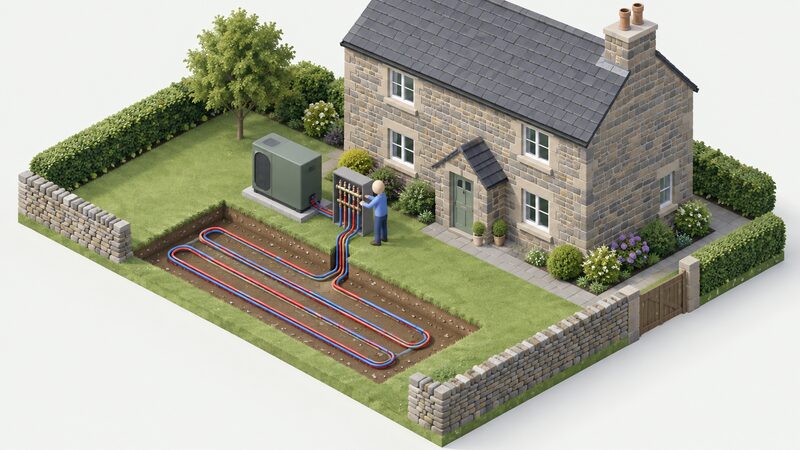
Ground source and water source units are treated differently from air source units. Permitted development rights permit the installation, alteration or replacement of a ground source heat pump or water source heat pump within the curtilage of a dwellinghouse1. Because a ground loop or borehole is buried rather than mounted on a wall, the highway-facing and boundary-distance conditions that shape air source siting do not apply in the same way. For the wider picture on where an outdoor unit can physically go, see Where a Heat Pump Outdoor Unit Can Go.
Noise: the 37dB(A) limit and MCS 020 a)
Noise is the condition most likely to decide whether a Welsh installation can use permitted development. The Welsh Government's own evidence is blunt: noise is one of the factors blocking widespread domestic air source heat pump deployment in Wales4.
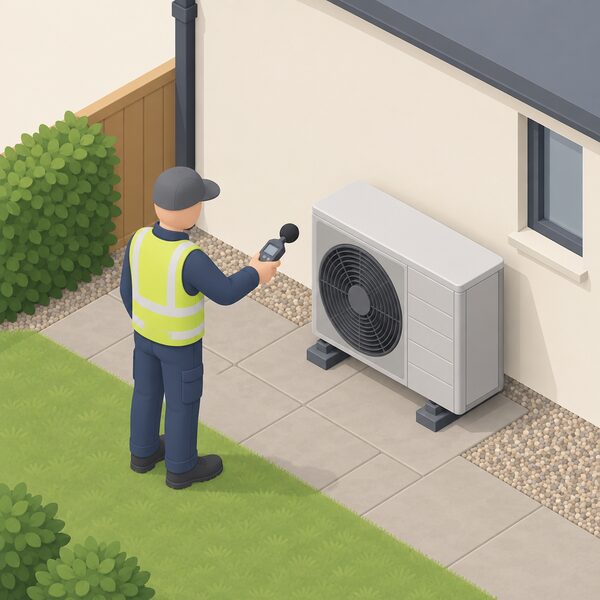
The permitted development noise limit in the MCS 020 calculation is 42.0 dB(A), assessed at the nearest neighbouring habitable room window or door4. The calculation assumes a background noise level of 40 dB(A) Lp4. If the final result is equal to or lower than 42.0 dB(A), the air source heat pump will comply with the permitted development noise limit for that assessment position and may be permitted development4. If the result is above 42.0 dB(A), the unit will not be permitted development4. The calculation also applies a maximum absolute level of 37.7 dBA for air source heat pumps4.
The 37 dB(A) figure that circulates in planning guidance is a different test, used where a unit exceeds the MCS standards and permission is needed. In that situation, noise levels emitted from the air source heat pump must not exceed 37 dB LAeq at any time, as measured on the boundary of the site with any neighbouring residential property18. The two numbers are not interchangeable: 42.0 dB(A) is the MCS 020 permitted development limit at the assessment position, and 37 dB LAeq is the boundary measurement applied in a planning application.
Where two units are proposed, the combined noise matters. Two units in operation together must not exceed the 40 dB limit under MCS 020(a)13. MCS 020 a) now contains a methodology for including up to two air source heat pumps in a sound calculation, which is what makes a two-unit permitted development assessment possible at all19.
Barriers change the arithmetic. A brick wall between the heat pump and the assessment position produces a reduction of -5 dB, and moving the unit less than 25cm can be enough to bring the assessment position into view and change the result21. That sensitivity is why the calculation is done for the specific position rather than for the model in the abstract. For the full method, see MCS 020: The Heat Pump Noise Assessment.
MCS 020 a): the sound calculation standard installers must follow
MCS 020 a) is the Microgeneration Certification Scheme standard for air source heat pump sound calculation for permitted development installations. Its full title is MCS 020 a) - Air Source Heat Pump Sound Calculation (For Permitted Development Installations)22. The legislation defines the MCS Planning Standards as the standards specified in the Microgeneration Certification Scheme for air source heat pumps, with MCS 020 b) covering small and micro wind turbines23.
Compliance is a condition of the right, not an optional extra. Development is not permitted by Class G unless the air source heat pump complies with the MCS Planning Standards3. The Welsh Government's consultation summary states that all air source heat pumps installed under permitted development rights will need to comply with MCS 020(a) standards13. Welsh Government guidance is explicit that an installation must comply with MCS 020(a), which sets installation standards including assessment of sound impact on neighbours1.
The 2025 changes tightened the wording. Article 5 removed "or equivalent standards" in order to provide clarity to installers that the MCS 020 a) Air Source Heat Pump Sound Calculation is the applicable standard24. The amendment substituted the reference to MCS 007 with a reference to MCS 020 a)22. The effect is that there is now a single named method rather than a family of acceptable alternatives, which removes an argument that a different calculation could satisfy the condition.
Scotland is considering the same move. The Scottish Government is considering revising its permitted development reference and removing the wording "or equivalent", to make it clear that installation must comply with MCS 020 a)20. The updated MCS 020 standards were published in March 202520.
For a household, the practical consequence is that the installer's sound calculation is the document that decides the planning route. If it passes, the installation proceeds under permitted development. If it fails, the household is in the full application process. The calculation is not a formality, and it is done before installation rather than after.
Air-to-air heat pumps: newly covered by permitted development
Air-to-air heat pumps, which heat by moving air rather than water, are now included within air source heat pump permitted development rights, as long as they are used for heating and not just cooling5. That is a change of substance for households considering a split system that can also provide summer cooling.
The condition attached to the inclusion is the important part. The right applies where the unit is used for heating, not merely for cooling. A system installed purely as an air conditioner does not fall inside the heat pump permitted development right on the strength of its ability to run in reverse. For the technology itself, see Air-to-Air Heat Pumps and Heating with Air Conditioning.
Air-to-air units are also outside the Boiler Upgrade Scheme, which is a separate funding question from the planning one. The planning position and the grant position move independently, and a household that qualifies for permitted development may still find no grant support for the technology.
How many heat pumps can you install on one dwelling
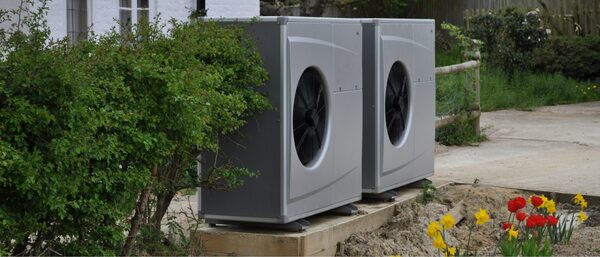
The quantity limits are set by the legislation and are straightforward once the property type is known.
| Property type | Air source heat pumps allowed under permitted development | Planning permission needed |
|---|---|---|
| Detached dwellinghouse | Up to two | More than two3 |
| Non-detached dwellinghouse | One | More than one3 |
| Block of flats | One | More than one3 |
The statutory wording is that more than one air source heat pump is not permitted on or within the curtilage of a dwellinghouse which is not a detached dwellinghouse or a block of flats, and more than two is not permitted for a detached dwellinghouse3. Local authority guidance states the same limits in plain terms: detached houses can install up to two heat pumps, while a non-detached house or a block of flats can install only one unit5.
The Heating and Hotwater Industry Council has taken a position on multiple units, arguing that planning permission should be sought where more than one unit is proposed on a detached dwellinghouse, because the assessment and implications are more complex25. For stand-alone blocks of flats installing more than one air source heat pump, the Council's view is that planning permission should be sought, and it suggests the planning rules should also be reviewed25.
Two units also have to satisfy the combined noise test. Two units in operation together must not exceed the 40 dB limit under MCS 020(a)13. The quantity limit and the noise limit therefore interact: a household can have two units on a detached house in principle, but only if the pair together passes the sound calculation. For the specific two-unit noise question, see What is the noise limit for two heat pumps on a detached house in Wales?.
If you need full planning permission: process and waiting times
Where permitted development does not cover the proposal, a householder application to the local planning authority is the route. The application has to demonstrate what the permitted development route would have taken on trust, which in practice means the siting plan, the noise assessment and the visual impact of the unit.
The scale of the Welsh task sets the context for how the rules are being handled. The Welsh Government's target is 580,000 heat pumps installed in Wales by 2035, drawn from the Climate Change Committee's Balanced Pathway projections6. Against that, the recorded total was 22,000 heat pumps in Wales by 20237. The 2021 figures recorded 11,171 heat pump projects, 122 MW of heat capacity and 199 GWh of estimated generation, with 2,073 new projects that year adding 21 MW11.
The Welsh Government has also been funding the demand side. A £5 million programme was announced to help Welsh households invest in greener homes, covering work such as installing a heat pump, upgrading insulation, or modernising a heating system26. Grant funding and planning consent are separate gates, and a household needs both where the installation falls outside permitted development.
The planning system is not the only regulatory gate. Building Regulations approval is required for the installation itself, for either a ground source or an air source heat pump15. A household that has cleared planning still has to clear building control.
What this means for household energy independence
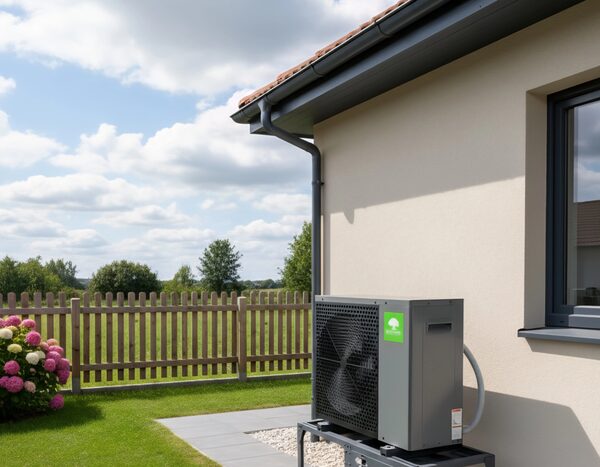
Planning rules matter to energy independence because they determine how quickly and how cheaply a household can move its heating off gas. Domestic heat pumps benefit from permitted development rights, which means that in most cases no planning permission is required to install them, subject to certain limitations and conditions1. That default is what allows a household to act without waiting on a discretionary decision.
The dependence that remains is real and worth stating plainly. A heat pump runs on electricity, so the household remains connected to the grid and to a supplier. The planning permission does not change that. What it changes is the household's ability to substitute its own heating source for a gas boiler, and to do so without a planning application that could take months and cost money.
The conditions themselves are the limit on that independence. The 3 metre boundary distance in Wales restricts where a unit can go on a tight plot2. The MCS 020 a) sound calculation can fail at a specific position even where the model is quiet on paper, and a failed calculation means a planning application13. The quantity limits cap what a detached house can do without permission at two units3. A household in a conservation area or World Heritage Site faces the strictest siting rules of all1.
The wider policy direction supports the shift. The Welsh Government's target of 580,000 heat pumps by 2035 is a statement that the default is expected to become the norm6. For households weighing the technology itself, the planning question sits alongside cost, sizing and the rest of the installation process, covered in Heat Pumps: The Full UK Guide and Heat Pump Installation: The Process from Survey to Handover.
Sources26 cited
- Planning permission: heat pumps, Welsh Government, 2026-09-17
- Written statement: Air source heat pump noise and permitted development rights in Wales report, Welsh Government, 2024-01-11
- Class G: Installation or alteration of air source heat pumps on domestic premises, legislation.gov.uk, 2025-05-29
- Air Source Heat Pump Noise and Permitted Development Rights in Wales, Phase 1 report, Welsh Government, 2023-12-13
- Planning guidance: heat pumps, Richmond Council, 2026-04-22
- Written statement: summary of responses to the consultation on Wales renewable energy targets, Welsh Government
- Energy generation in Wales 2023, Welsh Government, 2025-03
- Draft heat strategy for Wales, Welsh Government, 2023-08-16
- Preparing Wales for a renewable energy 2050, Welsh Government, 2019
- Changes to permitted development rights, Welsh Government, 2025-04-08
- Energy generation in Wales 2021, Welsh Government, 2022-12
- Air and ground source heat pumps, Croydon Council, 2026-09-17
- Changes to permitted development rights: summary of responses, Welsh Government, 2025-12
- Air source heat pumps: planning advice and guidance, Cornwall Council, 2026-09-17
- Building regulations: heat pumps, Welsh Government, 2026-09-17
- Planning permission: air source heat pump, Planning Portal, 2026-09-17
- Fact sheet 5: air source heat pumps, Pendle Borough Council, 2026-09-17
- Air source heat pumps: householder planning advice, Central Bedfordshire Council, 2026-09-17
- Permitted development rights: support and provision for new homes consultation, Scottish Government, 2025-09
- Permitted development rights: support and provision for new homes consultation, page 4, Scottish Government, 2025-09-03
- MCS 020: sound calculation for permitted development, Mid Sussex District Council, 2019-06-19
- The Town and Country Planning (General Permitted Development etc.) (England) (Amendment) Order 2025, legislation.gov.uk, 2025-05-06
- The Town and Country Planning (General Permitted Development) (England) Order 2015, Part 14, legislation.gov.uk, 2026-09-17
- Explanatory memorandum to the 2025 amendment order, legislation.gov.uk, 2025
- HHIC response to the Welsh Government consultation on permitted development rights, Heating and Hotwater Industry Council, 2024-04-03
- £5 million to help Welsh households invest in greener homes, Welsh Government, 2026-03-05
 Planning Permission WalesDo you need planning permission for an air conditioning unit outside your home in Wales?
 Home Energy Planning WalesSolar panels and heat pumps often need no planning permission in Wales, but the rules differ from England.
 Planning Permission in ScotlandDo you need planning permission for a heat pump in Scotland?
 Planning Permission in EnglandDo you need planning permission for an air source heat pump?
 Planning Permission in NIDo you need planning permission for a heat pump in Northern Ireland?
 Wind Turbine Planning in WalesDo you need planning permission for a wind turbine at home in Wales?