

In this guide
Wales runs its own planning system for householder energy work, and the first practical point is that guidance written for England does not carry across the border. The Planning Portal states on its heat pump, electrical, solar thermal, solar PV, flue, wind turbine, boiler, roof and EV charging pages that the guidance relates to the planning regime for England and that the policy in Wales may differ, adding that a householder in doubt should contact their local planning authority1.
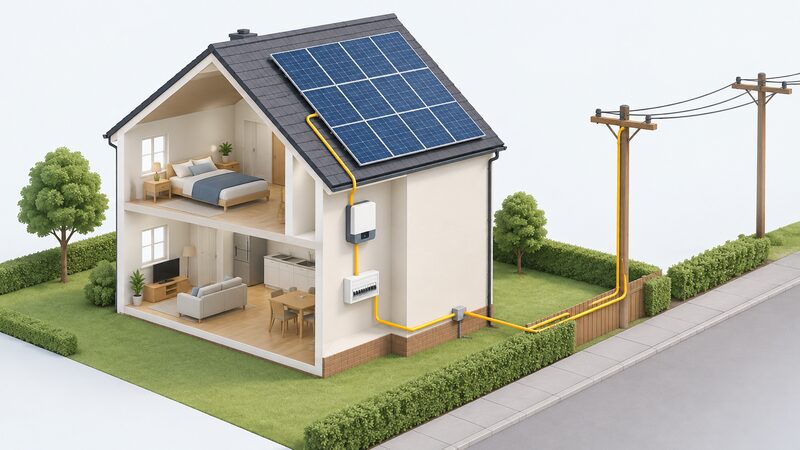
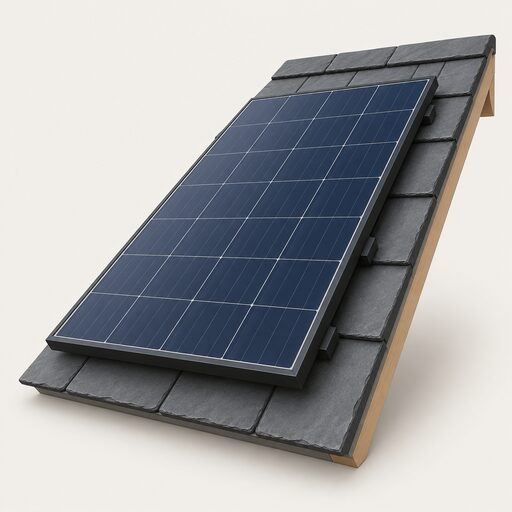
What applies instead is a Welsh framework: permitted development rights set by Welsh amendment orders to the General Permitted Development Order, national policy in Planning Policy Wales, and decisions taken by 22 local planning authorities. Solar panels and equipment installed on domestic buildings and land are usually considered permitted development, meaning planning permission is not required, though there are a few exceptions12. Domestic wind turbines can in some cases be installed without an application so long as specified limits and conditions are met6.
The direction of travel is towards more renewable generation and less fossil fuel. Planning Policy Wales promotes renewable energy developments covering wind, solar and other renewables, and states that oil and gas, including fracking, should be avoided13. The Welsh Government has said it will consult on planning policy that restricts fossil fuel heating in new developments, with a firm date communicated as a ban14.
Planning rules in Wales differ from England's, so check Welsh policy first
The single most useful thing a householder can know is that the English guidance most people find first does not govern a Welsh property. The Planning Portal repeats the same territorial caveat across its householder pages: the guidance relates to the planning regime for England, the policy in Wales may differ, and if in doubt the reader should contact their local planning authority1. That caveat appears on pages covering air source heat pumps, solar thermal water heating, solar electricity, wind turbines, boilers and heating, roof work, flues and chimneys, electrical work and electric vehicle charging1.
The caveat matters because permitted development is not a single UK-wide list. It is a set of rights created by orders, and Wales has made its own. The Town and Country Planning (General Permitted Development) (Amendment) (Wales) Order 2013 was made in relation to Wales and sits under the Town and Country Planning heading for Wales16. The 2019 Welsh order amends the Town and Country Planning (General Permitted Development) Order 1995, the older instrument that still forms the base of the regime20.
A householder in Wales therefore has three layers to work through. First, whether the work falls inside permitted development at all. Second, whether the property carries a designation, such as listing or conservation area status, that removes the right. Third, what the local planning authority's own published advice says, since authorities interpret and apply the national framework locally.
The practical consequence is that a quote from an installer who works mainly in England, or a decision taken from an English council's website, is not a reliable guide. The Welsh position has to be checked against Welsh orders and Welsh policy, and the authority that will determine any application is the Welsh local planning authority for the area.
Permitted development: when home energy equipment needs no application
Permitted development is the mechanism that lets certain minor changes be made without applying for planning permission12. For home energy equipment it is the route most households use, and it covers more than solar.
Solar panels and equipment installed on domestic buildings and land are usually considered permitted development, meaning planning permission is not required, but there are a few exceptions12. Domestic wind turbines can in some cases be installed without an application for planning permission, so long as specified limits and conditions are met6. The same broad logic, that ordinary domestic energy equipment is treated as permitted unless a condition or designation removes the right, runs through the Welsh regime.
The exceptions are where the work stops being ordinary. Solar panels on listed buildings need planning permission and listed building consent15. For non-residential listed buildings, planning permission will still be required15. Solar PV or solar thermal equipment on residential houses and flats is not required to have planning permission provided it complies with Class A, Part 14, Schedule 2 of the General Permitted Development Order 2015 as amended15.

The Welsh amendment orders that shape permitted development rights

The rights themselves come from Welsh statutory instruments. The Town and Country Planning (General Permitted Development) (Amendment) (Wales) Order 2013 carries the instrument number 2013 No. 1776 (W. 177) and was made in relation to Wales16. The Town and Country Planning (General Permitted Development) (Amendment) (Wales) Order 2019 is numbered 2019 No. 330 (W. 80); it was made on 20 February 2019 and laid before the National Assembly for Wales on 21 February 201917.
The 2019 order did specific work. It inserted Classes D and E into Part 2 on minor operations, to permit the installation of electrical outlets and upstands; it inserted Part 17A; it replaced Part 24; and it amended Part 43 to extend permitted development rights for non-domestic solar installations21. The substitution of Part 24 appears in Schedule 2 to the order20.
| Order | Instrument number | What it does |
|---|---|---|
| General Permitted Development (Amendment) (Wales) Order 2013 | 2013 No. 1776 (W. 177) | Welsh permitted development amendment, made in relation to Wales16 |
| General Permitted Development (Amendment) (Wales) Order 2019 | 2019 No. 330 (W. 80) | Inserts Classes D and E into Part 2, inserts Part 17A, replaces Part 24, amends Part 43 for non-domestic solar21 |
| General Permitted Development (Amendment) (Wales) Order 2026 | 2026 No. 79 | Brings most articles into force 1 June 2026, article 3(2) on 1 September 202618 |
The Welsh Government has continued to consult on the shape of these rights. A 2025 consultation sought views on proposed changes to permitted development rights in relation to air source heat pumps, off-street parking electric vehicle charging units, temporary camp sites, development by statutory undertakers for electricity, emergency affordable housing and meanwhile uses, and the definition of major development22. The same consultation covered the introduction of permitted development rights for reverse vending machines22. A 2023 consultation raised a 5MW example threshold for renewable energy developments23.
Planning Policy Wales: the national policy behind local decisions
Planning Policy Wales is the national policy that local authorities apply when they decide applications and write their own local plans. It will underpin all future planning decisions, and it has a firm focus on placemaking13. It promotes renewable energy developments covering wind, solar and other renewables13.
The policy has been revised over time. Edition 4 contained revised policy on renewable energy and some minor factual updates to planning policy on sustainable buildings, and it addressed major energy proposals over 50MW19. The same edition encouraged planning authorities to plan positively for low carbon and renewable energy by undertaking assessments of their area's potential to accommodate new developments19. An accompanying energy policy statement recognised that there is significant potential for microgeneration technologies in Wales19.
For a householder, Planning Policy Wales matters less as a rulebook for a single roof and more as the reason local decisions go the way they do. A local planning authority that has assessed its area's renewable potential, as national policy encourages, is more likely to have an adopted local plan that treats domestic renewables as acceptable in principle. That shapes how a borderline case is handled.
The Welsh Government has also set out support for local authorities to develop a local planning policy environment that supports delivery of more renewables planning and land use, including ministerial directive and updated guidance23. Alongside this sits a local ownership policy: all new energy projects are expected to have at least an element of local ownership, with a recommended offer of 10% to any Wales-based organisation23.
Renewable energy, the energy hierarchy and fossil fuel restrictions
Welsh energy policy sets targets that reach into planning. The Welsh Government has an aspiration of 1.5 GW of local ownership of renewable electricity and heat capacity in Wales by 2035, and a target for at least 1.5GW of renewable energy capacity to be locally owned by 2035, excluding heat pumps23. An earlier target, at least 1 GW of renewable energy capacity to be locally owned by 2030, was reported as nearly 90% achieved25.
The fossil fuel side is stated plainly. Planning Policy Wales says oil and gas, including fracking, should be avoided13. The draft heat strategy adds that the Welsh Government will consult on introducing planning policy that restricts fossil fuel heating in new developments, with a firm date communicated as a ban14. It also says the government will review the zoning powers in the Energy Bill and consider the benefits of adopting a similar approach in Wales14.
"oil and gas (including fracking) should be avoided"
Generation statistics give the householder a sense of scale. Wales locally owned renewable energy included around 56,200 domestic solar PV projects and over 10,500 domestic heat pumps as of 202125. Over 40 MW of locally owned renewable energy capacity was commissioned in 2021, consisting of 18 MW electrical and 22 MW heat25. Approximately 100 MW of gas, diesel and coal electricity generation capacity was locally owned in 2021, in small-scale projects such as farm diesel generators25. Small-scale energy from waste plants under 10 MW are only permitted if regionally necessary26.
Local planning authorities and when to contact yours

The local planning authority is the body that answers the practical question. Planning guidance for England states that the policy in Wales may differ and that, if in doubt, the householder should contact their local planning authority1. That instruction is the correct first step in Wales too, because the authority holds the local plan, the designation records and the enforcement role.
Wales has 22 local authority areas, and all 22 saw an increase in their total renewable energy capacity in 2023 compared with the previous year26. Each authority publishes its own planning advice, and some publish specific guidance on solar panels and planning permission15.
Local authorities also hold powers that touch home energy beyond planning applications. A local authority may declare the whole or any part of its authority to be a smoke control area, and before creating a smoke control order it must consult those affected by the change and take comments into consideration27. That matters for households burning solid fuel, where a change of appliance or fuel can interact with both planning and smoke control rules.
The wider Welsh planning framework: acts, bills and what is coming into force
Welsh planning law is being consolidated. The Planning (Wales) Act 2026 and the Planning (Consequential Provisions) (Wales) Act 2026 were approved by Senedd Cymru on 10 March 2026 and received Royal Assent on 27 April 202619. The new legislative framework is anticipated to come into force in October 2027, subject to commencement19. The Planning (Wales) Bill and the Planning (Consequential Provisions) (Wales) Bill had been introduced to the Senedd on 15 September 2025, with an oral statement made the following day19.
Alongside the Acts, the 2026 permitted development amendment order sets out its own commencement. Articles 1, 2, and 3(1) and (3) and articles 4 to 7 come into force on 1 June 2026; article 3(2) comes into force on 1 September 202618. The documents record the two commencement dates and do not resolve them into a single date, so both stand as given.
Other strands of Welsh energy policy feed into the planning picture. The Welsh Government has proposed that all new homes in Wales be heated and powered from clean energy sources from 2025, with tough new standards on new homes implemented in stages over five years, covering energy efficiency, low carbon heating and energy generation such as photovoltaic panels, heat pumps or district heat networks28. A National Energy Plan for Wales was planned for publication by the end of 2024, drawing on insights from the Future Energy Grids in Wales project, regional energy strategies, the emerging heat strategy and the energy targets24. Guidance on local and shared ownership of energy projects applies to all new energy development29.
A Welsh public energy company has also been consulted on: the consultation opened on Monday 7 September 2026 and runs until 30 November 202630.
Local area energy plans and what they mean for householders
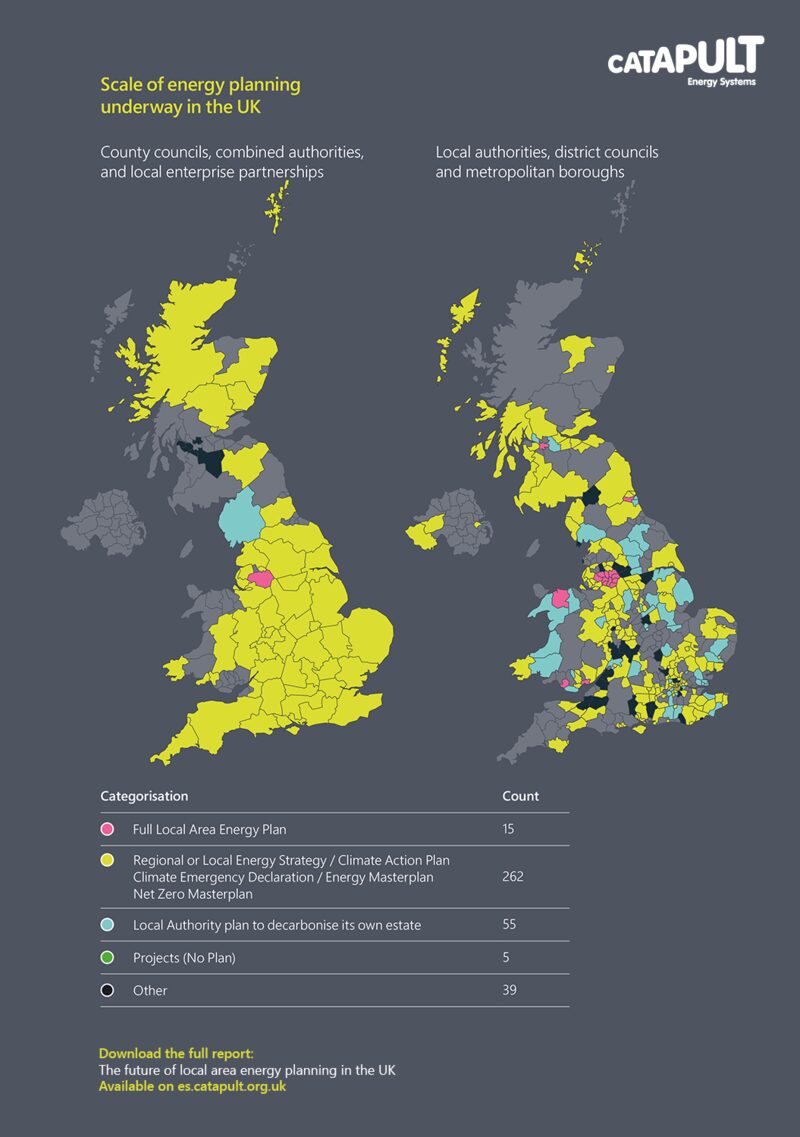
Local Area Energy Plans are area-wide plans for decarbonising energy, and they have moved from drafting to delivery in Wales. Energy Systems Catapult reported on 23 December 2024 that all 22 Welsh local authorities had completed Local Area Energy Plans, with councils now moving from planning to implementation29. The Welsh Government has said it will scale up local energy plans to create a national energy plan by 202429. Earlier work included the Energy Systems Catapult working with the mid Wales region, Powys and Ceredigion, to develop their energy plans29.
For a householder, a Local Area Energy Plan is context rather than permission. It indicates where an area expects heat pumps, district heat networks, solar and grid reinforcement to go, which can shape what a local plan encourages and how a future connection or network upgrade is treated. It does not by itself grant or remove permitted development rights for a single property.
The Welsh Government has also framed energy efficiency work in terms of local authority capacity, saying it will help local authorities and services switch to better Energy Performance Contracts that save money31. Laws about energy efficiency are made by the UK Government, but the Welsh Government has said it wants to do everything it can so Wales is using and managing its energy well31.
Sources31 cited
- Planning permission: air source heat pump, Planning Portal, 2026-09-17
- Planning permission: electrics, Planning Portal, 2026-09-17
- Solar thermal water heating, Planning Portal, 2026-09-17
- Solar panels: building regulations, Planning Portal, 2026-09-17
- Flue, chimney or soil and vent pipe: planning permission, Planning Portal, 2026-09-17
- Wind turbines, Planning Portal, 2026-09-17
- Solar electricity: photovoltaics, Planning Portal, 2026-09-17
- Electric vehicle charging: building regulations, Planning Portal, 2026-09-17
- Boilers and heating: planning permission, Planning Portal, 2026-09-17
- Heat pumps, Planning Portal, 2026-09-17
- Roof, Planning Portal, 2026-09-17
- Do I need planning permission, Cornwall Council, 2026-09-09
- Places enrich people's lives: heart of new planning policy, Welsh Government, 2018-12-05
- Draft heat strategy for Wales, Welsh Government, 2023-08
- Solar panels and planning permission, Cornwall Council, 2026-09-17
- The Town and Country Planning (General Permitted Development) (Amendment) (Wales) Order 2013, legislation.gov.uk, 2026-09-17
- The Town and Country Planning (General Permitted Development) (Amendment) (Wales) Order 2019: introduction, legislation.gov.uk, 2019-02-20
- The Town and Country Planning (General Permitted Development) (Amendment) (Wales) Order 2026, legislation.gov.uk, 2026-03-10
- Written statement: Planning Policy Wales Edition 4, Welsh Government, 2011-02-28
- The Town and Country Planning (General Permitted Development) (Amendment) (Wales) Order 2019: contents, legislation.gov.uk, 2026-09-17
- The Town and Country Planning (General Permitted Development) (Amendment) (Wales) Order 2019, legislation.gov.uk, 2019-04-01
- Changes to permitted development rights, Welsh Government, 2025-04-08
- Preparing Wales for a renewable energy 2050, Welsh Government, 2023-10
- Renewable energy deep dive: biannual recommendations update 2, Welsh Government, 2023-04-27
- Energy generation in Wales 2021, Welsh Government, 2022-10
- Energy generation in Wales 2023, Welsh Government, 2025-03
- Smoke control guidance: local authorities FAQs, Welsh Government, 2025-07-30
- All new homes in Wales to be heated and powered from clean energy sources from 2025, Welsh Government, 2020-01-20
- Renewable energy deep dive: biannual recommendations update 1, Welsh Government, 2022-09-20
- Shape plans for a new clean energy company owned by Wales to benefit Wales, Welsh Government, 2026-09-07
- Energy efficiency strategy: young person's version, Welsh Government, 2016
 Planning Permission WalesDo you need planning permission for solar panels on your house in Wales?
 Permitted Development by HomeCan you put up solar panels or a heat pump without asking the council?
 Planning Permission in WalesDo you need planning permission for a heat pump in Wales?
 Energy Policy in WalesWhat help can you get in Wales to make your home warmer and cheaper to run?
 Listed Buildings and AreasYour home is listed or sits in a conservation area, so do you need permission before adding solar panels, insulation or a heat pump?
 Planning Permission EnglandMost homes in England can have solar panels fitted without planning permission, but does yours count as one of the exceptions?