
In this guide
Scotland's statutory climate target is net zero emissions of all greenhouse gases by 2045, five years earlier than the rest of the UK1. The Climate Change (Emissions Reduction Targets) (Scotland) Act 2019 put that date in law, and it survived the 2024 repeal of the two interim targets that sat beneath it3. For a household, the target is not an abstraction: it is the reason the Heat in Buildings Strategy exists, and the reason the strategy asks over 1 million homes to convert to zero emissions heating by 20305.
The scale is the point. Around 50% of Scottish homes, or over 1 million households, are expected to convert to zero emissions heating systems by 2030, with the remainder converting by 2045 at the latest6. Emissions from homes and non-domestic buildings combined must fall by 68% by 2030 compared with 2020 levels8. Those two numbers, a conversion count and an emissions cut, are the ones that shape what happens to a Scottish house or flat over the next two decades.
What follows sets out what the law requires, how the interim targets changed, how Scotland's date compares with the rest of the UK, and what the buildings strategy asks of homes. It also sets out where the dependence remains: on the grid, on electricity prices, and on a supply chain that has to deliver the installations.
Scotland's net zero target: what the law requires
The Climate Change (Emissions Reduction Targets) (Scotland) Act 2019 requires Scotland to reach net zero by 20455. It sets targets to reduce Scotland's emissions of all greenhouse gases to net zero by 2045 at the latest, and it enshrined in law the commitment to a just transition to net zero1. The Act amended the earlier Climate Change (Scotland) Act 2009, which had been amended in 2019 to include the 2045 target2.
The 2045 date is a statutory duty, not a policy aspiration. The Scottish Government describes it as a target date for net zero emissions of all greenhouse gases by 2045, and the Climate Change Committee, an independent statutory body established under the Climate Change Act 2008, advises on progress against it1. That advice is regular: an annual Scottish progress report on reducing emissions, advice on emissions reduction targets, and independent assessments of Scotland's adaptation programmes1.
The target covers the whole economy, which is why buildings matter so much within it. Heating homes and non-domestic buildings is one of the largest single sources of emissions the Scottish Government has to eliminate, and the Heat in Buildings Strategy is the delivery route for that share8. The strategy sets out a pathway to zero emissions buildings by 2045, and states that by 2045 all homes and buildings will need to significantly reduce their energy use and use a zero emissions heating system8.
"The Climate Change (Emissions Reduction Targets) (Scotland) Act 2019 enshrined in law our commitment to a just transition to net zero"
The interim targets on the way to net zero

The 2019 Act originally set two interim targets beneath the 2045 date: a 75% reduction in emissions by 2030 and a 90% reduction by 20409. The Heat in Buildings Strategy was written against those figures, and its own documents refer to interim targets for reductions of 75% and 90% by 2030 and 2040 respectively8.
Both were repealed in 2024. The Scottish Government withdrew the two interim targets for 2030 and 2040 while keeping its net zero target by 20454. The Climate Change Committee records that Scotland's interim emissions targets for 2030 and 2040 were repealed in 2024 as the progress required to meet the 2030 target was judged out of reach3.
The 2040 figure had been endorsed before the repeal. In its 2022 report to Parliament, the Committee stated that the net zero date of 2045 and the 2040 interim target of a 90% reduction remained appropriate11. That assessment is now historical: the target it endorsed no longer exists in statute.
What replaced the interim targets is a carbon budget framework. Scotland's Climate Change Plan 2026-2040 is the current plan period, and the Committee said in November 2025 that it would assess the merits of whether the plan delivers the required reductions in its progress report early next year12. When it last assessed how Scotland was performing against its climate goals, it said the Government needed to set out clear detail of how policies will work together to deliver the required levels of emissions reduction12.
How Scotland's target compares with the rest of the UK
Scotland's 2045 date is five years earlier than the rest of the UK2. The Scottish Government's stated rationale is that Scotland has proportionally more land suitable for tree planting and higher potential for engineered removals, which is why the earlier date was judged achievable2. The UK's own net zero target, by contrast, is legally binding at 20504.
The difference is one of date, not of mechanism. Both targets are statutory, both are advised on by the Climate Change Committee, and both depend on electrification to deliver most of the reduction. The Committee models that the UK must reduce emissions by 87% compared with 1990 levels by 2040, and that electrification makes up 60% of emissions reductions by 204013. It estimates the net costs of delivering this at 0.2% of GDP per year on average13.
For households, the practical divergence between the nations sits in the buildings rules rather than the headline date. Scotland has its own Heat in Buildings Strategy, its own conversion targets and its own energy efficiency backstop, which is why the devolved and reserved energy powers matter when reading any of these figures. The wider picture across the four nations is set out in the guide to home energy across the UK nations.
| Nation | Net zero date | Buildings conversion goal |
|---|---|---|
| Scotland | 20452 | over 1 million homes by 2030, all buildings by 20455 |
| Rest of the UK | 20504 | set by UK-wide policy |
What the targets mean for Scotland's homes and buildings
By 2045 all homes in Scotland must have significantly reduced their energy use and use a zero emissions heating system14. The interim step is 2030, and it is demanding: over 1 million homes and the equivalent of around 50,000 non-domestic buildings will need to convert to a zero emissions heating system by 2030, with the remainder converting by 2045 at the latest7.
The emissions arithmetic behind that is a 68% cut. Emissions for homes and non-domestic buildings combined will have to fall by 68% by 2030 as compared to 20208. That figure appears consistently across the strategy documents, and it is the clearest statement of how much of the national effort is attributed to the buildings sector.
Two further dates shape what a household can expect. Regulations will require buildings to reach minimum energy efficiency standards equivalent to EPC C, with a backstop date of 20338. And the zero emissions heating requirement for existing buildings carries a backstop date of 20458. In practice that means fabric first, then the heating system: insulation and glazing ahead of, or alongside, a change of heat source.
The Climate Change Committee's Balanced Pathway for Scotland reaches net zero greenhouse gas emissions in 2045, and shows 92% of existing homes on low-carbon heat by 2045, reaching all homes by 20503. That is a modelled pathway rather than a legal requirement, and it sits slightly behind the strategy's own 2045 backstop, which is worth noting where the two are compared.

The Heat in Buildings Strategy and the zero emissions heat conversion goal
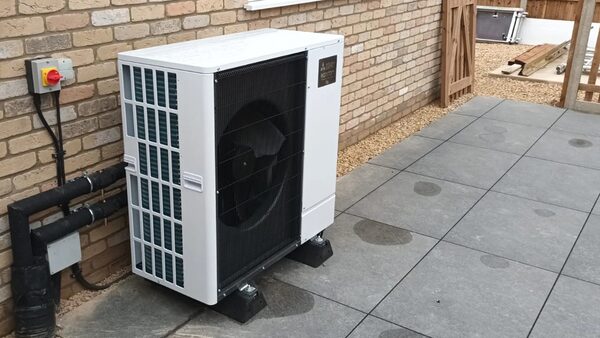
The Heat in Buildings Strategy: Achieving Net Zero Emissions in Scotland's Buildings is the document that turns the 2045 target into a programme for homes8. Its vision is for over 1 million homes in Scotland to convert to zero emissions heating by 2030, alongside the equivalent of 50,000 non-domestic buildings15. It aims to decarbonise over 1 million homes and the equivalent of 50,000 non-domestic buildings by 20308.
The strategy identifies heat pumps and heat networks as the strategic zero emissions heating technologies available in the near term7. That is a deliberate narrowing: it tells a household which technologies the programme is built around, and it explains why so much of the supporting policy, from the Heat Network Fund to the social housing standards, points in those two directions17.
The Heat Network (Scotland) Act adds a supply target to that. It requires 6 TWh of thermal energy to be supplied via heat networks by 20309. The Heat Network Fund exists to support the roll out of zero emission heat networks across Scotland17. For a household on or near a network, that route may be the practical one; for a household off any network, the strategy's near-term answer is a heat pump.
The Scottish Government has also committed to installing one million zero carbon heating systems by the end of the decade9. That commitment and the strategy's conversion target describe the same ambition from two directions, one counting installations and one counting homes.
What the CCC says about heating: heat pumps, heat networks and hydrogen
The Climate Change Committee's advice on how Scottish heating should decarbonise is consistent, and it is narrower than the range of technologies sometimes discussed. In the Balanced Net Zero Pathway, hydrogen boilers supply 5% of UK building heat demand in 205018. That is a marginal role, not a like-for-like replacement for the gas boiler.
The Committee's wider position is that the lower-cost, energy-secure future is electric, and that the Government should plan to accelerate electrification, in particular by making electricity cheaper19. Its number one recommendation remains to make electricity cheaper by taking policy costs off electricity bills, which it calls vital for ensuring the required scale-up of heat pump installations in the plan20. It expected that to be addressed in the upcoming Warm Homes Plan20.
On delivery, the Committee has been measured rather than satisfied. It noted some encouraging signs of progress in the delivery indicators in its recent progress report, but stated that a significant increase in roll-out rates is needed in many areas in the next few years20. Its chair, Nigel Topping, set out in June 2026 that accelerating electrification across the economy is the central task, and the Committee said it will continue to hold the Government to account for how it delivers against its targets21.
For a household, the practical reading is that the electrification route is the one the independent adviser expects, and that the pace of it depends on electricity prices and on installation rates rather than on any change of direction. The Committee's assessment of whether the current Scottish plan delivers is due in its progress report12.
Costs, bills and support for households making the switch
The Committee's cost estimate for the transition as a whole is 0.2% of GDP per year on average13. It does not publish a household saving figure for switching to a heat pump, and no single saving applies across Scotland: running costs depend on the tariff, the fabric of the home and the system installed. The Committee's recommendation on bills is structural rather than per-household, that electricity should be made cheaper by taking policy costs off electricity bills20.
Support for households is delivered through separate Scottish schemes rather than through the climate targets themselves. The Home Energy Scotland Grant and Loan Scheme is the main route for individual households, and the HEEPS Area Based Schemes fund work at street or area level. Social housing has its own standards, and the Energy Efficiency Standard for Social Housing sets the requirement for that tenure17.
Advice is free and separate from any product recommendation. Home Energy Scotland runs free webinars with Scottish Water explaining how saving water can reduce energy use and household bills, with free water-saving devices available afterwards subject to eligibility and availability22. Local authority home energy efficiency teams advise as well23.
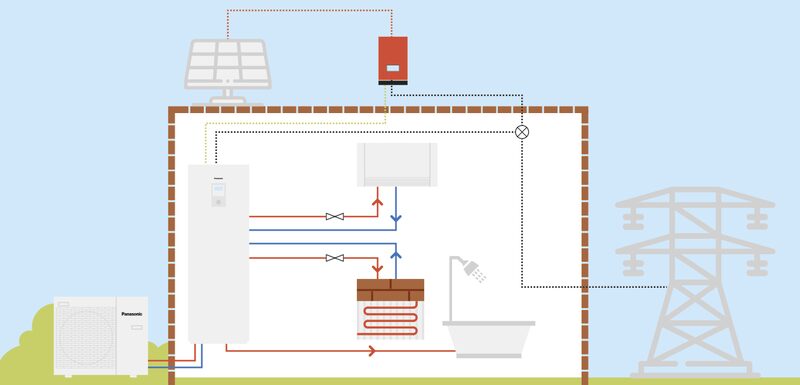
Where the dependence remains is worth stating plainly. A heat pump runs on electricity from the grid, so a household that converts trades a dependence on gas for a dependence on electricity and on the tariff it is on. A heat network ties a household to the network operator. Neither route makes a home self-sustaining on its own, and the targets do not require it: they require the emissions to go, not the connection. Households that add generation or storage reduce that dependence further, and the uptake of solar, batteries and microgeneration by nation sets out how Scotland compares.
Sources23 cited
- Climate change policy, Scottish Government, 2026-09-17
- Scotland's Carbon Budgets, Climate Change Committee, 2025-05-21
- Scotland's Climate Change Plan 2026-2040, Scottish Government, 2025-11-06
- The UK's climate change targets and the path to net zero, House of Commons Library, 2026-07-10
- Delivering net zero for Scotland's buildings, Scottish Government, 2023-11-28
- Tackling fuel poverty in Scotland, Scottish Government, 2021-12-23
- Heat in Buildings Strategy: business and regulatory impact assessment, Scottish Government, 2021-11-11
- Heat in Buildings Strategy: Achieving Net Zero Emissions in Scotland's Buildings, Scottish Government, 2021-11
- Heat pump sector deal: expert advisory group final report, Scottish Government, 2021-12
- Heat in Buildings Strategy: child rights and wellbeing impact assessment, Scottish Government, 2021-11-11
- Scottish emission targets: progress in reducing emissions in Scotland 2022, Climate Change Committee, 2022-12-07
- Response to the Scottish Government's Climate Change Plan, Climate Change Committee, 2025-11-07
- End the fossil fuel age for a secure and prosperous future, Climate Change Committee, 2025-02-26
- Energy efficiency in social housing, Scottish Government, 2026-09-17
- Heat in Buildings Strategy: summary document, Scottish Government, 2021-10
- Heat in Buildings Strategy: island communities impact assessment, Scottish Government, 2021-11-11
- Heat in Buildings: Scotland's National Public Energy Agency, Scottish Government, 2021-11-30
- Scottish Government hydrogen policy statement, Scottish Government, 2023-12
- Response to the Government's seventh carbon budget target, Climate Change Committee, 2026-06-02
- Response to the Government's carbon budget and growth delivery plan, Climate Change Committee, 2025-10-29
- Response to Parliament passing the seventh carbon budget into law, Climate Change Committee, 2026-06-24
- Water really worth saving, Home Energy Scotland, 2026-09-22
- Home energy efficiency, Argyll and Bute Council
 Home HeatingMost Scottish homes are heated by mains gas, so what happens to the rest?
 Climate TargetsNorthern Ireland has committed to cutting its greenhouse gas emissions to almost nothing by 2050, with a big reduction due by 2030.
 New Build Heat StandardScotland's New Build Heat Standard means gas and oil boilers are no longer allowed in new homes from April.
 Future Homes StandardWill your new build still have a gas boiler, and when do the new rules actually start?
 Carbon Budgets and Net ZeroThe UK has promised to cut its emissions to almost nothing by the middle of the century.
 Housing Stock Data for ScotlandScotland's housing is measured differently from England's, so the numbers you see may not compare directly.