
In this answer
Short answer
Scotland has installed more than 17 heat pumps per 1,000 households cumulatively, the highest rate of any UK nation1. In 2023/24, 7,660 MCS-certified heat pumps were installed in Scotland2. The quarterly official series, which counts only government-supported installations, recorded 1,006 installations in Scotland in 2026 Q2 (April to June), against 487 in 2024 Q43.
Those three figures measure different things, and the gap between them is the story. The cumulative rate captures every certified installation since records began. The MCS annual figure captures one year of certified work. The quarterly series captures only installations supported by government schemes, and its own documentation states that some devolved administration schemes in Scotland and Northern Ireland are currently not included5. No single published number is a complete count of heat pumps in Scotland.
What the figures do show is a market that is growing from a very low base. The Climate Change Committee recorded an 18% increase in heat pump installations between 2023 and 2024, driven by the Home Energy Scotland and Warmer Homes Scotland schemes6. The Scottish Government's own advisory group described the starting point in 2021 as "only a few thousand heat pumps installed annually in Scotland at present"7.
The headline number, and why three figures compete
The most defensible single answer is the cumulative rate: more than 17 heat pumps per 1,000 households, which independent analysis places above every other part of the UK1. For a household trying to judge whether Scotland is a normal or unusual place to install a heat pump, that is the number that matters, because it is normalised by housing stock and covers all certified work rather than grant-funded work alone.
The annual figures sit underneath it. MCS-certified installations reached 7,660 in 2023/24, up from 5,526 between August 2022 and July 2023, with 6,388 recorded in the calendar year 20232. The independent analysis of Scotland's installation sector puts current delivery at approximately 3,500 installations per year across 200 to 400 installers, with an estimated 210 companies operating in the sector1. That lower figure reflects the installer base's current throughput rather than the total number of units fitted.
The quarterly official series is the most granular and the most limited. Government-supported installations in Scotland ran at 933 in 2024 Q1, 934 in 2024 Q2, 693 in 2024 Q3 and 487 in 2024 Q4, then 538 in 2025 Q1, 611 in 2025 Q2, 745 in 2025 Q3 and 1,006 in 2026 Q24. The 2024 Q2 figure appears as both 934 and 884 in different releases of the same series, and the two figures are unresolved4.
Who the schemes cover, and who they miss
The statistics describe installations, not households, and the schemes behind them have defined eligibility. The Home Energy Scotland Grant and Loan offers Scottish homeowners support towards heat pump installation costs, and the scheme provides grants and loans to all domestic owner-occupiers in Scotland to install clean heat and energy efficiency measures15. Warmer Homes Scotland funds energy efficiency measures and a heat pump for eligible households, with all the work planned and carried out for the household and fully funded by the Scottish Government where criteria are met17.
The National Heat in Buildings Scheme is designed to be accessible to all households in Scotland, including island households, where they meet the eligibility requirements for the scheme criteria18. Independent guidance notes that all homes in Scotland can get an interest-free loan towards the cost of a heat pump19.
The coverage limitation matters for anyone reading the numbers. The DESNZ quarterly statistics cover government-supported heat pump installations only, domestic and non-domestic schemes, excluding some devolved administration schemes in Scotland and Northern Ireland5. A household that installed a heat pump without a grant, or through a Scottish scheme not captured in the UK series, does not appear in the quarterly counts at all.
Where installations are concentrated
The distribution across Scotland is uneven, and the pattern is geographic rather than demographic. Areas such as the Hebrides and Orkney have the highest heat pump installation rates in Scotland and exceed those of any local authority in England by a substantial margin1. Island and rural households off the gas grid have historically had the strongest case for moving away from oil and solid fuel, and the installation data reflects that.
The technology mix is correspondingly narrow. The very large majority of systems installed in Scotland are individual air and ground source heat pumps, or connections to heat networks powered by larger heat pumps7. For most households the practical choice is an individual air source unit, which is also the technology covered by the permitted development rights described below.
The Scottish Government's own review found no evidence to suggest that heat pumps could not operate effectively in Scotland, but also found that correct specification and sizing of heat pumps and heat emitters are critical determinants of heat pump performance20. That finding is the reason the installation rate matters less than the quality of each installation: a poorly sized unit in a Scottish climate underperforms regardless of how many neighbours have one.
Planning permission and building standards
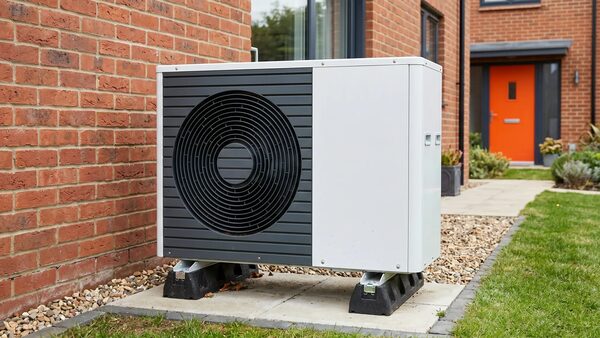
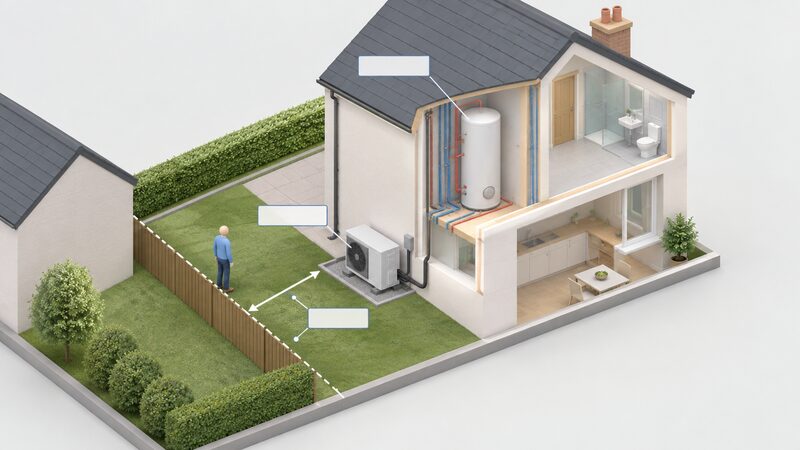
Planning rules in Scotland differ from the rest of the UK. Class 6H permits the installation, alteration or replacement of an air source heat pump on a dwelling or within the curtilage of a dwelling, but the existing rights require the unit to be sited 100 metres from the nearest neighbour's curtilage and are subject to prior notification to the planning authority on siting and design21. Independent guidance confirms that planning rules vary slightly in Wales and Scotland, where more stringent rules related to where the heat pump can be placed in relation to the property boundary exist22.
There are further exceptions. Listed buildings and conservation areas fall outside the standard position, and the Energy Saving Trust advises checking with the local planning department before committing23. Open loop ground and water source heat pump systems normally require permits from the Scottish Environment Protection Agency24.
Building standards add a separate layer for new work. The New Build Heat Standard does not apply to any emergency back-up heating system installed solely for use in the event of failure of the normal heating or hot water service system25. The original legislation prohibited these installations, except in specific exemption cases such as when they were deemed as 'emergency heating'25. Industry has recommended adding solar PV to the heat pump specification in the Building Regulations for Scotland26.
Installer capacity and the 2030 target
Delivery depends on installer capacity, and the numbers show how far that capacity has to travel. There are currently between 20 and 25 heat pumps fitted per trained installer per year in Scotland, which independent guidance suggests could increase to around 35 to 40 with the productivity gains that come with a more established market1. Reaching the 2030 trajectory would require a 48-fold increase in the number of installations and installers in just seven years1.
The target itself is set out in the Climate Change Committee's advice: annual heat pump installations in existing homes will need to accelerate rapidly, reaching nearly 35,000 by 20308. The Scottish Government's Heat in Buildings Strategy set out doubling the number of systems installed every year for the next five years as a pathway to that goal27. Installations in existing properties had stayed broadly constant since 2015 before the recent growth28.
For a household, the practical sequence is: check eligibility for Home Energy Scotland support, confirm whether the property falls under permitted development or needs a planning application, and have the unit specified and sized for the property rather than chosen by output alone. The Scottish Government's Heat Pump Sector Deal work and its expert advisory group continue to examine the supply chain and skills base needed to close the gap between current delivery and the 2030 figure29.
Sources30 cited
- Anticipating the shape of the heat pump installation industry in Scotland, Nesta, 2026-09-17
- Uptake of net zero technologies in Scottish homes, Energy and Climate Intelligence Unit, 2026-06-22
- Heat pump deployment tables Q2 2026, DESNZ, 2026
- Heat pump deployment quarterly statistics United Kingdom 2024 Q4, DESNZ, 2024
- Heat pump deployment quarterly statistics United Kingdom 2025 Q3, DESNZ, 2025-12-04
- Scotland's plan means immediate climate targets are now within reach, Climate Change Committee, 2026-02-25
- Heat Pump Sector Deal Expert Advisory Group, Scottish Government, 2021-06-14
- Scotland's Carbon Budgets, Climate Change Committee, 2030
- Heat in Buildings progress report 2024, Scottish Government, 2024-07
- Heat pump deployment quarterly statistics United Kingdom 2024 Q3, DESNZ, 2024
- Heat pump deployment quarterly statistics United Kingdom 2025 Q1, DESNZ, 2025
- Heat pump deployment quarterly statistics United Kingdom 2025 Q2, DESNZ, 2025
- Heat pump deployment quarterly statistics United Kingdom 2024 Q4, DESNZ, 2024
- Heat pump deployment quarterly statistics United Kingdom June 2024, DESNZ, 2024
- The Heat in Buildings Programme, Scottish Government, 2026-09-17
- Heat in Buildings progress report 2024, Scottish Government, 2024-10-10
- Delivering net zero for Scotland's buildings, Scottish Government, 2023-11
- Heat in Buildings National Scheme: island communities impact assessment, Scottish Government, 2022-09-29
- Exploring the costs to consumers of Scottish clean heating requirements, Nesta, 2024-08-01
- Heat in Buildings Strategy, Scottish Government, 2021-10
- Householder permitted development rights guidance, Scottish Government, 2021-04-01
- Are heat pumps noisy and is there regulation on noise, Nesta, 2025-01-21
- In-depth guide to heat pumps, Energy Saving Trust, 2026-07-16
- Draft guidance: domestic building services compliance guide, Scottish Government, 2021-07
- New Build Heat Standard part two, Scottish Government, 2026-09-20
- Cut bills for millions by making solar energy standard on new homes, Solar Energy UK, 2022-12-01
- Heat Pump Sector Deal final report, Scottish Government, 2021-12
- Heat Pump Sector Deal Expert Advisory Group, Scottish Government, 2021-12-02
- Heat Pump Sector Deal Expert Advisory Group interim report, Scottish Government, 2021-06-14
- Progress in reducing emissions in Scotland 2025, Climate Change Committee, 2023
 Heat Pump Install StatisticsHow many heat pumps are actually being fitted in the UK each year, and is that number going up?
 Planning Permission in ScotlandDo you need planning permission for a heat pump in Scotland?
 Climate TargetsScotland aims to stop adding greenhouse gases by 2045, five years before the rest of the UK.
 Policy, Targets and Coming RulesHeat pumps are central to the government's plans for greener home heating.
 Home Energy Planning ScotlandDo you need planning permission for solar panels or a heat pump in Scotland?
 Home HeatingMost Scottish homes are heated by mains gas, so what happens to the rest?