In this guide
Home Energy in Scotland, Wales and Northern Ireland: The Full Guide to How the Four Nations Differ
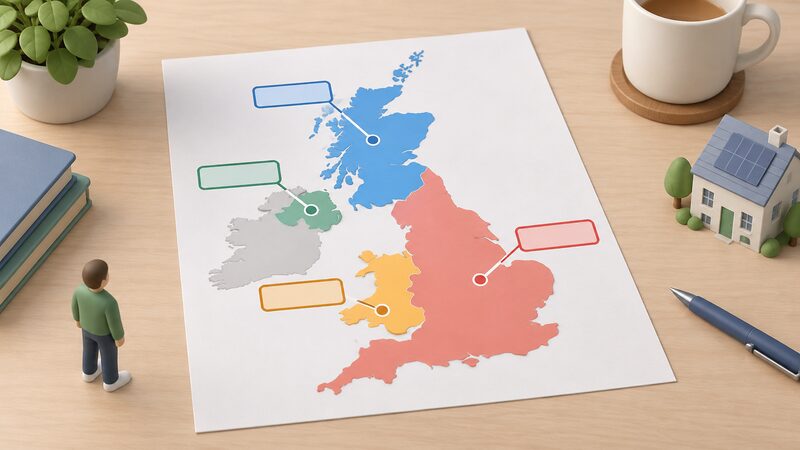
Home energy support in the United Kingdom is not one system. Help with home energy efficiency outside England is provided by the governments of Scotland, Wales and Northern Ireland, each through its own scheme, while programmes such as the Warm Homes: Local Grant cover private housing in England only1. Scotland has the Home Energy Scotland advice service and the Warmer Homes Scotland fuel poverty programme. Wales has the Nest scheme. In Northern Ireland the Affordable Warmth Scheme pays up to £7,500 towards energy efficiency measures, or up to £10,000 where a solid wall home needs insulation2.
The differences extend past grants. The Warm Home Discount does not run in Northern Ireland3. There are currently no smart electricity meters in Northern Ireland, and a rollout is planned to start in 2028, although smart meters have already been rolled out in Great Britain and the Republic of Ireland4.
This page sets out, nation by nation, what exists, who runs it, who qualifies and how the pieces compare. It links to the detailed pages on each scheme and ends with what the differences mean for a household trying to reduce its dependence on bought-in energy.
One United Kingdom, four home energy systems
The most visible divide is between Great Britain and Northern Ireland. Some UK government energy policy carries the label "Applies to England, Scotland and Wales", as the energy digitalisation framework does, and Northern Ireland sits outside it9. Within Great Britain, energy efficiency grants are a further dividing line. The Commons Library describes support in Scotland, Wales and Northern Ireland as coming from the governments of those nations, and the Warm Homes: Local Grant is aimed at private housing in England1. Tax guidance assumes the same structure. HMRC's manual on grant-funded heating supplies lists government schemes "in Wales, Scotland and Northern Ireland" next to the English example as separate grant-awarding bodies10. The page on which energy powers are devolved and which are reserved explains the constitutional reasons.
Each administration is also dealing with a different housing stock, which helps explain why the schemes are built differently. Scotland has around 2.45 million homes that vary in type, use, size, age, construction and energy efficiency11. Those homes account for around 30% of Scotland's total energy consumption (44 TWh)12. At the 2022 census, 27,859 Scottish households (1.1%) had central heating from another renewable energy source only, a category that includes electric and air pump systems13. Edinburgh's local heat strategy records that 1% of households used communal heating systems in 201914. For more, see the pages on how Scottish homes are heated, how Welsh homes are heated and how Northern Ireland homes are heated.
Benefits also differ by nation. The Cold Weather Payment is not paid in Scotland. Households there may instead receive an annual Winter Heating Payment, which is paid regardless of weather conditions in the area15.
Emergency support during the 2022 price crisis was delivered differently as well. Legislation in October 2022 provided for a £400 discount on energy bills for households in Northern Ireland through a separate Northern Ireland scheme16. By December 2022 this had become a single, one-off £600 payment to all households there18. In November 2022 the House of Lords was told that a typical Northern Ireland household had seen its energy costs increase threefold in a year19. More recently, a scheme has been announced to cut energy bills in Northern Ireland by £30 a year13.
Spending has diverged too. Evidence submitted to Parliament reported that in 2017 Northern Ireland spent 3 times as much per head on energy efficiency as England, and Wales spent 2 times as much20. The page on why energy grants differ by nation covers this in more detail.
Scotland: Home Energy Scotland advice and the Grant and Loan scheme

Almost every Scottish scheme is reached through Home Energy Scotland. Ofgem describes it as a source of free impartial advice on energy efficiency and renewable energy in Scotland, and notes that calls are free from landlines and most mobile networks21. The Scottish Government's progress reports for 2024 and 2025 both call it a "free independent advice and referral scheme". The word referral is important, because the service decides which funded programme a household is sent to as well as giving advice22. It advises householders, community groups and businesses throughout Scotland24. It is funded by the Scottish Government and is the referral partner for Area Based Scheme eligibility enquiries25. The Energy Saving Trust administers it on the Scottish Government's behalf8.
Three funding routes lead from it:
- Home Energy Scotland Grant and Loan Scheme. This offers homeowners in Scotland a grant, an interest free loan or a combination of both26. Loans have also been available to cover additional costs23. The Grant and Loan page has the detail, and the closed Loan and Cashback scheme has a page of its own.
- Area Based Schemes. Councils deliver these in partnership with the Scottish Government. West Lothian's scheme gives homeowners grant funding that focuses on solid wall insulation and other measures for homes that are hard to treat because of non-standard construction5. Glasgow's scheme gives home owners and landlords access to grant funding that meets the Scottish Government's future minimum energy efficiency standards24. See HEEPS Area Based Schemes.
- Private Rented Sector Landlord Loan. This is available in addition to Area Based Scheme grants. It supports landlords who are ineligible for those schemes to install energy efficiency and renewable energy measures in line with Scottish Government regulations25.
The service also runs an online Funding Finder that searches for funding and support on improving a home's energy efficiency, reducing bills and making the home warmer27. UK-wide bodies direct Scottish callers to the same number. The Met Office's winter guidance gives 0808 808 2282 for Scotland28. Ofgem's Energy Company Obligation guidance tells people living in Scotland to contact Home Energy Scotland on that number29.
A Scottish household therefore has one number to call and several possible results: a grant, a loan, a council-run scheme or the fuel poverty programme described next. The page comparing Home Energy Scotland with Northern Ireland's advice services sets the two models side by side.
Warmer Homes Scotland: the national fuel poverty programme
Warmer Homes Scotland is the Scottish Government's national fuel poverty scheme. It helps households in, or at risk of, fuel poverty to improve their heating and energy efficiency30. It was launched in September 201532 and relaunched in 2023 with increased funding for clean heating systems30.
Who it serves
The scheme is available to owner-occupiers and some private rented sector tenants who are living in or at risk of fuel poverty and who meet the qualifying criteria32. The Scottish Government's 2024 progress report says it mainly supports owner occupiers but also covers tenants in private rented homes33. Earlier annual reviews used a definition under which a household was in fuel poverty if it would need to spend more than 10% of its income on all household fuel use34. When the definition changed, the 2016 to 2017 review recommended reviewing the eligibility criteria so that the scheme continued to meet its objective35. That objective, as first stated, was to reduce fuel poverty by reducing the heating costs of vulnerable households36. The current definition is on the page about fuel poverty in Scotland.
What it installs
The scheme funds a range of heating and insulation measures, including renewable and micro-renewable heating, to improve the energy efficiency of the property37. The focus is on heating and insulation, but renewable and micro-generation measures have also been available, including ground source heat pumps, micro-wind, micro-hydro and micro-CHP systems32. Eligible homeowners can receive fully funded support38.
Since the 2023 relaunch, the order in which heating systems are offered has been explicit:
"Where technically suitable, households are offered clean heating systems first."
If a clean heating system would increase the household's energy bills, an emission-producing system may be provided instead. Most homes also get energy-saving upgrades, whichever heating system is installed30. An expert advisory group's December 2021 recommendation pointed the same way. It said the Scottish Government's fuel poverty programmes, Warmer Homes Scotland among them, should set targets in line with the ambition to at least double the number of heat pumps each year for five years39.
Scale
The scheme has helped more than 46,000 households throughout Scotland. Around 21,000 households have been referred to the fuel poverty support programme since the new scheme launched in October 20236. Performance figures for 2025 to 2026 were added to the published headline data on 10 June 202630.
Wales: the Nest scheme and what it funds
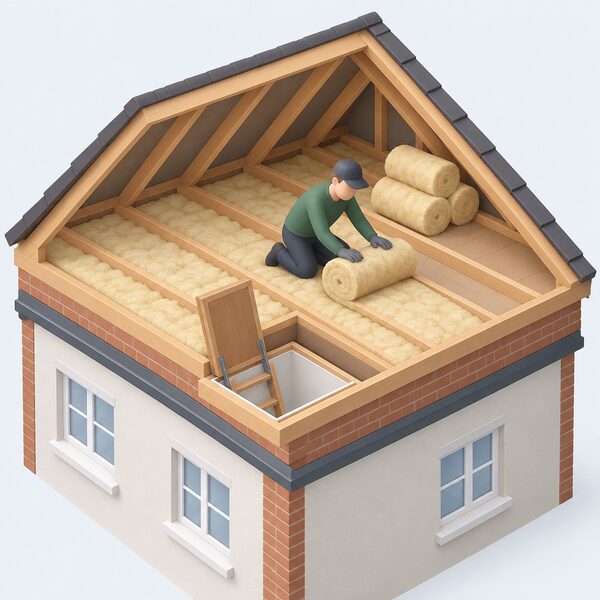
The Welsh Government's main programme is the Warm Homes Nest scheme. Its stated purpose is to make Welsh homes warmer and more energy efficient places to live7. The scheme has two tiers, advice and improvements, and they are open to different groups.
| Tier | Who it covers | What it provides |
|---|---|---|
| Advice | All households in Wales | Free, impartial advice to reduce energy bills and maximise income7 |
| Improvements | Eligible households | Free home energy efficiency improvements41 |
The advice tier is universal, and every household in Wales can use it7. The Welsh Government's climate action site describes the advice as aimed at lowering energy bills and improving health and wellbeing41. That is a broader aim than a purely technical service would have, and it reflects the scheme's beginnings as a fuel poverty measure. Welsh councils direct residents to Nest as the national route. Carmarthenshire's guidance for landlords on minimum energy efficiency standards also notes that Nest Wales provides funding for home energy improvements43.
The improvements tier is not universal. The Welsh Government's Warm Homes Programme delivers home energy efficiency improvements to eligible households44, and the scheme is run as a Welsh Government programme, not by energy suppliers or councils42. The Commons Library lists the government of Wales as the body responsible for home energy efficiency support there, alongside its Scottish and Northern Irish counterparts1.
The condition of Welsh housing explains the need. The latest comparable data puts homes in Wales at the lowest average energy efficiency rating of the four nations45. The 2017 spending comparison found Wales spending 2 times as much per head as England on energy efficiency20. For the stock itself, see Wales' housing stock and EPC ratings. For the predecessor area programme, see Arbed. The standard applying to social landlords is on the Welsh Housing Quality Standard page. Fuel poverty measurement in Wales is covered on the page about fuel poverty in Wales.
Northern Ireland: the Affordable Warmth Scheme and its £7,500 grant
Northern Ireland has no Warm Home Discount. Ofgem's page on that scheme directs readers to the Affordable Warmth Scheme instead3. The Housing Executive delivers the scheme46. It is directed at low-income households2, and its aim is to help with the effects of fuel poverty and energy inefficiency47.
Grant levels and scale
A household may receive up to £7,500. Where the home is of solid wall construction and needs insulation, grant aid may reach £10,0002. The Department for Communities gave the same figures in June 202348. In 2023-24, improvements were made to 2,746 homes at a cost of £14.4 million49. In July 2020, by comparison, a Belfast City Council paper recorded confirmed scheme funding of £12M across Northern Ireland for 2020-202150. Grants are subject to the availability of funding2.
Eligibility
The scheme rules list the following conditions2:
- the applicant lives in Northern Ireland;
- the applicant owns and occupies the property as a main home (or has a life interest arrangement in it), or rents from a private landlord;
- total annual gross household income is less than £23,000;
- the property is not a holiday home, bed and breakfast or commercial establishment;
- private tenants have their landlord's consent for the work.
Housing Executive and housing association tenants are not eligible2. Belfast City Council also notes that people who receive certain benefits could be eligible46.
The order of measures
Work is approved in a fixed order of priority2.
| Priority | Category | Measures |
|---|---|---|
| 1 | Insulation, ventilation, draught-proofing | Loft insulation installed or topped up to 300mm; roof, loft and eaves ventilation; hot water cylinder jacket; cavity wall insulation if suitable; draught proofing of doors and windows; removal and replacement of ineffective cavity wall insulation |
| 2 | Heating | Replacing solid fuel, LPG or Economy 7 with natural gas or oil central heating; converting Economy 7 to a high efficiency electrical storage system (only where gas and oil are not available); boiler replacement or system upgrade |
| 3 | Windows | Replacing single glazed windows |
| 4 | Solid wall measures | Solid wall insulation (detached properties only) |
A boiler replacement requires a boiler at least 15 years old. The householder must also be over 65, or have a child in receipt of Child Benefit or Kinship payments, or receive Disability Living Allowance, Personal Independence Payment, Attendance Allowance or Industrial Injuries Benefit2. The heating priority funds gas and oil central heating. That differs plainly from Scotland's clean-heating-first rule, and the page on oil heating in Northern Ireland gives the background.
How an application runs
- The householder contacts the NI Energy Advice Service on freephone 0800 111 4455 or uses its online form46.
- If the household appears to meet the entry requirements, an application form is sent. It is returned to the local Grant Office with supporting documents: wage slips, benefits award letters and bank statements as proof of income, plus proof of ownership or private tenancy and of main residence2.
- A technical assessment of the home follows, which may take up to 60 minutes2.
- Written approval confirms the grant amount, that work may start, the measures and their order of priority, and the completion date. Work is usually expected to finish within three months of approval2.
The householder appoints and employs the contractor. The Housing Executive states that it is not responsible for contractors and that work must follow building regulations. A gas boiler must be fitted by a registered Gas Safe engineer. Installers of cavity or solid wall insulation must be able to provide a minimum 25-year guarantee. The householder should not have to contribute to the agreed work, but pays the difference for any extra items the Grants Office does not approve2. Full detail is on the Affordable Warmth Scheme page.
Northern Ireland Sustainable Energy Programme: how the £8 million fund works
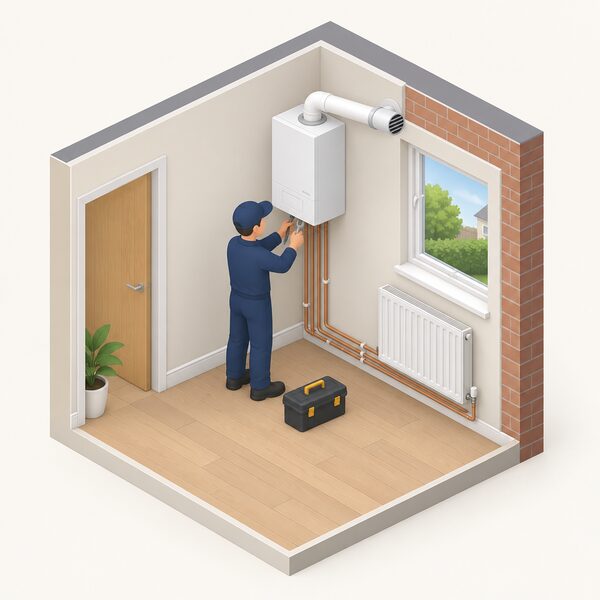
The second pillar in Northern Ireland is not funded by taxpayers. The Northern Ireland Sustainable Energy Programme (NISEP) is an £8 million fund collected from both domestic and business customers. The Energy Saving Trust administers it on behalf of the Utility Regulator8. Households pay for it through their bills and, if they qualify, benefit from the measures it funds.
For households it pays for a range of energy saving schemes, such as boiler upgrades, LED light bulbs and draught proofing51. NISEP is not a single scheme with a single application form. The Utility Regulator approves a list of individual schemes each year for homes and businesses in Northern Ireland. The schemes vary by location and licence area52, and they cover both domestic and business customers53.
Funding is divided into four categories54:
| Category | What it covers |
|---|---|
| Priority whole house solutions | Heating and insulation measures |
| Priority individual measures | Insulation and various other energy efficiency measures |
| Priority whole house solutions (innovative) | Innovative measures |
| Non-priority conventional schemes | Various measures for non-priority domestic and commercial customers |
Priority has been weighted this way since the programme began. The 2009 framework document allocated £2,460,041 to whole house schemes and £3,328,290 to individual measures for 2010/11. For 2011/12 the figures were £2,521,542 and £3,411,498, both marked as subject to review55. Those are the founding allocations and not current budgets, but they show the programme was designed from the start to favour priority households.
The Utility Regulator published the 2024/2025 annual report on 3 July 2026. It reports outturns for spend, savings and properties treated54. The NISEP page explains how the scheme lists work and what is planned to follow the programme. The supplier-funded obligation that operates in Great Britain is covered on the page asking whether the Energy Company Obligation applies in Northern Ireland.
Smart meters: why Northern Ireland differs, and what changes next
Metering is where the gap between Great Britain and Northern Ireland is widest. The Consumer Council states that there are currently no smart electricity meters in Northern Ireland, although they have already been rolled out in Great Britain and the Republic of Ireland. The Department for the Economy has announced plans for a rollout to all homes in Northern Ireland, starting in 20284.
The Consumer Council lists the expected benefits: reduced electricity costs, more accurate bills, support for a more reliable electricity network, and a contribution to Northern Ireland's net zero emissions targets4. Until the rollout, consumption statistics are compiled differently. In the official domestic electricity consumption indicator, Northern Ireland meters are classified as domestic on the basis of their tariff type56. Meanwhile, the existing meter stock is being renewed under the NIE Networks meter replacement programme.
Coverage is uneven within Great Britain too. An Ofgem statutory consultation from August 2025 recorded domestic electricity smart meter coverage in Scotland as 10% lower than in Wales57. Scottish Government research with fuel poor households, published in September 2020, found that people without smart meters had concerns about perceived inaccuracy and about data privacy and security. The same research found no notable differences in use of, or attitudes towards, smart meters between its main groups of interest58.
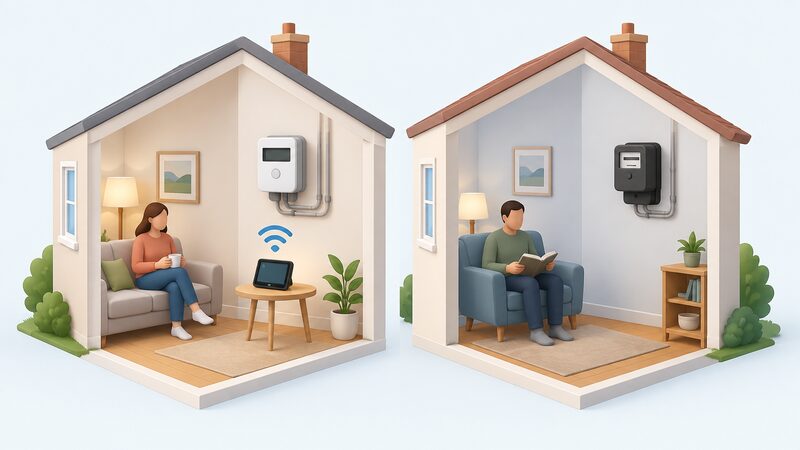
The lack of smart meters is not evidence that Northern Ireland homes perform poorly. The latest comparable data gives Northern Ireland the highest average energy efficiency rating, followed by Scotland and England, with Wales lowest45. See the average EPC rating in Northern Ireland for the figures.
Who to contact in each nation
Each nation has a free, impartial advice service that leads into its grants.
| Nation | Service | Contact | What it does |
|---|---|---|---|
| Scotland | Home Energy Scotland | 0808 808 2282, Monday to Friday 8am to 8pm, Saturdays 9am to 5pm5 | Free advice, plus referral to Warmer Homes Scotland, Area Based Schemes and the Grant and Loan scheme25 |
| Wales | Nest | Through the Welsh Government Warm Homes Nest scheme42 | Free, impartial advice for all households, and improvements for eligible households7 |
| Northern Ireland | NI Energy Advice Service | Freephone 0800 111 4455 or online form46 | Independent and impartial advice, plus referrals to energy grants and other sources of help59 |
| England, Wales and Northern Ireland | National Energy Action | Charity advice service60 | Advice and support to stay warm and manage energy costs60 |
In Northern Ireland, nidirect states that the Consumer Council NI and Northern Ireland Energy Advice both give free, independent and impartial energy advice to all domestic householders61. NI Energy Advice is also the required first contact for an Affordable Warmth application2.
England has no single national advice line equivalent to Home Energy Scotland, and local services do the job. Bristol's ECO Flex statement of intent, for example, sends residents to a local Home Energy Team on 0800 082 223462. Ofgem's guidance for Great Britain's supplier obligation also tells people living in Scotland to contact Home Energy Scotland29.
How the four nations compare at a glance
| England | Scotland | Wales | Northern Ireland | |
|---|---|---|---|---|
| Main fuel poverty scheme | Warm Homes: Local Grant (private housing)1 | Warmer Homes Scotland31 | Warm Homes Nest7 | Affordable Warmth Scheme2 |
| Warm Home Discount | Runs | Runs | Runs | Does not run3 |
| Cold weather benefit | Cold Weather Payment | Winter Heating Payment, paid regardless of weather15 | Cold Weather Payment | Cold Weather Payment |
| Smart electricity meters | Rolled out | Rolled out, coverage 10% lower than Wales57 | Rolled out | None at present, rollout from 20284 |
| Average energy efficiency rating rank | Third | Second | Lowest | Highest45 |
Private renters and landlords
How private renters are treated is one of the clearest differences between the nations.
- England. The Warm Homes: Local Grant covers privately rented properties with an EPC rating of Band D or E. For a private landlord's second and subsequent properties it pays 50% of the cost, up to £7,50063.
- Scotland. Warmer Homes Scotland covers some private rented sector tenants32. Area Based Schemes can give landlords access to grant funding24. The Private Rented Sector Landlord Loan serves landlords who are ineligible for those schemes25.
- Northern Ireland. Private tenants can apply to the Affordable Warmth Scheme with their landlord's consent, and social housing tenants are excluded2.
Stock and consumption
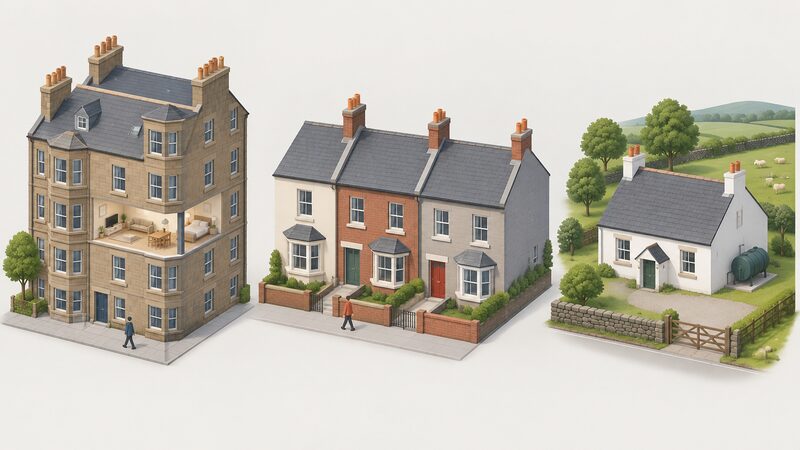
The buildings differ as much as the schemes do. The Scottish House Condition Survey 2023 shows flats making up a large share of parts of the stock. In one category it reports, households are split 56% houses and 44% flats64. The share of flats affects what can be fitted and who has to consent to it. Scottish Government planning advice from 2013 stated that households use more than a third of the electricity and more than half of the heat consumed in Scotland65. A 2019 Scottish Government appraisal noted that the rate of energy consumption in Scotland "is still higher than elsewhere in the UK"66. The pages on Scotland's housing stock, Northern Ireland's housing stock and microgeneration uptake by nation cover these differences. Planning rules for equipment are treated separately for Scotland, Wales and Northern Ireland.
What the differences mean for household energy independence
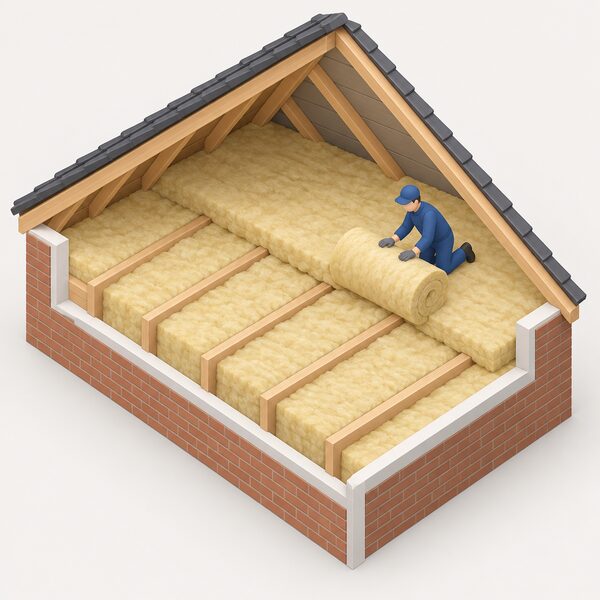
All the national schemes on this page reduce how much energy a home has to buy, which is the first step towards independence. Loft insulation to 300mm, cavity wall insulation and draught proofing are the first priority under the Affordable Warmth Scheme2, and most Warmer Homes Scotland homes get energy-saving upgrades whichever heating system is fitted30. A home that needs less heat is less exposed to price shocks of the kind that tripled typical Northern Ireland energy costs in a year19.
The nations differ on what the home depends on after the work is done. Scotland's programme now offers clean heating first where technically suitable, and it has made ground source heat pumps, micro-wind, micro-hydro and micro-CHP available. That moves a household off fossil fuel, although it still depends on the electricity grid30. Northern Ireland's heating priority replaces solid fuel, LPG or Economy 7 with natural gas or oil central heating. This improves comfort and efficiency but leaves the household tied to a delivered or piped fossil fuel2. Oil is covered on the pages on oil versus gas heating in Northern Ireland and the home heating oil scheme.
Metering sets another limit. With no smart electricity meters before the 2028 rollout, Northern Ireland households cannot yet use meter-enabled ways of managing consumption4. In Scotland, coverage lags behind Wales, and some households decline a meter over concerns about accuracy and data57.
Three kinds of dependence remain in every nation:
- Dependence on budgets. Affordable Warmth grants are subject to the availability of funding2, and NISEP is approved as an annual list of schemes52. A household's route to lower energy use is only as secure as the funding round it falls into.
- Dependence on eligibility. The funded tiers are aimed at low incomes and fuel poverty: a £23,000 income ceiling in Northern Ireland2, fuel poverty criteria in Scotland32 and eligible households in Wales44. Households above those lines get advice, not installed measures. In Scotland they also have the Grant and Loan route26.
- Dependence on tenure. Owner occupiers have the most options everywhere. Private tenants need a landlord's consent in Northern Ireland2, and social tenants are outside these schemes entirely.
The practical result is that the same house would be offered different measures, under different rules, depending on which side of a border it stands. Devolution and household energy independence develops that argument. The climate targets behind each nation's choices are set out for Scotland, Wales and Northern Ireland.
Sources66 cited
- Help with energy efficiency, heating and renewable energy in homes, House of Commons Library
- Affordable Warmth Scheme, Northern Ireland Housing Executive
- Warm Home Discount, Ofgem
- Smart meters, The Consumer Council, 2026
- Energy Efficient Scotland: Area Based Schemes, West Lothian Council
- Heat in Buildings progress report 2025, page 8, Scottish Government, 2025-10-02
- Home energy efficiency, Bridgend County Borough Council
- Help with energy efficiency, heating and renewable energy in homes (full briefing), House of Commons Library, 2026-05-13
- Energy digitalisation framework, UK Government, 2026-03-23
- VAT: grant-funded heating supplies manual, HM Revenue and Customs
- Energy efficiency in homes, Scottish Government
- Heat in Buildings Strategy, Scottish Government, 2021-10
- Research briefing CBP-9838, House of Commons Library, 2026-08-06
- Edinburgh Local Heat and Energy Efficiency Strategy, City of Edinburgh Council
- Cold Weather Payment, UK Government
- Energy Prices Bill publication, UK Parliament, 2022-10-18
- Government introduces new Energy Prices Bill, UK Government, 2022-10-11
- Help with energy bills for homes across Great Britain and Northern Ireland, UK Government, 2022-12-19
- Energy Prices (Domestic Supply) (Northern Ireland) Regulations 2022 debate(NorthernIreland)Regulations2022), Hansard, UK Parliament, 2022-11-16
- Written evidence on energy efficiency spending, UK Parliament Committees
- Domestic RHI: who to contact, Ofgem
- Heat in Buildings progress report 2025, page 10, Scottish Government, 2025-10-02
- Heat in Buildings progress report 2024, page 9, Scottish Government, 2024-10-10
- Area Based Schemes, Glasgow City Council
- Home energy efficiency, Argyll and Bute Council
- Local and small-scale renewables, Scottish Government
- Financial help for energy efficiency and low carbon heating improvements, City of Edinburgh Council
- Keeping your home warm in winter, Met Office
- Energy Company Obligation: homeowners and tenants, Ofgem
- Warmer Homes Scotland scheme: headline data, Scottish Government, 2025-10-29
- Warmer Homes Scotland annual review 2018-19, Scottish Government, 2020-07-30
- Energy saving home improvements, Scottish Government
- Heat in Buildings progress report 2024, page 7, Scottish Government, 2024-10-10
- Warmer Homes Scotland annual review 2017-2018, Scottish Government, 2019-06-28
- Warmer Homes Scotland annual review 2016-17, recommendations, Scottish Government, 2018-03-26
- Warmer Homes Scotland annual review 2016-17, objectives, Scottish Government, 2018-03-26
- Tackling fuel poverty in Scotland: a strategic approach, Scottish Government, 2021-12-23
- Heat Pump Sector Deal Expert Advisory Group: Scottish Government response, Scottish Government, 2022-11-11
- Heat Pump Sector Deal Expert Advisory Group final report, Scottish Government, 2021-12
- Heating your home, Carmarthenshire County Council, 2026-04-04
- Energy price cap explained, Welsh Government Climate Action Wales, 2026-03-04
- Nest Warm Homes Programme, Welsh Government
- Minimum energy efficiency standards, Carmarthenshire County Council
- Buildings and utilities news round-up, March 2023, Welsh Government, 2023-03-01
- Research briefing CBP-9889, House of Commons Library
- Stay warm at winter, Belfast City Council
- Energy saving grants in your area, nidirect
- Change in delivery of the Affordable Warmth Scheme, Department for Communities, 2023-06-02
- Northern Ireland Housing Statistics 2023-24, NISRA, 2023-24
- Affordable Warmth update, Belfast City Council, 2020-07-17
- Cost of living support, Belfast City Council
- NISEP list of schemes 2024-25, Utility Regulator, 2024-10
- NISEP list of schemes 2023/2024, Utility Regulator, 2023-05-09
- NISEP 2024/2025 annual report, Utility Regulator, 2026-07-03
- NISEP framework document, Utility Regulator, 2009-09
- Domestic electricity consumption indicator, Office for National Statistics
- Smart Meter Guaranteed Standards statutory consultation, Ofgem, 2025-08-08
- Research into the lived experience of fuel poverty in Scotland, Scottish Government, 2020-09-03
- Insulation, nidirect, 2026-09-02
- Worried about your energy bills, Energy Ombudsman, 2026-03-24
- Low carbon heating, nidirect
- Bristol ECO Flex statement of intent, Bristol City Council, 2023-06-06
- Warm Homes: Local Grant, Greater Manchester Combined Authority
- Scottish House Condition Survey 2023: key findings, Scottish Government, 2023
- Microgeneration planning advice, Scottish Government, 2013-03-04
- Permitted development rights work programme: sustainability appraisal, Scottish Government, 2019-06