

In this guide
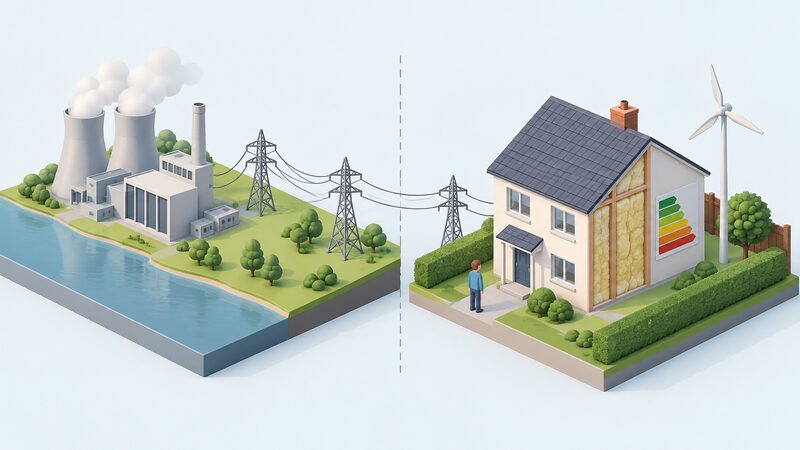
Energy policy in the United Kingdom is split, and the split does not run where most households assume. The energy system itself is reserved: generation, transmission, distribution and supply of electricity, oil and gas are matters reserved to the UK Government, together with consumer protection, product standards, weights and measures1. What is devolved is the building the energy is used in. Housing, building standards, planning, social housing standards and fuel poverty strategy sit with the Scottish Government, the Welsh Government and the Northern Ireland Executive, which is why the grant schemes, the retrofit programmes and the fuel poverty targets differ so sharply between the four nations while the tariff on the bill does not.
The practical consequence is that a household in Cardiff, Glasgow or Belfast faces a bill whose structure is set in Westminster and Ofgem, and a home whose insulation standards and grant eligibility are set in Cardiff Bay, Holyrood or Stormont. Even where the two touch, the reserved side wins: the Minimum Energy Efficiency Standards in the private rented sector are set by the UK Government precisely because energy is a reserved matter2, and consumer protection is controlled by the UK Government even where the heating policy driving the purchase is Scottish3. Fuel poverty, by contrast, is a devolved policy area and is defined and measured differently in different parts of the UK4.
Northern Ireland is a third case rather than a variation on the second. It sits outside the Great Britain price cap, outside the Energy Company Obligation and outside much of the Ofgem licensing framework, with its own department and its own regulator, and its own statutory routes for resolving disputes.
The reserved side: licensing, networks, levies and the cap
The reserved list is the backbone of the household bill. Energy infrastructure and regulation is the responsibility of the UK Government9. Supply licensing, network regulation and the conditions attached to a supplier's licence all flow from Westminster legislation and from Ofgem as the Great Britain regulator. The Energy Prices Act 2022 illustrates how far that reach goes: under section 21, the Secretary of State may modify an energy licence, including any conditions, standard or otherwise, of a licence, where that is considered appropriate in response to the energy crisis or in connection with the Act or a domestic energy price reduction scheme10. No devolved legislature has an equivalent lever.
Consumer representation is reserved on the same basis. Citizens Advice has statutory responsibilities to represent the interests of energy consumers across Great Britain11, a Great Britain remit rather than four national ones. Most consumer powers, including legislating for consumer rights and consumer enforcement, remain reserved to the UK Government12, a point the Scottish Government has stated plainly in its own heat in buildings work.
Regulation of energy efficiency, despite its obvious overlap with housing, also rests with the UK Government13. The Welsh Government has put the same thing in ordinary words in its energy efficiency strategy: laws about energy efficiency are made by the UK Government, but Wales wants to do everything it can so that Wales is using and managing its energy well14. That sentence captures the whole devolved position: influence over delivery, not over the statute.
A further layer sits above the regulator. The first Strategy and Policy Statement for energy policy in Great Britain was put into force in May 202415, giving UK ministers a formal route to set the strategic frame within which Ofgem operates. Heat networks, long outside the licensed regime, were brought in by the Energy Act 2023, passed by the UK Parliament, which will bring new consumer protections for heat network consumers across Great Britain16.
The price cap is a Great Britain instrument, and it caps rates rather than bills

The price cap is the clearest single example of a reserved power landing directly on the kitchen table. It protects people on standard variable tariffs, where the unit rate can go up or down depending on the energy market, and it applies where a customer has not signed up for a fixed-term contract with their supplier17. Ofgem sets the level every three months, and a separate cap is set for each of the 14 regions of Great Britain and applies throughout the region, with no breakdown below regional level17.
What the cap does not do matters as much. It sets the maximum amount a supplier can charge for a unit of energy and standing charge together; it does not limit the cost of the total bill, and the more energy used, the higher the bill17. Fixed tariffs, business energy contracts, heat networks and heating oil fall outside it17. For Northern Ireland, where heating oil is widespread, that exclusion is not a technicality.
The cap level is built from wholesale costs, network costs, policy costs, operating costs, EBIT, headroom, a levelisation allowance and VAT at 5% on gas for 1 October 2026 to 31 March 202717. The levelisation allowance exists to make sure prepayment and Direct Debit customers pay the same standing charge17. Network costs are the next most important component after wholesale, making up almost 30% of the total, and the government cut policy costs in April 2026 by ending a levy-funded energy efficiency scheme and shifting funding for the largest renewable generation support scheme to general taxation6.
| Cap detail | Figure | Period |
|---|---|---|
| Typical consumption assumed | 2,500 kWh electricity, 9,500 kWh gas18 | For cap figures |
| Direct Debit total | £1,755, up from £1,72019 | Announced 27 August 2025 |
| Standard Credit total | £1,890, up from £1,85519 | Announced 27 August 2025 |
| Prepayment total | £1,707, up from £1,67219 | Announced 27 August 2025 |
| Electricity unit rate | 27.69p per kWh, with a 54.75p daily standing charge20 | 1 January to 31 March 2026 |
| Next movement | A fall of 7%20 | 1 April to June 2026 |
For a dual-fuel home with typical usage in Great Britain paying by direct debit, the cap makes the annual bill around £1,758, with electricity at 27.69p per kWh and a 54.75p daily standing charge; Ofgem has confirmed the cap for 1 April to June 2026 will fall by 7%, and estimates suggest it is then expected to stay roughly the same until the end of the year18. Historic levels show how far the rates can move: the cap came into force at the beginning of 2019, wholesale price rises brought a 54% increase in April 2022, and the October to December 2022 cap was £3,37118. Ofgem has said it will be closely monitoring supplier compliance and will continue to take firm action against suppliers who fall short of their requirements19.
What the devolved governments actually control
The devolved side is the building, not the commodity. Wales' fourth carbon budget covers sectors where, in the Climate Change Committee's words, there are significant policy powers devolved to the Welsh Government21. The Committee provides separate advice to each of the devolved administrations on their carbon budgets, because Scotland, Wales and Northern Ireland have their own legal frameworks and decarbonisation targets22.
Four areas of real household consequence sit with the devolved governments:
- Building standards and planning. Even planning guidance is nation-specific: guidance on domestic wind turbines for England carries the warning that the policy in Wales may differ23. The practical rules are set out for Scotland, Wales and Northern Ireland.
- Fuel poverty strategy and targets. Fuel poverty is devolved and defined and measured differently in different parts of the UK4, which is the reason the rates for Scotland, Wales and Northern Ireland cannot be lined up against each other.
- Grant programmes. All three devolved administrations have additional, government-funded fuel poverty reduction programmes, focusing on energy efficiency24, which is the underlying reason grants differ by nation.
- Energy performance of buildings. Legislation relating to the energy performance of buildings is devolved in Scotland and Northern Ireland, while competition law and consumer protection law are reserved to the UK Government5.
Emissions trading is the exception that shows the rule: the UK Emissions Trading Scheme is jointly administered by the Scottish Government, UK Government, Welsh Government and Northern Ireland Executive8, one of the few genuinely shared instruments.
Northern Ireland: a separate system, not a variation
Northern Ireland's position differs in kind. The Great Britain price cap does not reach it, because the cap sets maximum prices for customers in each energy supply region of Great Britain6. The Energy Company Obligation, a government scheme requiring obligated energy companies to deliver energy efficiency measures to domestic premises in Great Britain25, does not apply either, a point covered in more detail on whether ECO applies in Northern Ireland. The Renewable Heat Incentive is likewise a Great Britain matter, with the Department for Energy Security and Net Zero responsible for RHI policy in Great Britain26.
Northern Ireland's own statutory machinery sits under its own departmental structures. Under the 2012 regulations governing certain energy disputes there, a dispute is referred to the Department, which shall appoint a suitably qualified person to determine it, and the appointed person may order as they think fit whether the costs, or any part of them, associated with the determination should be borne by one or other party27. That is a self-contained route with no Ofgem involvement.
The result is a nation where the reserved and devolved split does not describe the position well at all. Households there rely on NISEP and the Affordable Warmth Scheme rather than Great Britain schemes, and a large share of homes use oil central heating, which the cap does not cover.
The statutory plumbing: where the powers are written down

The reserved powers are not abstract. The Energy Performance of Buildings (England and Wales) Regulations 2012 were made under section 2(2) of the European Communities Act 1972 and section 74 of the Energy Act 201128, and the 2013 amending regulations under sections 9(2), 40(1) and 74 of the Energy Act 201129. Those instruments extend to England and Wales, not to Scotland or Northern Ireland, which is the mechanical expression of the devolution of building energy performance5.
Elsewhere the Secretary of State holds broad enabling powers over schemes. Under section 212 of the Energy Act 2004, the Secretary of State may give financial assistance to a scheme administrator, may make payments to the scheme administrator otherwise than as financial assistance, may guarantee the discharge of any financial obligation incurred by the scheme administrator, and may make regulations conferring or imposing specified powers or duties on scheme administrators30. In planning, procedural safeguards run in the other direction: where the Secretary of State is considering exercising the call-in power, written notice must be given to the relevant local planning authority, and a direction is subject to a disallowance period of 28 days beginning with the date on which the direction is made31.
The Energy Bill that became the Energy Act 2023 was centred on three pillars: leveraging investment in clean technologies; reforming the UK's energy system and protecting consumers; and maintaining the safety, security and resilience of the energy systems across the UK32. The third pillar is expressly UK-wide, which is a reminder that security of supply is not divisible by nation.
Where the boundary causes friction
The sharpest friction is over bills. Levies sit on the reserved side, and the devolved governments can only argue. The Scottish Government has urged the UK Government to rebalance environmental and social obligation costs on energy bills to reduce the premium paid by customers using electric heating33. The Welsh Government has drawn attention to UK Government policy supporting energy intensive industries with their energy costs by applying a levy to the bills of other consumers34. The Climate Change Committee's position is that making electricity cheaper, through rebalancing prices to remove policy levies from electricity bills, is a key recommendation35.
That matters because the devolved side owns the heat transition in buildings while the reserved side owns the price signal that determines whether a heat pump is cheaper to run than a boiler. A household in Scotland or Wales can be pushed towards electrification by devolved building policy and penalised for it by reserved levy policy at the same time.
There is a second friction over standards. Minimum Energy Efficiency Standards for the private rented sector are set by the UK Government because energy is reserved2, yet the building standards those homes must otherwise meet, and the social housing standards such as the Welsh Housing Quality Standard, are devolved. Two regimes act on the same wall.
"Energy, including generation, transmission, distribution and supply of electricity, oil and gas are matters reserved to the UK Government, together with consumer protection, product standards, weights and measures"
What the split means for a household's energy independence
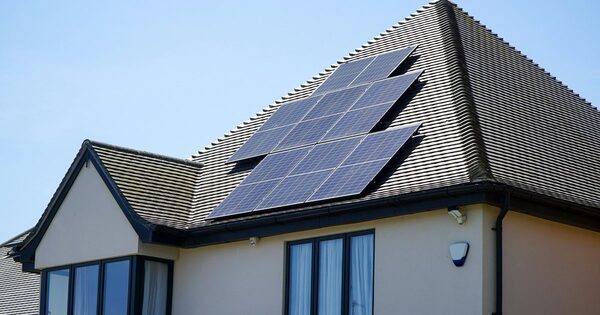
For a household trying to reduce its dependence on suppliers and imported fuel, the division of powers decides which door to knock on. Everything that changes the home itself, insulation, glazing, a heat pump, a solar array and its planning permission, runs through devolved policy and devolved grant schemes. Everything that changes the terms of the connection, the standing charge, the unit rate, the supplier's obligations and the protections when something goes wrong, runs through Westminster and Ofgem.
The dependence that remains is substantial and reserved. The UK is a net energy importer with a high dependence on gas and oil36, and it has been strongly affected by the energy crisis due to its dependence on natural gas for heating, electricity generation and industry37. In 2023 fossil fuels accounted for 76.6% of UK energy consumption, 1.6 percentage points lower than in 202238. The British energy security strategy set out how Great Britain would accelerate homegrown power for greater energy independence39, and the direction of travel on the electricity side is real: the phase out of coal from UK electricity generation continues alongside ongoing expansion of the second largest national offshore wind capacity40. System planning sits with the National Energy System Operator, responsible for "planning and delivering the energy of today and the future"41.
The generation picture also shows why devolved and reserved arguments recur. Renewables accounted for 29.3% of electricity generation for the UK as a whole, or 25.6% for the rest of the UK excluding Scotland42, a gap that underpins Scottish arguments about the mismatch between where power is generated and where the rules are set. On the demand side, domestic energy demand has fallen by 19% since 2000, despite a 12% increase in the number of households43, evidence that the devolved lever, the fabric of homes, does move the total.
None of this makes a household independent. Even a well-insulated home with its own generation remains connected to a reserved network, billed under a reserved cap and protected by reserved consumer law. What the devolved powers can do is shrink the quantity of energy that has to be bought under those terms, and shift the remainder from gas to electricity. The Climate Change Committee's assessment of the Heat and Buildings Strategy put the logic directly: delivering on those goals will help to protect UK consumers from future price spikes and increase energy security by reducing energy needs and shifting demand from gas to electricity, which in future will be predominantly supplied from UK-based renewable generation44.
For the wider picture of how these differences play out in each nation, see the overview of home energy across the UK nations and the companion page on devolution and household energy independence.
Sources44 cited
- Tackling Fuel Poverty in Wales 2020 to 2035, consultation outcome, Welsh Government, 2 March 2021
- Decarbonising private housing: the net zero elephant in the energy inefficient room, Senedd Research, 20 September 2026
- Heat in Buildings Strategy, easy read, Scottish Government, 7 March 2022
- Fuel poverty in the UK, House of Commons Library, April 2025
- EPC reform consultation, government response, Scottish Government, 21 January 2025
- Domestic energy prices and the price cap, House of Commons Library, 20 September 2026
- Energy Company Obligation ECO3 final determination report, Ofgem, 9 February 2023
- Climate change policy, Scottish Government, 17 September 2026
- Protection for energy customers ahead of RTS switch off, Scottish Government, 15 March 2025
- Energy Prices Act 2022, legislation.gov.uk, 2022
- Citizens Advice response to Ofgem consultation, Ofgem, June 2016
- Heat in Buildings quality assurance policy statement, Scottish Government, 7 June 2022
- Development of an energy efficiency strategy for Wales, Welsh Government, 15 October 2014
- Energy Efficiency in Wales: a strategy for the next 10 years, Welsh Government, 2016
- Electricity distribution networks study, government response, UK Government, 7 July 2025
- Delivering net zero for Scotland's buildings, Heat in Buildings Bill consultation, Scottish Government, November 2023
- Energy price cap, Ofgem, 17 September 2026
- Energy price cap briefing, House of Commons Library, 28 August 2026
- Summary of changes to the energy price cap, 1 October to 31 December 2025, Ofgem, 27 August 2025
- Energy price cap explained, Welsh Government Climate Action Wales, 2026
- Modern electric technologies offer Wales a bright future, Climate Change Committee, 14 May 2025
- The Seventh Carbon Budget, Climate Change Committee, 26 February 2025
- Wind turbines planning guidance, Planning Portal, 17 September 2026
- Good progress in some areas but much more needed, Climate Change Committee, 26 June 2013
- ECO4 scoring methodology decision, Ofgem, 12 April 2022
- Domestic RHI annual report, scheme year 11, Ofgem, July 2025
- Northern Ireland energy regulations, article 27, legislation.gov.uk, 2012
- The Energy Performance of Buildings (England and Wales) Regulations 2012, legislation.gov.uk, 17 December 2012
- The Energy Performance of Buildings (England and Wales) etc. (Amendment) Regulations 2013, legislation.gov.uk, 9 January 2013
- Energy Act 2004, Part 6 Chapter 4, legislation.gov.uk, 2004
- The Town and Country Planning (Development Management Procedure) Order 2015, legislation.gov.uk, 2015
- [Energy Bill [HL] 2022-23](https://commonslibrary.parliament.uk/research-briefings/cbp-9787/), House of Commons Library, 20 September 2026
- Tackling fuel poverty in Scotland: a strategic approach, Scottish Government, 23 December 2021
- Ofgem call for input on standing charges: Welsh Government response, Welsh Government, 15 February 2024
- Scotland's Carbon Budgets, Climate Change Committee, 21 May 2025
- Spring Statement 2022, HM Treasury, March 2022
- Climate policy that cuts costs: international policy comparison, Climate Change Committee, 19 September 2026
- DESNZ annual report and accounts 2025 to 2026, performance report, Department for Energy Security and Net Zero, 2026
- British energy security strategy, UK Government, 7 April 2022
- Progress in reducing emissions, 2025 report to Parliament, Climate Change Committee, 25 June 2025
- National Energy System Operator briefing, House of Commons Library, 10 July 2026
- Annual Energy Statement 2019, Scottish Government, 15 May 2019
- Future Insights series: domestic energy demand, Ofgem, March 2017
- Independent assessment: the UK's Heat and Buildings Strategy, Climate Change Committee, 16 March 2022
 Devolution and Energy PowersLiving in Scotland, Wales or Northern Ireland can mean different grants and building rules for your home than in England.
 The Full Rules and Regulation GuideConfused about who actually decides what you pay for gas and electricity, or why rules differ in Scotland and Wales?
 Utility Regulator NIWho sets your energy prices in Northern Ireland and who can you complain to?
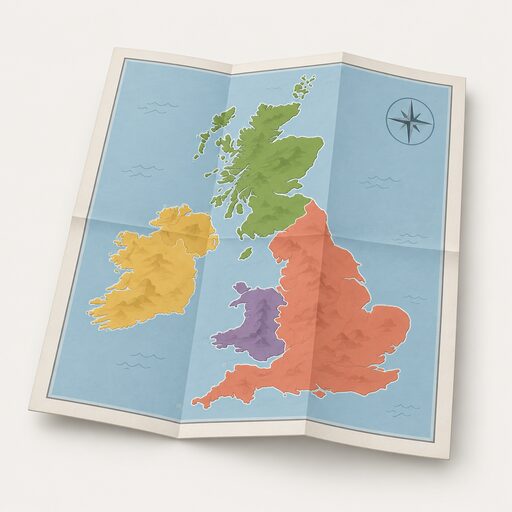 The Full Scotland, Wales and Northern Ireland GuideWhy a householder in Glasgow, Cardiff or Belfast faces different schemes, standards, targets and markets from one in England.
 Energy Policy in ScotlandWho decides how your home in Scotland is heated and improved?
 Check Which Energy Grants ApplyWhich energy grants can you actually get right now, and which have closed?