

In this guide
Wales has the oldest housing stock in the UK, with 26% of it built before 1919, and the private rented sector is older still, at 43% pre-19191. That age profile is the single biggest reason Welsh homes sit at the bottom of the British energy performance table. The Welsh Government's own assessment is blunt: Wales has the oldest and least thermally efficient housing in the UK and Europe2.
The measured position is that the average Welsh dwelling scores SAP61 on the RdSAP scale, which is the bottom of EPC band D3. Homes in Wales had a median EPC score of 68, band D, according to records from the ten years up to March 20254. Newer homes are a different story: new dwellings in Wales had a median EPC score of 84 over the five-year period to March 2025, up from 81 in the five-year period to March 20134.
For a household, the practical meaning is that the fabric of the building, not the fuel or the tariff, is usually the binding constraint on both bills and comfort. This page sets out what the Welsh stock looks like, how far EPC data actually reaches, what the Warm Homes Programme has done, and what the carbon budgets now require of Welsh homes.
Wales' housing stock in brief: the oldest in Britain and the hardest to heat
The age of the Welsh stock is not a marginal factor. Wales has the oldest housing stock in the UK, with 26% of this stock pre19191. The private rented sector has the oldest stock and highest proportion of poor quality housing, with 43% of stock pre19191. Just 6% of Welsh housing was built in the last 30 years, against that deep pre-war base3.
Age translates directly into thermal performance. Pre-1919 dwellings average EPC E (SAP53), and only dwellings constructed post 2000 achieve EPC band C on average (SAP73)3. The average energy efficiency for dwellings in Wales, calculated using RdSAP, is SAP61, which is the bottom of EPC band D3. The Welsh Government has described Welsh homes as among the oldest and least energy efficient in Europe7, and separately as the oldest and least thermally efficient housing in the UK and Europe2.
The headline distribution figure is that 63% of Welsh housing stock was graded EPC Band D or below in 20225. A separate 2022 figure puts 25% of Welsh housing stock as pre-dating 1900, the largest proportion in the UK5. Tenure matters as much as age: owner occupiers account for the greater part of housing stock at 70%, with registered social landlord stock at 10%8. Social housing performs best on EPC, having the highest percentage of dwellings in EPC bands C or above, while 55% of flats had an EPC band C and above, against 25% of houses9.
The survey basis for much of this is the Welsh Housing Conditions Survey (WHCS) 2017-2018, whose purpose was to provide an estimate of the condition and energy efficiency and performance of the housing stock in Wales10. It assessed dwellings against the Housing, Health and Safety Rating System (HHSRS) and the Welsh Housing Quality Standard (WHQS)10. The age and condition figures above are drawn from that survey, so they describe the stock as measured in 2017-2018 rather than today.

EPC coverage: what the data shows and what it doesn't
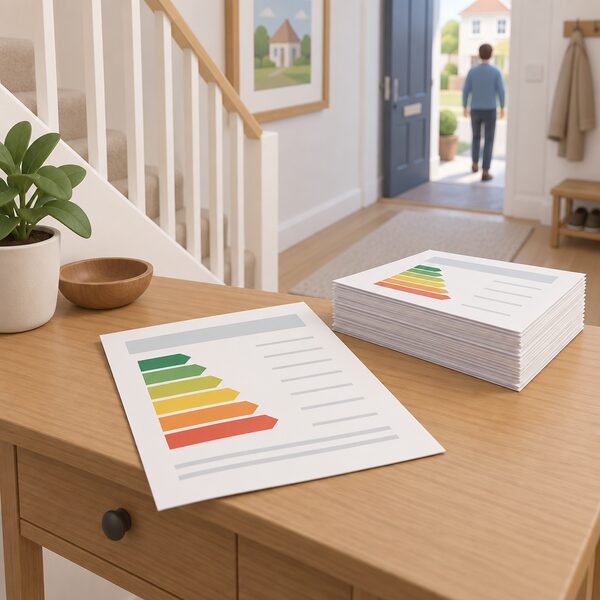
Every EPC figure on this page comes with a coverage caveat that the statistics themselves state plainly: these statistics do not cover the entire building stock across England and Wales11. That is not a technicality. It means the EPC record is a sample of the stock, weighted towards homes that have been sold, let or newly built, and it is the only large-scale measured dataset available.
The coverage estimates differ by method and by date. Measured against Census 2021 housing stock, EPCs cover around 60% of the housing stock in England and around 55% in Wales12. A later release puts it higher: EPCs cover around 71% of the housing stock in England and around 67% in Wales13. A 2023 release sits between the two, at just less than 60% in Wales14. The most recent ONS analysis states that 67% in Wales had at least one EPC registration since records began in 2007, as of March 20254. The gap between the 55% and 67% figures reflects different denominators and different counting rules, and both are in circulation.
Coverage is not evenly spread across the stock. A much smaller proportion of dwellings built before 1930 were covered by an EPC (58%), compared with dwellings built since 2012 (90%)4. The homes least likely to have a measured rating are the older, harder-to-treat ones that most need one.
There are further exclusions. The Rent Smart Wales dashboard does not include properties on the Rent Smart Wales database where the address data is insufficient to match with an EPC15. New house building data does not include information from other private approved inspectors, likely resulting in an undercount in the total number of new dwellings started and completed in Wales16. Any count of Welsh homes, and any count of Welsh EPCs, is therefore a floor rather than a total.
EPC ratings across Wales: why the stock lags behind
The distribution of ratings in Wales is shaped by three things: the age of the stock, the dominance of solid-wall construction in the oldest tranche, and the tenure mix. The 63% of Welsh housing graded EPC Band D or below in 2022 is the summary figure5. The average dwelling sits at SAP61, the bottom of band D3.
Lodgement volumes give a sense of how slowly the picture moves. In the 12 months to March 2023, in Wales, 80,000 domestic EPCs were lodged, a 6% decrease on the previous 12 months14. From July to September 2023, 20,000 EPCs were lodged on the Register covering domestic properties, a 3% decrease compared to the same quarter in 2022, when there were 21,000 domestic lodgements17. In the quarter April to June 2025, 2,000 EPCs were lodged for new dwellings in Wales, a 5% decrease12. These are transaction-driven numbers: an EPC is generally produced when a home is sold, let or built, not on a fixed cycle.
Where the ratings fall within a quarter varies by property type. In Wales, from July to September 2023, the majority of new properties were given a B EER (66%), while existing dwellings were more likely to receive a C (44%) or D (36%) rating17. In the quarter April to June 2025, existing dwellings were more likely to receive a C (47%) or D (33%) rating12. The pattern is consistent: new build clusters at the top of the scale, the existing stock clusters around C and D.
Heat pump presence in the EPC record is small. Of properties with EPCs, 1.4% of properties in England and 1.5% in Wales have heat pumps4. That is a measure of what is recorded on certificates, not a count of installed systems, but it indicates how little of the Welsh stock has moved to a low carbon heat source.
For a household, the EPC band is a rough proxy for running cost and for what retrofit work is likely to be needed. It is not a statement about the household's behaviour, and it does not capture appliances, tariffs or occupancy. It captures the building.
New builds: median EPC score up from 81 to 84

New build performance in Wales has improved, and the improvement is measurable. In Wales, median EPC scores for new dwellings increased from 81 to 84, comparing the five-year period to March 2013 with the five-year period to March 20254. Across England and Wales, properties built after 2012 had a higher median EPC score (84) than homes built before 20124. In both England and Wales, new builds in urban, larger rural and smaller rural areas all had a median EPC rating of 844.
The most recent quarterly data shows how tightly new build clusters at the top of the scale. In the quarter January to March 2026, 92% of new domestic properties in Wales received an energy efficiency rating of A or B, and the majority of new dwellings were given an A EER (55%)13. In the quarter April to June 2025, 90% of new domestic properties received an energy efficiency rating of A or B, with 9% rated C or D, and the majority of new dwellings were given a B EER (44%)12. Earlier quarters show the same shape: from January to March 2023, 84% of new domestic properties received an A or B rating14, and from July to September 2023, 87% did17.
Volumes have moved around. In the 12 months to March 2026, 8,000 EPCs were lodged for new dwellings in Wales, including new builds, conversions and change of use, a 19% increase on the previous year, while in the quarter January to March 2026, 2,000 were for new dwellings, a 43% increase13. In the 12 months to June 2025, 7,000 EPCs were lodged for new dwellings in Wales, a 9% decrease on the previous year12. Local spikes occur: the local authority with the largest increase in EPCs lodged for new dwellings compared to the same quarter in 2024 was Conwy, at 367%12, and in an earlier quarter the largest increase was in Blaenau Gwent, at 400%14.
The policy direction behind this is explicit. The Welsh Government has committed to build 20,000 high quality, low carbon homes for rent over the next five years18, and has set out that all new homes in Wales will be heated and powered from clean energy sources19. Improved energy efficiency from 2020 was expected to lead to a 37% reduction in CO2 from new dwellings, compared with the standards then current19.
| Measure | Wales figure | Period | Source |
|---|---|---|---|
| Median EPC score, new dwellings | 84 | Five years to March 2025 | 4 |
| Median EPC score, new dwellings (earlier) | 81 | Five years to March 2013 | 4 |
| Median EPC score, existing homes | 68 (band D) | Ten years to March 2025 | 4 |
| New domestic properties rated A or B | 92% | January to March 2026 | 13 |
| New dwellings given an A EER | 55% | January to March 2026 | 13 |
| New dwellings given a B EER | 44% | April to June 2025 | 12 |
The Warm Homes Programme: Nest and Arbed
The Welsh Government's Warm Homes Programme has been the main delivery route for improving the existing stock, and it has run through two distinct mechanisms. Nest is the Welsh Government's demand led scheme designed to tackle fuel poverty in Wales20. Arbed was the area-based counterpart, working at street and estate level. By the end of March 2020, investment of more than £366m in the Warm Homes Programme (Nest and Arbed) had improved the energy efficiency of more than 61,400 homes in Wales, drawing on European, UK and Welsh Government funding6.
Nest's scale and reach are documented year by year. In 2016/17, the Welsh Government provided £19.5m for Nest21. The scheme has also leveraged funding from other sources: it leveraged an additional £4.2m of ECO funding into Wales as of September 201420. Nest provides all householders in Wales with access to advice and support to help them reduce their energy bills21, and the advice service is available to all households in Wales22.
The scheme's purpose is targeted rather than universal in its improvement work. It is designed to help households facing an immediate risk to their health and wellbeing due to a lack of essential heating or hot water23. The Welsh Government offers free energy upgrades through the Warm Homes Nest Scheme for houses with a poor Energy Performance Certificate rating24. Nest is not identical to ECO or GBIS, the UK-wide schemes, and operates on its own eligibility rules25.
Arbed, by contrast, is closed. Its successor arrangements and the wider grant landscape are set out in why energy grants differ by nation, and the Arbed programme itself is covered in Arbed: the closed Welsh scheme.
Nest: who qualifies and what is funded
Nest eligibility has two routes, and the health route carries a specific EPC threshold. To be eligible, a home must have an EPC rating of D or lower (SAP score 68 or lower), and someone in the household must have a qualifying health condition22. The scheme looks to support people in Wales living on a lower income who receive a means tested benefit or live with a respiratory, circulatory or mental health condition26. An earlier statement of the rules described the scheme as offering a package of free home energy improvement measures to households who are in receipt of a means tested benefit who live in a very energy inefficient home, with a SAP rating of F or G20.
What is funded is a package rather than a single measure. This includes a referral for eligible householders for a package of free home energy efficiency measures such as a new boiler, central heating system, loft or cavity wall insulation, or renewable technologies21. More recent guidance describes replacement of boiler or electric storage heaters to ensure you have a safe and reliable heating system23. The Nest scheme offers a range of free, impartial advice as part of the Welsh Government Warm Homes fund27.
Private landlords face an additional condition. Nest works in partnership with Rent Smart Wales to ensure all private landlords are officially registered before being allowed access to support16. A consultation on a future demand-led fuel poverty scheme to succeed Nest proposed amending eligibility to exclude private landlords28. Separately, an EPC rating of E or above is required on domestic private rented property in Wales in order to comply with the law27.
Outcomes are recorded after installation. Around two thirds (66%) of households moved up to band C, among the 232 homes with a recorded post-installation rating in the period 1 October 2024 to 31 March 202522. In 2022-23, 23.2% of households had a SAP rating of C, 60.2% rated D, 13.7% rated E and 2.9% rated F16.
| Item | Detail | Source |
|---|---|---|
| Advice line | 0808 808 2244 | 23 |
| advicewales@est.org.uk | 29 | |
| Health route EPC threshold | Band D or lower (SAP 68 or lower) | 22 |
| Income route | Means tested benefit, or a qualifying health condition | 26 |
| What is funded | Boiler or storage heater replacement, central heating, insulation, renewable technologies | 21 |
| Landlord condition | Registered with Rent Smart Wales | 16 |
Quality assurance and the Wales-based installer network
Delivery under Nest runs through a defined installer base. A network of Wales-based installers provided the installation services under the management of the Nest team22. In 2022-23, 100% of installations were completed by Wales-based installers16. That is a deliberate feature of the scheme rather than an incidental one: it keeps the supply chain, the training and the warranty relationship inside Wales.
The advice side has its own reach figures. A direct mail campaign reached 154,764 vulnerable households in Wales in the period 1 April 2024 to 31 March 202522. All households in Wales also have access to free, impartial advice to help reduce energy bills and maximise income30. The Nest advice service is available to all households in Wales, whether or not they go on to receive physical measures22.
Complaints and customer service are handled through the same advice line. The Nest advice team can be contacted on 0808 808 2244 to log a complaint, and the customer service manager can be reached at advicewales@est.org.uk or on the same number29. The scheme publishes a customer service and complaints policy29.
For a household, the installer network matters for two reasons. First, it determines who carries out the work and therefore who holds the workmanship guarantee. Second, it means the practical quality question is about a Welsh supply chain rather than a national one. The Welsh Government's own resident engagement work, through the Active Building Centre case study, records how retrofit programmes are experienced by residents8.
What the CCC's 73% carbon budget means for Welsh homes
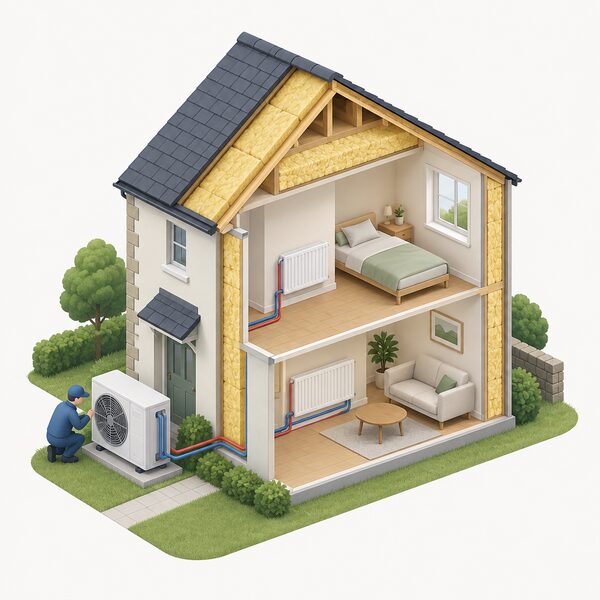
The Climate Change Committee recommended in May 2025 that Wales' Fourth Carbon Budget, covering 2031 to 2035, be set at an average annual reduction of 73% on 1990 levels, with the Welsh Government to set the budget by the end of 202531. That is the figure against which Welsh housing policy now has to be judged, and it is a steepening of an already demanding trajectory.
The existing targets are substantial in their own right. In 2019, the UK Committee on Climate Change stated that Welsh Government should target no less than a 95% reduction in carbon emissions by 2050, against 1990 levels3. Housing currently produces 21% of Welsh carbon emissions3. The decarbonisation programme requires Welsh homes to have reduced carbon demand by 80% by 20508. Other Welsh Government statements put the residential share differently: residential emissions make up 10% of all carbon emissions in Wales18, and new and existing homes currently account for 9% of Welsh greenhouse gas emissions19.
The policy instruments attached to these targets are already visible. The Welsh Housing Quality Standard has required social homes to reach not less than EPC D, with a new standard looking at a target of an A rating6. Short term UK energy efficiency targets, such as MEES requiring EPC C for private rented housing, need to go further according to the Welsh Government's own decarbonisation strategy3. The Welsh Government has also consulted on a heat strategy for Wales7.
For a household, the direction of travel is that the building fabric and the heat source are both in scope, and that the standards applied to social and private rented homes are tightening ahead of those applied to owner-occupied homes. The full picture of Welsh carbon budgets is set out in Wales' carbon budgets and net zero target, and the way Welsh homes are heated is covered in how Welsh homes are heated.
Sources31 cited
- Private sector housing renewal and adaptations, Swansea Council, 2026
- Reducing carbon emissions in our homes: new report calls for action and ambition, Welsh Government, 2019
- Homes of today for tomorrow: decarbonising Welsh housing between 2020 and 2050, Welsh Government, 2024
- Energy efficiency of housing in England and Wales, Office for National Statistics, 2025
- Energy use in Wales, Welsh Government, 2022
- Outcome summary: tackling fuel poverty 2020 to 2035, Welsh Government, 2021
- Written statement: consultation on Heat Strategy for Wales, Welsh Government, 2023
- Active Building Centre resident engagement case study, Welsh Government, 2024
- Welsh Housing Conditions Survey: energy efficiency of dwellings, April 2017 to March 2018, Welsh Government, 2018
- Welsh Housing Conditions Survey April 2017 to March 2018: technical report summary, Welsh Government, 2021
- Energy Performance of Building Certificates in England and Wales: April to June 2025, UK Government, 2025
- Energy Performance of Buildings Certificates statistical release: April to June 2025, UK Government, 2025
- Energy Performance of Buildings Certificates statistical release: January to March 2026, UK Government, 2026
- Energy Performance of Buildings Certificates statistical release: January to March 2023, UK Government, 2023
- Energy Performance Dashboard, Rent Smart Wales, 2026
- Warm Homes Nest scheme annual report 2022 to 2023, Welsh Government, 2023
- Energy Performance of Buildings Certificates statistical release: July to September 2023, UK Government, 2023
- No more fossil fuels to heat new homes, Welsh Government, 2021
- All new homes in Wales to be heated and powered from clean energy sources, Welsh Government, 2020
- Evaluation of the Nest energy efficiency scheme: summary, Welsh Government, 2015
- Warm Homes Nest report reveals benefits for homes and businesses, Welsh Government, 2017
- Warm Homes Nest scheme annual report 2024 to 2025, Welsh Government, 2026
- Get help with unexpected costs such as food and heating, Welsh Government, 2026
- Warm Homes Nest Scheme, Parliamentary Office of Science and Technology, 2026
- Written statement: support for householders impacted by closure of the Energy Company Obligation scheme, Welsh Government, 2026
- Nest: a scheme to make your home warmer and more energy efficient, Isle of Anglesey County Council, 2026
- Stricter energy efficiency rules set to apply to all private rental homes in Wales, Welsh Government, 2020
- A future demand-led fuel poverty scheme to succeed Welsh Government Warm Homes: Nest, Welsh Government, 2016
- Nest home energy support scheme: customer service and complaints policy, Welsh Government, 2024
- Home energy efficiency, Bridgend County Borough Council, 2026
- Wales' Fourth Carbon Budget, Climate Change Committee, 2025
 Housing Stock Data for WalesHow energy efficient are Welsh homes, and how many have a rating?
 Efficiency of UK HomesMost UK homes now score better on energy than they did a decade ago, but older houses still lag well behind new builds.
 New Build Energy PerformanceHow energy efficient are new build homes compared with older ones?
 Housing Stock and EPCsHow energy efficient are Scottish homes, and how many reach a good rating?
 Welsh Housing Quality StandardWhat does the Welsh Housing Quality Standard mean for your home if you rent from a council or housing association in Wales?
 Energy Policy in WalesWhat help can you get in Wales to make your home warmer and cheaper to run?