In this guide
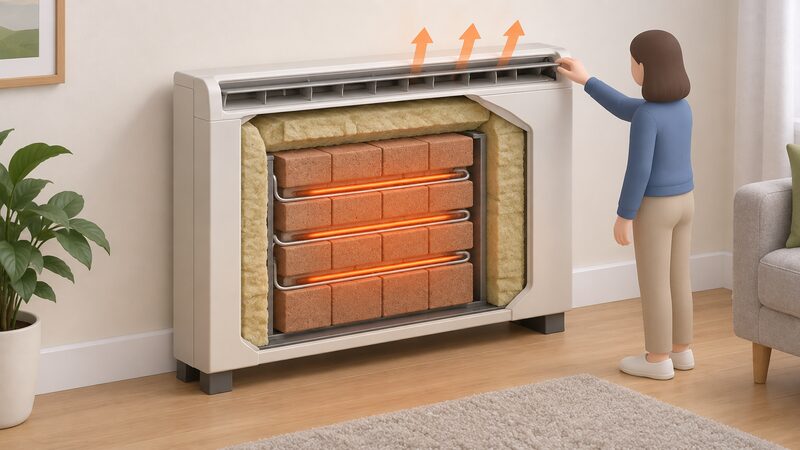
A storage heater uses cheaper off-peak night-time electricity to create and store heat, which is then released the following day1. The store is a core of heavy ceramic or clay blocks inside the casing: electric elements heat the bricks overnight, and the bricks give that heat back to the room gradually through the next day2. Because the heat is made hours before it is wanted, a storage heater has two distinct phases, a charging phase and a heating phase, and it does not produce heat instantly the way a plug-in electric heater does4.
That design only makes financial sense on a tariff with a cheap night rate. Night storage heaters were built around Economy 7 and Economy 10, tariffs historically designed for storage heating, and guidance states they should always be used on an Economy 7 tariff to take advantage of cheaper overnight electricity5. Economy 7 gives seven off-peak hours, usually between midnight and 7am, at a night rate typically about half the day price, with a more expensive 17-hour day period in exchange6. It needs a special multi-rate meter installed at the property8.
Running costs are the sticking point. Electricity is around four times more expensive than gas per unit9, and a parliamentary briefing puts annual heating for a three-bedroom semi-detached house on electric storage heaters at £3,000 to £3,800 as of March 2026, the most expensive fuel type in the comparison10. Modern high heat retention models are the most efficient type of night storage heater and are reported to be up to 27 per cent cheaper to run than standard storage heaters4, but they cannot escape the underlying price of electricity.
What a storage heater is and how it works
Electric storage heaters use electricity to generate heat and store it inside their core, which is often made from heavy clay blocks3. Nothing burns, so there is no flue, no pipework and no chimney connection, and no heating tank is required for the space heating itself12. Each heater is a stand-alone appliance hard-wired to a circuit, which is why storage heating is usually described as heaters rather than a central heating system.
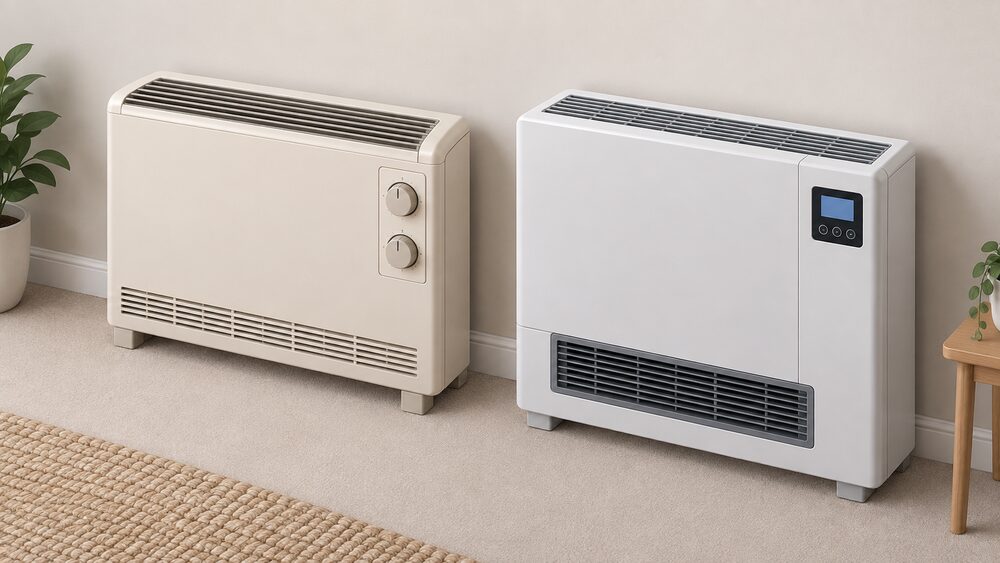
Older heaters are controlled by two dials, an input and an output3. The input or charge control regulates the amount of heat that is stored up during the night, and is set higher in cold weather and turned down or off in warmer weather6. The output control governs how quickly that stored heat is released during the day14. The two together decide the two things that matter: how much electricity is drawn into the core overnight, and the rate at which it comes back out into the room3.
Modern digital models replace the dials. They add a thermostat, letting a room temperature be set, and an automatic charge control that regulates energy use by storing more or less heat at night4. Sensors and smart controls on these heaters store what the source describes as "just the right amount of heat"4. Storage heaters made after 2018 must meet stricter efficiency standards and come with better controls3, and new rules mean they must have casings that hold more heat, or fans to help distribute warm air around the room when needed12. Building guidance for electric storage heaters requires automatic control of input charge and an adjustable heat release rate.
The practical consequence of the two-phase design is that planning ahead is essential: the heater relies on heat stored overnight, and any change made to the input setting will not take effect until the next day4. That is a different habit from turning a boiler thermostat up and feeling the difference within minutes. Related control principles are covered under heating controls and thermostats.
Charging overnight: the role of off-peak electricity
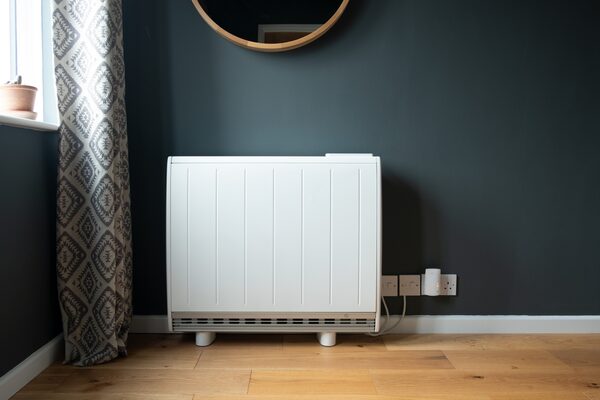
Storage heaters charge during off-peak hours when electricity is cheaper, usually overnight4. The charge is the whole transaction: the household buys a block of heat at the night price and spends it through the day. Most storage heaters will only charge up at night, which is why the input setting can be left in place without danger of drawing expensive day-rate electricity2.
Where stored heat runs out before bedtime, integrated models include a boost function, but it draws more expensive on-peak electricity16. The same warning applies to older heaters: the boost setting does not use cheap-rate stored heat, it uses expensive daytime electricity, and should only be used once the store is exhausted2. Using boost routinely converts a cheap-rate heating system into an expensive one.
High heat retention models push the split further towards the cheap window. Integrated storage heaters carry an assumed 85:15 split between off-peak and peak electricity, while high heat retention storage heaters have an assumed 90:10 split4. The most capable models estimate the next day's heating demand based on user habits and weather conditions, so the input setting needs no adjustment at all2.
There is a dependence buried in all of this. The heater cannot make heat when it is wanted; it can only spend what it took on overnight. A cold snap that arrives during the day cannot be answered from storage, only from peak-rate top-up. For a household chasing independence, the store is genuine flexibility for the grid, and it is why storage heaters sit alongside heat pumps, heat batteries and electric battery storage in the list of technologies that shape time-of-use tariff design17.
Economy 7 and Economy 10: the tariffs storage heaters were designed for
Storage heaters store heat generated from cheaper night-time rates acquired on Economy 7 or Economy 10 tariffs5. Both tariffs were historically designed for storage heating. In Scotland, Total Heat with Total Control, Economy 7 and Comfort Plus are named as meters and tariffs designed to work with storage heating15.
| Feature | Economy 7 | Economy 10 |
|---|---|---|
| Off-peak hours | Seven hours, usually between midnight and 7am6 | Three hours in the afternoon, two in the evening and five through the night6 |
| Window definition | A seven-hour period at some point between 11pm and 8am, set by the regional network operator; regional windows run between 7 and 9 hours7 | Three of the off-peak hours in the afternoon, seven overnight7 |
| Off-peak price | Night electricity typically about half the price of day2 | Unit rates up to half the price of peak rates18 |
| Standing charge | Not stated | Often higher18 |
| Meter | Special multi-rate meter required8 | An Economy 10 meter is required, and suppliers may charge a fee as they are fairly uncommon6 |
| Comparison | Remains on offer from most suppliers7 | Many price comparison sites, including Uswitch, cannot support comparisons for Economy 10 meters7 |
Economy 7's advantage is conditional. As a rule of thumb, a household would need to use more than 35 per cent of its electricity at night for Economy 7 to be cost-effective, because the day rate is higher in exchange7. Economy 10's overnight heat window is shorter than Economy 7's: it typically offers only five hours of heat at night, complemented by three in the afternoon and two in the evening18. Properties on Economy 10 are expected to be on electric rather than gas heating18. Economy 7 tariffs are typically used with electric storage heaters but are available to anyone [4 is not the source here; see 12].
A household can move off a restricted arrangement: a supplier can arrange for a credit meter to be installed, though this may cost a fee7. More detail sits on Economy 7, Economy 10 and heating tariffs.
Identifying the meter
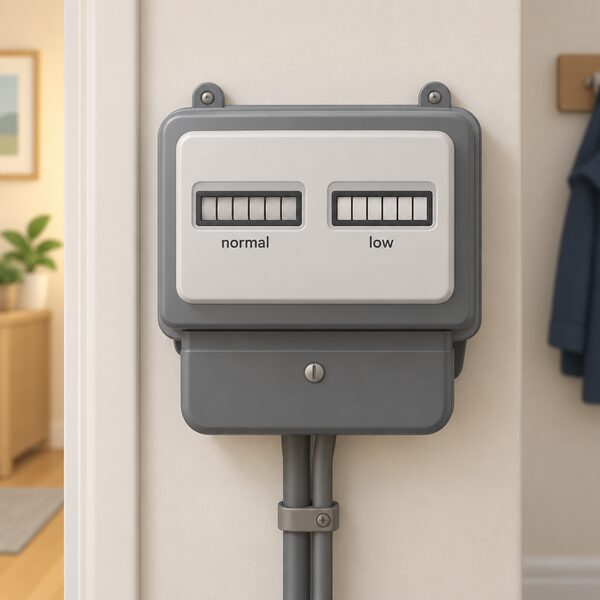
An Economy 7 meter displays two readings, one for on-peak hours, which may be marked normal or day, and one for off-peak, marked low or night14. Smart Energy GB describes the same arrangement: "These two sets of numbers are typically marked 'low' and 'normal'."1 On digital and prepayment meters, each reading is usually reached by pressing a button, and the registers are sometimes marked Rate 1 and Rate 2, or R1 and R214.
Householders with older storage heating sometimes describe the arrangement as complex metering, or a restricted meter20. Where the metering is unusual, the heating and the tariff are locked together, and changing one generally means addressing the other.
Running costs: cheap to charge, dear per kilowatt hour
Two figures pull in opposite directions. Off-peak electricity is genuinely cheap relative to the day rate, typically about half2. But electricity as a fuel is around four times more expensive than gas per unit9, and all electric resistance heating is 100 per cent efficient at point of use21, meaning there is no efficiency gain to offset the fuel price the way a heat pump delivers.
| Heater type | Tariff | Reported annual running cost | Source basis |
|---|---|---|---|
| Night storage heater, traditional | Economy 7 | £912, flat16 | Independent guidance, June 2026 |
| Night storage heater, high heat retention | Economy 7 | £676, flat16 | Independent guidance, June 2026 |
| Standard storage heater, 2-bed 1960s house | Not stated | About £98512 | Supplier guidance |
| Electric storage heating, 3-bed semi | Not stated | £3,000 to £3,80010 | Official statistics, March 2026 |
These figures are not directly comparable: the £912 and £676 figures are for a flat, the £985 figure is for a two-bedroom 1960s house built to the regulations typical at the time, and the £3,000 to £3,800 range is a three-bedroom semi-detached house across Great Britain regions in March 2026 and is identified as the most expensive fuel type in that comparison16. Together they show the direction: dwelling size dominates, and a home on storage heating is at the expensive end of the fuel table.
Comparisons with other options cut both ways. Where there is no gas mains, storage heaters are cheaper to operate than a standard electric heater, and plain electric heaters tend to be more expensive to run than storage heaters5. Against liquid fuel, off-grid guidance is critical: electric night storage heaters "have significant disadvantages because they are expensive to use and offer limited control"22. Dynamic storage heaters are a further case, with running costs still higher than night storage heaters because they do not work with Economy 716. Electric plug-in heaters do not effectively heat a home and are very expensive to run.
The verdict from independent advice is conditional rather than flat. Night storage heating is described as a cheap form of electric heating if the controls are understood, the settings are updated regularly to match the heat needed, and the household is on Economy 723. Where those three conditions fail, the bill rises quickly. See also electric heating running costs.
High heat retention models: better insulation, better controls
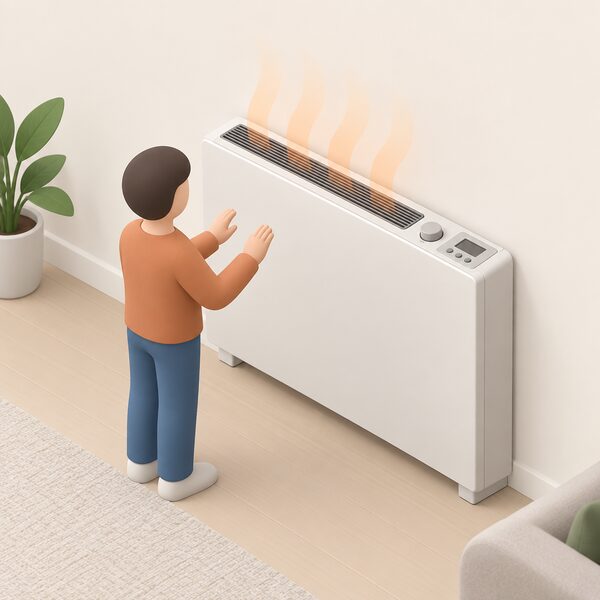
High heat retention storage heaters are the most efficient type of night storage heater16. They retain more heat than other storage heaters, are well insulated, and have automated controls3. Modern models hold heat for longer and generally come with improved heating controls, including an automatic charge control, a thermostat and a programmer3. They can also release heat more quickly when needed, sometimes using a fan to send out warm air3.
The definition is a measured standard, not marketing. A high heat retention storage heater is one with heat retention not less than 45 per cent measured according to BS EN 6053111, the standard covering characteristics of storage heaters11. A maker states the same threshold with the time attached:
"To be classed as high heat retention it must be able to retain at least 45% of the heat generated from the overnight charge for 16 hours after the charge has ended"
Independent testing describes high heat retention heaters holding up to 45 per cent of their heat even 24 hours after they were last charged25. The trade-off is capital cost: these models are more expensive to buy but lower to run than traditional or integrated models, which is what makes them the most cost-effective of the storage types on the same tariff16. Upgrading to a modern storage heater is reported to reduce energy bills by about 10 per cent, and high heat retention models to be up to 27 per cent cheaper to run than standard storage heaters2.
Uptake is measurable. Under the Energy Company Obligation, the measure "ESH - Upgrade to a high heat retention electric storage heater" has recorded 15,122 measures26. High heat retention storage heaters also appear as an eligible works category under local Home Improvement loan heating rules27.
Ranges sold in the UK
Manufacturers' own descriptions of their storage products, given for information and not as a recommendation:
| Range | Maker's description |
|---|---|
| Dimplex Quantum | High heat retention storage heaters "designed to work effectively with Economy 7 tariffs"28 |
| Dimplex Quantum RF HHR | Stated to "retain the energy stored overnight from off-peak electricity"29 |
| STIEBEL ELTRON SHF and SHS | A range of compact high heat retention heaters, stated to have low space requirement and heat retention capacity that "can bridge even long breaks between charging"13 |
| Electrorad Thermastor HHR | Stated to be usable "with both Economy 7 and Economy 10 tariffs"24 |
| Fischer Elektrostore HHR | Stated to offer Frost Protection, Eco and Comfort temperatures, for use with Economy 7 or Economy 10 tariffs30 |
Individual product pages are available for Dimplex storage heaters and the Dimplex Quantum.
Where storage heaters fall short
The central limitation is timing. Storage heaters can often leave a home very warm in the morning and struggle to stay warm in the evening5. The store is largest just after the charge ends and smallest at the point most households want heat most. Lower output settings help stored heat last longer through the day and into the evening, but that is a rationing exercise, not extra heat.
Physical bulk is the second limitation. Storage heaters are large and chunky, stick out from the wall and take up a considerable amount of room5. The bricks that make the storage possible are also what makes the appliance heavy and deep. Compact high heat retention ranges exist, with low space requirement claimed by their makers13, but the principle still demands mass.
Electrical capacity is the third. Because of the greater power consumption of storage heaters, operating several simultaneously requires a correctly loaded electrical circuit kept separate from other household appliances31. Storage heaters also need a connection to the correct circuit and are hard-wired to it3. Sizing follows the same regulatory logic as any heating system: Approved Document L requires the heat loss calculation in BS EN 12831-1 for the dwelling and a sizing methodology that takes account of the dwelling's properties, and systems should not be oversized32. Welsh consultation guidance has proposed that a heating appliance should not be sized for more than 120 per cent of the design heating load unless justified. Related rules are set out under building regulations for heating systems.
Control is the fourth limitation, and it is the one off-grid guidance keeps returning to when comparing storage heating with liquid fuel22. A household cannot simply ask for more heat at 7pm without paying peak rate.
Costs, installation and replacement
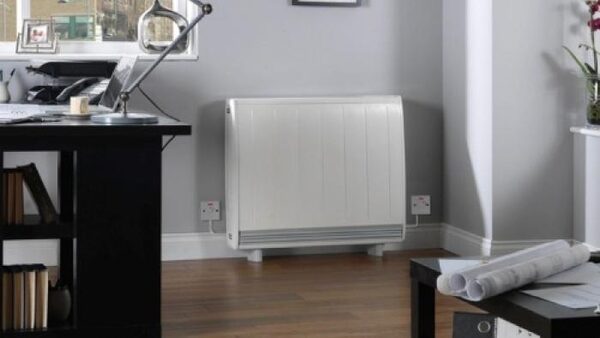
Prices for the heaters themselves vary widely by specification. Basic models are reported to cost as little as £150, with more spent for higher specification5, while modern storage heaters are reported from around £400 each25.
| Item | Reported cost |
|---|---|
| Night storage heater, traditional, installed | £200 to £400 per heater16 |
| Night storage heater, high heat retention, installed | £400 to £800 per heater16 |
| Night storage heater, all types, installed | £200 to £800 per heater depending on type16 |
| Dynamic storage heater, installed | £400 to £600 per heater16 |
| Electric storage heaters, per room | £900 to £1,4009 |
| Replacement onto existing wiring, labour | From around £70, excluding the heater, depending on location33 |
Installation is comparatively simple where a suitable circuit already exists. Electric heating normally requires no flue or pipework, with most products just needing a connection to the electric circuit, and in new build work the heater can be fitted at the second fix wiring stage21. It is also easy to add heaters to a system at any stage as budgets allow, because they operate as stand-alone units21. Storage heating can be simpler to install than gas central heating because there is no gas boiler, pipework or flue12.
Where new wiring is needed rather than a like-for-like swap, costs rise above the replacement figure34. Storage heaters can also be replaced with modern electric radiators, an alternative covered under electric radiators and panel heaters and compared on direct acting electric heating vs storage heaters.
Maintenance, safety and lifespan
There is no combustion, so the maintenance regime is unlike that of a gas or oil appliance. Electric heating needs very little maintenance, with safety checks suggested every five years9. Electric space heaters "need no regular maintenance"21, and a supplier states its storage heaters are low maintenance and do not require annual servicing12. Landlords are separately expected to arrange for heating equipment to be regularly serviced.
Electric space heaters are stated to last an average of 50 per cent longer than a conventional fossil-fuel heat source21. Warranty terms vary by maker and model: Dimplex offers a standard two-year parts and labour guarantee on its Duo Heat, CXL, TSR/TSE and XLN/XLE/XLS storage heater ranges35, while a supplier notes that some storage heaters come with 30-year warranties12. Those are the makers' own terms and should be read against the specific model. Economy 7 storage heaters are described by one supplier as safe when used correctly.
Because there is no gas or oil burner, there is no combustion carbon monoxide risk from the heater itself, which is a genuine difference from the appliances covered under carbon monoxide and home heating safety. The risks that remain are electrical and mechanical: heavy appliances, dedicated circuits and ageing wiring.
Storage heaters in the UK housing stock
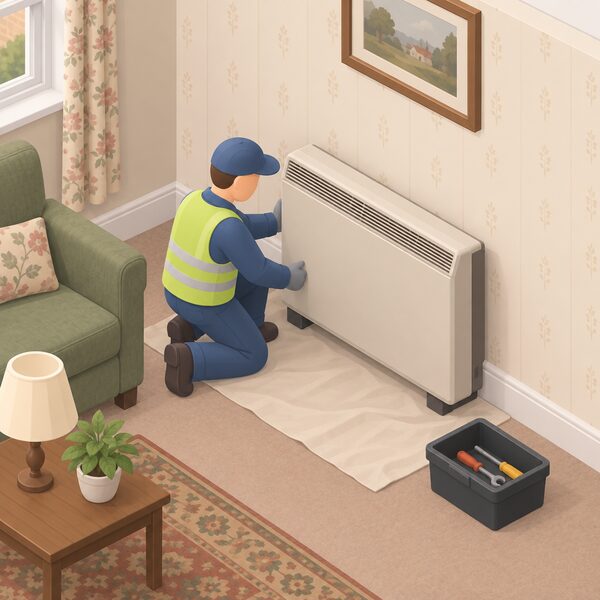
Storage heaters are a minority technology with a long history. They fell out of favour in the 1980s and 1990s as electricity prices increased and people wanted heat on a more flexible schedule25. Estimates of the current share cluster around five per cent of homes, though the basis differs between sources.
| Measure | Figure | Basis |
|---|---|---|
| UK homes heated by electricity, storage heaters or heat pumps | 8.6%36 | Independent guidance, June 2025 |
| UK housing stock, electric storage heaters | 5.5% [36 is wrong; see 22] | Industry body, October 2021 |
| Scotland, storage heaters | Around 5% of the stock, 202437 | Official statistics |
| Scotland, corrected 2023 figure | 7% storage heaters38 | Official statistics, January 2025 |
| England and Wales, electric heating | 9% of households39 | Official, May 2025 |
| UK households using electric heating such as storage heaters | Around 2.3 million40 | Independent, June 2025 |
More than 80 per cent of UK households currently heat with gas or oil and will be affected by the transition to electrified heating, and 90 per cent of UK homes are stated to have sufficient insulation and electrical capacity to operate a heat pump39. In Scottish social housing decarbonisation case studies, the majority of properties in the research switched from electric storage heating41, and an Energy Saving Trust case study records a household moving from storage heating on a restricted meter to an air source heat pump20. Storage heating is therefore both a legacy system being replaced and, in its high heat retention form, a measure still being installed under ECO26. Electric storage heaters are recognised as efficient heating under the Northern Ireland Decent Homes Standard where used on an off-peak or Economy 7 tariff.
What storage heating means for household independence
Storage heating removes several dependencies outright. There is no gas or oil supply, no flue, no tank of fuel to buy and no boiler to service annually13. Electric heating at both off-peak and standard rates is now stated to be less carbon intensive than fossil-fuel alternatives21. Heaters are stand-alone, so a household can add them room by room as budget allows21.
What remains is a deeper dependence on a single supply and a single commercial arrangement. The home is entirely reliant on the grid and on a supplier offering a suitable multi-rate tariff. Economy 7 remains on offer from most suppliers7, but the off-peak window is defined by the regional network operator, not the household7, and Economy 10 meters are uncommon enough that suppliers may charge to fit one and many comparison sites cannot price them18. Smart meter compatibility with Economy 7 and 10 is itself listed as a constraint19. Households on complex metering have less room to shop around than those on a single rate.
Against that, the thermal store is real flexibility. A brick core charged at night is a form of demand shifting the household owns outright, with no cloud service and no app required on older models. Where solar or battery equipment is being considered, storage heaters sit in the same family of flexible loads named in tariff design work17, and the wider picture is set out under home heating and energy independence and the main guide at /boilers-heating/.
Sources41 cited
- What is Economy 7, Smart Energy GB, 2026-04-07
- Night storage heaters, Centre for Sustainable Energy, 2025-10
- Electric storage heaters, Energy Saving Trust, 2026-05-20
- A guide to using electric storage heater controls, Energy Saving Trust, 2026-05-21
- Electric heaters vs storage heaters, energyhelpline, 2026-09-20
- Getting the most from Economy 7, National Energy Action, 2026-09-10
- Economy 7 explained, Uswitch, 2026-09-08
- Energy: your questions answered, Confused.com, 2026-07-03
- Electric heating, Energy Saving Trust, 2026-07-01
- Domestic energy prices briefing, House of Commons Library, 2026
- SAP 10.3 full specification, BRE Group, 2026-01-13
- Storage heaters explained, EDF, 2026-09-17
- Storage heating, STIEBEL ELTRON, 2026-09-17
- Reading your gas or electricity meter, Centre for Sustainable Energy, 2026-08
- Saving energy with electric storage heaters, Home Energy Scotland, 2025-01
- Electric heating, Centre for Sustainable Energy, 2026-06
- Default tariff consultation response, Energy Saving Trust, 2025-04-09
- Economy 10 explained, Uswitch, 2025-12-08
- Can I get a smart meter, Smart Energy GB, 2026-03-16
- Upgrading storage heaters with an air source heat pump, Energy Saving Trust, 2026-02-19
- Benefits of electric space and water heating, BEAMA, 2026-09-17
- Off-gas grid heating options, OFTEC, 2026-09-17
- Energy saving myths, Centre for Sustainable Energy, 2026-07
- High heat retention storage heaters, Electrorad, 2026-09-20
- Electric central heating, Which?, 2025-09-22
- ECO public reports and data, Ofgem, 2026-08-11
- Eligible and non-eligible works, Cornwall Council, 2025-10-01
- Storage heaters, Dimplex, 2026-09-17
- Quantum RF HHR storage heater, Dimplex, 2026-09-17
- Storage heaters, Fischer Future Heat, 2026-08-14
- Storage heaters comparison, Herschel Infrared, 2022-05-19
- Approved Document L Volume 1, Welsh Government, 2026-04
- Storage heaters guide, OVO Energy, 2021-12-02
- Storage heaters, HIES Scheme, 2020-03-17
- Guarantee terms and conditions, Dimplex, 2026-09-17
- Decarbonisation of heat, Energy Systems Catapult, 2025-06-27
- Scottish House Condition Survey 2024 key findings, Scottish Government, 2024
- Scottish House Condition Survey 2023 key findings, Scottish Government, 2025-01-28
- Heating our homes report, UK Parliament, 2025-05-09
- How to make electricity cheaper, Nesta, 2025-06-05
- Social housing decarbonisation case studies, ClimateXchange, 2024-08-13
 Heating Schedules and SetbackIs it cheaper to leave the heating on low all day, or set it to come on only when you need it?
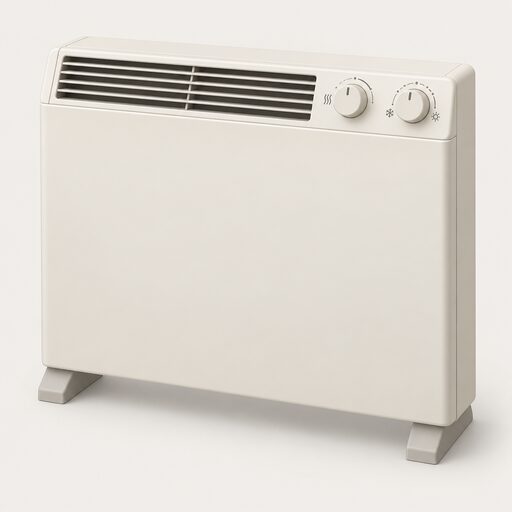 Storage Heater ControlsExplains manual input and output dials, automatic charge control and the smart charging used by modern high-retention heaters.
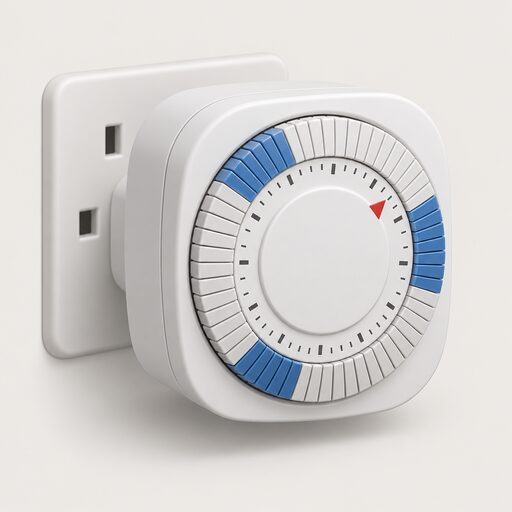 Controls and Time-of-Use TariffsCheaper electricity at night only saves money if your heating actually uses it then.
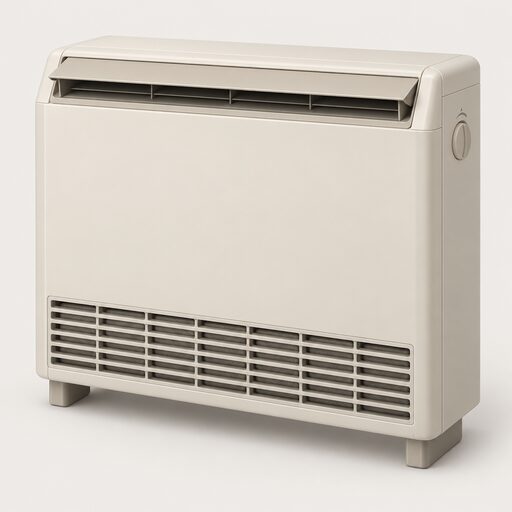 Electric Heating CostsHow to work out what electric radiators, panel heaters, infrared and storage heaters cost to run per hour and per season.
 Heat Batteries and Zero EmissionA heat battery stores cheap overnight electricity as heat, then releases it to warm your home or your hot water.
 Heat Pump Electricity TariffsA heat pump tariff gives you cheaper electricity for part of the day, so running your heating costs less than on a standard rate.