
In this guide
A biomass boiler burns solid wood fuel, typically pellets, chips or logs, to heat a home's radiators, underfloor circuits and hot water in the same way an oil or gas boiler does. In England and Wales the Boiler Upgrade Scheme offers £5,000 off the cost and installation of a biomass boiler1, but only where the property is in a rural location and is not, and has never been, connected to the gas grid2. Reported installation costs for biomass under the scheme had a median of £13,765 and a lower quartile of £11,679 in the second quarter of 20263.
Biomass is a small part of the scheme. Between the scheme's launch in May 2022 and July 2026, 600 biomass voucher applications were received and 419 redemptions were paid, against 88,092 redemptions for air source heat pumps3. The restrictions explain much of that: biomass boilers are described in Ofgem's guidance as eligible "only in limited circumstances", subject to additional location and air-quality requirements4, with a maximum permitted system capacity of 45 kWth5.
Room stoves sit under a different legal regime. They attract no grant, and in a smoke control area the governing question is not efficiency but what may lawfully be burned and in what appliance. Wood cannot be burned in an open fireplace in a smoke control area, and dry wood may be burned only in an appropriate exempt appliance6.
What a biomass boiler does in a house
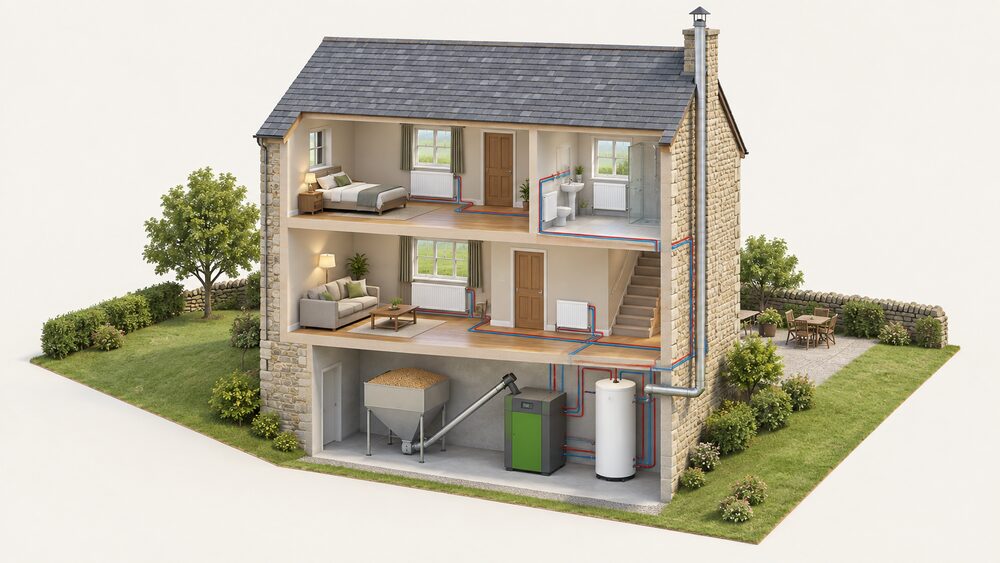
A biomass boiler is a wet heating appliance: it produces hot water that circulates through radiators and heat emitters or underfloor pipework and, in most domestic installations, heats a cylinder. Under the Boiler Upgrade Scheme the system must provide both space heating and hot water, and must be capable of meeting the full space heating and hot water demands of the property8. That requirement has been in the scheme since its earliest installer guidance8 and was restated explicitly in later versions9. It rules out treating biomass as a top-up appliance; scheme guidance says separately that biomass boilers are not eligible to be installed as supplementary appliances10.
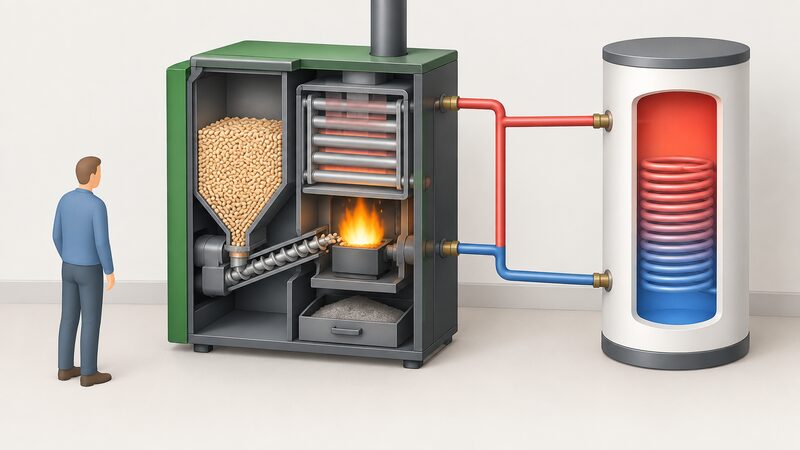
The fuel side is what distinguishes biomass from every other wet system. An eligible boiler must be designed and installed to use solid biomass fuel11, and under the Domestic Renewable Heat Incentive rules the appliance had to be designed and installed to burn solid biomass only, including wood pellets, with fossil fuel permitted only for ignition12. For VAT purposes, a wood-fuelled boiler is one fuelled solely by wood, including wood chips and pellets, straw or similar vegetal matter13.
Pellet boilers are the most automated form: pellets are fed from a hopper or bulk store by an auger, which is also why metering guidance for these systems refers to measuring fuel input through auger revolutions or flue gas analysis14. Log boilers are hand-fed in batches and usually paired with a large buffer or accumulator tank. Chip systems need the largest store of all. Hot water can be part of the package or not: under the Domestic RHI, biomass systems did not have to provide domestic water heating to be eligible, although they could11. The Boiler Upgrade Scheme takes the stricter position described above.
The £5,000 grant and what it is set against
The Boiler Upgrade Scheme is an installer-led scheme in England and Wales providing upfront capital grants15. It offers grants of up to £7,500 in total across its technologies, with £5,000 off the cost and installation of a biomass boiler16; the £7,500 figure applies to heat pumps, not biomass. The £5,000 biomass value was confirmed again in the approved grant categories notice effective 21 July 202617 and in the House of Commons Library briefing, which notes it applies only in rural locations and in properties not connected to the gas grid18. Welsh capital grant guidance for 2026 to 2027 lists the same figure for rural off-grid properties only19.
| Element | Position | Source |
|---|---|---|
| Grant value, biomass boiler | £5,00017 | Approved grant categories, 21 July 2026 |
| Grant category | Biomass boiler in an off-gas grid property replacing any other fossil fuel heating system17 | Approved grant categories |
| Voucher validity | 3 months5 | Installer guidance |
| Maximum capacity | 45 kWth5 | Installer guidance |
| Self-builds | Not an eligible technology20 | Installer guidance |
| Air-to-air heat pump, for comparison | £2,5001 | Ofgem scheme page |
The grant is claimed by the installer as a voucher, and the timing is tight: biomass boiler vouchers are valid for three months, alongside air-to-water and air-to-air heat pumps, while ground source heat pump vouchers run for six months7. Ofgem may audit applications. Evidence that can be requested includes valid ID, proof of address, proof of property ownership, MCS certificate copies, evidence of supplementary heating, EPCs and EPC site notes, utility bills or fuel delivery receipts, photographs of the previous and installed heating systems, purchase receipts or quotes, total building heat loss calculations, and an emissions certificate for a biomass boiler [12 was heat pumps; see]4. Where there is no valid EPC, alternative evidence may include a utility bill dated within three months, the most recent fuel receipt, photographs of the existing system and an expired EPC where available7. Installers must retain everything relied upon for six years from the date the application was properly made5.
Further detail on national schemes sits on the pages for heating grants in England and heating grants in Wales; the Boiler Upgrade Scheme itself extends to England and Wales only15.
Who is eligible: rural, off-grid and nothing else
The eligibility test for biomass is narrower than for any other technology in the scheme. Ofgem's installer page states that biomass boilers "can only be installed in properties that are not, and have never been, connected to the gas grid" and "can only be installed in rural properties"2. Installer guidance puts it as a flat rule: biomass boilers may only be installed in properties in rural areas5, and must not be installed in properties connected to the gas grid10. The grants service description makes the pairing explicit: biomass boilers are only eligible in properties that are both in a rural location and not connected to the gas grid, while heat pumps carry neither restriction16.
To that, GOV.UK adds the air quality condition: the boiler must have an emissions certificate showing that polluting emissions are kept to a minimum21. The numerical thresholds are in the installer guidance: particulate matter must not exceed 30g/GJ net heat input and NOx must not exceed 150 g/GJ net heat input5. Eligible biomass boilers must also comply with air quality requirements under the earlier Domestic RHI rules11.
Two further exclusions catch people out. Biomass boilers are not an eligible technology in self-build properties20, and they cannot be installed as supplementary appliances10. For households on the gas grid or in towns, the practical answer is that biomass is not grant-supported at all, and the comparison to make is with heat pumps against boilers or with the options set out for heating a home off the gas grid.
What installations cost, and what the scheme has delivered
Costs are installer-quoted; there is no published list price for a domestic biomass installation. The clearest UK evidence is the scheme's own reporting. For the second quarter of 2026, the median reported cost of a biomass installation was £13,765, with a lower quartile of £11,6793. Ofgem's annual report for 2024 to 2025 gives an average total quote for biomass, including the grant value, of £16,223, against £13,433 for air source heat pumps, £27,924 for ground source and £22,503 for shared ground loop systems22. The £5,000 grant is deducted from these totals, not added to them.
Volumes are low and have been throughout. By the end of February 2024, 199 grants had been paid for biomass boilers cumulatively since the scheme launched23. By July 2026 the cumulative totals stood at 600 voucher applications received and 419 redemptions paid3. Under the earlier Domestic Renewable Heat Incentive, biomass boilers generated 54.5 GWh of eligible heat in Scheme Year 10 and £4,229,918 was paid, against lifetime totals of 3,290.6 GWh and £356,110,184 since the start of that scheme [20 corrected]. Biomass deployment under the RHI reached its peak in Scheme Year 6 and has fallen since [20 corrected].
Running costs depend on delivered fuel prices, which are not published in the way regulated gas and electricity prices are; a household buying pellets or logs is dealing with a local or regional supplier and a seasonal market. The general comparison across fuels is covered on the page for home heating running costs by fuel.
Smoke control areas: the law that governs stoves
Smoke control areas are made under the Clean Air Act 1993, and in Wales also under the Environment (Air Quality and Soundscapes) (Wales) Act 20246. Inside one, only authorised fuels, or exempted furnaces and boilers, may be used, and chimney smoke is not allowed with only a few exceptions24.
"It is an offence to emit smoke from a chimney of a building, from a furnace or from any fixed boiler if located in a designated smoke control area unless an authorised fuel was used."
The rules reach further than people expect. They cover all properties that emit smoke from a chimney of a building, or a chimney serving the furnace of any fixed boiler or industrial plant, including residential properties6, and the prohibition includes outdoor buildings with a chimney, such as summerhouses26. It is also an offence to acquire an unauthorised fuel for use within a smoke control area unless it is used in an exempt appliance25, and it is illegal to sell and buy unauthorised fuels for that use unless the fuel is for an exempt appliance, in a building, fireplace, or a fixed boiler or industrial plant27.
What may be burned:
- Smokeless fuels: anthracite, semi-anthracite, gas and low volatile steam coal26.
- Authorised or certified manufactured solid fuels26.
- Dry wood, but only when using an appropriate exempt appliance26.
- Only the fuel types the manufacturer says can be used in the appliance26.
Enforcement typically starts with education. A household can first be issued with an Improvement Notice explaining the rules and offering advice on the impacts of pollution from solid fuel burning and how to minimise emissions6. Buying or receiving controlled, unauthorised solid fuels for burning in a smoke control area without an exempt appliance can attract a fine of up to £1,0006. Councils hold the orders and can advise on which fuels may be burned locally28, and government guidance tells contractors working at different locations to check each time whether they are in a smoke control area24.
Choosing a compliant appliance and buying compliant fuel
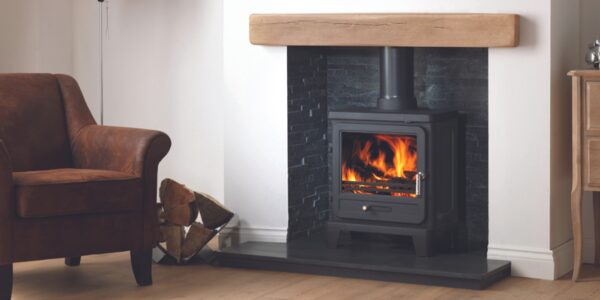
Two separate certification systems apply, one to the appliance and one to the fuel.
On the appliance side, Defra exemption is the legal route to burning wood in a smoke control area, and HETAS administers that exemption scheme. HETAS also operates the Cleaner Choice Approval Scheme, under which a stove must meet both the current requirements for exemption and have attained listing on the Defra website29. For biomass boilers, HETAS states that they "must demonstrate that they too meet the same stringent emissions standards and are exempted for use in smoke control areas where legally required"29. The scheme, while focused on particulate emissions, also provides assurance that the listed appliance meets the relevant UK regulations covering safety and performance requirements, correct operation and correct installation for HETAS registrants29. Appliance standards generally are covered on the page for heating appliance standards and certification.
On the fuel side, the incentive schemes have their own test, which is about sustainability rather than smoke. For biomass installations, fuel must be listed on the Biomass Suppliers List, demonstrating that it meets the sustainability criteria, and must be a fuel type within the maximum moisture content allowed by the emissions certificate11. The purchase receipt should carry the supplier's Biomass Suppliers List authorisation number12. For a room stove, the consumer-facing marker is Ready to Burn firewood, which HETAS pairs with the questions of when the chimney was last swept and whether the appliance has been serviced30.
Space, storage and maintenance: the real demands
Biomass is the most physically demanding domestic heating system in common use, and the burden is continuous rather than one-off.
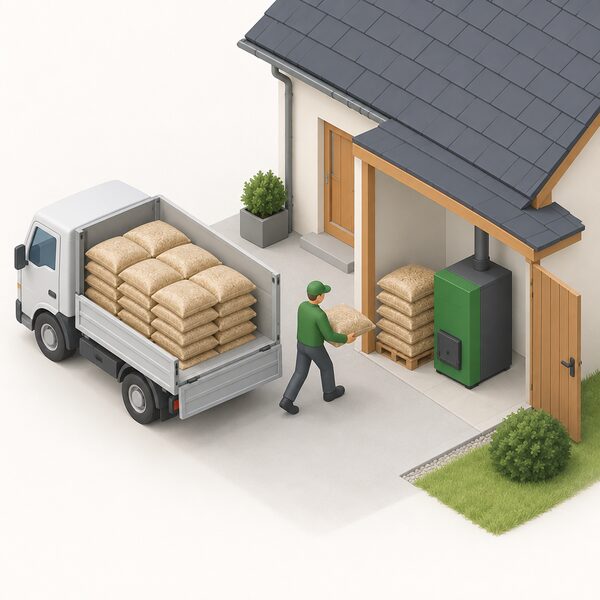
- Fuel store. Pellets, chips or logs need a dry, accessible store sized for a delivery, sited where a lorry or trailer can reach it. In Northern Ireland, permitted development for a container for storing solid biomass fuel is conditioned on the fuel being used to provide heat within the curtilage of the dwellinghouse31.
- Plant room space. The boiler itself, the hopper or auger feed, and in log systems a buffer tank, all need floor area and headroom well beyond a wall-hung gas boiler.
- Ash removal. Every biomass appliance produces ash that must be cleared on a routine cycle, by hand in most domestic systems.
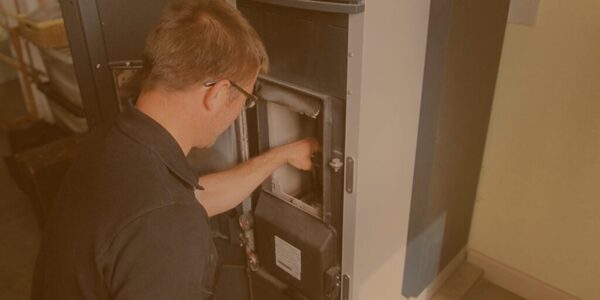
- Annual service and sweeping. HETAS frames good practice for solid fuel owners around an annual service and regular chimney sweeping30. Sweep prices are quoted locally and vary by region.
- Fuel ordering. Unlike a gas supply, fuel does not arrive automatically. Running out is a heating failure.
A cylinder is normally part of the installation, since the grant-eligible system must meet the property's full hot water demand as well as its space heating demand9. The options are covered on the page for hot water cylinders, and output sizing on boiler sizing.
Where biomass leaves a household dependent
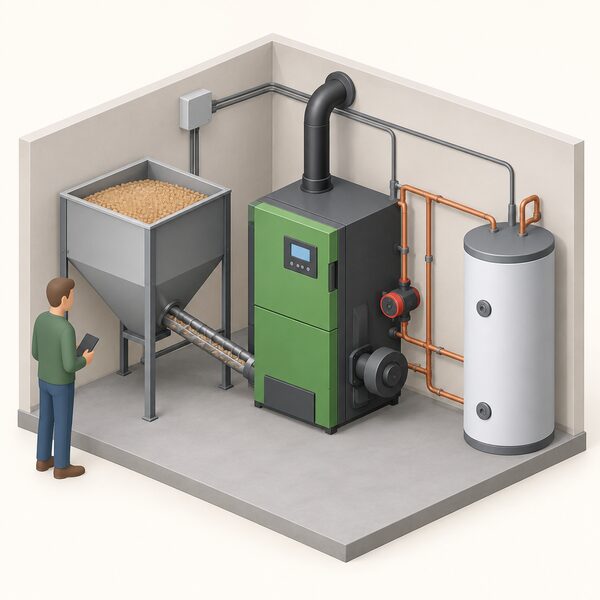
Biomass genuinely removes the two dependencies that matter most to many rural households: the gas grid, which by definition is absent, and the oil or LPG supply chain it replaces. Fuel can be bought locally and, in the case of logs, sometimes produced on site. Heat does not stop when the electricity price rises, and the household is not tied to a single national supplier for its heat.
The dependencies that remain are real and should be stated as firmly. The boiler needs electricity for its auger, controls, pump and fan: metering guidance for these systems assumes electrical supplies to the boiler and to the hot water cylinder where it is served by the boiler14, so a power cut stops an automated pellet system. The household depends on a fuel supplier, and on that supplier holding a Biomass Suppliers List authorisation if scheme rules apply12. It depends on an appliance manufacturer for parts and on a competent installer for commissioning and service. And it depends on air quality law, which is tightening: in a smoke control area the appliance must be exempt and the fuel authorised, and those lists are set by government, not by the householder24.
The grant, finally, is conditional in a way that shapes the decision entirely. Rural location, no current or historical gas connection, an emissions certificate within the 30g/GJ particulate and 150 g/GJ NOx limits, a system no larger than 45 kWth, and a three-month window to complete the work5. Households outside those conditions can still install biomass, but at full installer-quoted cost and without scheme support. The wider trade-offs between fuels and independence are set out on home heating and energy independence and on the main guide to boilers and home heating.
Sources31 cited
- Boiler Upgrade Scheme, Ofgem, 2026
- Boiler Upgrade Scheme: information for installers, Ofgem, 2026
- Boiler Upgrade Scheme statistics, July 2026, GOV.UK, 2026-08-27
- Boiler Upgrade Scheme guidance for property owners v5, Ofgem, 2026-04-28
- Boiler Upgrade Scheme guidance for installers v5.1, Ofgem, 2026-07-02
- Smoke control area guidance for homes and businesses: FAQs, Welsh Government, 2025-07-30
- Boiler Upgrade Scheme guidance for property owners v5, draft, Ofgem, 2026-03-25
- Boiler Upgrade Scheme installer guidance, Ofgem, 2022-07-21
- Domestic RHI: eligible heating systems, Ofgem, 2026
- Boiler Upgrade Scheme guidance for installers v5, Ofgem, 2026-04-28
- Domestic RHI essential guide, Ofgem, 2024-06
- VAT on energy saving materials and grant-funded heating supplies, HMRC, 2026
- Domestic RHI annual report 2023 to 2024, Ofgem, 2024-07
- Domestic RHI guide to metering, Ofgem, 2022
- Boiler Upgrade Scheme property owner guidance v2.3, Ofgem, 2023-09-25
- Boiler Upgrade Scheme grant listing, Find a Government Grant, 2026
- Notice of approved grant categories and values for the Boiler Upgrade Scheme, GOV.UK, 2026-07-21
- The Boiler Upgrade Scheme, research briefing, House of Commons Library, 2026-05-13
- Ynni Cymru capital grant funding scheme 2026 to 2027 guidance, Welsh Government, 2026-04
- Boiler Upgrade Scheme guidance for installers v2.1, Ofgem, 2023-05-18
- Apply for the Boiler Upgrade Scheme: check if you are eligible, GOV.UK, 2026
- Boiler Upgrade Scheme annual report 2024 to 2025, Ofgem, 2025-07
- Boiler Upgrade Scheme quarterly report issue 7, Ofgem, 2024-02-29
- Preventing air pollution, GOV.UK, 2026
- Building regulations guidance Part J: heat producing appliances, Welsh Government, 2026
- Smoke control guidance for local authorities: FAQs, Welsh Government, 2025-07-30
- Smoke control area guidance: acquisition and sale of unauthorised fuels, Welsh Government, 2025-07-30
- Insulation and home energy advice, nidirect, 2026-09-02
- What is the Cleaner Choice Scheme?, HETAS, 2026
- Can my neighbour complain about my log burner?, HETAS, 2026
- Planning (General Permitted Development) Order (Northern Ireland) 2015, Schedule Part 2, legislation.gov.uk, 2015
 Gas Boilers GuideMains gas boilers heat around 23 million UK homes.
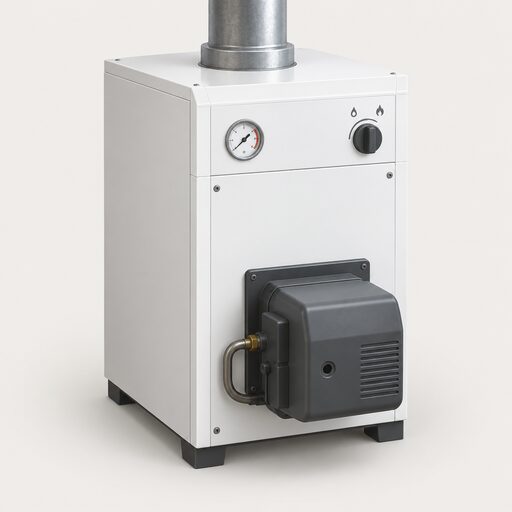 Oil Boilers and Heating OilHow oil-fired boilers work, the kerosene they burn, and the tanks, burners and servicing they need.
 New Boiler Cost in the UKWhat a replacement boiler costs in the UK by type and fuel, and what drives the installation element: conversions, relocations, flue work and system upgrades.
 Ground Source Heat Pump CostWhat a ground source heat pump costs in the UK, splitting groundworks and drilling from the heat pump and internal works, and how the £7,500 Boiler Upgrade Scheme grant and the £9,000 off-gas-grid uplift change the figure.
 The Full Boilers and Heating GuideWhich boiler suits your home, and when is it worth swapping the old one?
 Will Gas Boilers Be Banned?What has actually been legislated, proposed or dropped on gas and oil boiler phase-out across the four UK nations, and the difference between new build rules and replacement in existing homes.