In this guide
A condensing boiler is a boiler designed to make use of the latent heat released by the condensation of water vapour in the combustion flue products1. In a non-condensing appliance that vapour leaves through the flue as hot waste gas. A condensing boiler cools the flue gases far enough that the vapour turns back into liquid water, releasing the energy that was locked up in changing it to steam in the first place, and uses that energy to warm the water returning from the radiators2.
The practical result is that new boilers in the UK are required to be condensing types and are at least 90% energy efficient3. Condensing boilers have been legally required since 20054, and by law all new and replacement boilers must be condensing5. The gain is real but bounded: the condensing mechanism only works when the water coming back to the boiler is cool enough, roughly below 54 degrees C, and most condensing boilers in UK homes are set with flow temperatures of 70 to 80 degrees C, which means a large number of them rarely condense at all6.
For a household the lens is straightforward. A condensing boiler makes each unit of purchased gas, oil or LPG go further, but it does not change where that fuel comes from. The home remains connected to a gas network or a fuel delivery, to a mains electricity supply for the pump and controls, and to a manufacturer for parts and warranty. What is gained is less waste, not independence.
What a condensing boiler is: heat taken back from its own flue
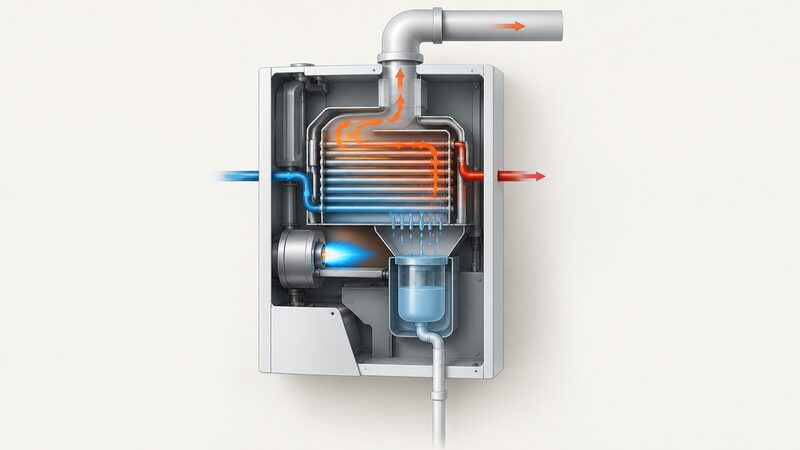
The defining feature is the heat exchanger. A condensing boiler has a bigger and more efficient heat exchanger that recovers almost all the heat out of the gas it burns, so that very little useful heat is lost through the flue9. That exchanger is powered by the heat generated by the flue gases themselves, and the cool water returning from the radiator circuit is the thing that absorbs it2.
The recovered energy has a name. Boiler makers and building physicists both call it latent heat: the energy released when water vapour changes state back to liquid. Burning gas or oil produces carbon dioxide and water vapour. A conventional boiler sends that vapour up the flue while it is still hot, and the latent heat goes with it. A condensing boiler recaptures the vapour, condenses it to liquid water and extracts that additional heat of vaporisation10.
Two consequences follow. The first is that condensing appliances run cooler than older ones, because the recovery pass depends on low return temperatures. The second is that the process produces liquid water, which has to be drained. That is the trade: a pipe and a drainage point in exchange for energy that used to leave through the roof. Modern condensing models are also much smaller than old boilers, so they take up less space11.
The technology is no longer optional or specialist. All modern boilers now use condensing technology as standard, and the term describes the process rather than a particular shape of appliance12. Condensing units are made for gas, oil and wood10, and are available as regular, system and combination boilers13.
How the condensing process works, step by step
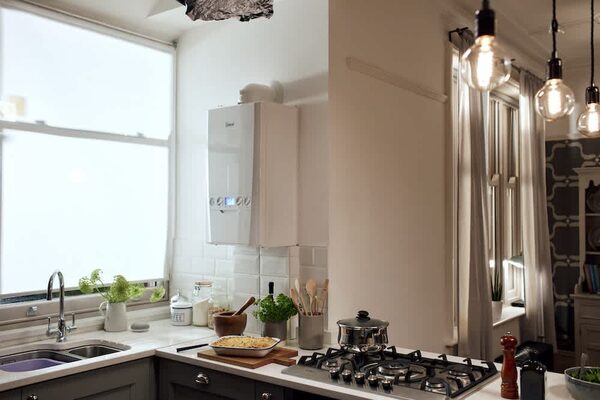
- Fuel is burned at the burner, producing hot combustion gases and water vapour.
- Those gases pass over the heat exchanger, heating the water that circulates to the radiators or the cylinder.
- The still-warm gases then meet the cooler water returning from the heating circuit. Heat lost during the boiler's normal use is extracted and reused to preheat incoming cold water12.
- The water vapour in the flue gases is captured and turned back into a liquid, and that waste water leaves the system through the condensate pipe2.
The heat given back at steps three and four is not free extra energy: it is energy that was always in the fuel and was previously vented. The critical condition is temperature. The gases must be cooled below the dew point of the water vapour they carry, and the only thing cold enough to do that inside a domestic boiler is the return water from the radiators. If the return water is hot, the gases never cool far enough, no condensation forms, and the boiler behaves much like a non-condensing appliance with a larger heat exchanger. This is why the same appliance can be highly efficient in one house and ordinary in another. Nesta puts the threshold at around 54 degrees C for the water returning to the boiler6.
Efficiency: at least 90% of the fuel becomes usable heat
The figure quoted across official, independent and manufacturer sources converges near 90%. The Planning Portal states that new boilers in the UK are all required to be condensing boilers, which are at least 90% energy efficient3. The Energy Saving Trust uses the same benchmark for an A-rated boiler, at 90% of fuel converted into usable heat, against 60 to 70% for an older appliance14.
Sources differ at the upper end, and it is worth being clear why. UKIFDA puts condensing boilers at up to 97% efficient15, a best-case figure that reflects laboratory test conditions rather than a boiler running at typical UK settings, while uSwitch frames the everyday gain more modestly as 10 to 20% more efficient than regular boilers8.
| Source type | Stated efficiency | Reference |
|---|---|---|
| Official (Planning Portal) | at least 90% for new UK boilers | 3 |
| Independent (Energy Saving Trust) | 90% of fuel into usable heat, A-rated | 14 |
| Independent (OFTEC, liquid fuel) | over 90%, equal to gas boilers | 13 |
| Independent (UKIFDA) | up to 97%, against 60 to 70% for an older boiler | 15 |
| Independent (uSwitch) | 10 to 20% more efficient than regular boilers | 8 |
Off the gas grid the picture is similar. OFTEC states that the latest liquid fuel-fired condensing boilers have efficiency ratings of over 90%, equal to gas boilers, that modern condensing appliances are available as regular, system and combination boilers, and that non-condensing boilers can only be fitted where the building qualifies for an exemption based on an assessment of the technical difficulty and cost of installing a condensing model13. In Wales, building regulations guidance is that a condensing boiler with a SEDBUK rating of A or B should be installed unless an assessment by a Gas Safe registered engineer indicates otherwise16. A fuller treatment sits on boiler efficiency and ErP ratings.
The gain is also not static. Official statistics for England and Wales covering installations from 2011 to 2015 found that savings from new condensing boilers were around a tenth lower in the fifth year after installation than in the first17.
Flow temperature: why lower settings mean higher efficiency
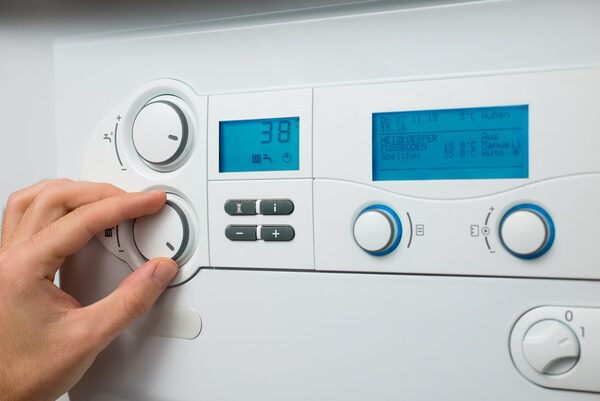
Rated efficiency is measured under defined conditions. SAP's default efficiency data for condensing boilers is based on the design flow temperature of the water in the heat distribution system being 55 degrees C or higher, and where a system has been designed for a lower temperature an efficiency adjustment applies, with thresholds at a design flow temperature of 45 degrees C or 35 degrees C as stated on the commissioning certificate18. Below 35 degrees C the correction for 35 degrees C is used, and above 80 degrees C the correction for 80 degrees C is used1.
In an occupied home the mechanism is simple: boilers are more efficient when the return temperature is low, and this can save both energy and money. Research from Nesta cited by the Energy Saving Trust found that turning the flow temperature down to 60 degrees improves a boiler's efficiency by nearly 4%19. Nesta separately estimates that households could reduce their gas use, costs and emissions by 8%6.
| Guidance | Recommended flow temperature | Reference |
|---|---|---|
| Energy Saving Trust, citing Nesta | 60°C, improving efficiency by nearly 4% | 19 |
| Welsh Government, citing Which? | 50 to 70°C is enough for many homes, against 75 to 80°C typically set | 20 |
| Smart Energy GB | around 55 to 60°C, which sets the boiler into condensing mode | 21 |
"Most condensing boilers in use across the UK are set with flow temperatures of 70-80°C"
Emitters matter as much as the dial, because a larger radiator surface or an underfloor circuit returns water to the boiler cooler for the same room temperature. Stored hot water is a separate question, set at the cylinder rather than by the heating flow. See boiler flow temperature and radiators and heat emitters.
The condensate pipe: what it is and where it drains
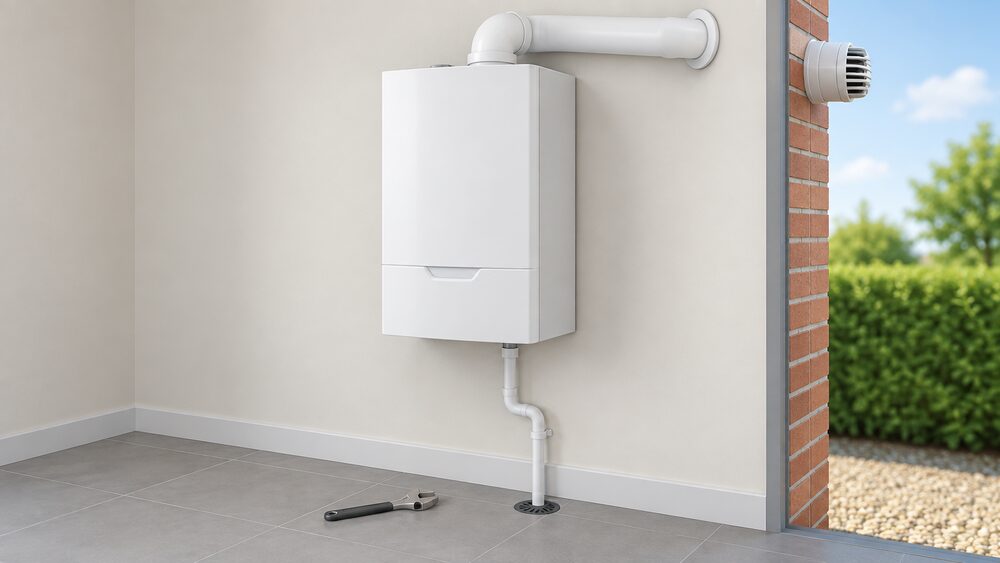
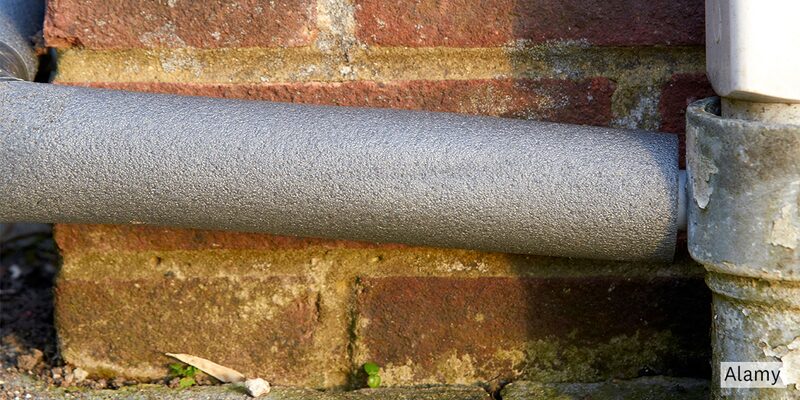
The condensate pipe is a small pipe that carries away the water produced by the boiler22. It is usually plastic, typically grey or white, connected to the bottom of the boiler, and is often found either underneath the boiler or on the outside wall nearby23. Its job is to drain the liquid away into the household waste water drainage so the appliance can work normally24.
The water is not clean. Condensate is slightly acidic, because it carries contaminants from combustion, and must be disposed of into a suitable drain25. That is why a condensing installation needs a drainage point and cannot simply discharge to open ground.
Quantities are modest but continuous. Ideal puts output at around two litres of condensate water an hour from a boiler working efficiently11, and two to three litres an hour is quoted for each hour of operation7. Discharge is intermittent rather than steady, because the water collects in a trap before releasing, and evidence of condensed water running through the pipe is an indication that the boiler is working normally26.
Installation practice reflects the freezing risk. Baxi recommends that the condensate pipe is fitted internally and insulated to reduce the likelihood of it freezing during winter and causing the boiler to shut down27. Where the pipe must run outside, Viessmann advises a relatively short length connecting directly to the drainage system, steeply angled so other waste water cannot travel up it, and ideally well clad24. Home Energy Scotland advises insulating the plastic pipe with foam pipe insulation to keep it warmer and prevent the condensate water from freezing28.
If the pipe freezes
Signs are recognisable: no water coming out, visible ice or a pipe that feels very cold, or a gurgling noise from the boiler or pipes22. Guidance from gas networks and manufacturers is consistent on the remedy: hold a hot water bottle, warm cloth or microwaveable heat pack around the frozen section, or pour hot but not boiling water over an external pipe, then reset the boiler if needed8. Where a boiler still will not fire after thawing, SGN's advice is to contact a gas supplier if home or boiler care cover is held, or a Gas Safe registered engineer22.
For a pipe that freezes repeatedly, uSwitch lists moving it inside, replacing it with a wider diameter pipe, fitting foam pipe insulation, or retrofitting manufacturer antifreeze, and describes foam insulation as the most energy-efficient way to protect it8. Worcester Bosch also lists turning the boiler's heating control to maximum and fitting a drain cover to protect the pipe end26. More on diagnosis sits under boiler faults and fault codes.
Combi, system or heat only: all three are condensing types
"Condensing" describes the heat recovery process, not a fourth category of boiler. Ideal states plainly that all three of these boilers are types of condensing boilers29, and Baxi that heat only and system boilers are also condensing boilers12.
| Type | Hot water | Storage | Reference |
|---|---|---|---|
| Combi | Instant, on demand | No hot water tank | 2 |
| System | Via cylinder | Uses a hot water tank | 11 |
| Heat only / conventional | Via cylinder | Uses a hot water tank | 11 |
Ideal describes combi boilers as the only type of condensing boiler that provides both central heating and instant hot water in one package2, and as suited to small homes29. Condensing boilers are the most common type of new boiler fitted in UK homes8.
Condensing appliances also appear inside hybrid systems: HHIC describes an air source electric heat pump alongside a gas condensing boiler as the most common hybrid heating system30. Fuller detail on each type sits on combi boilers, system boilers and regular boilers, with the wider picture on boilers and home heating.
Choosing the output: sizing by bedrooms, radiators and bathrooms
Condensing boiler outputs generally run from 24 to 42 kW depending on the heating and hot water needs of a home. Vaillant's guidance maps that range onto property size31.
| Bedrooms | Radiators | Bathrooms | Output |
|---|---|---|---|
| 1 to 2 | 0 to 10 | 1 | 24 to 27 kW |
| 2 to 3 | 1 | 23 to 30 kW | |
| 3 to 4 | 10+ | 2 to 3 | 28 to 34 kW |
| More than 4 | 20+ | More than 3 | 35 to 42 kW |
Other guidance is broadly consistent: Intergas puts a flat or a 2 to 3 bedroom house with one bathroom and up to ten radiators in the 24 to 30 kW range for a combi32.
Modulation matters as much as maximum output, because a boiler that can turn down low runs longer at lower temperatures and condenses more of the time. The Navien NCB500 system boiler illustrates the span: the NCB500-15k is rated at a condensing heat output of 16.4 kW maximum and 2.9 kW minimum at 50/30 degrees C, and the NCB500-30k at 32.6 kW maximum and 4.8 kW minimum at the same flow and return33. Those outputs are quoted at the condensing condition of 50/30 degrees C rather than the 80/60 rating often used elsewhere. Sizing method is covered in boiler sizing.
Costs, savings and what installation involves
There is no single published price for a condensing boiler installation, and quotes are installer-specific. The Energy Saving Trust gives one benchmark: installing an A-rated condensing gas boiler plus a full set of heating controls will cost about £3,90034.
Savings claims vary widely and their provenance matters. The Planning Portal says only that a high-efficiency condensing boiler with heating controls could save a substantial amount of money over a year3. Nesta's independent modelling gives 8% off gas use, costs and emissions from lowering flow temperature6. Maker guidance is more expansive, citing hundreds of pounds a year31; the official and independent figures are the safer guide, because the larger claims rest on comparison with much older appliances. On regional variation, the Energy Saving Trust notes that in Northern Ireland upgrading an oil boiler can save £440 a year34.
Installation itself is regulated rather than optional. Condensing boilers have been legally required since 20054, in Wales the guidance is a SEDBUK A or B rated condensing boiler unless a Gas Safe registered engineer's assessment says otherwise16, and for liquid fuel a non-condensing replacement requires an exemption to be established first13. So a non-condensing boiler is not simply a cheaper choice. See building regulations for heating and new boiler cost.
Two practical requirements follow the appliance into the property: a drainage point for the condensate, and a flue route. Both can dictate where the boiler can go, particularly in flats and in older properties without a convenient waste connection.
Servicing, lifespan and keeping the efficiency
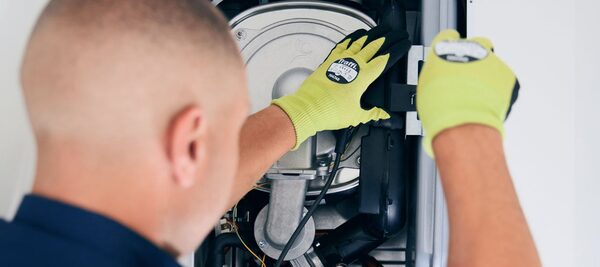
Annual servicing is the consistent recommendation. uSwitch states that a boiler should be serviced at least once a year8. Vaillant specifies once a year by a Gas Safe registered heating engineer31, and Ideal at least once a year so essential checks can be carried out by a Gas Safe registered engineer11. The Centre for Sustainable Energy frames the purpose in efficiency terms: the boiler should be serviced annually to ensure it stays in good working order and maintains its efficiency35. Baxi adds the commercial condition:
"To ensure a safe boiler operation, and maintain warranties, we always recommend having your boiler serviced regularly."
On replacement, Ideal notes that many boiler manufacturers and fitters recommend changing a boiler every 15 years11. Related pages cover boiler servicing and maintenance and boiler warranties.
Working with solar water heating
A condensing boiler can be paired with solar water heating, but the arrangement depends on whether the home stores hot water. OFTEC describes the standard method: a solar system combined with a liquid fuel or gas-fired boiler through a compatible hot water cylinder having two heating coils, one fed by the panels and the other by the boiler37.
The Energy Saving Trust states that a conventional boiler with a hot water cylinder is often compatible with solar water heating, though the existing cylinder must be replaced with one designed for solar or a dedicated solar cylinder, and that few combi boiler models are compatible with solar thermal systems, as they are not designed to heat water in a cylinder38. A household with a combi would likely need to add a solar hot water cylinder and replace the boiler with a conventional boiler or a heat pump38. Elsewhere the same body notes that solar water heating is easier to work with system boilers, although combi boilers can be adapted39.
No solar thermal system removes the need for a boiler. Because the amount of sunlight varies through the year, solar water heating will not give 100% of a household's hot water needs and is best used alongside a boiler or an immersion heater to make up the difference39. For a household weighing energy independence, that is the honest position: solar thermal reduces the fuel a condensing boiler must burn for hot water in summer, and leaves the boiler, its fuel supply and its grid connection in place for the rest of the year. See solar thermal water heating and hot water cylinders.
What a condensing boiler does not change
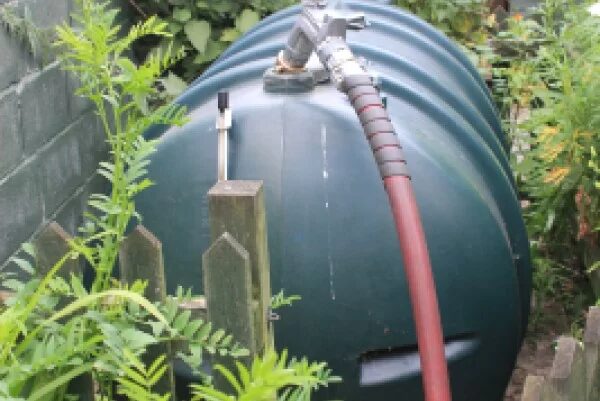
Efficiency is not autonomy. A condensing boiler burning mains gas still depends on the gas network and a supplier's tariff; an oil version depends on deliveries and on-site storage; an LPG version on bulk tank refills. All of them need mains electricity for the pump, fan and controls, so a power cut stops the heating regardless of how much fuel is in the tank. Parts and warranty support come from a single manufacturer, and annual servicing is required by the warranty terms as well as for safety36.
What the technology does deliver is a permanent reduction in waste: heat recovered from flue gases that would otherwise be lost to the atmosphere, lowering both carbon footprint and bills2. Whether that reduction is realised in a given house depends on something the household controls, which is the flow temperature, and on something the installer controls, which is whether the emitters are sized to let the return water run cool. A boiler installed at 70 to 80 degrees C and never adjusted is a condensing appliance that spends most of its life not condensing6.
Sources39 cited
- SAP 10.3 full specification, BRE Group, 2026-01-13
- Combi boiler vs condensing boiler, Ideal Heating, 2026-09-17
- Boilers and heating: sustainability, Planning Portal, 2026
- Boilers, Home Energy Scotland, 2026-09-20
- Best boilers guide, Confused.com, 2025-11-03
- Lowering boiler flow temperature to reduce emissions, Nesta, 2026-09-17
- Boiler condensate pipe guide, Boiler Central, 2026-07-14
- Boiler maintenance guide, uSwitch, 2026-09-03
- What are the different types of boilers, Baxi, 2026-09-17
- Condensing boiler guide, Netatmo, 2026-09-20
- Condensing boilers, Ideal Heating, 2026
- Understanding condensing boilers, Baxi, 2026-09-14
- Your home guide to liquid fuel heating, OFTEC, 2026-09-20
- In-depth guide to heat pumps, Energy Saving Trust, 2026-07-16
- Help and advice for consumers, UKIFDA, 2026-01-29
- Building regulations: boilers and heating, Welsh Government, 2026-09-17
- National Energy Efficiency Data Framework report 2026, GOV.UK, 2026-06-11
- SAP low temperature heating guidance, NCM Product Characteristics Database, 2026-09-17
- Should I turn my boiler's flow temperature down, Energy Saving Trust, 2026-05-20
- Five top tips from Which? to cut your energy bills, Welsh Government, 2026-03-18
- Boiler flow temperature, Smart Energy GB, 2026-04-22
- My boiler isn't working, SGN, 2026
- Getting ready for winter: your condensate pipe, Vaillant, 2026
- Fix a frozen boiler condensate pipe, Viessmann, 2022-04-05
- My boiler isn't working, Northern Gas Networks, 2026-07-24
- Frozen condensate, Worcester Bosch, 2026-09-20
- Boiler safety: what you should consider, Baxi, 2026-08-26
- Protect pipes in winter, Home Energy Scotland, 2025-12
- The difference between combi, heat only and system boilers, Ideal Heating, 2026
- Hybrid heating systems guide, HHIC, 2026-09-17
- What is a condensing boiler, Vaillant, 2026
- What size combi boiler do I need, Intergas, 2026-01-22
- NCB500 system boiler, Navien, 2026
- Tips to improve the EPC rating of your home, Energy Saving Trust, 2026-08-03
- Upgrading and replacing your boiler, Centre for Sustainable Energy, 2026-06
- What is a condensing boiler, Baxi, 2026-09-17
- Your home guide to solar water heating, OFTEC, 2026-09-20
- Solar water heating, Energy Saving Trust, 2026-05-20
- Boilers advice, Energy Saving Trust, 2026-05-20
 System Boilers ExplainedA system boiler heats your radiators and stores hot water in a separate cylinder, so several taps and showers can run at once.
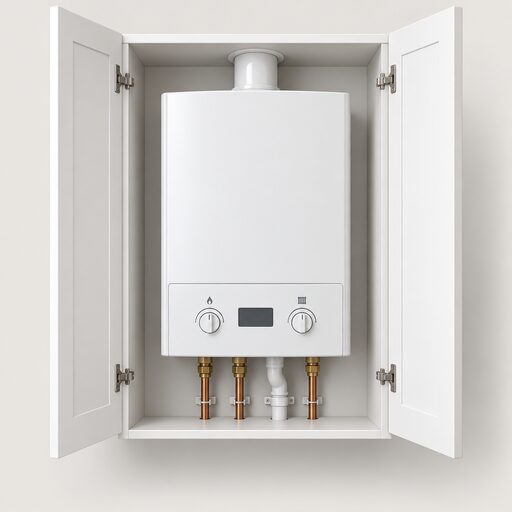 Combi BoilersWhat a combination boiler is, how it produces heating and instantaneous hot water from one unit, and the flow rate and mains pressure it depends on.
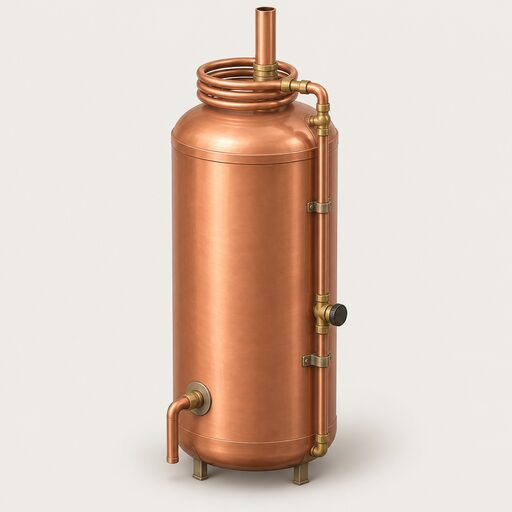 Regular and Heat-Only BoilersGot tanks in the loft and a hot water cylinder in the airing cupboard?
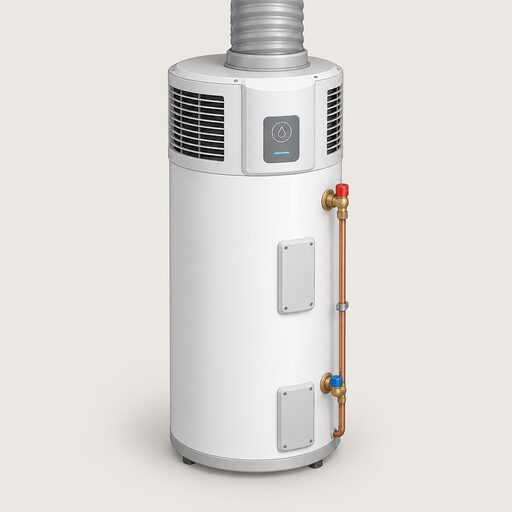 Hot Water Heat PumpsA hot water heat pump heats only the water in your cylinder, using air instead of a boiler flame.
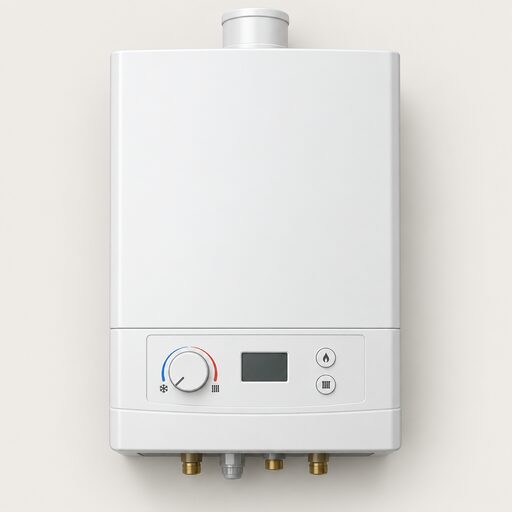 Flow TemperatureTurning down your boiler flow temperature can cut your gas bill, but how low can you go before the house feels cold?
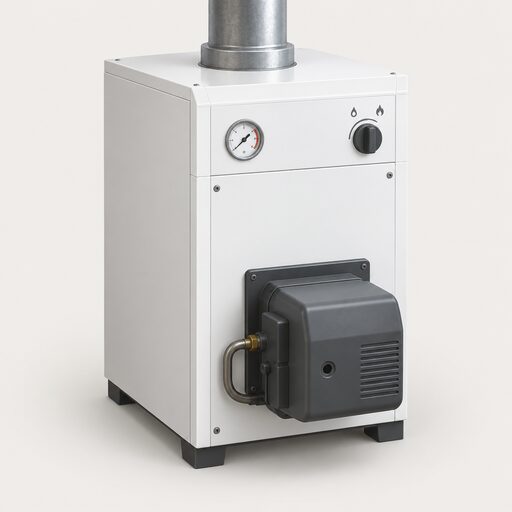 Oil Boilers and Heating OilHow oil-fired boilers work, the kerosene they burn, and the tanks, burners and servicing they need.