
In this guide
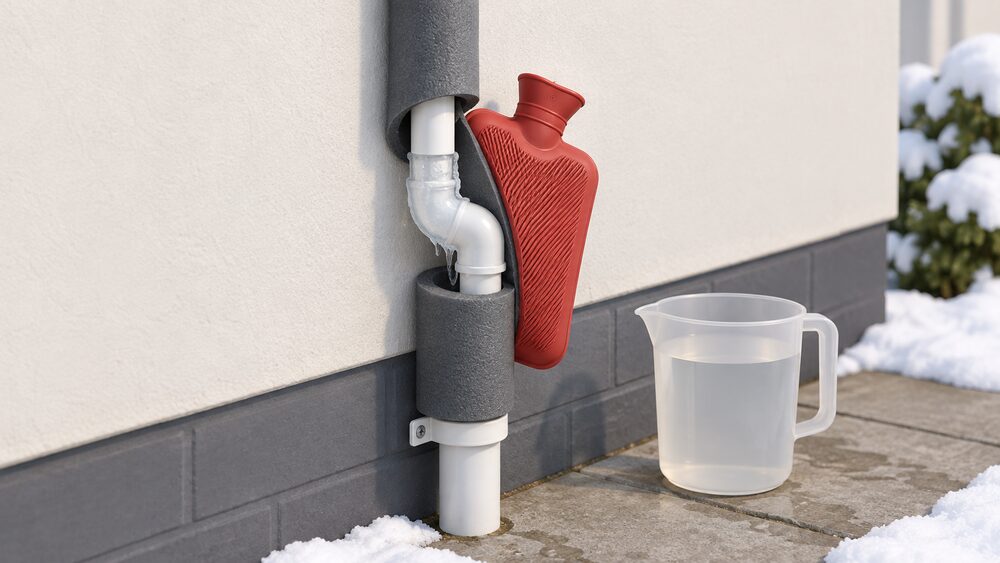
A frozen condensate pipe is one of the most common reasons a boiler stops working in cold weather, and it is one of the few boiler faults a householder can usually clear without an engineer. When the outside temperature drops below zero, the water sitting in the condensate pipe can freeze, blocking the pipe and causing the boiler to shut down as a safety measure1. The fix is to thaw the external pipe with warm, not boiling, water or a hot water bottle, then reset the boiler.
The pipe itself is a small plastic pipe that carries away the water a condensing boiler produces as it extracts heat from its flue gases3. It usually runs from the boiler to a drain, and the section that freezes is almost always the part outside the building. Because the boiler shuts down rather than running on with a blocked drain, a frozen pipe leaves a home without heating and hot water at exactly the point in the year when both matter most4.
This guide covers how to recognise a frozen condensate, the safe thawing method step by step, what never to use, how to restart the boiler, and the insulation, routing and pipe-size changes that reduce the chance of a repeat. It also sets out the point at which the job stops being a householder task and becomes work for a Gas Safe registered engineer.
What a condensate pipe is and why your boiler has one
A condensing boiler is designed to make use of the latent heat released by the condensation of water vapour in the combustion flue products9. In practice that means it extracts heat from the hot exhaust gases that older boilers send straight up the flue, pre-heating the water fed into the boiler10. The by-product of that process is liquid water, and the condensate pipe is what carries it away.
The pipe allows water from the condensing process to be drained from the heating system and disposed of with household waste water1. It is usually connected to the boiler and made of plastic, and you can usually find it on the wall outside your home or underneath your boiler3. Its job is to drain liquid away from the boiler so the appliance can function at its optimal level7.
That water is not clean. Condensate must be disposed of in the right way, into a suitable drain, because it contains contaminants that make it slightly acidic2. This is why the pipe has to terminate at a drain or soakaway rather than being allowed to pool, and why a blocked or frozen pipe is a fault rather than a nuisance.
Condensing boilers come in both combination and system models, and both types produce condensate10. The efficiency gain is the reason the pipe exists at all: condensing boilers are capable of using around 90% of their heat, against the lower figure a non-condensing boiler achieves11. A household therefore has a condensate pipe because it has an efficient boiler, and the freezing risk is the price of that efficiency in a cold climate.
Why the pipe freezes and the boiler shuts down
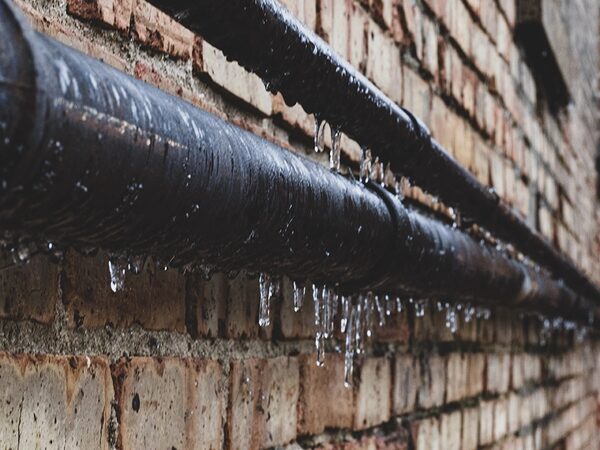
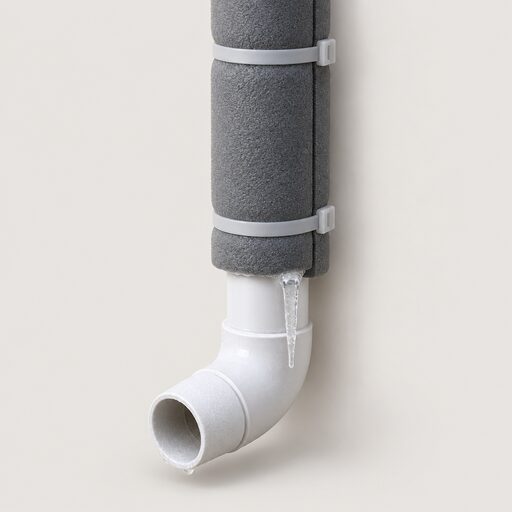
In cold weather, the water that passes through the condensate pipe can become frozen, blocking the pipe and allowing condensate to back up2. When the outside temperature drops below zero, condensate pipes can often freeze, which leads to the boiler shutting down as a safety precaution5. The boiler will automatically shut down if the pipe gets blocked with ice, or anything else, because it cannot safely dispose of the water it is producing3.
The consequence is total rather than partial. A frozen boiler condensate pipe can stop your boiler working and potentially leave you without heating, cold water and unable to cook4. A boiler that has stopped working in the cold is likely to have frozen boiler condensate pipes, which makes the pipe the first thing to check rather than the last8.
The mechanism is worth understanding because it explains why the fault recurs. The condensate drainage pipe freezes and becomes blocked with ice, which causes the condensate to back up into the boiler and potentially a complete shutdown12. The blockage does not have to be long: a plug of ice at an elbow or at the point where the pipe leaves the heated envelope is enough.
Freezing is most likely on external runs, and the risk rises with the length of pipe exposed to the weather. Condensate pipes can freeze due to extremely low temperatures or ice building up on the pipe, which will need clearing if the boiler is to run again13. Because the boiler is doing the right thing by locking out, the fault is not a boiler failure in the usual sense, and no amount of resetting will clear it while the ice remains.
Signs your condensate pipe is frozen: gurgling, lockout and error codes
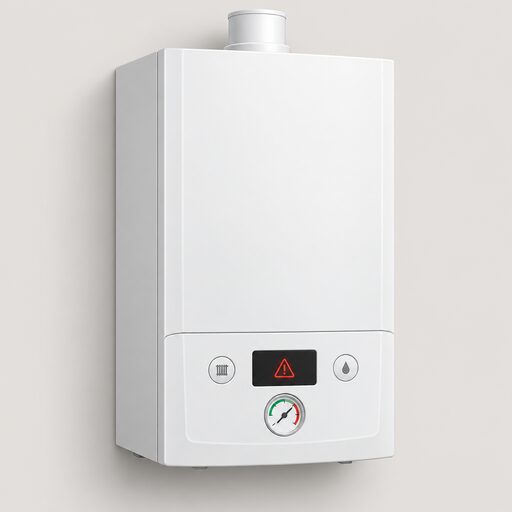
The first indication that a boiler condensate pipe is frozen will usually be that you have no hot water and heating despite the boiler having been working fine, often with an unfamiliar gurgling sound from the boiler and fault codes displayed1. If you hear gurgling noises coming from your heating system and the boiler shuts down during freezing temperatures, it is likely the condensate pipe has frozen10.
The physical check is straightforward. If water is not coming out of the pipe, you can see ice or it feels very cold, it is probably frozen8. You can usually find the pipe on the wall outside your home or underneath your boiler, so the check takes a minute and needs no tools3.
Fault codes vary between manufacturers, so a code on its own does not confirm ice. What matters is the combination: a boiler that stopped during a cold spell, a gurgling sound, and an external pipe that is iced or very cold. Broader frozen-pipe warning signs include a lack of water coming out of your taps, central heating making a gurgling sound or sitting in lockout, a boiler that will not switch on, and a toilet that will not flush10. Those wider signs point to pipework freezing elsewhere in the home rather than the condensate alone, and are covered in how to prevent and deal with frozen pipes.
| Sign | What it points to |
|---|---|
| No hot water or heating after the boiler worked normally | Boiler lockout, often condensate related1 |
| Unfamiliar gurgling from the boiler or pipes | Condensate backing up1 |
| Fault code displayed on the boiler | Consult the manual; codes vary by maker1 |
| No water from the external pipe, ice visible, or pipe very cold | Frozen condensate confirmed8 |
| Taps, toilet or other pipework also affected | Wider frozen pipework, not just condensate10 |
How to thaw a frozen condensate pipe, step by step
The thawing method is simple, and the order matters. Carefully remove any pipe lagging and pour warm water down the side of the pipe, repeating the process until it starts to thaw7. Starting from the top of the pipe and working your way down, apply the water, or wrap the hot water bottle or heat pack, over the pipe until the ice within has melted3.
Where the pipe is fully or partially frozen, start at the outlet, then move to flat sections or elbows, as these typically freeze faster1. Thawing out pipes slowly using a hot water bottle or heated towel or cloth, starting at the end nearest the tap, is the method recommended for frozen pipework generally14. Working slowly matters because a rapid change in temperature is what cracks plastic.
- Locate the condensate pipe, usually on the external wall or under the boiler3.
- Check for ice, cold to the touch, or no water emerging8.
- Remove any pipe lagging from the frozen section7.
- Pour warm, not boiling, water down the side of the pipe, or hold a hot water bottle or heat pack against it7.
- Start at the outlet, then work on flat sections and elbows1.
- Repeat until the ice has melted and water can drain7.
- Reset the boiler and check whether it fires12.
- If it does not, run through the steps a second time, as a condensate pipe can take a while to defrost fully7.
If the boiler still does not fire up after trying to thaw the condensate pipe, contact your gas supplier if you have home or boiler care cover, or a Gas Safe registered engineer15. The reset itself should follow the manufacturer's guidance on how to restart the boiler safely, because reset procedures differ between models7. A general walkthrough of the reset sequence is in how to reset a boiler after a lockout.
Warm water, hot water bottles or a hairdryer: what to use and what never to use
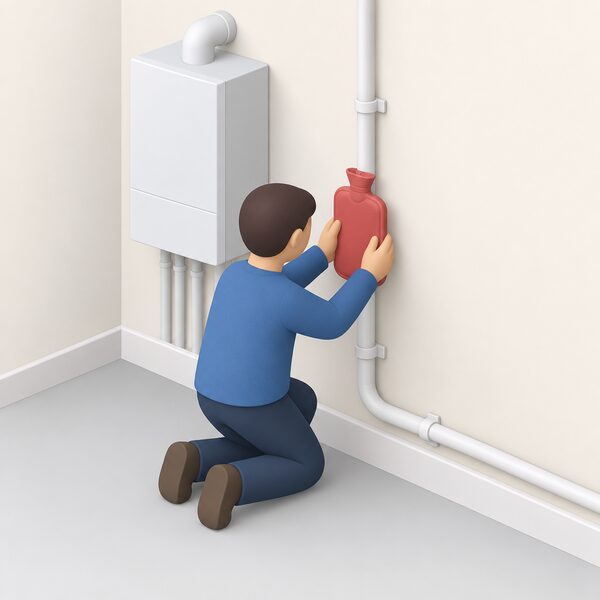
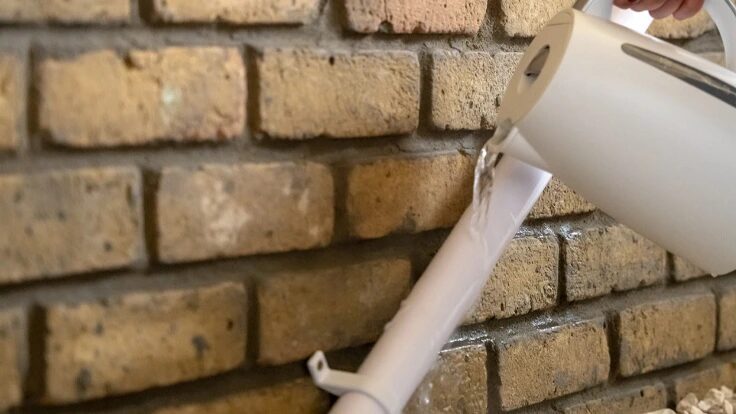
Warm water is the default. Boil a kettle and leave it to cool for 10 to 15 minutes so that it is warm rather than boiling, then apply it down the pipe3. You could also use a hot water bottle or microwavable heat pack3. For internal pipes, hold a hot water bottle against the pipe8. For the external pipe, pour hot, but not boiling, water on it8.
The prohibition is consistent across sources and it is about the pipe, not the boiler. It is crucial not to use boiling water, which can crack the pipe7. Avoid using boiling water for thawing as this can be problematic if there are splits in the pipe that you have not spotted10. Avoid using boiling water or naked flames for thawing, as there could be unnoticeable splits in the pipe or flammable material nearby14.
A hot water bottle has a practical advantage over poured water: it applies heat to the frozen section for a longer period of time1. That makes it the better option for a stubborn blockage, and it avoids the risk of water pooling around the pipe in freezing conditions and refreezing.
When to stop and call a Gas Safe registered engineer
Thawing the external pipe is a householder task, and doing it yourself can save the cost of a call-out5. The boundary is gas. Only a qualified Gas Safe registered engineer should carry out gas installation, repair or service16. If you have tried to thaw your condensate pipe several times, but your boiler is still underperforming, that might be a sign of a bigger problem and an engineer should be called7.
There are specific situations that require an engineer rather than a second attempt. If water has got into your gas pipes within your home, you will need to contact a Gas Safe registered engineer to clear the system17. Where a frozen condensate has been dealt with but the system needs explaining, rectifying and restoring, the route is to ring your local Gas Safe Registered installer, who will be able to explain the situation, rectify the problem and get the system working again12.
Finding an engineer is straightforward. Use your postcode to find Gas Safe-registered engineers in your area, or telephone an advisor on the freephone number19. The Gas Safe Register helpline is 0800 408 550020. You can also find your local Gas Safe Registered engineer by calling 0800 408 5577 or visiting gassaferegister.co.uk22. For gas appliance and boiler problems, the register directs callers to 0800 408 5500 or its website23. Call 0800 408 5500 for a list of local Gas Safe registered engineers18.
Checking credentials matters as much as finding a name. Always use Gas Safe registered professionals24. The register is the official list, and registration requires information such as National Insurance numbers for any engineers being registered25. A separate guide covers how to check an engineer is Gas Safe registered.
Stopping it happening again: insulation, pipe routing and wider diameters
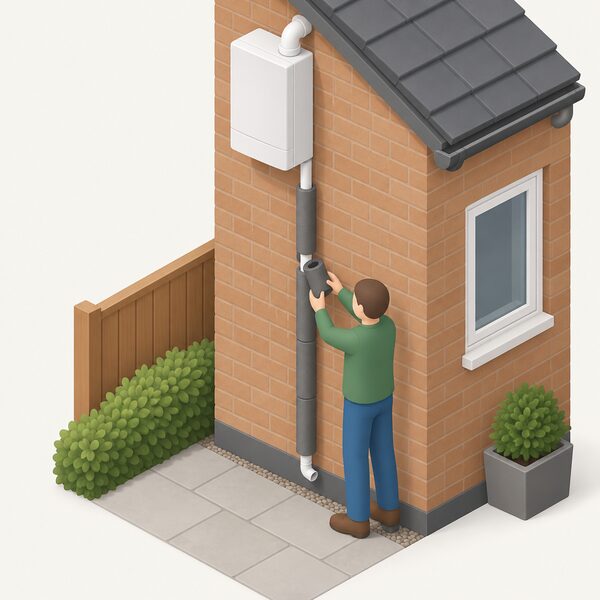
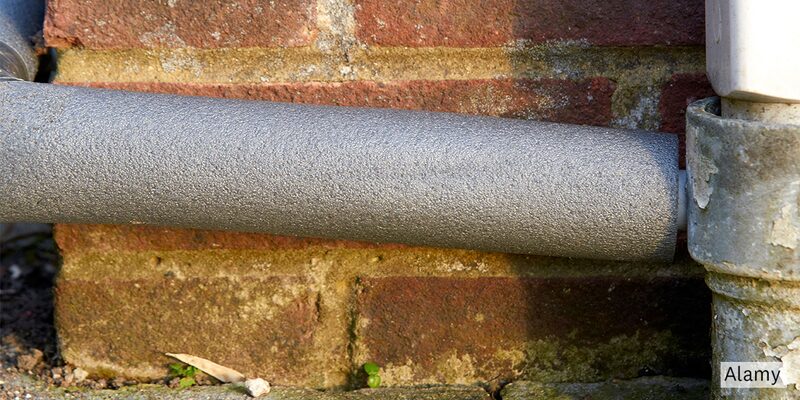
The most energy-efficient way to protect the pipe is to wrap the condensate pipe in foam pipe insulation5. If you have got an external condensate pipe, make sure it is properly insulated with foam, as this keeps it warmer and prevents the condensate water from freezing4. Insulating the plastic pipe with foam pipe insulation keeps it warmer and prevents the condensate water from freezing26. Insulation can be bought from any DIY store, and you can add it to the pipe outside yourself8.
Routing is the second lever. If possible, the condensate pipe should run internally as far as possible, because the less pipe that sits outside, the better3. Pipes should fall as directly and steeply as possible, and the fewer bends the better3. A black pipe on a wall that gets sun can often absorb enough heat to prevent freezing3. Relocating a pipe is not a DIY job, so you will need to pay for a heating engineer to complete the work3.
Diameter is the third. The internal diameter should not be smaller than 30mm, and some manufacturers recommend at least 32mm or up to 40mm, so check your manufacturer's instructions3. Replacing the pipe with one of a wider diameter is one of the recognised remedies for a pipe that keeps freezing5. External sections should have a waterproof and UV-resistant coating on the insulation, and the installation should meet the latest building standards regulations relating to gas boilers, BS 6798:20143.
| Measure | Detail | Who can do it |
|---|---|---|
| Foam insulation | Wrap the external pipe in foam pipe insulation5 | Householder, insulation from a DIY store8 |
| Waterproof, UV-resistant coating | Required for external insulation3 | Householder or engineer |
| Wider diameter | Internal diameter not below 30mm; some makers say 32mm or up to 40mm3 | Engineer |
| Internal routing | Run the pipe internally as far as possible3 | Engineer, not a DIY job3 |
| Steep fall, fewer bends | Pipes should fall as directly and steeply as possible3 | Engineer |
| Antifreeze retrofit | Retrofit manufacturer antifreeze5 | Engineer |
A wider programme of winter preparation helps. Check any existing pipe insulation and avoid a frozen gas pipe27. Home Energy Scotland advises insulating the plastic pipe with foam pipe insulation to keep it warmer and prevent the condensate water from freezing26. The same logic applies across the rest of the home's pipework, and how to prepare a home for winter sets out the wider checklist.
What this means for a household's energy independence
A frozen condensate pipe is a small, specific dependence made visible. The household controls the boiler, the thermostat and the insulation on the pipe, and can clear the blockage itself in most cases. What it does not control is the weather that freezes the pipe, the gas supply that feeds the boiler, or the manufacturer's design decisions about where the pipe runs and how wide it is.
The practical independence available here is real but bounded. Thawing the pipe yourself avoids a call-out, and insulating it reduces the chance of a repeat. Beyond that, the remedies that would make the fault far less likely, rerouting the pipe internally or replacing it with a wider diameter, require a heating engineer and a payment3. A household can improve its position with foam insulation and a check of the existing lagging, and that is the extent of what it can do without professional work.
The dependence that remains is on gas and on the grid of engineers who are legally allowed to touch the appliance. Only a qualified Gas Safe registered engineer should carry out gas installation, repair or service16, and the register is the official route to finding one19. A household that keeps the pipe insulated, knows where it is, and knows the thawing method is in a better position than one that does not, but it is still relying on a fuel it does not produce and a trade it cannot legally perform itself.
Sources27 cited
- Fix a frozen boiler condensate pipe, Viessmann, 2022-04-05
- My boiler isn't working, Northern Gas Networks, 2026-07-24
- How to thaw a frozen boiler condensate pipe, Which?, 2026
- Common boiler problems and repair costs, Which?, 2025-09-17
- Will your boiler break this winter, Which?, 2020-02-11
- How to keep your boiler working in cold weather, Which?, 2025-12-11
- Frozen condensate pipes, Alpha Innovation, 2025-11-06
- My boiler isn't working, SGN, 2026
- SAP 10.3 full specification, BRE Group, 2026-01-13
- Frozen pipes, CIPHE, 2022-12-12
- Different boiler types, Uswitch, 2026-09-18
- Get fit for winter: insulate your pipes to prevent freezing, HHIC, 2016-09-12
- How does a system boiler work, Baxi, 2026-09-17
- Don't be frozen out, CIPHE, 2024-01-11
- Be winter ready, SGN, 2026
- Why it's vital to use a qualified gas engineer, HHIC, 2025-09-12
- Flood advice, Northern Gas Networks, 2025-10-22
- Flood advice, Cadent Gas, 2026-09-20
- Gas Safe Register, nidirect, 2025-10-29
- Gas Safety Week 2024, Cadent Gas, 2026-09-20
- Gas appliances: advice for owners and occupiers, HSE, 2026
- Under your feet, Cadent Gas, 2026-09-20
- Make the right call, Cadent Gas, 2026-09-20
- Top gas safety tips from HHIC, HHIC, 2025-09-14
- Registration to carry out gas work, GOV.UK, 2026-09-17
- Protect pipes in winter, Home Energy Scotland, 2025-12
- Staying safe and warm this winter, Northern Gas Networks, 2025-11-03
 Prevent Frozen PipesMeasures that reduce freezing risk in lofts, garages and outbuildings, and the steps to take when a pipe has already frozen or burst.
 Faults and Fault CodesThe faults UK households meet most often: lockouts, kettling, pressure loss, frozen condensate pipes and no hot water, and what the fault code systems used by major brands indicate.
 Air Conditioning SafetyA safety guide to home cooling appliances: plug and circuit loading, flammable refrigerants in portable units, condensate and water damage, venting, window sealing and product recalls, with the markings to look for.
 Smell Gas or Suspect COThe emergency steps for a suspected gas escape or carbon monoxide alarm, including ventilation, ignition sources and turning the supply off at the emergency control valve.
 Condensing BoilersCondensing boilers squeeze extra heat out of the gas they burn by turning the steam in their waste gases back into water.
 Bleed a RadiatorThe step-by-step method for bleeding a radiator, the tools needed and the order to work through a house.