
In this answer
Short answer
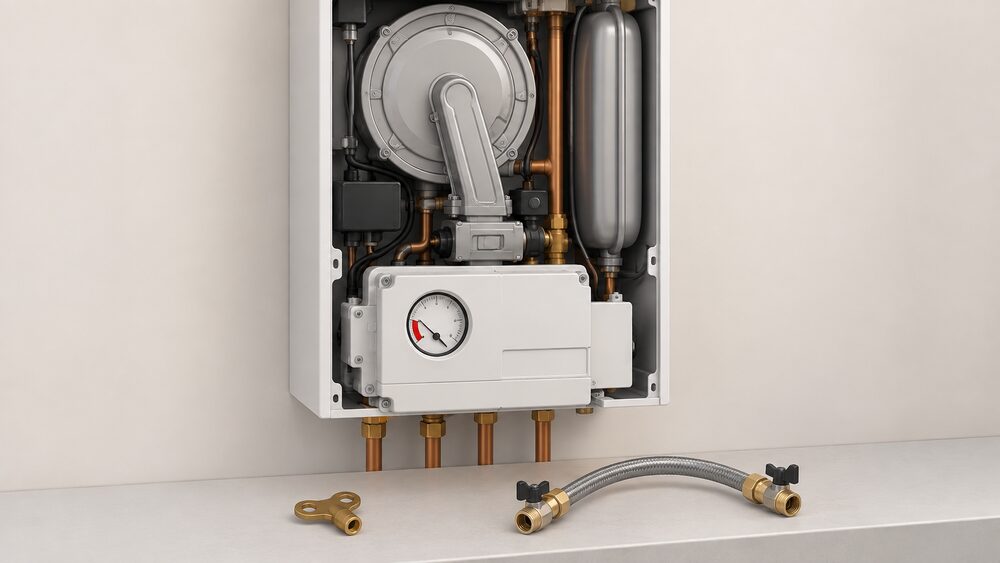
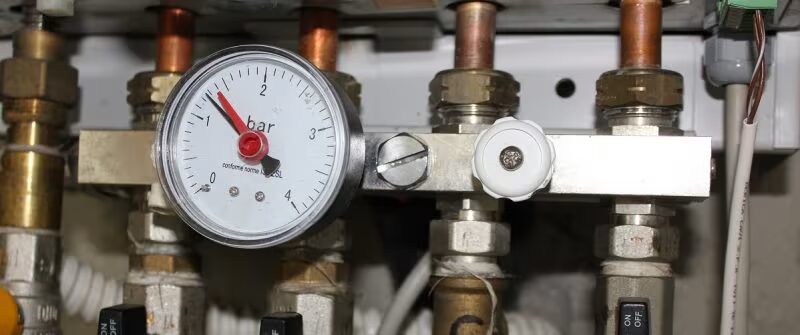
Low gas pressure in a home usually means one of two different things, and they call for different responses. Inside the house, it is most often the boiler's own pressure gauge reading below 1 bar, which stops the boiler working properly and produces error messages or a loss of heating and hot water1. That is a boiler and heating system problem, not a network problem. At the meter, low pressure means the gas arriving from the street is weaker than it should be, and that is a network matter.
If you can smell gas, or you have poor pressure or no gas at all, the number to call is the National Gas Emergency Service on 0800 111 9992. The same number covers a smell of gas, a gas escape, poor pressure, no gas, and a suspected carbon monoxide release3. The service sends an emergency gas engineer from your local distribution network, who ensures steps are taken to make the situation safe4.
What follows sets out the emergency steps, who to call for which problem, what happens after a flood, and why a supply that has been turned off cannot simply be turned back on by the householder.
What low gas pressure means and the common causes
Low pressure at the boiler is a closed-system problem. Which reports that a reading below 1 on the boiler pressure gauge means the boiler will not be able to work properly, and error messages or poor performance follow1. Uswitch lists leaks in the pipes or valves as one cause, and notes that bleeding radiators releases air and lowers the pressure in the system8. Which adds two further triggers: recently bled radiators that need the pressure resetting, and heating that has been off for a very long time9.
That combination matters because the causes point in different directions. A system that has slowly lost pressure over months is more likely to have a small leak somewhere in the pipework or valves. A system that dropped immediately after radiators were bled is usually just short of water and needs topping up through the filling loop. A system that dropped after a long summer shutdown may simply have cooled and contracted.
Low pressure at the meter is a different matter entirely. It is a supply-side condition, and it is one of the triggers for calling the emergency line: Northern Gas Networks advises contacting 0800 111 999 if you can smell gas, experience poor pressure or have no gas7. A household cannot diagnose or fix that, and should not try.
For the household's independence, the distinction is the useful part. Boiler pressure is within the household's control, and understanding the gauge is a small piece of self-reliance. Pressure at the meter is not: it depends on the distribution network, the transmission system and, ultimately, on gas being available at all. Transmission networks carry gas at high pressures and speeds across the country, and that infrastructure is what stands between a household and a cold boiler10.
Smell gas or suspect a leak: the emergency steps first
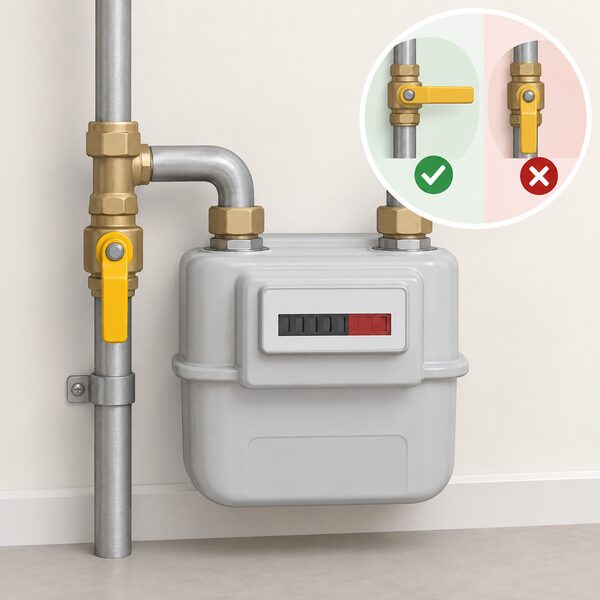
A smell of gas is treated as an emergency, and the steps are consistent across the network operators and safety bodies. Open doors and windows to let fresh air in. Turn off the gas at the meter if it is safe to do so, unless the meter is in a cellar. Do not use electric switches, and extinguish naked flames11. Cadent gives the same sequence and adds that the mains tap near the meter is turned off by turning the handle 90 degrees12. Confused.com's guidance is to open windows and external doors immediately so the gas disperses as quickly as possible13.
If the leak is in a cellar or basement, the advice changes: evacuate rather than go down to the meter12. SGN's version of the same instruction is to open windows and doors, turn off the gas supply at the meter as well as any gas appliances, and call the National Gas Emergency number on 0800 111 9992.
For homes on LPG rather than mains gas, the sequence is broader because there is a storage vessel to isolate. Liquid Gas UK advises closing the manual outlet valve on the cylinder or tank, turning off all appliances and the property's emergency valve, opening doors and windows, not switching lights or electrical equipment on or off, calling your supplier, dialling 999 for the fire brigade, and leaving the premises14. That is a different procedure from a mains supply, and households on LPG should know which one applies to them.
The independence point here is blunt. A gas escape is one of the few household energy situations where the correct action is to stop using the fuel entirely and leave. There is no household-level fix, and no amount of self-sufficiency changes that.
Who to call: network operator, gas supplier or Gas Safe engineer
Three different parties handle three different problems, and calling the wrong one costs time.
The National Gas Emergency Service on 0800 111 999 handles anything that smells, leaks or fails to arrive. It sends an emergency gas engineer from your local distribution network, who ensures steps are taken to make the situation safe4. Northern Gas Networks describes the call handling: you are put through to an experienced operator, who asks a few questions and dispatches an engineer15. The same number is repeated across SGN, Cadent and Northern Gas Networks guidance for a smell of gas2.
A Gas Safe registered engineer handles work on appliances and internal pipework. The register can be searched by postcode, or an advisor reached on the freephone number 0800 408 550017. Northern Gas Networks directs householders to the same number for a list of local registered engineers7, and Cadent repeats it for finding a local engineer18. The Health and Safety Executive confirms the same route: ring Gas Safe Register on 0800 408 5500 or check the website to see whether an engineer is registered5.
The gas supplier handles the commercial relationship: the account, the meter installation and the emergency contact details held on record. Cadent's guidance on gas supply emergencies sets out customer obligations plainly: you must give accurate emergency contact details to your gas supplier, keep them up to date, and be ready to stop using gas as soon as asked19.
"You must give accurate emergency contact details to your gas supplier"
A Gas Supply Emergency is a formal status rather than a household fault, and any gas network or the Network Emergency Coordinator can declare one19. That is the mechanism behind a widespread instruction to stop using gas, and it is why the contact details on the supplier's record matter.
After a flood: why pressure drops and what must be done before gas is restored
Flooding affects a gas supply in ways that are not obvious from the boiler. Water can enter the gas pipes within the home, and the remedy is not a household one: contact a Gas Safe registered engineer to clear the system6. Northern Gas Networks gives the same instruction7.
The restoration rule is firm. Do not try to turn the gas supply back on yourself; restoration must be done by an appropriate qualified person6. Cadent states it as a direct instruction: do not turn it back on until advised it is safe to do so20. SGN's incident guidance is that, for safety reasons, customers should not attempt to turn their gas supply back on themselves21.
There is a further condition that catches people out. If an appliance has a fault, the supply will not be reconnected until it has been checked by a Gas Safe engineer, and Cadent's own engineers are not qualified to repair appliances20. So a flood that damages a boiler can hold up the gas restoration even after the pipework is clear.
On turning gas off before leaving a flooded property, the guidance is more permissive than many households assume. Northern Gas Networks states that there is no safety reason to turn off the gas supply before vacating a property, though it may be turned off at the emergency control handle if preferred or if an authorised agency advises it, and it should not be attempted if the meter is under water or in a cellar7. SGN's winter guidance says to turn off the gas at the emergency control handle if it is safe and able to be done, and not to attempt it if the meter is in a cellar or basement22. Electrical Safety First, covering flood damage generally, advises arranging for other services such as gas to be turned off by the service providers23.
Wales & West Utilities sets out what restoration involves from the network side: access to the property is needed to turn the gas supply back on, and gas appliances cannot be used until safety is confirmed24.
Restoring a turned-off supply: why only a qualified person can do it
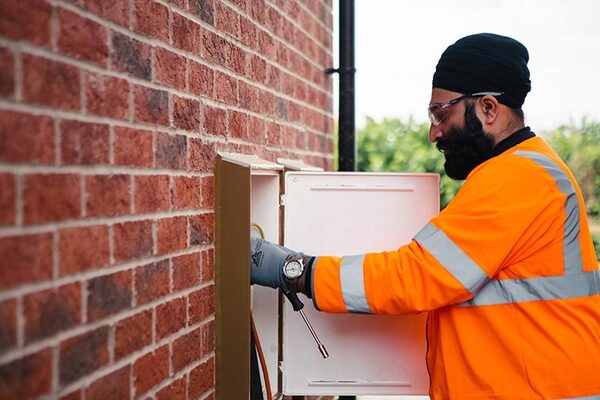
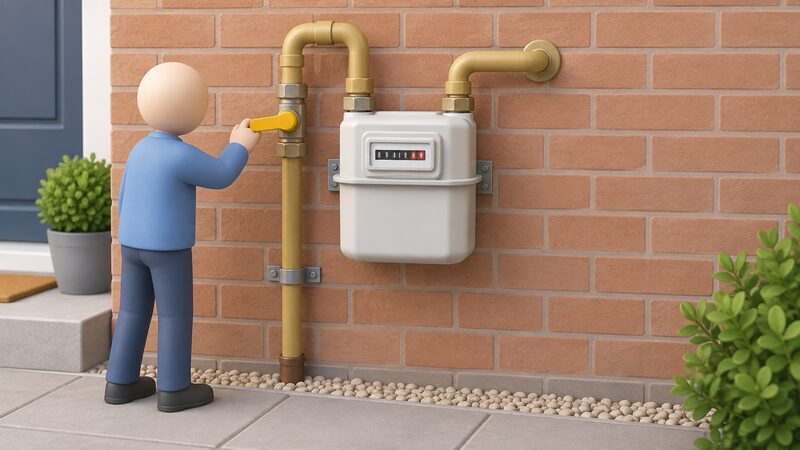
A gas supply that has been turned off at the meter, whether after a flood, an incident or an emergency call, is not a tap that can be reopened. Northern Gas Networks states that a turned-off gas supply must be restored by an appropriate qualified person7. Cadent's instruction is not to turn it back on until advised it is safe to do so20. SGN's incident response guidance says customers should not attempt to turn their gas supply back on themselves, for safety reasons21.
The reason is that restoration is not only about gas flow. It is a check that the installation is sound. During a loss of gas supply, engineers visit all affected properties to temporarily turn off gas supplies at the meter, provide an information card or letter, and then visit each property to restore supply and perform safety checks21. The safety check is the point of the visit.
If a household needs the supply turned off for other reasons, such as building work or a permanent disconnection, that is a network job rather than an emergency one. Northern Gas Networks advises contacting it immediately to arrange for an engineer to safely turn off the gas supply25. SGN handles new connections, meter moves, pipework changes and disconnection from the gas network for household customers26.
For a household thinking about independence, this is the clearest limit in the whole subject. Gas is a delivered fuel with a chain of custody: the network owns and operates the pipe, the supplier owns the commercial relationship, and a registered engineer owns the work on the installation. A household can monitor its boiler pressure and know the emergency number. It cannot restore its own supply, and it should not try.
Where the household's control ends
The practical split is straightforward. Boiler pressure below 1 bar is a household-visible symptom with household-level causes, most often a leak, recently bled radiators or a long period with the heating off1. Pressure at the meter, a smell of gas, or no gas at all is a network matter, and the number is 0800 111 9992.
Beyond that, the dependencies are structural. The gas arrives through a distribution network and a transmission system carrying gas at high pressures and speeds across the country10. The meter comes from a supplier, not the network: Northern Gas Networks does not supply gas meters, and the householder arranges meter fitting with a chosen energy supplier after the network issues an MPRN27. Restoration after any interruption requires a qualified person7. For homes on LPG, the isolation procedure is different again, involving the cylinder or tank valve and a call to the supplier14.
Households that want to understand the wider picture can read where Britain's gas comes from and gas distribution networks, or the pillar page on UK energy supply. For the emergency framework itself, gas supply emergencies covers warnings, deficit notices and household priority.
Sources28 cited
- How to keep your boiler working in cold weather, Which?, 2025-12-11
- Smell gas, SGN, 2026
- Know or suspect you have a gas emergency, IGEM, 2026-09-20
- Smell gas, Cadent Gas, 2026-09-20
- Gas safety in the home: FAQ for owner occupiers, Health and Safety Executive, 2026
- Flood advice, Cadent Gas, 2026-09-20
- Flood advice, Northern Gas Networks, 2025-10-22
- What pressure should your boiler be?, Uswitch, 2024-11-13
- What should your boiler pressure be?, Which?, 2025-09-16
- Gas transmission networks, House of Commons Library, 2026-09-17
- Gas and carbon monoxide safety, Electricity North West, 2026-09-19
- Emergency engineer visit, Cadent Gas, 2026-09-20
- What to do if you smell gas, Confused.com, 2025-09-08
- Safety advice, Liquid Gas UK, 2026-09-20
- Gas emergencies, Northern Gas Networks, 2025-10-22
- Gas Safety Week, Cadent Gas, 2026-09-20
- Gas Safe Register, nidirect, 2025-10-29
- Energy efficiency, Northern Gas Networks, 2026-06-25
- Gas supply emergencies, Cadent Gas, 2026-09-20
- Locating your meter and turning off the gas, Cadent Gas, 2026-09-20
- Gas supply updates, SGN, 2026
- Be winter ready, SGN, 2026
- Flood damage and electrical safety, Electrical Safety First, 2026-09-19
- Domestic customers FAQs, Wales & West Utilities, 2026-09-20
- What do I do to stay warm while my gas is off?, Northern Gas Networks, 2026-01-14
- Gas connections for household customers, SGN, 2026
- Apply now for a new gas connection, Northern Gas Networks, 2026-09-17
- Disconnection FAQs and guidance, Northern Gas Networks, 2025-10-30
 Gas Supply EmergenciesIf gas runs short, will my home lose supply?
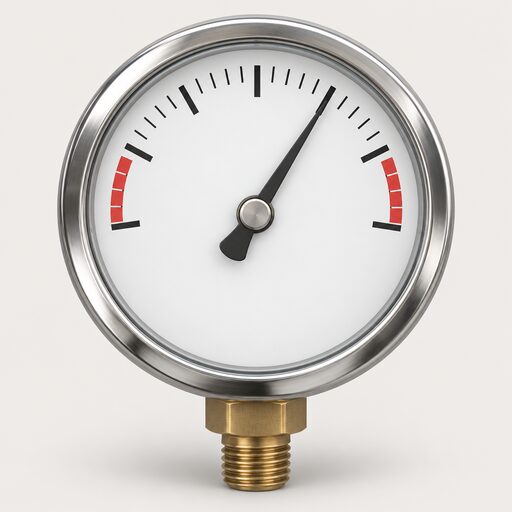 Boiler PressureIf the needle on your boiler has crept up or dropped, what should it read when the heating is off, and what counts as too high or too low?
 Who to Call for Energy HelpA single reference to the right contact for each situation: gas escapes, power cuts, water leaks, meter faults, billing disputes, scams and free advice.
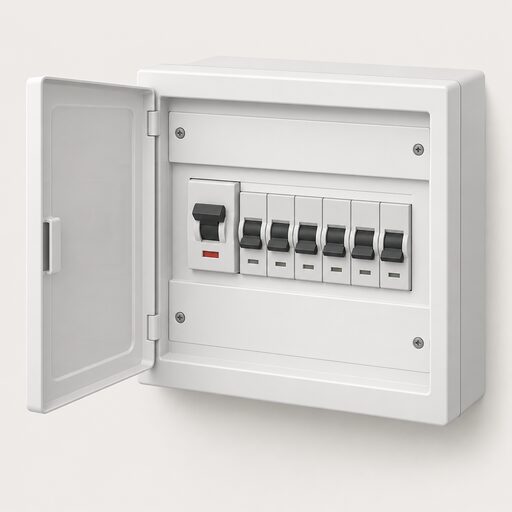 Turn Off Gas, Water, PowerWhere the gas emergency control valve, internal stopcock and consumer unit main switch are usually found and how each is operated.
 Prepare Energy for StormsWhat to do before and during a storm or flood warning to protect meters, the consumer unit, heating equipment and fuel tanks.
 Flow TemperatureTurning down your boiler flow temperature can cut your gas bill, but how low can you go before the house feels cold?