
In this guide
A gas supply emergency is a formal, staged response to a shortage of gas on the national system. It begins long before any household loses supply, with notices that ask large users to cut consumption, and it ends with a controlled restoration once pressure is stable. The order in which users are curtailed is the part that matters most to a home: domestic customers sit at the end of it, so a request to stop using gas reaching households is a late and serious stage, not a routine one.
The scale of the system explains why. UK gas demand was 687 terawatt hours (TWh) in 2024, the lowest level since the early 90s, and 37% lower than demand in 20101. Even at that reduced level, the UK does not supply itself: on a five-year average, UK Continental Shelf gas provides 43% and Norwegian Continental Shelf gas 35% of gross annual supply2. The UK is a net importer of natural gas, importing more than it exports, which leaves it exposed to global price and supply movements3.
For a household, the practical meaning is narrow but important. A gas deficit warning is a signal that the system is short, not an instruction to a home. Curtailment reaches domestic properties only at the final stage, and the network operator's priority services register exists for households that need extra help if it does.
The short answer: a staged ladder, with homes last
A gas supply emergency is the industry's escalation ladder for a gas shortage. It runs from early warnings that the system margin is thin, through a gas deficit warning that asks large consumers to reduce demand, to a network gas supply emergency in which the network operator instructs firm load shedding: the controlled interruption of supply to users in a set order. Households are last in that order.
The reason households are protected is that domestic gas is treated as the demand that cannot be deferred without immediate harm. Large industrial users, power stations and some commercial sites can reduce or stop consumption with notice and with contractual arrangements in place. A home cannot. So the curtailment sequence works down from the largest, most flexible users to the smallest and least flexible, and domestic properties are the final category.
That does not make a household passive. A request to stop using gas, when it comes, is a safety instruction. Turning off appliances and the meter supply reduces demand on a network that may already be operating at reduced pressure, and it shortens the event for everyone connected to the same part of the system. The stages exist so that this instruction is issued only when the alternatives have been used.
The wider context is a system that has shrunk in demand but not in dependence. Gas demand in 2024 was 37% lower than in 20101, yet the UK remains a net importer3, and the Climate Change Committee has found the UK strongly affected by the energy crisis because of its dependence on natural gas for heating, electricity generation and industry7. A gas emergency is the sharp end of that dependence.
The figures behind the framework
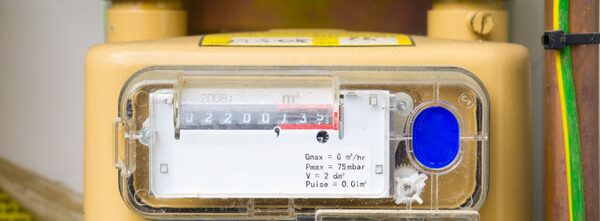
The figures that frame a gas emergency are demand, supply share and household consumption. UK gas demand was 687 TWh in 2024, described in official guidance as the lowest level since the early 90s, and 37% lower than demand in 20101. On the supply side, official statistics give UK Continental Shelf gas 43% and Norwegian Continental Shelf gas 35% of the UK's gross annual gas supply on a five-year average2.
At household level, the average GB household uses 13,697 kWh of gas per year4. That average conceals a wide spread: a well-insulated flat and a large detached house on the same street can differ severalfold, and it is the aggregate of those homes that makes domestic demand the largest single block on a cold day.
| Figure | Value | As of | Source |
|---|---|---|---|
| UK gas demand | 687 TWh | 2024 | 1 |
| Change since 2010 | 37% lower | 2024 | 1 |
| UKCS share of gross annual supply | 43% (five-year average) | 2025 | 2 |
| NCS share of gross annual supply | 35% (five-year average) | 2025 | 2 |
| Average GB household gas use | 13,697 kWh per year | 2024 | 4 |
One further point sets the legal backdrop rather than the financial one. The Energy Act 2008 gave the Secretary of State powers to amend existing, or create new, licence conditions and industry codes for the purposes of delivering the Smart Meter Implementation Programme, so the machinery for changing what suppliers and networks must do sits in statute rather than in voluntary agreement5. That matters for the demand side of a gas emergency: the obligations that shape metering, and with it the visibility of household consumption, can be altered through licence conditions and codes without fresh primary legislation.
What drives a shortage
Gas emergencies are driven by the balance between demand and available supply, and both sides move. On demand, cold weather is the single largest factor: the Commons Library lists high demand from cold weather among the causes of the price and supply stress of 2022, alongside the return of global gas demand after pandemic restrictions, supply unable to keep up, regional factors in Europe, debate about whether Gazprom could increase supply, low levels of wind, outages at nuclear plants, and a fire that shut down a key electricity interconnector3.
That list is instructive because it mixes gas-specific and electricity-specific causes. Gas and electricity are coupled: gas generates a large share of Britain's electricity, so a gas shortage can become an electricity shortage, and a cold, still week can tighten both at once. The Climate Change Committee has factored in a 50% increase in electricity demand to reflect the expected increase in transport, industry and buildings decarbonisation, which raises the stakes on the gas system's role as a backstop8.
On the supply side, the constraint is structural. The UK is a net energy importer with a high dependence on gas and oil9, and it is a net importer of natural gas specifically3. Domestic production is declining, and the Climate Change Committee has stated that even if all new fields are developed, the UK will not produce enough gas to meet heating demand by 202710. That is the timeline that makes the emergency framework more than theoretical.
"The UK has been strongly affected by the energy crisis due to its dependence on natural gas for heating, electricity generation and industry"
Efficiency and demand reduction are the levers a household controls. The Climate Change Committee has found that the policies needed to drive improvements in energy efficiency in homes that are not fuel poor are currently inadequate11, and it has called for incentives to act and greater awareness of preparing for climate risk and reducing emissions10. Where those policies are absent, the demand side of a gas emergency is left to weather and price.
How the framework differs across the UK nations

The gas emergency framework is largely a Great Britain matter, because the gas transmission and distribution system that the curtailment order protects is the GB system. Northern Ireland sits outside it, with its own gas network arrangements and its own electricity market, so a GB gas deficit warning does not map directly onto a Northern Ireland household's position.
Within Great Britain, the differences that matter to a household are in the safety and landlord rules that sit alongside the emergency framework, not in the curtailment order itself. In England, from 1 October 2022, all relevant landlords must provide a carbon monoxide alarm in any room used as living accommodation which contains a fixed combustion appliance, excluding gas cookers12. In Wales, the Fitness for Human Habitation Regulations require a landlord to ensure that a carbon monoxide alarm is present in any room which has a gas, oil or solid fuel burning appliance installed13. In Northern Ireland, the Building Regulations provide that the provision in a dwelling of devices to detect and give warning of the presence of carbon monoxide gas does not require notices or deposit of plans14.
| Nation | Position on the gas emergency framework | Related safety rule |
|---|---|---|
| England | Within the GB curtailment order | Landlord carbon monoxide alarm duty in rooms with a fixed combustion appliance, excluding gas cookers12 |
| Scotland | Within the GB curtailment order | GB-wide gas safety regime applies |
| Wales | Within the GB curtailment order | Landlord carbon monoxide alarm duty in rooms with a gas, oil or solid fuel appliance13 |
| Northern Ireland | Separate gas network and market arrangements | Carbon monoxide detection devices exempt from notices and plan deposits14 |
The practical consequence is that a household in England, Scotland or Wales is protected by the same curtailment order and served by the same national gas transmission system, while a household in Northern Ireland depends on separate arrangements. For the network that delivers gas to a street, the operator differs by region, and the local gas distribution network is the first point of contact when supply fails at a property.
The rules that sit alongside the emergency
The rules around a gas emergency are a mix of network obligations, safety law and consumer protection. The curtailment order itself is a network and system operator matter, exercised through the gas supply licence regime and the emergency arrangements that sit behind it. Ofgem's licence guide is explicit about its own status: it is intended as a helpful tool only, and does not modify or replace the conditions in the gas and electricity supply licences15. The binding obligations are in the licences, not the guide.
Safety law sits alongside. The Health and Safety Executive's gas safety guidance for domestic premises is the reference point for appliance safety, and a request to stop using gas during an emergency is a safety instruction rather than a commercial one12. Where a gas appliance is faulty or a smell of gas is reported, the response is a safety response, and it takes precedence over any question about who pays.
Consumer protection rules also bear on the aftermath. The Warm Home Discount (England and Wales) Regulations 2022 set conditions on what a supplier may count as a qualifying cost, including that a supplier may not count the costs of installing a mains gas fuelled boiler or central heating system unless it replaces an existing mains gas system and at least one person in the premises is aged 65 or over, under compulsory school age, or has significant health problems or a disability making them vulnerable to cold-related illness or spending the majority of their time in the premises16. Ofgem has consulted on a requirement to offer lower standing charge tariffs, with a reduction of £85 to £100 for gas consumers, broadly reflecting the ratio of non pass-through costs in the cap17.
For households in debt or at risk of self-disconnection, the rules matter more than the emergency stages. Ofgem's self-disconnection and self-rationing work addresses the position of customers who go without supply because they cannot afford it, which is a different problem from a network emergency but produces a similar outcome at the meter18. Ofgem has also reported that suppliers must do more to help those in debt, with customers accruing more than £600 in average unpaid bills19.
What it means for a household's energy independence
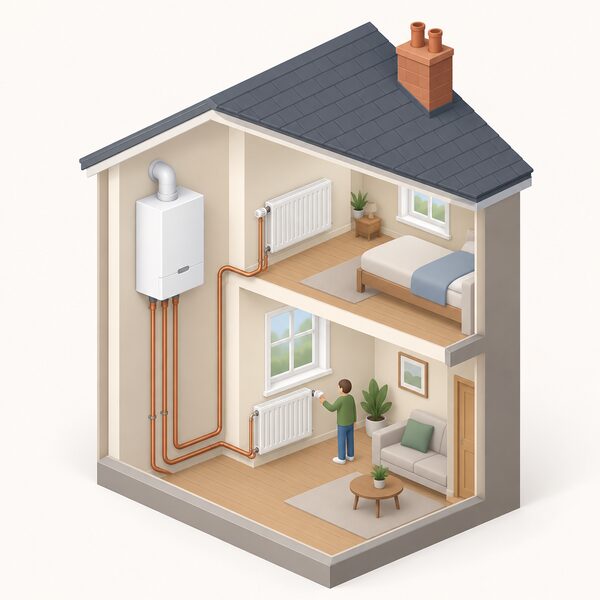
A gas supply emergency is the clearest demonstration of where a household's energy independence ends. A home can insulate, reduce demand, and control when it uses gas, but it cannot create gas. The curtailment order protects domestic supply precisely because homes have no substitute at short notice, and that protection is a function of the network, not of anything the household owns.
The dependence is structural and documented. The UK is a net energy importer with a high dependence on gas and oil9, and a net importer of natural gas3. Domestic production covers part of demand, with UK Continental Shelf gas at 43% and Norwegian Continental Shelf gas at 35% of gross annual supply on a five-year average2, but the Climate Change Committee's assessment is that even with all new fields developed, the UK will not produce enough gas to meet heating demand by 202710.
What a household can control is the demand side. Average GB household gas use is 13,697 kWh per year4, and heating homes accounts for around 14% of UK greenhouse gas emissions5. Reducing that demand lowers exposure to both price and shortage, and it is the one variable a household sets directly. The Climate Change Committee has found that the policies needed to drive energy efficiency improvements in homes that are not fuel poor are currently inadequate11, which means the demand-side lever is largely left to the household.
The remaining dependence is on the grid, the network operator and the supplier. A home connected to the gas network depends on the distribution network to deliver gas, on the transmission system to move it, and on imports to fill the gap between UK production and demand. A gas deficit warning is the moment that chain is tested, and the curtailment order is the mechanism that decides who keeps supply. For a household, the honest position is that independence in a gas emergency means having a plan for the hours without gas, not having a way to avoid the emergency.
Sources19 cited
- Gas demand and the UK energy system, House of Commons Library, 2025
- Statutory Security of Supply Report 2025, Department for Energy Security and Net Zero, 2025
- UK gas supply, prices and security, House of Commons Library, 2022
- Ofgem archetypes update 2024, Ofgem, 2024
- Domestic Renewable Heat Incentive annual report, scheme year 11, Ofgem, 2025
- Energy price cap changes, October to December 2025, Ofgem, 2025
- Climate policy that cuts costs, Climate Change Committee, 2026
- A reliable, secure and decarbonised power system by 2035, Climate Change Committee, 2023
- Spring Statement 2022, HM Treasury, 2022
- A lack of leadership is preventing essential investment, Climate Change Committee, 2023
- Taking stock of the UK government's heat and buildings strategy, Climate Change Committee, 2022
- Gas safety in domestic premises: frequently asked questions, Health and Safety Executive, 2022
- Fitness for human habitation guidance for landlords, Welsh Government, 2022
- The Building Regulations (Northern Ireland) 2012, legislation.gov.uk, 2012
- Licence guide: information for consumers, Ofgem, 2019
- Warm Home Discount (England and Wales) Regulations 2022, legislation.gov.uk, 2022
- Requirement to offer lower standing charge tariffs, Ofgem, 2025
- Self-disconnection and self-rationing final impact assessment, Ofgem, 2020
- Suppliers must do more to help those in debt, Ofgem, 2017
 Electricity Margin ShortagesWill the lights stay on this winter, and what would have to happen before homes lose power?
 Turn Off Gas, Water, PowerWhere the gas emergency control valve, internal stopcock and consumer unit main switch are usually found and how each is operated.
 Prepare a Home for a Power CutA household checklist for before, during and after an outage: what to keep charged and to hand, which appliances to switch off, how long food stays safe and what to do about medical equipment.
 Prepare Energy for StormsWhat to do before and during a storm or flood warning to protect meters, the consumer unit, heating equipment and fuel tanks.
 Getting a New Gas ConnectionHow a household applies for a new or upgraded gas connection, who carries out the work, the quotation and contribution rules, typical timescales, and what a connection means for a home's energy independence.
 The Full Backup Power GuideHow long do UK power cuts usually last, and what can keep your fridge, heating or phone going until the power comes back?