
In this guide
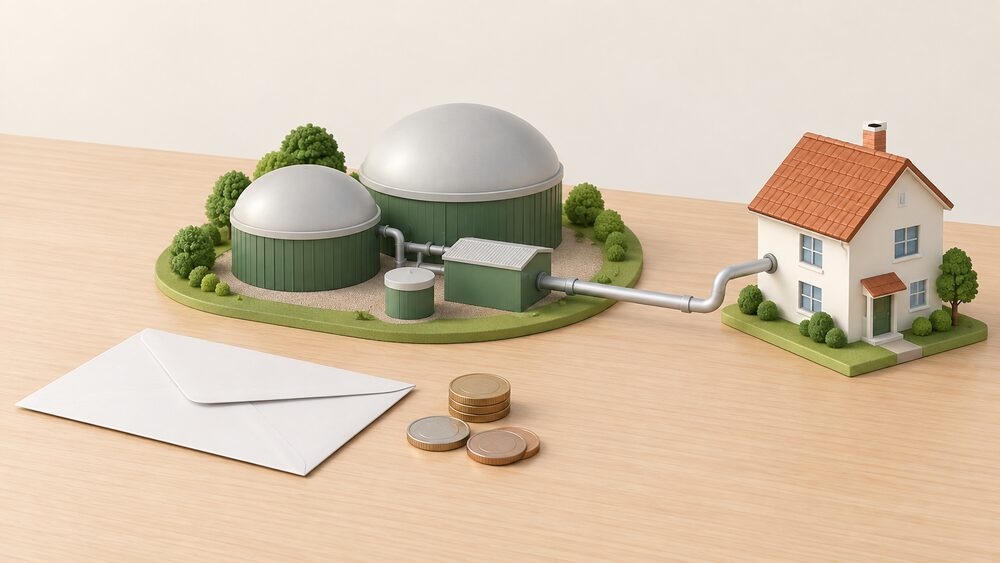
Biomethane is a low carbon, or even carbon negative, gaseous fuel produced from the anaerobic digestion of organic material such as food waste, sewage, manure and crops. It is molecularly identical to fossil gas, which means it can be supplied through the existing pipelines and is entirely compatible with the gas systems already used by households, commercial businesses and industrial sites1. For a household, that is the central fact: nothing in the home needs to change for biomethane to arrive, and nothing in the home can tell whether it has.
The scale today is modest but real. There are 130 biomethane sites already connected to the grid, with capacity to heat up to one million homes1. The industry's longer term figure is far larger: up to 120TWh by 2050, which equates to up to 90% of overall demand in 2050 on a scenario of significantly lower gas demand by then1. Between those two points sits a policy question about feedstock, funding and network planning that has not been settled.
What biomethane does for a household's energy independence is partial and specific. It substitutes a domestically produced gas for imported molecules, using infrastructure that already exists, and it does so without asking the household to buy anything. What it does not do is remove dependence on the gas network, on a licensed supplier, or on a support scheme whose budget is controlled by government. This page sets out how the gas is made, how much of the grid it fills, what it costs, and where the limits lie.
What biomethane is and how it is made
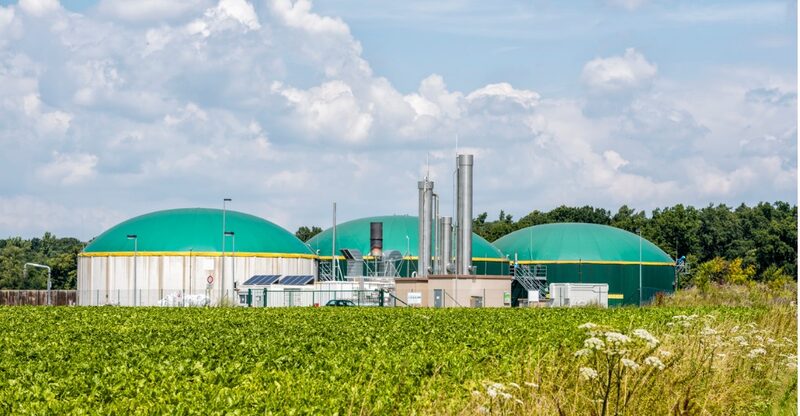
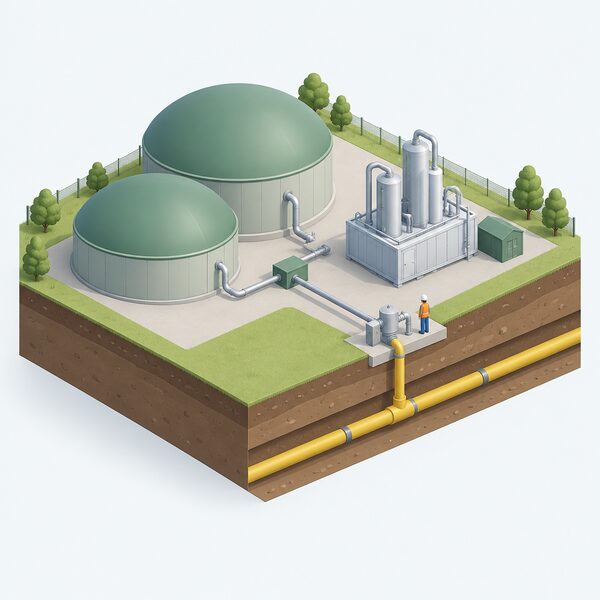
Biomethane is produced from the anaerobic digestion of organic material such as food waste, sewage, manure and crops1. Anaerobic digestion is a natural process in which micro-organisms break down organic matter, such as animal manure or waste food, within a contained environment, producing biogas which can then be used as fuel to generate electricity4. The raw output of that process is biogas; biomethane is the upgraded product, processed to the quality needed for injection into the gas grid.
Green gas, the term used on tariffs and in policy documents, comes from the same process: anaerobic digestion, where bacteria are used to break down food or farm waste to produce gas5. The two terms describe the same production route at different stages of refinement.
The feedstocks are the ordinary waste streams of a working economy. Food waste from households and food processing, sewage sludge from wastewater treatment, manure from livestock farming and purpose-grown crops all feed digesters. That matters for how the sector scales: the resource is distributed across the country rather than concentrated in a few geological formations, and it is replenished annually rather than extracted once.
Biomethane is produced when organic material such as food waste, manure, sewage or crops is broken down, and it can be used for heating and cooking like natural gas2. The process is anaerobic digestion, in which bacteria break the material down in digester tanks without oxygen1. Some production also uses thermal gasification of household waste, sewage and industrial by-products6.
"It is a low carbon – or even carbon negative – gaseous fuel produced from the anaerobic digestion (AD) of organic material such as food waste, sewage, manure and crops."
The distinction between biogas and biomethane is not academic. Biogas contains impurities and a lower methane concentration, and is typically burned on site to generate electricity or heat. Biomethane is cleaned and concentrated so that it behaves like natural gas, which is what allows it to be injected into a distribution network and drawn off by a boiler miles away. The upgrading step is what converts a local waste treatment by-product into a grid commodity.
Molecularly identical to fossil gas: why the existing grid works as it is
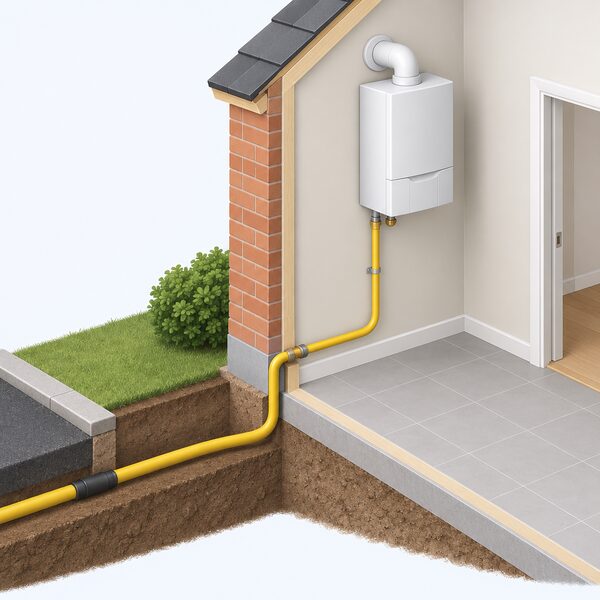
The reason biomethane can be used at all without a national retrofit programme is chemical. It is molecularly identical to fossil gas, meaning that it can be supplied through existing pipelines and is entirely compatible with existing gas systems used by households, commercial businesses and industrial sites1. No appliance change, no new meter, no separate pipe.
That compatibility extends to the network itself. Polyethylene distribution pipes were being laid in the UK as early as the 1970s, and that modern plastic network is what carries gas to homes today7. Biomethane injection points connect into that same system. The gas distribution networks that deliver gas to streets are the physical route by which biomethane reaches a boiler, and they are described in more detail in gas distribution networks.
The practical consequence for a household is that biomethane is not a competing technology to a gas boiler. It is a change in what flows through the pipe. A home connected to the gas grid is already, in principle, biomethane-ready. The constraint is supply, not equipment.
This is also why biomethane sits differently in the energy security picture from hydrogen. Hydrogen blending requires changes to gas quality regulations and, at higher concentrations, to appliances. Biomethane requires neither. It is the lowest-friction substitution available for the existing gas network, which is precisely why the industry argues it should be prioritised. The wider question of what else might flow through those pipes is covered in hydrogen in the gas grid.
How much biomethane is in the UK grid today
There is already enough biomethane flowing through the gas network to heat up to one million homes, thanks to the 130 biomethane sites already connected to the grid1. That is the current position as of May 2025. It is a meaningful volume and a small fraction of total demand.
The industry's own framing of the growth path uses a 50TWh figure, which it states represents 14% of the UK's current gas demand1. The gap between the current one-million-home equivalent and that 50TWh marker is the build-out the sector says it can deliver with the right support.
For context on what the gas network serves, the gas network provides for some 85% of dwellings in England3. Biomethane therefore has a very large addressable base of connected homes, and a very small current share of the molecules those homes burn.
| Measure | Figure | Date |
|---|---|---|
| Biomethane sites connected to the grid | 130 | May 20251 |
| Heating equivalent of current capacity | up to one million homes | May 20251 |
| 50TWh as a share of current gas demand | 14% | May 20251 |
| Long term potential | up to 120TWh by 2050 | May 20251 |
The network companies have submitted plans for the next regulatory period to connect well over 30TWh of new biomethane production capacity, covering 2026 to 20311. That is a connection pipeline, not a guarantee of production, but it indicates what the networks expect to be asked to accommodate.
How far production could grow: from 7 TWh now to a potential 120 TWh
The long term figure the industry uses is up to 120TWh by 2050, and it states that 120TWh equates to up to 90% of overall demand in 2050, based on a scenario of significantly lower gas demand by then1. Both halves of that sentence matter. The 120TWh is a feedstock potential; the 90% only holds if total gas demand has fallen substantially by mid-century.
The same source sets out a 50TWh milestone representing 14% of the UK's current gas demand1. Read together, the two figures describe a sector that could supply a large share of a much smaller gas system, rather than a large share of today's system.
National energy system planning uses a comparable order of magnitude for bioresources generally. Bioresource demand of 120 TWh is set out for 2030 in the system operator's scenarios, alongside green hydrogen production of 2 TWh by 20356. The two figures sit in the same planning document and illustrate that biomethane and hydrogen are being modelled as complementary rather than alternative uses of the same resource base.
The government's hydrogen ambition sits alongside this: a target to double ambition to up to 10GW of low carbon hydrogen production capacity by 20308. Biomethane and hydrogen are both domestic gas options competing for the same policy attention and, in some cases, the same biomass feedstock. How that competition resolves is not settled in the documents available.
Where the gas comes from: food waste, sewage, manure and crops as feedstocks
The feedstocks are food waste, sewage, manure and crops1. Each has a different profile in terms of availability, competing use and carbon accounting.
Food waste and sewage sludge are the most straightforward: they are waste streams that must be treated anyway, and digestion captures energy while reducing the volume requiring disposal. Manure from livestock farming is similarly a by-product, though its collection and transport have their own emissions. Purpose-grown crops are the most contested feedstock, because land used for energy crops is land not used for food, and the carbon accounting depends heavily on how the crop is grown and what it displaces.
The broader biomass picture in the UK is dominated by wood: the most common fuel used is wood, although plant oils, sugar cane and other crops can also be used9. That describes solid biomass combustion rather than anaerobic digestion, but it illustrates the competition for organic material across the energy system.
For the gas grid specifically, the supply picture is still overwhelmingly fossil. The remainder of UK gas supply is primarily made up of Liquefied Natural Gas shipments at 21%, on a five-year average10. Biomethane sits within the domestic production slice, and its growth is a question of how quickly that slice can be enlarged. The wider composition of supply is set out in where Britain's gas comes from.
Carbon credentials: carbon neutral today, carbon negative with capture
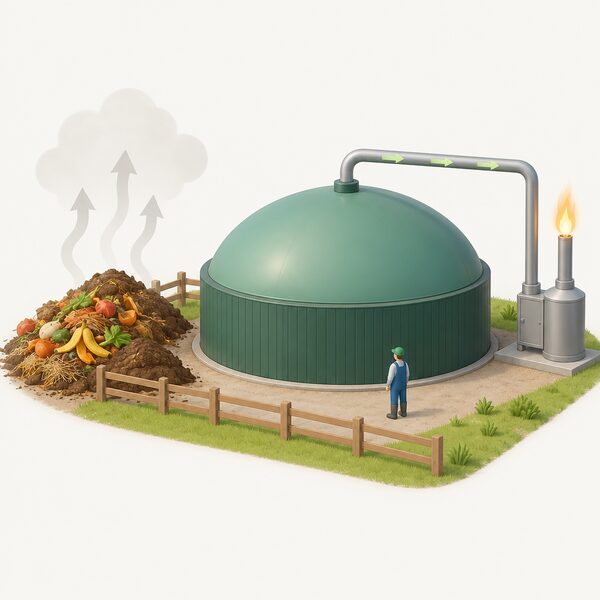
Biomethane is described as a low carbon, or even carbon negative, gaseous fuel1. The carbon negative case arises where the feedstock would otherwise decompose and release methane to the atmosphere, and where the digestion process captures that methane and burns it as fuel instead. Capturing the carbon dioxide released during upgrading would push the balance further.
The wider UK picture provides the context. The UK is now halfway to Net Zero emissions, and emissions from coal are now zero11. Those are economy-wide figures, not biomethane-specific, but they show the direction of travel and the scale of what remains.
Methane accounting is where biomethane's credentials are most sensitive. The base year for UK greenhouse gas emissions is 1990 for carbon dioxide, methane and nitrous oxide12. Methane is a short-lived but potent greenhouse gas, and the case for digesting manure and food waste rests substantially on avoiding the methane that would otherwise be released.
Heating homes accounts for around 14% of the UK's total greenhouse gas emissions, which is the share biomethane is competing to reduce13. That figure frames the size of the prize and the limits of any single solution.
What it means for householders: compatibility with boilers and hybrid systems
For a household on the gas grid, biomethane requires no action. It is compatible with existing gas systems used by households, commercial businesses and industrial sites1. A boiler that runs on natural gas runs on biomethane.
The policy environment around heating is moving in a different direction, however, and households weighing up equipment should understand the distinction between what a fuel can do and what a standard will permit. The Future Homes Standard consultation states that gas boilers, including hybrid and hydrogen-ready boilers, will not meet the proposed standards14. That is a proposed standard for new homes, not a ban on biomethane as a fuel.
There is a related restriction on the Boiler Upgrade Scheme: biomass boilers must not be installed in properties connected to the gas grid15. That rule concerns biomass boilers, not biomethane, but it illustrates that grant funding is being directed away from combustion in connected homes.
For off-gas-grid homes, the timetable has moved. The government has set out a delay to the ban on installing oil and LPG boilers, and new coal heating, for off-gas-grid homes from 2026 to 203516. Homes not connected to the gas network therefore have a longer window, and no access to biomethane through a pipe.

Why rural areas stand to gain most
The rural case for biomethane is about feedstock proximity and about the limits of the alternatives. Rural areas have the land, the farms and the waste streams that feed digesters, and they have the highest concentration of homes outside the gas network.
The numbers are stark. In Scotland, 55% of dwellings in rural areas are not within the coverage of the gas grid17. In the 2024 survey, 57% of those in rural areas are not connected18. The two figures come from successive years of the same survey series and describe the same underlying pattern.
The rural population concentration is captured in the archetype work: 96% of one archetype's population is in rural areas, against a Great Britain average of 22%19. That is a modelling construct, but it reflects how heavily rural households feature in the off-gas-grid population.
Policy has not consistently favoured rural households. Premises in rural areas in England are not eligible for the rural off gas uplift under the ECO4 and GBIS rules20. Biomass boilers supported under one scheme are for rural properties only in England or Wales21. The result is a patchwork: rural homes are the most likely to be off the gas grid, the most likely to have the feedstock nearby, and subject to eligibility rules that vary by nation and scheme.
The Green Gas Levy and how the sector is funded

The Green Gas Support Scheme provides financial incentives for new anaerobic digestion biomethane plants to increase the proportion of green gas in the gas grid22. It supports the generation of biomethane by anaerobic digestion, for injection into the gas grid23. The scheme opened in Autumn 202124.
The funding mechanism is the Green Gas Levy. The scheme is funded via a Green Gas Levy25, and that levy places an obligation on licensed fossil fuel gas suppliers in GB to pay a quarterly levy based on the number of gas meters they serve2. Suppliers recover the cost through bills.
The bill impact is modelled rather than current. Gas customers could see their annual bills rise by approximately £4.70 at the peak of the levy in 2028, assuming a transition to a volumetric levy2. That is the official assessment of the peak, and it is conditional on the levy design changing.
For comparison on what a gas bill looks like, the benchmark maximum charges for the charge restriction period give a Midlands prepayment gas bill of £790.25 per annum at 12,000 kWh, and an East Midlands figure of £781.15 per annum at 12,000 kWh27. Those are benchmark maxima for prepayment customers, not typical bills, and they are given here only to show the order of magnitude against which a levy of a few pounds sits.
The industry has argued for more. The UK Government has been told it must expand the scope of the Green Gas Levy, or a parallel scheme, and amend gas regulations to allow for greater blending of hydrogen28. That is a policy ask, not a commitment.
Policy and network plans: where biomethane fits in net zero
The statutory backdrop is the target to achieve net zero greenhouse gas emissions across the whole UK by 2050, set in 201929. The Heat and Buildings Strategy restates the UK's statutory target of reaching Net Zero greenhouse gas emissions by 205026. Biomethane sits within that framework as one of several options for decarbonising heat.
The strategy's stated benefits are relevant to households: delivering on these goals will help to protect UK consumers from future price spikes and increase energy security by reducing energy needs and shifting demand from gas to electricity, which in future will be predominantly supplied from UK-based renewable generation30. That framing places electrification at the centre and biomethane as a transitional or complementary measure.
Wales has taken a different route on new connections. The Welsh approach is to ensure that the standards mean that no new buildings are connected to the gas grid from 202531. That is a significant divergence: new Welsh buildings will not have a gas connection to receive biomethane through, whatever the supply mix.
The industry's own position is that biomethane has system value and growth potential, while noting that the current policy support framework does not address its future1. The network companies have submitted plans to connect well over 30TWh of new biomethane production capacity for 2026 to 20311. Whether that capacity is built depends on the support framework that follows the current scheme.
For a household, the practical reading is this. Biomethane is a real, working, domestically produced gas that requires no change in the home and reduces the imported share of the gas burned. It is also capped by feedstock, by levy budget and by a policy framework that has not yet decided how large a role it should play. The dependence that remains is on the gas network, on a licensed supplier, and on government decisions about how much green gas is worth paying for.
Sources31 cited
- The role of biomethane in reaching net zero, IGEM, May 2025
- Price Cap: Decision on changes to Annex 4, Green Gas Levy allowance, Ofgem, 4 February 2022
- Building regulations discussion document, Northern Ireland Department of Finance, 11 October 2023
- Feed-in Tariffs Annual Report Scheme Year 13, Ofgem, December 2023
- Green energy, Uswitch, 4 September 2026
- NESO document 263861, NESO, 2030
- Ensuring safe hydrogen in the gas network, SGN, 2026
- Major acceleration of homegrown power in Britain's plan for greater energy independence, GOV.UK, 2030
- Insulation, nidirect, 2 September 2026
- Statutory security of supply report 2025, GOV.UK, 17 December 2025
- Progress in reducing emissions: 2026 report to Parliament, Climate Change Committee, 2026
- Publication of emissions data 2022, Welsh Government, 18 June 2024
- Domestic Renewable Heat Incentive Annual Report Scheme Year 11, Ofgem, July 2025
- The Future Homes and Buildings Standards 2023 consultation, GOV.UK, 17 September 2026
- Boiler Upgrade Scheme guidance for installers, Ofgem, 28 April 2026
- Delivering net zero for Scotland's buildings, Scottish Government, 28 November 2023
- Scottish House Condition Survey 2023: key findings, Scottish Government, 2023
- Scottish House Condition Survey 2024: key findings, Scottish Government, 2024
- Ofgem archetypes update 2024, Ofgem, February 2024
- ECO4 and GBIS eligibility and pre-installation declaration, Ofgem, 17 September 2026
- Boiler Upgrade Scheme guidance V2.3, Ofgem, 25 September 2023
- Energy terms explained, Ofgem, 2026
- Carbon Budget Delivery Plan, GOV.UK, 30 March 2023
- Heat and Buildings Strategy: strategic environmental assessment, Scottish Government, 26 February 2021
- Heat and Buildings Strategy: achieving net zero emissions in Scotland's buildings, Scottish Government, 7 October 2021
- Equality impact assessment for the Heat and Buildings Strategy, GOV.UK, 1 March 2023
- Benchmark maximum charges for the charge restriction period 13a, Ofgem, 2025
- Scottish Government hydrogen policy statement, Scottish Government, 21 December 2020
- Heat and Buildings Strategy, GOV.UK, 2050
- Independent assessment: the UK's heat and buildings strategy, Climate Change Committee, 16 March 2022
- 2023 progress report: reducing emissions in Wales, Climate Change Committee, 2025
 UK Electricity Generation MixBreaks down the shares of gas, wind, nuclear, solar, biomass, hydro and imports in UK electricity generation, how those shares move by hour and season, where the published figures come from, and what the mix means for a household's energy independence.
 The Full Where Our Energy Comes From GuideWhere does the gas in your boiler and the electricity in your sockets actually come from?
 Where Britain's Gas Comes FromWhere does the gas in British homes actually come from, and how much of it is ours?
 Biomass Boilers and StovesHow pellet and log biomass boilers and room stoves work in UK homes: the £5,000 Boiler Upgrade Scheme grant and its rural, off-gas-grid conditions, emissions limits, smoke control area law, fuel sourcing and the practical demands of storage and maintenance.
 Grid-Scale Battery StorageConnected and pipeline battery capacity in Great Britain, what these assets are paid to do, how long they can run, and how grid batteries differ in purpose and scale from a home battery.
 The Full Energy Suppliers GuideWho the UK's domestic gas and electricity suppliers are, how the market is structured across Great Britain and Northern Ireland, what a supplier is licensed and obliged to do, how the price cap limits bills, what happens when a supplier fails, and who regulates it all.