
In this answer
Short answer
A village property can usually be connected to the gas network if a viable main runs close enough, but the answer is conditional rather than automatic. The household applies to the gas distribution network that owns the pipes in its area, pays for the connection, and in many cases digs the trench itself. Wales & West Utilities quotes a starting price of £3,912 plus VAT for a new gas connection to a house or small business1, and a standard connection typically takes 6 to 8 weeks once payment is made1.
What the connection delivers is a pipe and a meter point reference number, not gas and not a meter. Northern Gas Networks states that it is not a gas supplier, and that it provides the MPRN after the quotation is accepted while the customer arranges meter installation with a chosen energy supplier2. SGN says the same: a household must contact a gas supplier to arrange for a meter to be fitted3.
That distinction matters for what a village connection does for energy independence. It replaces a dependence on delivered fuel, such as heating oil or LPG, with a dependence on a piped network, a supplier and the wholesale gas market behind both. It is a change of supply route, not a step towards self-sufficiency.
Who runs the gas network in your area, and who to contact
Gas distribution in Great Britain is divided between regional network operators, and the household's first task is to identify which one owns the pipes at the property. Energy Networks Association describes these operators as the companies to contact if you have energy infrastructure on your land5. SGN, for instance, covers Scotland and southern England and invites households to apply online for a quote for a new gas connection to any single domestic property6. Wales & West Utilities covers Wales and the south west of England1.
The transmission layer is separate. Ofgem notes that gas transmission is owned and operated by National Grid Gas, the exception within a system otherwise run by distribution networks7. Transmission is the high-pressure backbone; the connection a village household is buying is to the low-pressure distribution main in the street.
Northern Ireland is a different case. The Northern Ireland Statistics and Research Agency states that not all areas of Northern Ireland are connected to the gas network, with urban and suburban areas tending to be well served while many rural and western parts have limited or no access8. A rural household there may find no main to connect to at all. Where a dispute with a supplier arises, the Utility Regulator is the contact for problems dealing with a fuel supplier9.
For households in the Republic of Ireland, the route is different again: the Institution of Gas Engineers and Managers directs them to Gas Networks Ireland10.
How a village connection works: from enquiry to MPRN
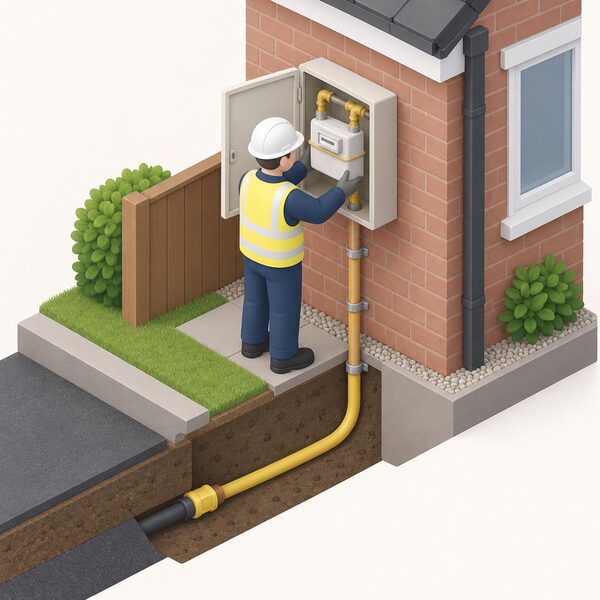
The process begins with an application to the network operator, which produces a quotation. SGN's household process is to apply online for a quote11. The price is not fixed by a tariff: Northern Gas Networks states that the cost is determined by the type of property being connected, the position of the nearest viable main, and how much pipework is required to connect the property2. Distance from the main is therefore the single largest variable in a village setting.
Once the quotation is accepted and payment made, the network carries out the work and issues the meter point reference number. Northern Gas Networks confirms it will provide the MPRN after the quotation is accepted2. The MPRN is the identifier registered against a specific address, and it is what a supplier needs in order to register the property and begin billing12.
The final step sits with the household and its chosen supplier, not the network. The meter is arranged separately, and the network's role ends at the pipe and the reference number3.
What a new connection costs: from £3,912 plus VAT, and what moves the price
Published prices vary widely by region and by who does the digging. Wales & West Utilities gives a starting figure of £3,912 plus VAT for a new gas connection to a house or small business1. SGN's standard quote estimates for southern England are £3,336 plus VAT inside the M25 and £3,198 plus VAT outside it where SGN digs the trenches, falling to £2,669 plus VAT and £2,559 plus VAT respectively where the householder digs them3. Electricity North West gives an average of £1,790 including VAT for one new domestic connection, though that is an electricity figure and not a gas one13.
| Network and area | Price | Who digs |
|---|---|---|
| Wales & West Utilities | from £3,912 plus VAT | Network |
| SGN, southern England inside M25 | £3,336 plus VAT | SGN |
| SGN, southern England inside M25 | £2,669 plus VAT | Householder |
| SGN, southern England outside M25 | £3,198 plus VAT | SGN |
| SGN, southern England outside M25 | £2,559 plus VAT | Householder |
The gap between the two SGN columns is the clearest single signal of what moves the price: the household's own labour on the trench. Beyond that, the drivers are the distance to the nearest viable main, the amount of pipework needed, and the type of property2. Altering an existing domestic connection rather than making a new one starts at £1,000 plus VAT14.
Prices are quoted per property and are installer-quoted in practice; the figures above are the networks' own published starting points and estimates, read in 2026.
Timescales: 6 to 8 weeks as standard, up to 90 days with a road closure
The standard figure is consistent across several networks. Wales & West Utilities states that once payment is made, a standard connection typically takes 6 to 8 weeks to complete1, and repeats the same 6 to 8 weeks from payment to completion in its general connections guidance15. Cadent gives an average of 6 to 8 weeks from payment to carry out disconnection works16.
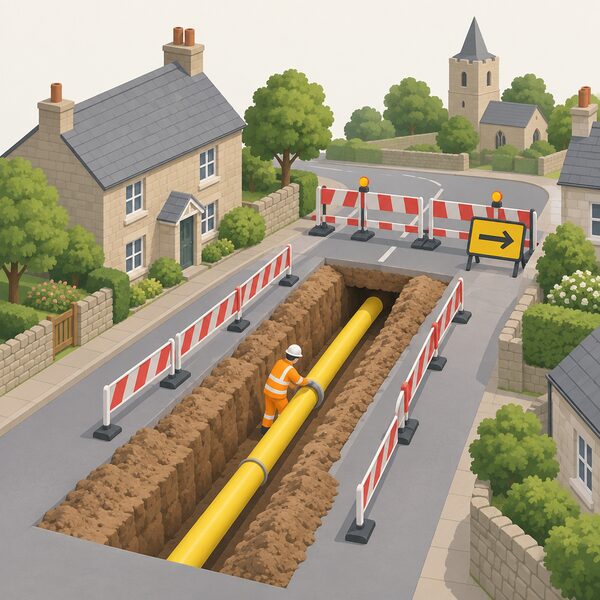
Two things stretch that. The first is a road closure: Wales & West Utilities states that if a road needs to be closed to do the work, it may take up to 90 days4. The second is the nature of the property. NIE Networks gives 6 to 12 weeks for connecting a new home17, and SGN gives 6 to 12 weeks after accepting the quote in Scotland, which could vary depending on the work required3.
Wales & West Utilities records two figures for the same work: within 6 weeks of payment in one place and 6 to 8 weeks in another, with the longer figure repeated in its main guidance1.
For a village, the road closure point is the one to watch. A main that stops short of the property may need to cross or run along a highway, and that is where the 90-day figure applies.
What you dig and supply yourself: trench, ducting and meter box rules
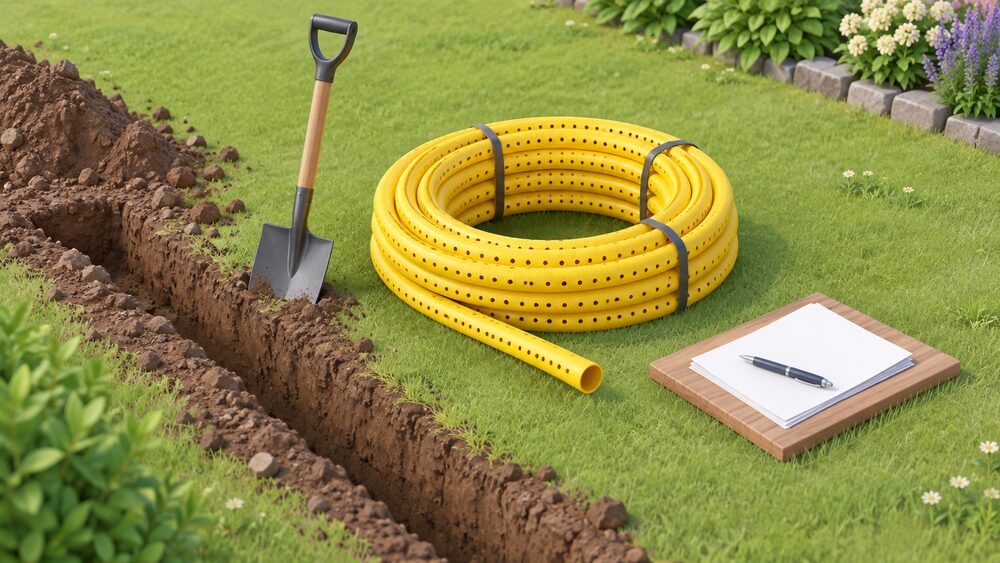
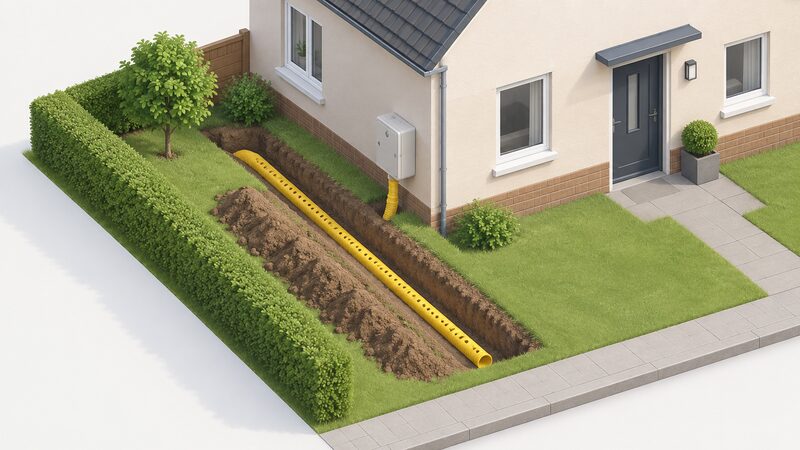
Where the household takes on the digging, the network sets the specification. Wales & West Utilities requires a trench at least 500mm deep and between 250mm and 300mm wide, and allows for digging a further 75mm deeper in poor ground conditions4. The trench must be on the customer's own land18.
Ducting for the gas service pipe must be yellow and perforated, and can be obtained from a builder's merchants4. The colour identifies it as gas infrastructure and the perforations allow any accumulated gas to disperse.
The meter box is the household's responsibility too. UK Power Networks, describing the equivalent electricity process, states that if you dig the trench yourself it must be ready for cable installation, and the meter box must be installed where the meter is to be connected19. The same division of labour applies on the gas side: the network lays the pipe, the household provides the route and the housing.
What a gas connection does and does not do for household energy independence
A connection changes what a village home depends on. An off-gas home is defined as one not connected to the natural gas network22, and connecting it replaces delivered fuel with a piped supply. That is a real convenience and, for many rural households, a cost change. It is not independence.
The dependence that remains is layered. The household depends on the distribution network for the pipe, on a supplier for the meter and the gas itself, and on the wholesale market for the price. The network does not sell gas: Northern Gas Networks is explicit that it is not a gas supplier2, and SGN directs households to a supplier for the meter3. The National Energy System Operator states that it does not connect directly to homes or other domestic properties23, so the domestic relationship is with the distribution network and the supplier, not the system operator.
There is also a direction of travel to weigh. The MCS Foundation states that all new residential properties will not be connected to the gas grid from 202524. A household connecting an existing village property today is connecting to a network that new-build homes are being kept off.
Against that, a gas connection removes the standing charge question only if it is later removed: the Energy Saving Trust notes that in an all-electric future home there would be no standing charge for a gas connection25. Removing a meter ends both the gas usage charges and the standing charges attached to that supply point10.
For a household weighing a village connection, the honest summary is that it buys a cheaper, more convenient fuel route in most cases, at the price of a new set of dependencies and a network whose long-term role is being questioned. Households considering the alternative should look at heating oil and LPG supply and at what energy security and household independence actually means in practice.
Sources25 cited
- Connect: new gas connections, Wales & West Utilities, 2026
- Gas connections: FAQs and guidance, Northern Gas Networks, 2025
- Apply for a new gas connection, SGN, 2026
- Gas connections FAQ, Wales & West Utilities, 2026
- Energy network operators: customer contact, Energy Networks Association, 2026
- Gas connections for household customers, SGN, 2026
- Disconnecting from the gas network, Institution of Gas Engineers and Managers, 2026
- Energy terms explained, Ofgem, 2026
- Continuous Household Survey: heat and insulation 2024-25, Northern Ireland Statistics and Research Agency, 2025
- Support for people in rural homes, Home Energy Scotland, 2026
- Gas connections: how it works, SGN, 2026
- Gas pipe upgrades, Wales & West Utilities, 2026
- Adding more power: what's involved, UK Power Networks, 2026
- Make changes to your gas connection, Wales & West Utilities, 2026
- Gas connections, Wales & West Utilities, 2026
- Which? energy survey results, Which?, 2026
- Overdue utility bills, nidirect, 2026
- Moving your supply: what happens after I apply, UK Power Networks, 2026
- New electricity connection: what's involved, UK Power Networks, 2026
- New electricity connection: what happens after I apply, UK Power Networks, 2026
- Smell gas, Cadent, 2026
- Housing archetypes for heat pump deployment, MCS Foundation, 2026
- How much will my new supply cost?, Electricity North West, 2026
- Domestic and homeowner connections help, National Energy System Operator, 2026
- Permitted development rights: support and provision for new homes consultation, Scottish Government, 2025
 The Full Your Type of Home GuideLiving in a flat, an old listed house or somewhere off the gas grid changes what energy help you can get and what you are allowed to install.
 Getting a New Gas ConnectionHow a household applies for a new or upgraded gas connection, who carries out the work, the quotation and contribution rules, typical timescales, and what a connection means for a home's energy independence.
 Leaving the Electricity GridCan you really cut your home off the grid completely, and what does it cost to have your electricity supply removed for good?
 Living Off the Gas GridNo mains gas at your home?
 Is Off-Grid Living Legal?Can you legally live without mains gas or electricity in the UK?
 Unit Rates by RegionWhy do electricity and gas prices differ depending on where you live?