

In this guide
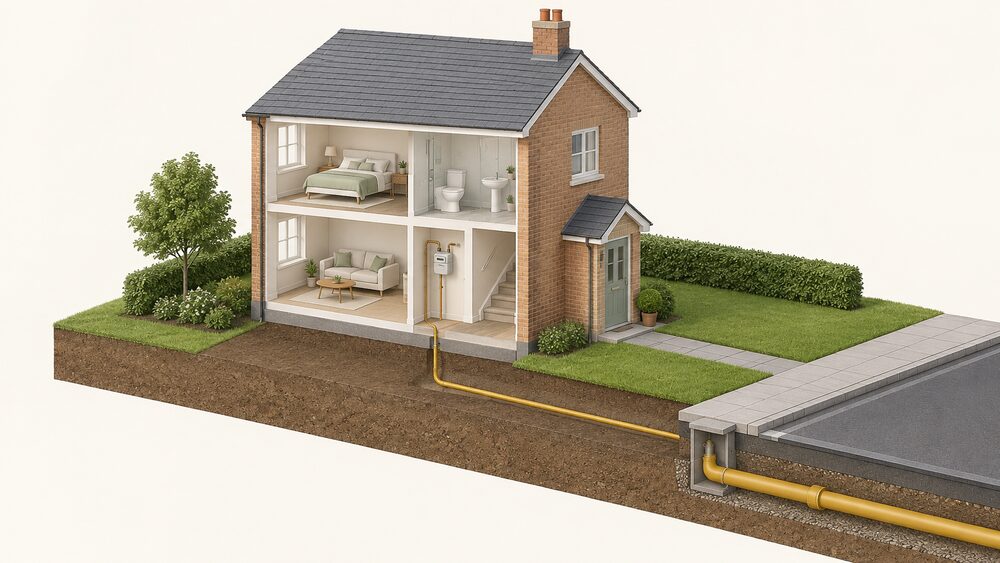
SGN is the gas distribution network for Scotland and for southern and south-east England. It delivers gas to 5.9 million homes and businesses across those two areas1. If your home has a gas meter and you live north of the border or in the south of England, SGN owns the pipes in the street and up to your meter, and it is the organisation you ring when gas is escaping.
What SGN does not do is sell you gas. Your supplier does that, and your supplier is also responsible for maintaining your meter2. SGN's role is the network: the pipes, the emergency response, new connections, meter alterations and the long programme of replacing old metal mains with plastic. That split matters for a household, because it decides who you call for which problem, and it decides what you can and cannot ask SGN to do.
For energy independence, the position is blunt. A home on the SGN network is connected to the gas grid, buying gas from a supplier, and dependent on both. SGN's own plans point towards hydrogen and biomethane in those same pipes, and towards a net zero business by 2045, but the pipes remain a shared, supplied infrastructure rather than something a household controls1.
What SGN does and who it serves
SGN is one of the four gas distribution network operators in Great Britain, alongside Cadent Gas, Northern Gas Networks and Wales & West Utilities7. It describes itself as trusted to deliver gas to 22 million homes, a figure that sits well above the 5.9 million it reports elsewhere, and the two numbers are not reconciled in the documents1. The 5.9 million figure is the one tied to its own network area, so it is the safer number to hold on to.
Beyond the pipes, SGN runs a set of services aimed at households in difficulty. Its energy advice partners, the Centre for Sustainable Energy and the Energy Saving Trust, offer confidential and independent information about home energy efficiency, help with switching to better tariffs, and support with clearing energy bill debt8. A partnership network is aiming to help 500,000 vulnerable customers use energy safely, efficiently and affordably by 20269.
SGN also runs a Care and Repair service for eligible Priority Services Register customers, helping with the cost of repairing or replacing gas-fuelled appliances and gas pipework where SGN has had to isolate the gas supply after an emergency visit4. That is a narrow but real protection: it applies where the network operator has cut the gas off, not as general appliance cover.
The company's customer promises set out what a household can expect when something goes wrong. SGN commits to an initial response to a complaint within 5 working days, or 10 working days if a visit is needed, and its staff and contractors wear visible identification cards, with a password scheme available through the Priority Services Register4. Information can be provided by video interaction, telephone translation, in other languages, in large print, in Easy Read, or in Braille on request, and the customer service team can be reached by phone, text, chat, email or social media4.
For a household, the practical point is that SGN is a regulated monopoly with published standards, not a company you choose. You cannot switch network operator, and the standing charge on your bill pays for the network regardless of which supplier you buy gas from. What you can do is know which organisation to call, and use the support that exists when the network fails.
Scotland and southern England: the network area
SGN's area is two separate regions joined under one company. It is the gas transporter for Scotland, and the gas transporter for south and south-east England5. Northern England is served by Northern Gas Networks, and Wales and the south west by Wales & West Utilities, so a household in Manchester or Cardiff is not an SGN customer5.
The southern England patch is often confused with the area of a similarly named electricity company. Scottish and Southern Energy covers southern England and northern Scotland, which overlaps with SGN's gas area in the south but not in the north10. The names are close and the geographies are not the same, so it is worth checking which organisation actually owns the pipe at your property rather than assuming from the name.
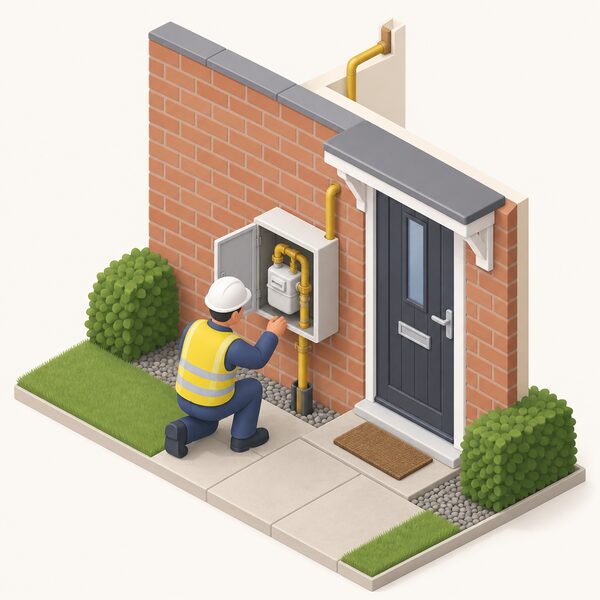
SGN also acts as service partner for National Gas Metering in Scotland and the south of England, carrying out meter exchanges on its behalf2. Its engineers hold contracts to replace old gas meters in certain parts of the UK when scheduled under the policy meter exchange programme, and it works with gas suppliers on that replacement work2.
For a household, the network area decides three things: who responds to a gas escape, who quotes for a new connection or a meter move, and who carries out mains replacement work in your street. It does not decide who bills you, and it does not change when you switch supplier. The dependence on the network is fixed by geography, and the only way to remove it is to leave the gas grid altogether, which is a separate decision covered in disconnecting your gas supply permanently.
New gas connections, meter moves and disconnections
SGN handles new gas connections to a property, moves of an existing meter or gas pipe, and disconnection from the gas network for household customers13. The route in is an online application for a quote14.
For a standard connection, the conditions are specific. The termination point of your gas service must be within 20 metres of a relevant gas main, whether on public or private land, and must be under 3 metres high, with no engineering difficulties or obstacles that would result in more than 20 metres of pipe being laid15. You also need to make sure SGN has clear access to the area it needs to work in before the team arrives on site14. Where a property has never been connected to gas or electricity mains, the connection has to be requested from a gas transporter or distribution network operator, and there is a charge16.
A new connection does not come with a meter. SGN does not supply the gas meter, and you must contact a gas supplier to arrange for one to be fitted15. SGN provides a Meter Point Reference Number to help with that arrangement14. The same division applies at Northern Gas Networks, which states plainly that it does not supply gas meters and that the applicant must contact a preferred supplier to arrange fitting17.
Disconnection works in the opposite direction. SGN can disconnect a gas supply if the customer no longer needs it13. Where a disconnection is going ahead, the household needs to contact its current gas supplier and arrange for the gas meter to be removed before the planned start date17. That sequencing matters: the network operator deals with the service pipe, the supplier deals with the meter.
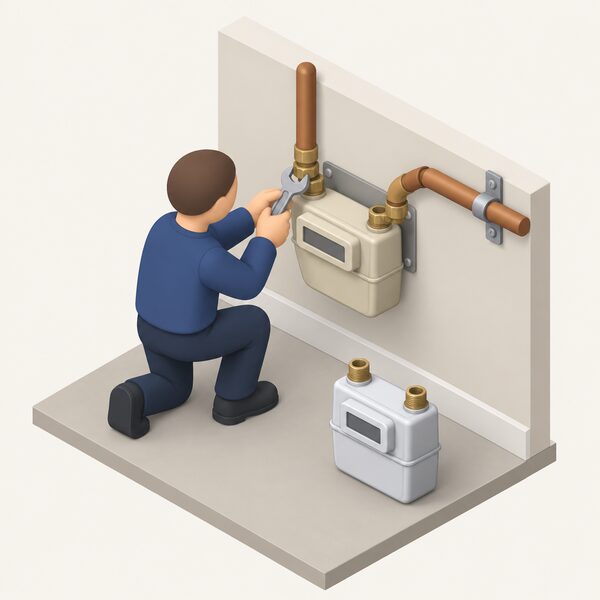
On the mains replacement programme, SGN's stated policy is to keep a meter in the same location wherever possible, with relocation as the final option, and it notes that relocation may require excavation in a garden or driveway18. Where a meter does need to move, SGN directs customers to its alter your gas connection page12.
Meter moves and alterations: costs from around £60 to £1,210
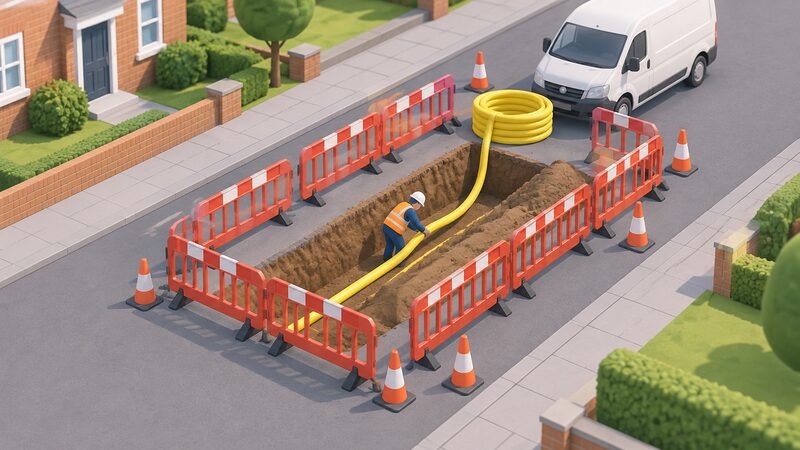
Moving a gas meter is a paid job, and in most cases where the household requests the move, the household pays, for both gas and electricity meters5. SGN's own published alteration charges give the clearest picture of what that means in practice.
| Work | Area | Charge |
|---|---|---|
| SGN to refit the meter | Scotland | £103 plus VAT6 |
| SGN to refit the meter | Southern England, inside the M25 | £110 plus VAT6 |
| Refit meter and reconnect outlet pipework | Scotland | £207 plus VAT6 |
| Refit meter and reconnect outlet pipework | Southern England, inside the M25 | £222 plus VAT6 |
| Standard alteration, SGN digs the trenches | Scotland | £795 plus VAT6 |
| Standard alteration, SGN digs the trenches | Southern England, outside the M25 | £859 plus VAT6 |
| Standard alteration, SGN digs the trenches | Southern England, inside the M25 | £1,007 plus VAT6 |
Both figures should be treated as indicative until SGN quotes for the specific property.
For wider context, a comparison of network operators published in August 2026 puts SGN's basic alteration costs at around £605 to £1,210, depending on whether SGN performs the excavation work and which part of the country the customer lives in5. The same comparison gives Wales & West Utilities a starting cost of £1,200 for moving a gas meter, Northern Gas Networks around £810 without digging rising to £1,362 with digging, and each additional metre at £24 to £1145. Those are other companies' figures, included only to show the spread.
Two practical conditions sit alongside the price. SGN can alter your gas supply pipe and move your meter, but this may result in the wireless connectivity of the meter being lost, which matters if the meter is a smart meter19. And where a meter is hard to reach for topping up, Ofgem's guidance is to ask your supplier to move it, and that a fee may apply20. Payment for SGN's alteration work is made online once the household is happy to proceed21.
Who looks after your meter and who to call
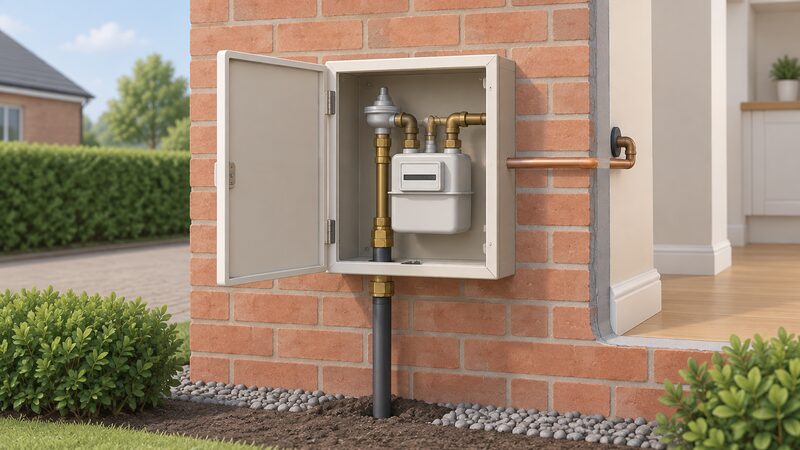
The single most useful thing to know about the SGN network is where its responsibility stops. SGN owns and maintains the pipes that carry gas to your property. Your gas supplier is responsible for the maintenance of your gas meter, and for sending you bills for the gas you use2. For gas meter issues, the number to call is your supplier's, found at the top of your energy bill3.
The property owner's responsibility is the internal pipework from the meter to the gas appliances, and appliances should be checked and serviced annually by a Gas Safe registered engineer17. The Health and Safety Executive's guidance for owner-occupiers sits on the same division of duty22.
That leaves a set of questions that are not SGN's to answer. SGN supports the roll-out of smart gas meters across Scotland and the south of England but cannot arrange for a household to have one19. A smart meter automatically sends your electricity and gas meter readings to your supplier, and it is the supplier who arranges installation23. Ofgem's consumer guidance on smart meters runs through the supplier route as well23.
Finding out who your supplier is takes a postcode. The Find My Supplier service is described as the quickest way to find out, and it can also give you your Meter Point Reference Number and your gas transporter10. Your MPRN appears on your gas bill or through the Find My Supplier search tool10. The service requires only a postcode to identify your supplier11.
Priority services register: free extra support
The Priority Services Register is a free service that helps households needing additional support during an unexpected interruption to gas supply24. SGN administers its own register, which it uses to identify customers who need priority support in a gas emergency or during an interruption4. It is free to sign up25.
What the register delivers is practical. As a Priority Services customer you can receive extra help and practical support if your gas supply is ever interrupted26. SGN provides PSR customers with alternative heating and cooking appliances when it needs to interrupt the gas supply, and access to hot food and hot water after 48 hours if the supply is off for longer4. The same free register model runs across the energy networks: SSEN offers tailored support and live updates during unplanned outages through its own register27, and the Energy Ombudsman describes the Priority Services Register as a free service for consumers who may need extra support28.
Signing up is not a single action. The guidance is to contact all your utility suppliers directly, because each organisation keeps its own register29. That means SGN for the gas network, your gas and electricity suppliers, and your water company if you want the same support there.
"To sign up for the Priority Services Register you will need to contact all your utility suppliers directly."
For a household, the register is one of the few forms of resilience that costs nothing and does not depend on owning equipment. It does not keep the gas flowing, and it does not remove the dependence on the network. It changes what happens when the network fails, which for a household with a medical need, young children or a single occupant is the part that matters.
Safety: gas escapes and emergency response
The gas emergency number is 0800 111 999, and it is free to call3. It is a national number, so it covers SGN's areas and everywhere else in Great Britain30. The Met Office's power cut guidance gives the same number for gas emergencies30, and Cadent's advice line guidance repeats it22.
SGN's published response targets are to attend uncontrolled gas escapes within one hour and controlled escapes within two hours4. Those are aims rather than guarantees. For comparison, Northern Gas Networks reports responding to over 97% of gas escapes within one to two hours, while aiming for 100%, and describes its service as a 24/7 gas emergency service31.
How often does this matter? Ofgem's consumer research in Scotland found that of the 8% of consumers who had contacted SGN, 48% did so to report a problem with the gas supply or a gas leak, which is 4% of all consumers with mains gas33. That is a dated figure from August 2019, but it is the only measure in the documents of how often households actually ring the network operator.
Carbon monoxide is the related risk. Northern Gas Networks runs a safety campaign urging households to take no chances with gas safety26, and publishes carbon monoxide advice alongside it31. SGN's own safety messaging sits within its transition work1. The practical rules are the same across networks: if you smell gas, ring the emergency number rather than the general customer service line, and do not operate electrical switches.
SGN's net zero plans: hydrogen, biomethane and pipe replacement
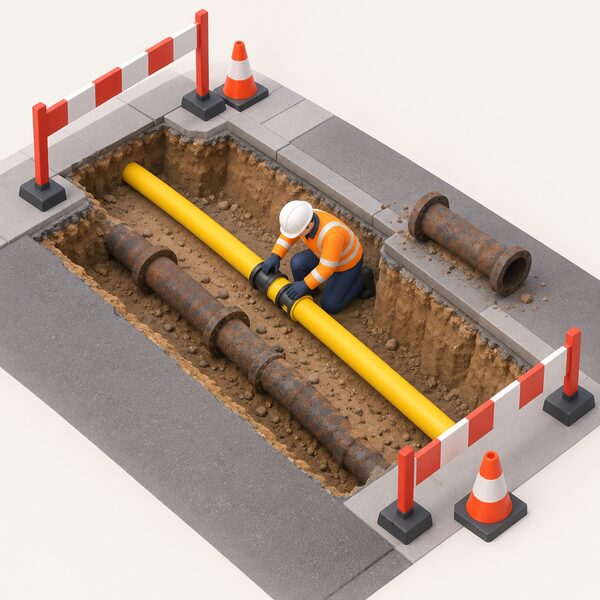
SGN's forward plans rest on two things: replacing the pipes, and changing what flows through them. On the first, SGN is replacing old metal pipes with new plastic pipe to ensure homes and businesses in the south of England and across Scotland continue to receive a safe and reliable gas supply18. It commits to reducing natural gas emissions by maintaining and upgrading its cast iron pipes by 20324.
On the second, SGN's position is that adapting existing networks to use green hydrogen will allow decarbonisation faster and further than the alternative18. That is a network operator's argument for repurposing the gas grid rather than replacing it, and it is contested ground. The wider picture on blending and trials is covered in hydrogen in the gas grid, and the renewable gas side in biomethane and green gas.
SGN's own operational commitments are more concrete than the hydrogen ambition. It aims to ensure all its business operations have net zero climate impact by 20454, and to replace its fleet with electric, hybrid or hydrogen fuel cell-powered vehicles as soon as possible4. It also commits to developing biodiversity projects to create more healthy green land on its sites and benefit local communities by 20264. For comparison, Northern Gas Networks is aiming for net zero by 2031 for its operational activity32.
For a household, the honest reading is this. The pipe replacement programme is maintenance: it keeps the gas flowing safely and does not change what a home depends on. The hydrogen and biomethane plans, if they arrive, would change the carbon content of the gas rather than the household's relationship with the network. A home on the SGN network remains connected to a shared grid, buying from a supplier, with the network operator's investment decisions shaping what is available to burn. The alternatives that change the fuel rather than the pipe are set out in energy security and household independence.
Sources33 cited
- Keeping you safe and warm as we transition to clean energy, SGN, 2026
- Meter exchange, SGN, 2026
- Gas safety in the home, Health and Safety Executive, 2026
- Our customer promises, SGN, 2026
- How to move your gas or electricity meter, Uswitch, 2026-09-04
- Alter your gas connection, SGN, 2026
- Energy terms explained, Ofgem, 2026
- Extra help, SGN, 2026
- 5,000 free carbon monoxide alarms and energy advice for older people in southern England, SGN, 2025-02-26
- Who is my gas and electricity supplier, Confused.com, 2026-07-03
- Who supplies my electricity and gas, Uswitch, 2026-06-29
- Meter box repairs, SGN, 2026
- Household customers, SGN, 2026
- Connections: how it works, SGN, 2026
- Apply for a new gas connection, SGN, 2026
- Moving house gas and electricity guide, Uswitch, 2026-08-26
- What to expect, Northern Gas Networks, 2026-09-04
- Upgrade work FAQs, SGN, 2026
- Smart meters, SGN, 2026
- Get help with your prepayment meter, Ofgem, 2026
- Move your gas meter, SGN, 2026
- Make the right call, Cadent Gas, 2026-09-20
- Get help with your smart meter, Ofgem, 2026
- My boiler isn't working, Northern Gas Networks, 2026-07-24
- Reducing your energy usage, SGN, 2026
- Take no chances with gas safety, Northern Gas Networks, 2026-09-14
- Preparing for a power cut, SSEN, 2026-09-19
- Worried about your energy bills, Energy Ombudsman, 2026-03-24
- Heating your home, Carmarthenshire Council, 2026-04-04
- What to do in a power cut, Met Office, 2026-09-20
- Carbon monoxide advice, Northern Gas Networks, 2026-07-24
- Highlights of our plan, Northern Gas Networks, 2025-01-30
- Consumer attitudes to energy networks in Scotland, Ofgem, 2019-08