

In this guide
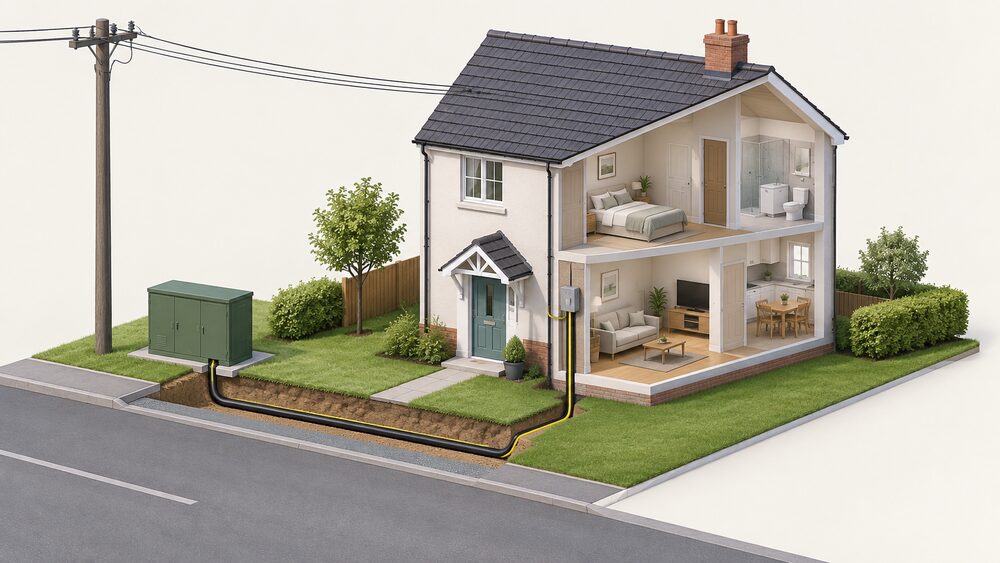
Scottish and Southern Electricity Networks (SSEN) is the electricity distribution network operator for central southern England and the north of Scotland, delivering power to over 3.8 million homes and businesses across those two areas1. It does not sell electricity and it does not bill you. It owns and maintains the wires, cables, substations and fuses that carry power from the transmission network to your property, and it is the body you deal with when the power fails, when a supply needs moving, or when generation is connected to the local network.
For a household, SSEN is the part of the energy system that is genuinely local and genuinely unavoidable. You can change supplier, switch tariff, add solar or a battery, but the network under the street is a regulated monopoly and SSEN is it. That makes the practical questions worth knowing in advance: who to call at 2am, what the Priority Services Register does, how long a planned cut lasts, what compensation exists and what it does not cover.
What SSEN is and where it operates
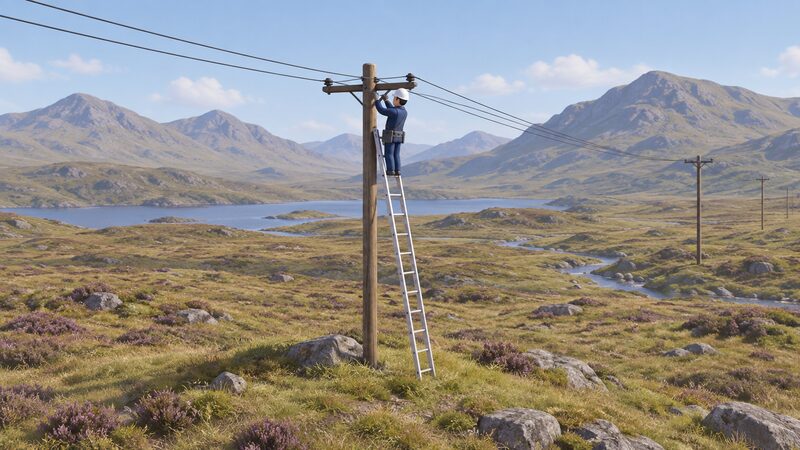
SSEN Distribution runs two separate licence areas that are not joined to each other. The southern area covers central southern England, including Berkshire, Hampshire, Wiltshire, Dorset, Somerset, Oxfordshire and the Isle of Wight, and SSEN describes itself as the distribution network operator for Newbury and surrounding areas of Berkshire2. The northern area covers the north of Scotland, including the Highlands and islands, where the network faces the weather and terrain that shape much of SSEN's storm response.
The customer counts published by SSEN vary with the date and the area being described. One 2024 figure puts the central southern England distribution area at over 3.1 million customers8, while a 2023 statement describes SSEN as responsible for delivering power to over 3.8 million homes and businesses across central southern England and the north of Scotland1. A 2022 release gives the same 3.8 million figure for the combined area9, and a separate 2022 release refers to 3.1 million customers in central southern England alone10. The two numbers are consistent if the larger one is the combined total and the smaller one is the southern area, but SSEN's own pages do not always make that distinction clear.
Investment in the central southern England network runs at over £150 million a year, spent on building resilience and capacity7. That spending sits behind a network serving 3.1 million customers in central southern England6, part of a licence area covering both the north of Scotland and central and southern England10. For households, it is the investment that determines how quickly faults are cleared and how much headroom exists for new low-carbon connections.
For a household, the practical point is simple: SSEN is the fixed infrastructure beneath your home, and its investment decisions determine how quickly faults are cleared and how much new load, from heat pumps and EV chargers, the local network can absorb. The wider picture of who owns and runs Britain's wires is set out in electricity distribution networks.
The role of a network operator: what SSEN does and does not do
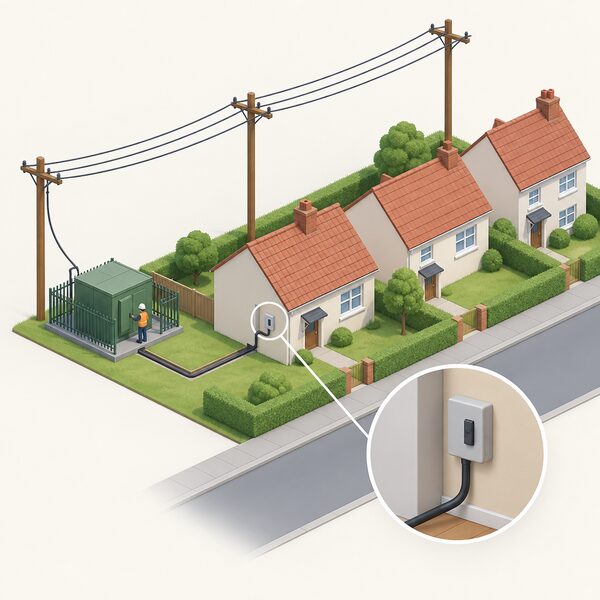
A network operator is responsible for the pipes and wires that move energy11. That single sentence draws the boundary that causes most confusion. SSEN owns and maintains the cables, overhead lines, substations and the service cable and main fuse that connect your property to the network. It does not generate electricity, does not buy or sell it, does not set the price you pay per unit, and does not send you a bill.
The split matters most when something needs moving. SSEN moves the service cable and main fuse; the electricity supplier moves the meter12. A household wanting a meter relocated therefore starts with the supplier it pays, not with SSEN13. SSEN's own service alteration work covers relocating the service cable and main fuse that connects the property to the electricity network12.
| Job | Who does it |
|---|---|
| Service cable and main fuse | SSEN12 |
| Electricity meter | The supplier you pay12 |
| Tariff, billing and payment | The supplier11 |
| Wires, substations and overhead lines | SSEN11 |
Above SSEN sits the National Energy System Operator, described in government guidance as the whole system planner, the operator of the electricity system and expert advisor to government and Ofgem14. SSEN operates within the distribution price control set by Ofgem, and in 2026 it noted the publication of Ofgem's Sector Specific Methodology Decision for the ED3 regulatory period, which will set the allowed investment and returns for the years ahead.
There is also a data dimension. SSEN states that it typically collects and aggregates half-hourly consumption data on a regular basis for sections of its low voltage network, and does not store individual customers' half-hourly consumption data15. It also notes that the number of smart meters installed in its network is relatively low, which limits the benefits available from that data15.
Priority Services Register: who qualifies and what it provides
The Priority Services Register is a free support service offered by energy suppliers and network operators to help vulnerable people16. It is not a tariff and it does not reduce a bill. What it does is flag a household so that the network knows to give it tailored support, live updates and additional help during unplanned outages5.
SSEN lists the qualifying groups explicitly:
- Deaf or hard of hearing4
- A disability4
- Children under five in the home4
- Blind or partially sighted4
- A chronic illness4
- Medical equipment or aids reliant on electricity4
- Over 604
Those categories are broad, and SSEN has run campaigns highlighting that thousands of customers who qualify have not signed up8.
Registration is free and can be done through SSEN directly5. For households where someone depends on powered medical equipment, there is a separate and more specific step: SSEN asks that reliance on electricity for medical equipment be reported by calling 0800 294 32595. That is distinct from the general register and is the route that determines whether a generator can be provided.
The register is the single most useful thing a household can do in advance. It costs nothing, it changes what the network does when supplies fail, and it is the mechanism by which proactive contact is made before severe weather arrives.
Power cuts: reporting, restoration times and what to expect

The number to call is 105. SSEN gives it for reporting a power cut or damage to its equipment, and the lines are open 24 hours a day, 365 days a year3. It is free to call, and the same number takes questions about a planned power cut5. Reports can also be made through the PowerTrack website and app4.
Restoration timing depends on the kind of outage. For a planned cut, power should return automatically and, for a planned cut, within one hour after the expected time of reconnection17. If it has not returned within an hour of the scheduled time, NIE Networks advises visiting Power Check for more information and reporting the cut18, and the same logic applies to any network: report it rather than wait.
For rota load disconnection, the published time is approximate. Power might be switched off or reconnected around 30 minutes before or after the published time depending on network conditions19. That tolerance is worth knowing because it means a scheduled window is a target, not a guarantee.
One cause of very short interruptions is vegetation. SSEN states that if branches touch overhead cables, power may go off for around one minute and come back on5. These brief outages are common on rural overhead networks and rarely need a call, though repeated occurrences are worth reporting.
The measurement of an outage period is not always from the moment the lights go out. National Grid Electricity Distribution, explaining the Guaranteed Standards of Performance, states that the outage period is measured from the time it became aware of the power cut, either by a telephone call to its emergency service or an alert from automated equipment on the high voltage network, and that the outage period restarts if the supply comes back on and then goes off again20. That rule shapes when compensation thresholds are crossed, and it is the reason reporting a fault promptly matters.
Storm preparedness and how SSEN responds
SSEN's storm response is a standing operation that scales with the forecast. Ahead of a lightning warning in the north of Scotland, the company brought in additional control room teams, prepared supplies of replacement components, put extra engineering teams on standby, added extra call handlers, and sent text messages to vulnerable customers4. The network also has an automatic safety response: if lightning strikes the infrastructure, it automatically closes down for a brief period to allow a series of safety checks before supplies are re-established4.
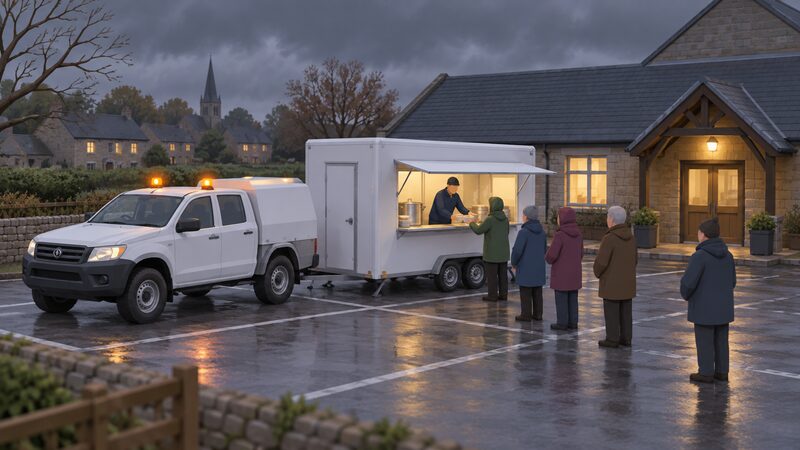
The scale of a major event is considerable. During Storm Floris, SSEN reported a thousand-strong team working to fix faults and support affected customers, more than 7,500 hot meals provided to people awaiting reconnection, proactive contact with 100,000 vulnerable customers ahead of the storm by text or phone call, and average waiting times for those calling of around 90 seconds6. During Storm Amy, SSEN described its own 700-strong storm response team supported by colleagues from its network region in the south of England21.
"Our own 700-strong storm response team has been supported by colleagues from our own network region in the south of England"
The pattern across events is consistent: pre-positioned teams, proactive contact with registered vulnerable customers, welfare support in the form of hot food, and a compensation scheme triggered by duration rather than by cause. After Storm Amy, SSEN ran a final push in parts of the Highlands to reconnect remaining customers22, and after Storm Henk it confirmed power had been restored to all customers affected23.
For a household, the lesson is that storm resilience is partly a network function and partly a household one. The network restores supply; the household decides how long it can manage without it. Community Energy South guidance on preparing for a power cut covers the practical steps, and the energy security and household independence page sets out what a home can control.
Planned power cuts: notice, rescheduling and compensation
A planned cut is work on the network that requires the supply to be switched off. SSEN states that it will aim to provide written notice at least 2 days before it plans to switch off the power5. Citizens Advice gives the same rule from the consumer side: your electricity network operator must give you 2 days' notice if it plans to cut off your supply to do work24.
Once a date and time is confirmed, SSEN states that it is unable to make any changes5. That is a firm position and worth planning around: the window is set, and a household that cannot be without power at that time has limited room to move it.
For rota disconnections under the Electricity Supply Emergency Code, the notification route is different. SSEN states that it will notify customers by text message by 6pm the day before, stating the start and end time of the interruption, with information also on powercut105.com, the SSEN website and the PowerTrack app25. In Northern Ireland, planned emergency power cuts can take place without warning if SONI instructs NIE Networks to reduce demand immediately, with an aim to notify via media and social media beforehand3.
On compensation, SSEN is direct: it does not offer compensation for planned power cuts, and follows the standards set by Ofgem5. That is the general position for planned work. The Guaranteed Standards of Performance payments apply to unplanned outages that exceed set durations, not to a planned interruption carried out with proper notice.
Compensation and reimbursement after an outage
The statutory compensation scheme is set by Ofgem and paid by the network operator. Citizens Advice summarises the trigger as being without power for a significant amount of time, typically 12 hours or more, or experiencing four power cuts in a year of at least three hours each17. Ofgem's own guidance sets out the same framework and the exclusions that apply26.
The exclusions are as important as the triggers. Ofgem states that compensation is not paid for blackouts caused by a national power shortage, damage to electrical equipment or appliances, or a low supply after a power cut26. Citizens Advice adds that no compensation is payable in certain emergency situations, for example a blackout caused by a national power shortage24. Electricity North West confirms the same for emergency rota load disconnection: under Ofgem rules, compensation is not available for an emergency power cut of this nature19.
Beyond the statutory scheme, SSEN has run discretionary storm packages. After Storm Floris, customers without power for more than 12 hours were entitled to £30 per person for every day off supply, to cover the cost of food and drink6. After Storm Amy, the same £30 per person per day figure applied to customers without power for more than 12 hours21. SSEN also stated that customers without power for more than 12 hours who had not been able to visit one of its free hot food outlets could claim for food and drink costs, and that if a power cut was confirmed to have lasted beyond 48 hours, all customers could benefit from support with alternative accommodation costs22.
After Storm Henk, SSEN applied the Guaranteed Standards of Performance: customers without power for over 24 hours received £80, with a further £40 for every subsequent six-hour period they were off supply23.
| Event | Payment | Condition |
|---|---|---|
| Storm Floris | £30 per person per day6 | Off supply more than 12 hours |
| Storm Amy | £30 per person per day21 | Off supply more than 12 hours |
| Storm Henk | £80, then £40 per further six hours23 | Off supply more than 24 hours |
| Planned cut | None5 | Ofgem standards apply |
Connecting generation and moving your supply: applications and costs
SSEN handles connections for new supplies, supply upgrades, generation and heat pumps, and the routes differ by size and type.
For small-scale generation, SSEN offers a Fast Track service that makes it quicker and easier to apply for a connection for eligible solar panels, battery storage systems and other small-scale generation installations27. The application requires a site plan with a map highlighting the full land boundary, the proposed or existing meter point marked, and the proposed location of generation marked13. Applications are returned to SSEN's connections team by email, and larger jobs, including supply upgrades over 70kVA, are handled with a costed quote13.
There is a threshold that catches people out. SSEN states that an application must be made before connecting if you are installing up to 3.68kW per phase at more than one property, if there is more than one generator at a single property, or if another property within the same postcode, ignoring the last two digits, has had generation installed within the last 28 days by the same installer28. Even if the total generation across all properties or generators is below 3.68kW, an application is still required28.
For a new connection to one to four properties, quotes are usually issued within 5 to 15 working days depending on the complexity of the project, and the quoter makes contact within 5 working days to discuss the design29. The customer is responsible for buying materials including meter boards, meter boxes, hockey stick, ducting and sand, fitting meter boards and meter boxes, laying ducting, registering the MPAN with the supplier, booking the meter installation date, and settling additional land rights or traffic management payments29.
For heat pumps, SSEN provides a connection process with an application returned to connections@ssen.co.uk and a contact number of 0800 048 351630. Supply increases are usually free of charge up to a maximum of 80 amps for domestic customers27.
For a household, the connection process is the point at which independence meets the network. Solar, a battery or a heat pump all require SSEN's involvement at some stage, and the timescales are set by the network rather than by the installer. The new electricity connection page covers the wider process, and apply for an electricity supply upgrade deals with capacity increases.
Complaints and the Ombudsman
SSEN states that if it is unable to resolve a complaint to the customer's satisfaction, it will send a deadlock letter, after which the customer may take the complaint to the Ombudsman for an independent review31. A deadlock letter is not the only route: customers can also contact the Ombudsman without a deadlock letter if their complaint has remained open after 8 weeks31.
That two-route structure is standard across network operators and mirrors the supplier-side process described by Ofgem11. The practical sequence is to raise the issue with SSEN first, keep a record of dates and reference numbers, and then use either the deadlock letter or the eight-week threshold to escalate.
Sources31 cited
- SSEN to carry out helicopter line patrols next week as part of its post-storm works programme, SSEN, 2023
- Portsmouth power supplies boosted by £1.7 million infrastructure upgrade, SSEN, 2022
- Emergency power cuts, NIE Networks
- Weather Warning ahead of extensive lightning in the north of Scotland, SSEN, 2025
- Planned power cuts, SSEN
- Thank you to our customers following Storm Floris, SSEN, 2025
- SSEN multimillion investment in Charminster power supplies, SSEN, 2023
- SSEN Distribution's New Year campaign highlights thousands of customers missing out on free support during power cuts, SSEN, 2024
- Multi-million pound Hampshire network upgrade reaches milestone, SSEN, 2022
- SSEN marks milestone in self-restoring electricity supply system, SSEN, 2022
- Complain about your energy supplier, Ofgem
- Moving your meter, SSEN
- Installations above 3.68kW per phase but 50kW or less, SSEN
- Electricity distribution networks study: government response, GOV.UK
- Smart meters, SSEN
- Energy costs, Swansea Council
- Preparing for a power cut, Centre for Sustainable Energy
- How do I know if or when my power will be switched, NIE Networks
- Emergency power cuts, Electricity North West
- Standards of performance, National Grid Electricity Distribution
- After all homes are reconnected following Storm Amy, a thank you to our customers, SSEN, 2025
- Final push in parts of the Highlands to reconnect customers following Storm Amy, SSEN, 2025
- SSEN restores power to all customers affected by Storm Henk, SSEN, 2024
- Get compensation if you have a power cut, Citizens Advice
- Electricity Supply Emergency Code (ESEC), SSEN
- Check if you can get payment for a power cut, Ofgem
- Existing electricity supplies, SSEN
- Installations of up to 3.68kW per phase at more than one property, SSEN
- Connect 1 to 4 new properties, SSEN
- Heat pump connections, SSEN
- Ombudsman services, SSEN