In this guide
Heat Pumps: The Full UK Guide
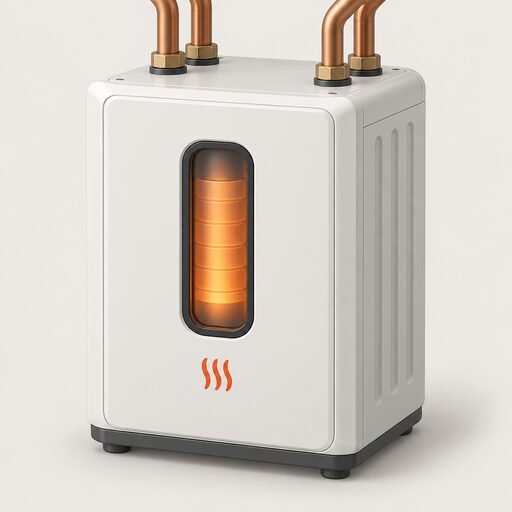
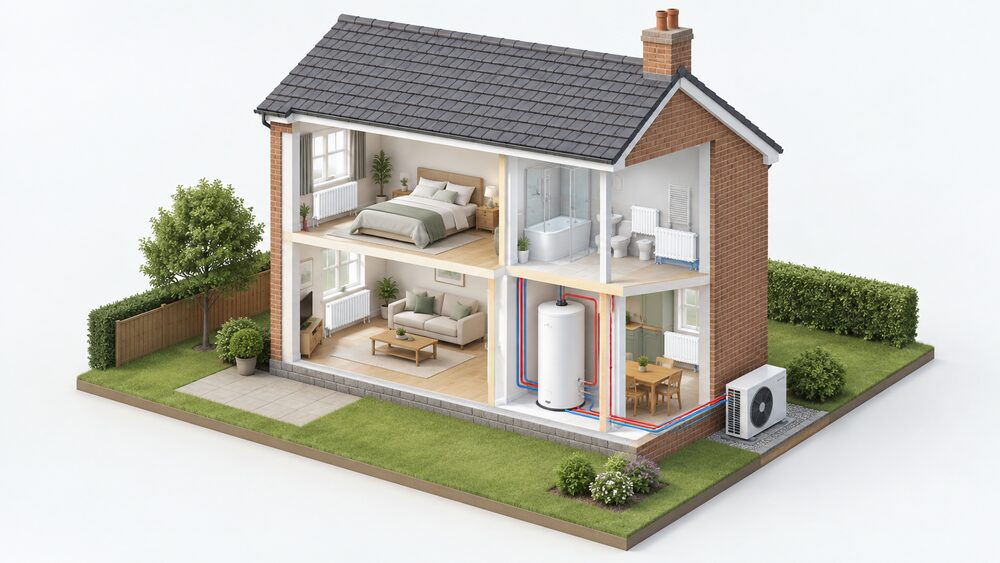
A heat pump is an electric heating system that moves heat rather than generating it. It takes low-grade heat from the outside air, the ground or a body of water, raises its temperature with a compressor, and delivers it to radiators, underfloor heating and a hot water cylinder1. Because the electricity is used to move heat that already exists, a typical heat pump delivers three to four units of heat for each unit of electricity needed to run it2.
For a UK household the headline figures are these. The Centre for Sustainable Energy puts running costs at around £800 to £1,050 a year and installation at £6,000 to £18,000 for an average flat or small home, as of June 20263. In England and Wales the Boiler Upgrade Scheme pays a £7,500 grant towards the installation4.
A heat pump takes a home off gas, oil or LPG and puts its heating onto electricity. That is a real gain in independence from imported fossil fuels. It leaves the household dependent on the electricity grid, on the price of electricity relative to gas, and on the quality of the installation. This page sets out each of those points and links to the detailed pages beneath it.
A heat pump moves heat rather than making it
A boiler burns fuel to create heat. A heat pump uses electricity to collect heat from outside the building and bring it indoors. The Low Carbon Hub defines it as "an efficient, low-carbon heating system that uses electricity to move heat rather than generate it"1. The Construction Products Association gives this as the reason for the efficiency: because heat pumps move heat rather than create it, they can produce several units of heat for every unit of electricity used8.
The legal definition used across the UK's building regulations describes the same thing in more formal terms. The Building Regulations (Northern Ireland) 2012 define a heat pump as a machine, device or installation that transfers heat from natural surroundings such as air, water or ground to buildings or industrial applications by reversing the natural flow of heat, such that it flows from a lower to a higher temperature9. The wording comes from Article 2 of Directive 2010/31/EU, which uses an almost identical definition10.
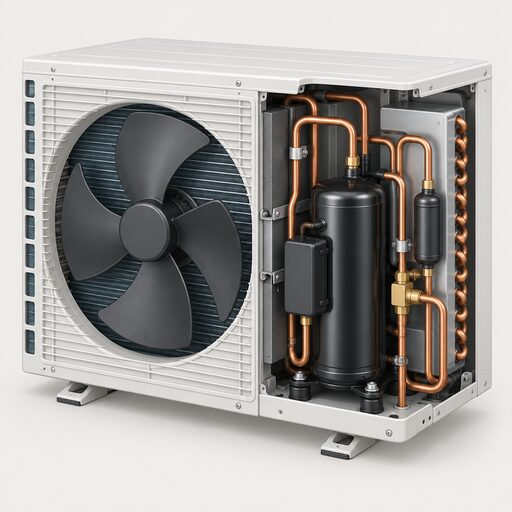
Heat does not flow from cold to hot on its own, so the machine has to do work to reverse that flow. The government's Home Energy Model methodology notes that most heat pumps use an electrically driven compressor to do this11. The compressor drives the refrigeration cycle. A refrigerant absorbs heat from the source and is then compressed so that its temperature rises. It gives up that heat to the water in the heating system, or to indoor air in an air-to-air unit. In an air source unit, as Pendle Borough Council's fact sheet puts it, the heat pump "moves heat from the air to a hot water supply"12.

The same Home Energy Model paper states the rule that governs heat pump performance:
"Heat pumps operate more efficiently when the source temperature is higher and/or the sink temperature is lower"
The guidance on flow temperature, radiator size and insulation later on this page follows from that rule. The refrigerant itself is covered in heat pump refrigerants, and the two outdoor unit layouts are covered in monobloc and split heat pumps.
Air source, ground source and water source: which type fits which home
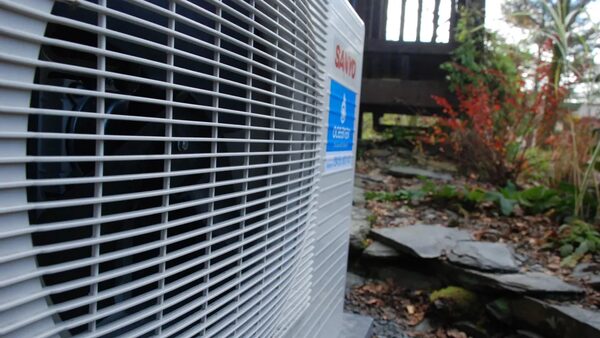
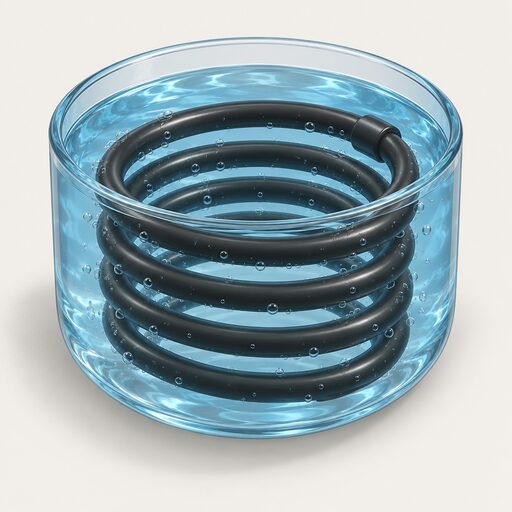
Welsh Government planning guidance names three types of domestic heat pump: air source, ground source and water source13. Energy Saving Trust adds air-to-air as a category in its own right14. The types differ in where the heat comes from and how it is delivered indoors.
| Type | Heat source | Delivers heat to | Fits which home |
|---|---|---|---|
| Air source (air-to-water) | Outside air1 | Water in a wet central heating system15 | The most common domestic type in Great Britain16 |
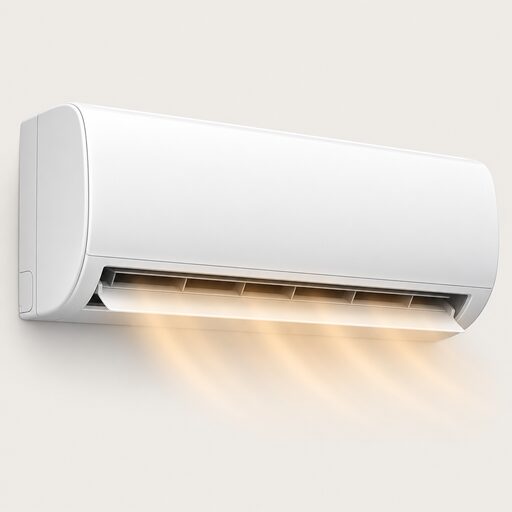
| Air-to-air | Outside air | Indoor air, and can run in reverse for cooling17 | Homes without a wet system. Not treated as a renewable system in ECO415 |
| Ground source | Heat stored in the ground18 | Space heating and domestic hot water19 | Homes with very large gardens or land3 |
| Water source | Ground water, surface water, or sea or sewage water20 | As ground source | Homes with access to a suitable water body |
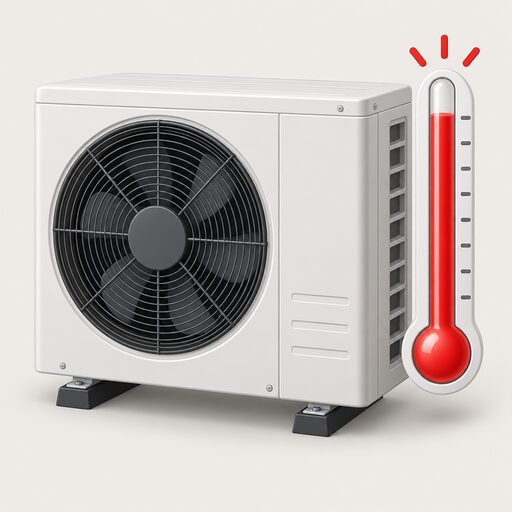
Air source heat pumps are what most UK households mean by the term. Smart Energy GB describes air source, or air-to-water, units as the most common domestic heat pumps16. Ofgem's ECO4 guidance describes an air-to-water system as one that transfers heat drawn from surrounding air to water in a wet central heating system15. HMRC's guidance notes that air source units can serve space heating, water heating, or both19. The wet-system version is covered in air-to-water heat pumps. Air-to-air heat pumps work differently and sit outside the main grant scheme.
Ground source heat pumps transfer heat from the ground outside to the home's heating and hot water18. The Centre for Sustainable Energy says they need pipes dug into the ground and are most suitable for homes with very large gardens or land3. Several properties can share one ground array. Ofgem notes that a ground source system may consist of a shared ground loop, which ECO4 treats as a district heating variant15. See ground loops and boreholes and shared ground loop networks.
Water source heat pumps use the energy stored in ground water, surface water, or sea or sewage water, according to the European Heat Pump Association, a non-UK trade body20. For grant purposes the Boiler Upgrade Scheme groups them with ground source, along with systems on shared ground loops21.
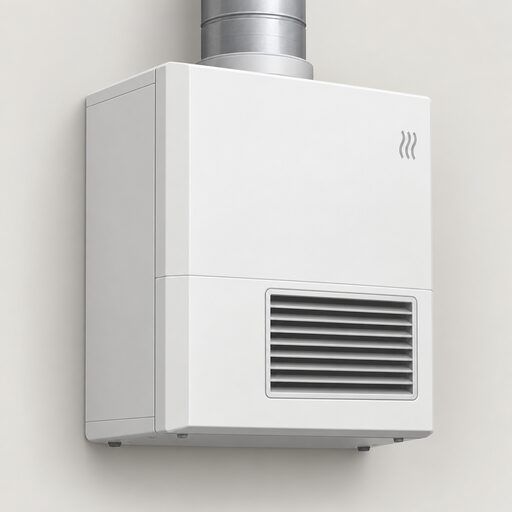
Other variants have their own pages: hybrid heat pumps, high-temperature heat pumps, exhaust air heat pumps and hot water heat pumps.
Efficiency: three to four units of heat for every unit of electricity
The most widely quoted figure is three to four units of heat for every unit of electricity. Which? gives it, and the Centre for Sustainable Energy gives it for a "well-designed and installed heat pump"2. The Development Bank of Wales, the Low Carbon Hub, Energy Saving Trust's in-depth guide, NICEIC and the Centre for Alternative Technology all give the same range22. Energy Saving Trust expresses it as 300 to 400%24.
Some sources give different figures, and the gaps between them reflect real variation.
| Source | Figure given |
|---|---|
| Which?, CSE, Energy Saving Trust (in-depth guide), NICEIC, CAT | Three to four units of heat per unit of electricity2 |
| Energy Saving Trust (heat pumps overview, ground source guide) | Three units of heat26 |
| nidirect (Northern Ireland) | Usually three units, or three or more for air source27 |
| Pendle Borough Council fact sheet | 2 to 3 units for an air source heat pump12 |
| Which? (heat pumps vs boilers) | Between 2.5 and 4.5 units for a typical heat pump28 |
The spread comes from the rule in the previous section. Efficiency depends on the temperature of the source and the temperature the system has to deliver. The same machine performs differently in different houses and different weather. The lower figures are the more cautious end of what an installed system achieves across a year, and the upper figures depend on low flow temperatures and good design.
Official comparisons with boilers put it more simply. The Welsh Government says heat pumps are three times more energy efficient than traditional boilers29. The UK government's heat and buildings factsheet says they can be over three times more efficient than boilers30.
Expected performance in a UK home is best judged from monitored installations. A government publication on households at risk of fuel poverty draws on monitored data from over 1,100 UK heat pump installations31. The measures behind these figures are explained in COP, SCOP and SPF, and the field evidence in how heat pumps actually perform in UK homes.
For household independence, the three-to-one ratio means each unit of heat needs only about a third of a unit of electricity drawn from the grid. It is still purchased energy. The heat collected from outside is free, and the electricity that collects it is not.
Flow temperatures: 35°C, 45°C and 55°C, and why lower is better
Flow temperature is the temperature of the water the heat pump sends to the radiators or underfloor pipes. The UK's Product Characteristics Database, which feeds the energy rating of homes, holds heat pump performance records at three flow temperatures: 35°C, 45°C and 55°C. The default is 55°C. A lower value of 45°C or 35°C is used where the commissioning certificate states that design flow temperature32.
| Flow temperature | Where it sits |
|---|---|
| 35°C | Lowest database value. Underfloor heating runs at 35°C to 40°C25 |
| 45°C | Described as usual in heat pumps, and the upper end of the most efficient range33 |
| 55°C | The database default where no lower design temperature is certified32 |
Lower is better because the heat pump has less work to do when it lifts the heat a shorter distance. Which? says standard, or low temperature, heat pumps are at their most efficient when running at 35 to 45 degrees2. Energy Saving Trust's installer toolkit says a heat pump operates most efficiently when delivering lower temperature water than a traditional boiler would, up to 45°C34. Its installation guide says heat pumps often send water to radiators at between 35 and 45°C35.
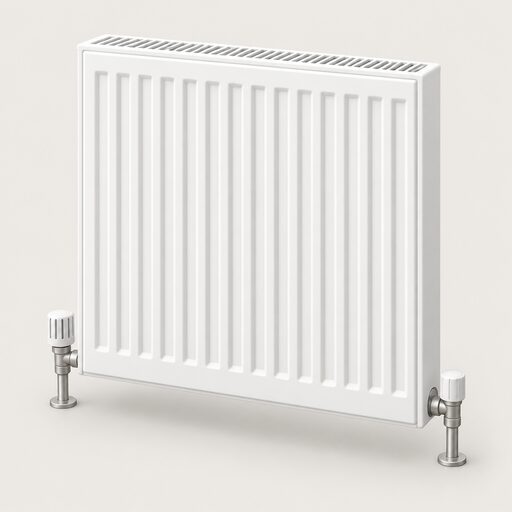
Lower flow temperatures make each radiator less powerful. Energy Saving Trust notes that if the water in the system drops to 45°C, which is usual in heat pumps, radiators sized for a boiler will not give out as much heat as before33. This is why emitter size and insulation come up before every installation. The Centre for Alternative Technology describes underfloor heating, with a flow temperature of 35°C to 40°C, as another good option25.
The detail is in what flow temperature heat pumps use and underfloor heating versus radiators. Homes that cannot reach low flow temperatures are the intended market for high-temperature heat pumps.
Costs: installation from £6,000 to £18,000 and running costs of £800 to £1,050 a year
Published installation costs vary with the home, the date and the scope of work counted.
| Source and date | Figure | Applies to |
|---|---|---|
| Centre for Sustainable Energy, June 2026 | £6,000 to £18,0003 | Average flat or small home |
| Low Carbon Hub, October 2025 | £8,000 to £12,00023 | Air source heat pumps |
| Public Accounts Committee report, May 2024 | £8,000 to £15,00036 | Depends on the work needed to the home |
| Nesta, June 2024 | Median £9,70037 | Flats |
| Nesta, June 2024 | Median £12,00037 | Semi-detached and terraced houses |
None of these sources states the VAT position, and the figures are before any grant. The Public Accounts Committee tied its range to the work that needed to be done to the home36. That is the main driver. A house that needs a cylinder, new radiators and new pipework costs more than one that needs only the unit. Ground source systems cost more because of the groundworks, as covered in ground source heat pump cost. Modelling for the Scottish Government on new-build homes found air source heat pumps had the lowest capital cost for houses, but the highest for a block of flats under the business-as-usual specification38.
The Centre for Sustainable Energy puts running costs at around £800 to £1,050 a year on a single-rate tariff, as of June 2026. It describes heat pumps as one of the cheapest electric heating options3. Whether that is cheaper than the household's current bill depends on what it replaces. Which? says bill savings will be greater if the old system was LPG or direct electric heating than if it was mains gas39.
Full breakdowns are in how much a heat pump costs, heat pump running costs and heat pump versus gas boiler running costs.
The £7,500 Boiler Upgrade Scheme grant and how to claim it

The Boiler Upgrade Scheme offers £7,500 off a heat pump40. The government's notice of approved grant values, dated 21 July 2026, confirms that amount4. The scheme covers homeowners in England and Wales41. Scotland and Northern Ireland are outside it. Support in those nations is covered in heat pump grants and funding across the UK.
| Item | Position |
|---|---|
| Grant for a heat pump | £7,5004 |
| Ground source, including water source and shared ground loops | £7,50021 |
| Ground source voucher validity | 6 months43 |
| Nations covered | England and Wales42 |
| Installer requirement | MCS certified, and certified to install heat pumps43 |
| Product standard | MCS 007, Version 744 |
The scheme runs through the installer. Ofgem's guidance is addressed to installers and requires that they "must be MCS certified and be certified to install heat pumps and/or biomass boilers"43. The product must also meet the named standard. The government's notice of standards specifies Version 7 of MCS 007 Product Certification Scheme Requirements: Heat Pumps44. A quote from an installer without that certification cannot carry the grant.
Air-to-air systems sit outside this support. Ofgem's ECO4 guidance says an air-to-air system "is not considered to be a renewable system in ECO4"15. The separate page on air-to-air grant eligibility explains the Boiler Upgrade Scheme position. See also heat pump cost with the grant and the grant in Wales.
Sizing, insulation and emitters: what a home needs before installation
Approved Document L for England sets the baseline that heat pump systems "have been sized appropriately" and have adequate controls45. Sizing starts from a heat loss calculation. The Welsh consultation version of Approved Document L lists the information a new dwelling's owner should receive46:
- details of the heat loss calculation
- the design flow temperature
- confirmation of the competent person scheme
- the size of the emitter circuit
- minimum set back temperatures
Energy Saving Trust notes there may come a point in cold weather when an undersized heat pump's output is not enough. A system that is too small leaves the house cold33. See heat pump sizing and heat loss calculations.
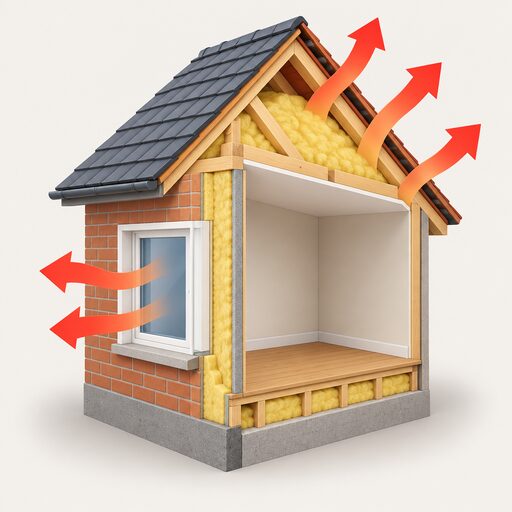
Insulation. The Construction Products Association lists four things to consider before installation8:
- loft insulation levels
- wall insulation, especially cavity or solid walls
- double or triple glazing
- draught-proofing around doors and windows
Energy Saving Trust says topping up wall, floor and loft insulation beforehand helps reduce running costs41. Which? gives the same advice for ground source heat pumps39. Whether insulation has to come first is discussed in fitting a heat pump without insulating first.
Emitters. OFTEC, the oil heating trade body, says that to be at their most efficient heat pumps will usually need more or larger radiators, or substantially improved insulation, when they replace gas or liquid fuel heating47. Which? says an assessment of whether bigger or additional radiators are needed belongs before installation48. See radiators and emitters and whether new radiators are needed.
Hot water: a cylinder is almost always part of the system
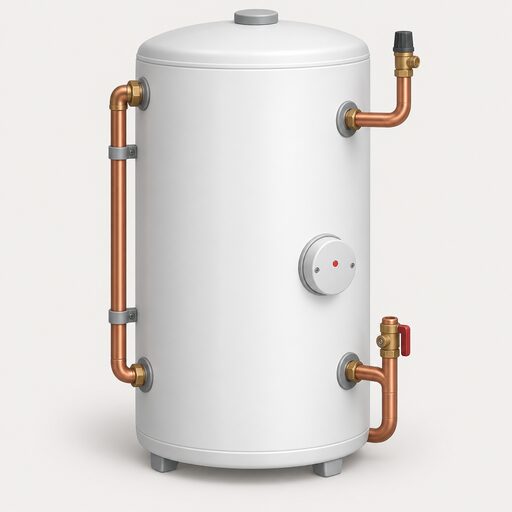
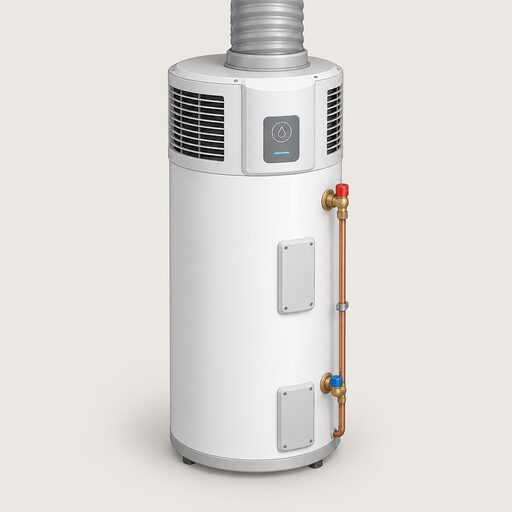
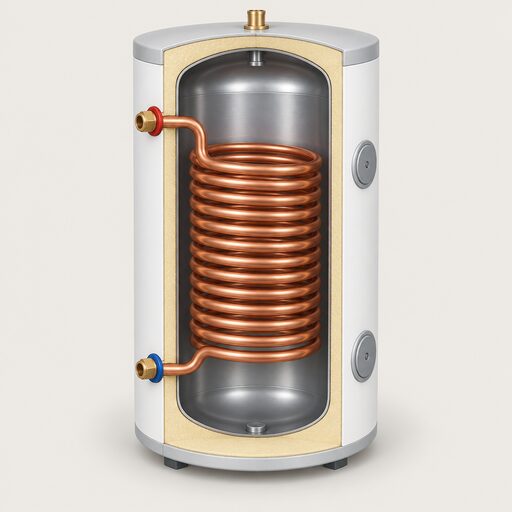
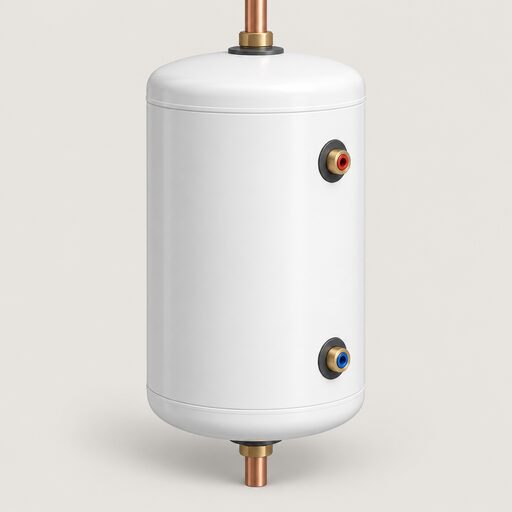
Croydon Council's guidance says: "Unlike combi-boilers, heat pumps do not provide hot water instantly, so you will need to use a hot water cylinder"6. Energy Saving Trust says all heat pumps need space for a cylinder, ideally inside the house24. Which? says a household replacing a combi boiler will probably need to install one2. A UK government paper compares the arrangement to older generations of gas boiler systems49.
A hybrid is the exception. Where a combi boiler or instantaneous water heater is kept, no cylinder is needed alongside the heat pump14. See hot water cylinders for heat pumps and heat batteries.

Planning permission, permitted development and the 1-metre boundary rule
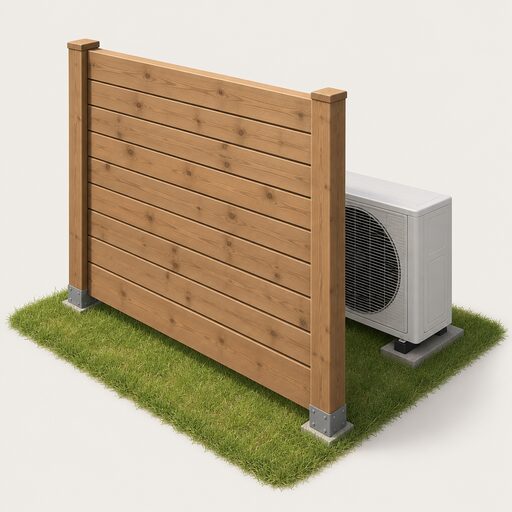
In England, most domestic air source installations proceed under permitted development, without a planning application. The rights sit in Part 14 (Renewable Energy) of the Town and Country Planning (General Permitted Development) (England) Order 201550. They cover the installation, alteration or replacement of an air source heat pump on a house or block of flats, or within its curtilage, which means its garden or grounds. The Planning Portal lists these conditions51:
- the installation must comply with the MCS Planning Standards (MCS 020a)
- the outdoor compressor unit, including housing, must not exceed 1.5 cubic metres on a house or 0.6 cubic metres on a block of flats
- only the first installation is permitted development on a house which is not detached or on a block of flats
- on a detached house, the first two air source heat pumps are permitted development
- there must be no existing wind turbine at the property
- installations on pitched roofs are not permitted development, and on a flat roof all parts must be at least one metre from the external edge
- rights do not apply within the curtilage of a Listed Building or on a Scheduled Monument site
- in a Conservation Area or World Heritage Site, the unit must not be on a wall or roof fronting a highway, or nearer to a highway than the building
- elsewhere, it must not be above ground floor level on a wall fronting a highway
- it must not be used solely for cooling, and must be removed when no longer needed
The 1-metre rule applies to flat roofs
The 2015 Order as originally made excluded any installation where "any part of the air source heat pump would be installed within 1 metre of the boundary of the curtilage"52. Cornwall and Cotswold councils still state that rule, and Which? listed it in November 2024 as a trigger for a planning application53.
The government announced in November 2024 that it would "remove the 1m boundary rule, enabling heat pumps to be installed within 1m of the property boundary", and repeated this in June 202555. Its November 2025 response on the Boiler Upgrade Scheme describes amendments to permitted development rights in England which include the removal of the rule57. The Planning Portal conditions listed above contain no boundary distance51. Some council pages have not caught up with the change. Cornwall also notes that permitted development rights can be removed locally by a planning condition or an Article 4 Direction53.
Wales has its own rights for air, ground and water source heat pumps13. A Welsh Government summary of consultation responses states that air source installations must comply with MCS 020a, and "where compliance is not achieved a planning application will be required"58. Each nation has its own page: England, Scotland, Wales and Northern Ireland. See also the MCS 020 noise assessment and where an outdoor unit can go.
Building Regulations, MCS 007 certification and installer competence
Building Regulations apply whether or not planning permission is needed. Approved Document L for England sets these expectations for heat pump systems45:
- all heat pumps should meet Ecodesign product regulations
- the system should be sized appropriately and have adequate controls
- minimum controls are weather compensation or internal temperature control, plus a timer or programmer for space heating
- the heat pump and any dedicated ancillary products, such as integrated hot water storage vessels, should be commissioned in accordance with the manufacturer's instructions and the system design parameters
- the person carrying out the work should be suitably competent
Where a registered competent person does the work, the process ends with paperwork that the household will want to keep45:
- The installer commissions the system.
- A copy of the Building Regulations compliance certificate goes to the occupier.
- The certificate, or a copy of the information on it, goes to the building control authority.
Ground source systems have further commissioning steps in the Welsh consultation version of Approved Document L. Ground arrays, including header pipes and manifolds, should be flushed as one system and purged of air. A closed-loop installation should be pressure tested to BS EN 805. The owner should be told which fluids were used and their commissioned concentrations46.
Two MCS documents are relevant. MCS 007 is the product standard, and Version 7 is the one the Boiler Upgrade Scheme names44. MCS 020a is the planning standard. Installer certification is separate from both and is a condition of the grant43. More detail is in heat pump standards and certification, heat pump installation and heat pump controls.
Running a heat pump: smart meters, time-of-use tariffs and servicing
A heat pump's running cost depends on when it draws electricity as well as how much. MCS says smart meters can help make heat pumps more efficient and cost-effective. They enable time-of-use tariffs and allow heating to run when electricity is cheaper, including through the demand flexibility service59. The Welsh Government describes time-of-use tariffs as cheaper rates during off-peak hours and incentives for energy usage on high-supply days60. Energy Saving Trust says a household switching to a heat pump time-of-use tariff could save money on its bills61. See time-of-use tariff savings and solar and a battery with a heat pump.
Servicing. Energy Saving Trust's guidance is for a service according to the manufacturer's advice, usually once a year and preferably before winter, as with a fossil fuel boiler5. It also says the heat pump itself is likely to last 20 years or more5. See servicing and maintenance and servicing and warranty.
Noise. Energy Saving Trust gives the typical range of a running heat pump as 40 to 60 decibels. Which? compares that to a dishwasher or microwave, and notes that energy labels show the decibel level both inside and outside the home61. Croydon Council's guidance states:
"In the UK, the legal noise limit for heat pumps is 42 decibels."
Cold weather. Heat pumps extract heat even in below-freezing temperatures16. Energy Saving Trust says they can perform down to -15°C or lower. It says most current models work down to about -25°C and some cold-climate models as low as -35°C33. The Welsh Government gives -20°C62. Which? adds that efficiency drops in very cold weather2. See heat pumps in cold weather.
Cooling. Air-to-air units can run in reverse to cool a home in summer. HMRC notes that fixed air source heat pumps can be reversed in the same way17. OFTEC says only that "some" heat pumps can do this47. See using a heat pump for cooling.
Brands and product ranges sold in the UK
Many manufacturers sell heat pumps in the UK, and each has its own page on this site. They include Vaillant, Grant, Viessmann, Kensa, Panasonic, Bosch, Ideal Heating, LG, Octopus Energy and STIEBEL ELTRON. The list is descriptive and is not a ranking.
As one example of how a range is laid out, this is the Vaillant aroTHERM plus as described on a supplier's product page63.
| Vaillant aroTHERM plus | Stated by the product page |
|---|---|
| Output sizes | 3.5kW, 5kW, 7kW, 10kW and 12kW models |
| Refrigerant | R290, described as a natural refrigerant |
| Noise | Described as quiet. The 10kW model is "slightly louder but still within a comfortable noise range" |
These are the seller's own descriptions. The page gives no decibel figure. Prices are installer-quoted. The choice of refrigerant is discussed in R290 versus R32.

How heat pumps fit the UK's move away from gas boilers
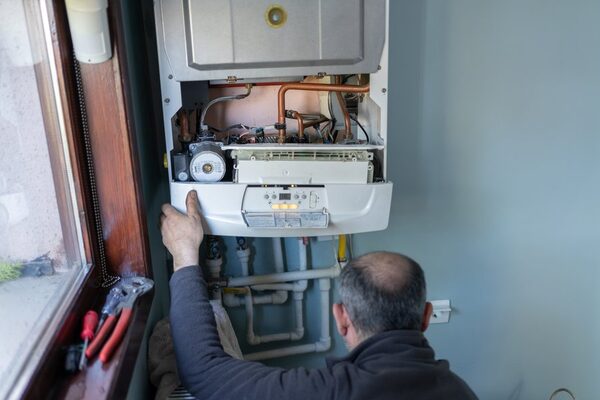
Energy Saving Trust expects heat pumps to become more common in the UK as fossil fuel boilers are slowly phased out26. A briefing from the Parliamentary Office of Science and Technology summarises the technical position:
"Heat pumps are technically suitable for most UK homes if installed appropriately."
Deployment is growing, and public funding drives much of it. Official statistics show a 30% increase in government-supported heat pump installations in the 12 months to June 2025, compared with the preceding 12 months64. In the year ending March 2025, 56% of government-supported installations were funded through the Boiler Upgrade Scheme65. Scottish Government modelling for new-build standards found that air source heat pumps consistently produced the lowest DDER, the energy measure used in that work, across the house types modelled38.
The price of electricity is the main obstacle. The UK government's factsheet says heat pumps can be over three times more efficient than boilers, and introduces that with the words "even though". The efficiency advantage does not automatically mean lower bills30. The parliamentary briefing states that reducing the price of electricity relative to gas would make heat pumps more competitive7. The government's work on households at risk of fuel poverty, based on over 1,100 monitored UK installations, addresses the same problem31. Manchester City Council takes a practical view and says that in most homes changing the boiler is often the most cost-effective way to lower emissions66.
The policy timetable is covered in UK heat pump policy and targets. The household case is covered in heat pumps and energy independence and replacing a gas, oil or LPG boiler.
Where heat pumps fall short: poorly insulated homes and mains gas households
The limits are as well documented as the benefits.
Poorly insulated homes. New Forest District Council's guidance says heat pumps are best suited to buildings with good insulation levels, and that insulation may need adding internally or externally67. Smart Energy GB says draughts or poor roof insulation can cause substantial heat loss and wasted energy16. Croydon Council's guidance is more direct:
Mains gas households. Savings against a gas boiler are smaller than against LPG or direct electric heating39. Which? reports that a household could save as much as 50% and more on running costs compared with a gas boiler. It attaches three conditions to that figure: a high quality installation, high efficiency and a heat pump tariff2. Without those conditions, the saving is not assured.
Installation quality. Energy Saving Trust records that poor installations have been a problem in UK homes in the past. Installers did not size systems correctly, upgrade radiators, replace narrow bore pipework or properly insulate pipework. It says these issues are much less common now that standards have tightened5.
Public understanding. The parliamentary briefing finds that public interest in and understanding of heat pumps is low7. That makes poor buying decisions more likely.
Remaining dependence. A heat pump ends the household's dependence on gas, oil or LPG. In exchange, the household depends on the electricity grid, on a supplier's tariff, on a certified installer, and on the manufacturer's parts and controls for 20 years or more. Matching the type of heat pump to the home is covered in which homes suit a heat pump. The alternatives are compared in heat pump versus electric radiators and heat pump versus biomass boiler.
Sources67 cited
- Energy glossary: heat pump, Low Carbon Hub, 2026-08-05
- An introduction to heat pumps, Which?, 2025-09-22
- Electric heating, Centre for Sustainable Energy, 2026-06
- Notice of approved grant categories and values for the Boiler Upgrade Scheme, GOV.UK, 2026-07-21
- Heat pump questions answered, Energy Saving Trust, 2026-05-27
- Air and ground source heat pumps, Croydon Council
- POSTnote 699: heat pumps, Parliamentary Office of Science and Technology
- Is your home suitable for a heat pump?, Construction Products Association, 2026-02-18
- The Building Regulations (Northern Ireland) 2012, legislation.gov.uk, 2012-05-15
- Directive 2010/31/EU, legislation.gov.uk, 2010-05-19
- Home Energy Model technical paper: heat pump methodology, GOV.UK, 2026-01
- Fact sheet 5: air source heat pumps, Pendle Borough Council
- Planning permission: heat pumps, Welsh Government
- Hybrid heat pumps, Energy Saving Trust, 2026-07-16
- ECO4 New Measures and Products Guidance v3.0, Ofgem, 2026-03-26
- How do heat pumps work, Smart Energy GB, 2026-03-16
- How heat pumps work: a guide for homeowners, NICEIC, 2025-09-17
- Ground source heat pumps, Energy Saving Trust, 2026-07-16
- VAT energy-saving materials manual: heat pumps, HMRC
- About heat pumps, European Heat Pump Association, 2026-04-24
- Boiler Upgrade Scheme statistics, July 2026, GOV.UK, 2026-08-27
- Heat pumps: expert guide for homeowners, Development Bank of Wales, 2024-11-07
- The real cost of a heat pump, Low Carbon Hub, 2025-10-30
- In-depth guide to heat pumps, Energy Saving Trust, 2026-07-16
- Heat pumps, Centre for Alternative Technology, 2025-06-27
- Heat pumps, Energy Saving Trust, 2026-06-11
- Heat pumps, nidirect, 2025-02-24
- Heat pumps vs boilers, Which?, 2025-09-22
- Heat pumps, Welsh Government, 2025-11-17
- Carbon Budget and Growth Delivery Plan: heat and buildings factsheet, GOV.UK, 2026-06-23
- How to ensure a successful transition to heat pumps for households at risk of fuel poverty, GOV.UK, 2026-07-01
- Low temperature heating, Product Characteristics Database
- How to ensure a heat pump runs efficiently, Energy Saving Trust, 2026-05-19
- Heat pump myths, Energy Saving Trust Green Heat Toolkit, 2025-09-02
- Heat pump installation: a step-by-step guide, Energy Saving Trust, 2026-07-15
- Public Accounts Committee report, UK Parliament, 2024-05-26
- How to make heat pumps more affordable: assumptions and methods, Nesta, 2024-06-13
- Improvements to the energy standard for new domestic buildings, Scottish Government, 2026-07-24
- Installing a ground source heat pump, Which?, 2025-09-22
- Heat pumps, Climate Action Wales
- Is now a good time to get a heat pump?, Energy Saving Trust, 2025-12-12
- Help to save households money and deliver cleaner heat to homes, GOV.UK, 2024-11-21
- Boiler Upgrade Scheme guidance for installers v5.1, Ofgem, 2026-07-02
- Boiler Upgrade Scheme notice of standards, GOV.UK, 2026-07-21
- Approved Document L, Volume 1: Dwellings, GOV.UK, 2026
- Approved Document L Volume 1, consultation version, Welsh Government
- What heating options are available off the grid, OFTEC
- Would a heat pump work for your home?, Which?, 2024-11-19
- What impact can heat pumps have in domestic heating today, GOV.UK, 2023-11-21
- Planning guidance: heat pumps, London Borough of Richmond upon Thames, 2026-04-22
- Planning permission: air source heat pump, Planning Portal
- General Permitted Development Order 2015, Part 14 Class G (as made), legislation.gov.uk
- Air source heat pumps, Cornwall Council
- Permitted development, Cotswold District Council
- Warm Homes Plan and heat pumps, MHCLG, 2024-11-21
- Rooftop solar for new builds to save people money, GOV.UK, 2025-06-06
- Amendments to the Boiler Upgrade Scheme: government response, GOV.UK, 2025-11
- Changes to permitted development rights: summary of responses, Welsh Government, 2025-12
- Smart meters, MCS, 2026-07-24
- Smart meters, Climate Action Wales, 2026
- Heat pump fact check, Energy Saving Trust, 2026-07-01
- Your essential guide to heat pumps, Climate Action Wales, 2025-02-20
- Vaillant heat pump, E.ON Next
- Heat pump deployment quarterly statistics, UK, 2025 Q2, GOV.UK, 2025
- Heat pump deployment quarterly statistics, UK, 2025 Q1, GOV.UK, 2025
- Homes and energy, Manchester City Council
- Heat pumps, New Forest District Council