

In this guide
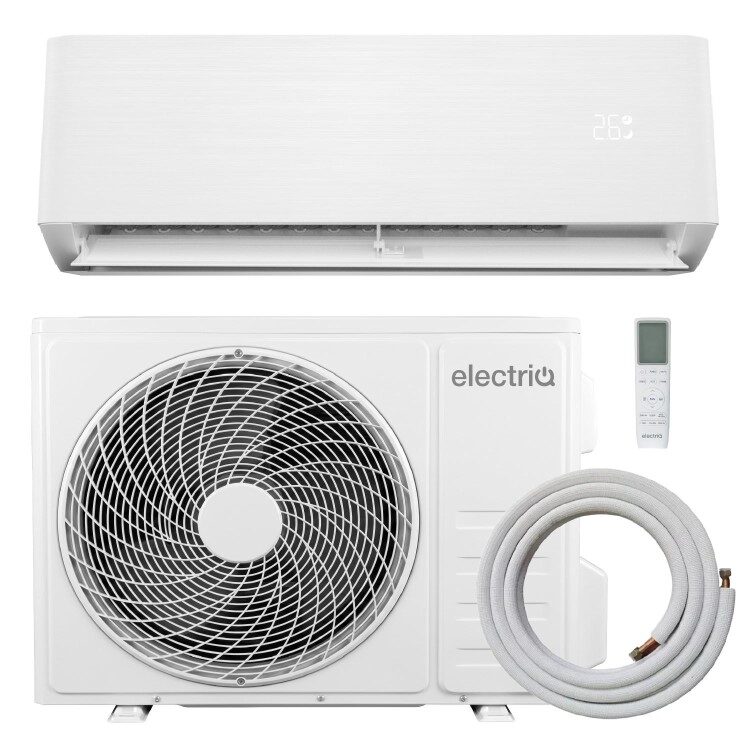
An electriQ split air conditioner is an air-to-air heat pump: one outdoor fan unit and one indoor head, joined by refrigerant pipework, that moves heat rather than making it1. In cooling mode it takes warmth out of a room. In heating mode the refrigerant cycle runs the other way and the same hardware brings warmth in from the outdoor air. That is the whole of the technology, and it is the same principle behind every air source heat pump sold in the UK2.
What that means for a household is narrower than the phrase "heat pump" usually implies. A split unit heats and cools the room its indoor head serves. It does not heat a cylinder, so it produces no hot water, and it does not circulate warmth to bedrooms and bathrooms through a wet system3. Air-to-air units are also treated separately from the mainstream grant-funded market: they provide cooling as well as heating, and they are not part of the Boiler Upgrade Scheme route that air-to-water systems use4.
The appeal is cost and simplicity. A single split unit is a fraction of the price of a full wet heat pump installation, needs no radiators, no cylinder and no underfloor work, and can be bought directly by a householder. The trade-off is that it leaves the rest of the house on whatever heating it already had, and it keeps the home on electricity bought from a supplier.
Heating and cooling: how the heat pump function works in practice
A heat pump is a device that can provide heating, cooling and hot water for residential, commercial and industrial use, and it does so through the refrigeration cycle1. Despite the name, all heat pumps can provide both heating and cooling1. In a split air conditioner that dual capability is the entire product: the same compressor and refrigerant circuit serve summer and winter, and the reversing valve decides which way the heat travels.
The mechanism is straightforward. A heat pump uses electricity to move warmth from outside your home to inside your home2. It captures heat from outside and moves it into your home, and while it uses electricity to do this, the heat energy delivered is much more than the electrical energy used to run it7. That ratio is what separates a heat pump from a resistive heater, and it holds in heating mode on a split unit just as it does on a wet system.
Air-to-air units are recognised as a distinct category. They provide cooling as well as heating8, and many heat pumps function as heating and cooling systems, able to provide summer air conditioning9. Heat pumps can also recover and reuse the heat generated when cooling, which is why a unit running in cooling mode is simultaneously rejecting heat that could be put to use elsewhere4.
For a household, the practical consequence is that the unit earns its keep twice. A room that is uncomfortable in July is the same room that is underheated in January, and one appliance addresses both. What it does not do is serve the whole house. A split head heats the space it is in, and warm air does not travel through closed doors the way a wet circuit does. Homes that rely on air-to-air heating usually run several heads, or accept that the rest of the house stays on its existing system.
Efficiency and running cost: what the figures mean for a household

Efficiency on a heat pump is expressed as a ratio of heat delivered to electricity used. A worked example makes it concrete: if a heat pump used 3,000 kWh of electricity over the year and provided 12,000 kWh of heat, that is a SCOP of 4, or 400% efficiency10. A split air conditioner running in heating mode is doing the same arithmetic, though its published figures are usually quoted for cooling and for specific test conditions rather than as a seasonal heating figure.
Running costs depend on the price of electricity, not on the badge. Heat pumps cost around £800 to £1,050 a year to run, making them one of the cheapest electric heating options5. That figure is for a whole-home system. A single split unit serving one room uses far less, but it also heats far less, so the comparison is not like for like.
| Scenario | Modelled annual cost | Basis |
|---|---|---|
| Heat pump on a time of use tariff | £640 to £750 saved against a single rate tariff | Flexibility modelling11 |
| Heat pump plus EV on a heat pump tariff | £850 heat pump, £550 charging, £1,400 total | Octopus Cosy example12 |
| Benchmark heat pump household | 5.66 MWh electricity, no gas | Annual total13 |
| Whole-home heat pump running cost | £800 to £1,050 a year | Electric heating comparison5 |
Tariffs change the picture more than hardware does. Modelling found average savings of £640 to £750 a year by operating a heat pump flexibly on a time of use tariff, against a single rate tariff with a standard heat pump profile11. A typical UK household with an electric vehicle and a heat pump on a heat pump-focused tariff such as Octopus Cosy was modelled at £850 a year for the heat pump and £550 for charging, a total of £1,40012. A benchmark heat pump household is modelled at 5.66 MWh of electricity in total per year and no gas13.
The caution is that electricity is priced higher per unit than gas, and that shows up in real installations. In one Edinburgh flat, the heat pump was costing more to run than the old gas boiler despite using fewer units of energy, because the price per unit of electricity is higher than for gas14. A split unit avoids some of that by heating one room rather than a whole house, but the unit price of electricity is the same.
Installation and siting: what a split system needs in a UK home
Split system heat pumps comprise an outdoor fan unit and an indoor heating unit16. The two are connected by refrigerant pipework that has to be run, insulated and concealed, and the circuit has to be evacuated and charged before the unit will work. That is the part of the job that separates a split from a plug-in appliance.
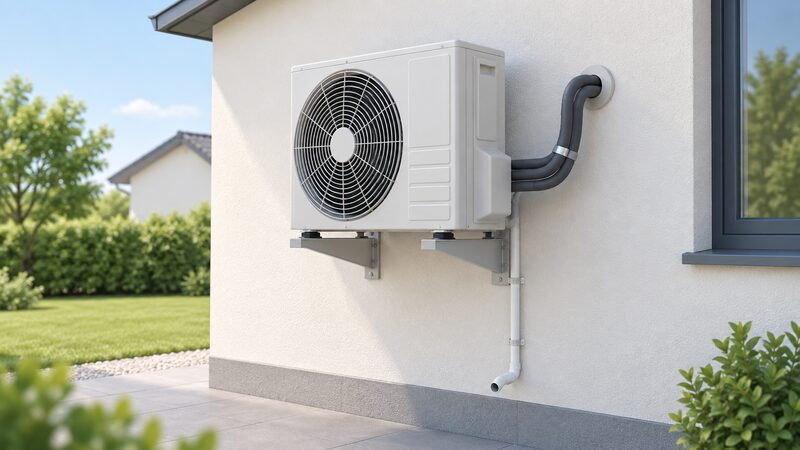
The outdoor unit needs a position with airflow around it, a firm mounting, and a route for condensate. It also needs an electrical supply. Whether an existing circuit can carry the load is a question for the installing electrician, who can check the protective device and cable against the unit's rating. Where a new connection or a supply upgrade is needed, the local distribution network operator handles applications, and Electricity North West, for example, takes domestic low carbon technology applications by form and email17.
Noise is a planning consideration as well as a comfort one. The outdoor fan unit is the louder half of the system, and its position relative to a neighbour's window or a boundary matters. Rules differ across the four nations: England, Scotland and Wales each have their own permitted development conditions for air source heat pumps, and Northern Ireland has a separate building regulations position. A unit that fails the noise or siting conditions needs planning permission.
Refrigerant handling is regulated. The circuit contains a fluorinated gas, and work on it is restricted to people holding the relevant qualification. That is why a householder can buy a split unit but cannot legally commission it, and why the installation cost is not optional.
Cost and where to buy in the UK
There is no single published price for an electriQ split unit that covers the range, and prices move with model, output and retailer. Units are sold through UK electrical retailers and online marketplaces, and the buyer arranges installation separately. That is a different route from the mainstream heat pump market, where at least 33 manufacturers supply air source heat pumps in the UK and Mitsubishi Electric, Vaillant, Daikin and Samsung account for nearly two-thirds of total annual UK sales6.
For context on what a full wet system costs, independent case study work puts buying and installing a heat pump at about £10,500, with a range from £8,000 to £15,00018. Replacing heating in electrically heated homes is estimated at somewhere in the range £10,480 to £19,98019. A single split unit is a small fraction of those figures because it does a small fraction of the work: one room, no cylinder, no emitters, no wet circuit.
| Option | Indicative capital cost | Scope |
|---|---|---|
| Single split air conditioner | Retailer-quoted, no published range | One room, heating and cooling |
| Full wet heat pump installation | About £10,500, range £8,000 to £15,00018 | Whole home, hot water |
| Replacing heating in an electrically heated home | £10,480 to £19,98019 | Whole home |
More than 95% of heat pumps sold in the UK use electricity as the driving fuel20, so a split unit is not an unusual choice of fuel, only an unusual scope of service. Where a household already has a wet system, a split unit adds a room-specific option rather than replacing anything. Where a household has no wet system at all, a split unit can carry part of the load but leaves hot water and the remaining rooms unaddressed.
Prices for electriQ units are retailer-quoted and vary by seller and by season, so no range is given here. Installation is separately quoted by a local refrigeration or air conditioning engineer, and that quote will reflect pipe run length, whether a new electrical circuit is needed, and access to the outdoor position.
Warranty, registration and support

Warranty terms on budget split units are set by the seller and vary by product, so the terms that apply are the ones supplied with the specific unit at the point of sale. Registration is normally handled through the retailer or the brand's support route rather than through a national installer scheme, and a claim will usually ask for proof of purchase, the serial number and evidence that the unit was commissioned correctly.
That last requirement is where split units differ from wet heat pumps. A wet system installed under a certified scheme carries a manufacturer's warranty tied to an approved installer, and some suppliers offer long terms: E.ON Next, for example, offers Ideal and Vaillant heat pump installations with seven-year manufacturers' warranties21. A budget split unit bought directly has no equivalent installer network behind it, so the paperwork that proves correct commissioning is the householder's to keep.
Certification is a separate question from warranty. Eurovent Certita Certification lists heat pumps among the technologies it certifies22, and MCS operates a product certification route23. A unit that carries third-party certification has had performance independently checked; a unit that does not has only the maker's figures. For a household weighing a budget purchase, that distinction is worth checking before ordering.
Support arrangements also matter for servicing. A split unit needs its filters cleaned and its outdoor coil kept clear, and the refrigerant circuit should be left alone unless there is a fault. Fault diagnosis on a budget unit often runs through the retailer's returns process rather than a manufacturer's engineer visit, which is a slower route than a wet system's service plan.
Where a split unit falls short
The limits are structural, not a matter of quality. A split unit produces no hot water, so a home relying on it still needs a cylinder, a combi boiler or an electric shower arrangement. It heats the room it serves, so a whole-house strategy needs several heads or a second system. And it keeps the household buying electricity from a supplier, with the standing charge and unit rate that go with it.
Air-to-air units also sit outside the grant framework. They provide cooling as well as heating, and the Boiler Upgrade Scheme route is built around air-to-water systems4. That means the capital cost is not offset, which is part of why the units are cheap in the first place.
There is a wider cost context. Electrification of heat pumps is modelled at a cumulative additional cost of £270 billion to 2050 across residential and non-residential buildings24, and a heat pump on older efficiency figures could increase annual household bills by as much as £200 on a standard tariff25. Those figures describe the national picture, not a single room, but they explain why running cost, not purchase price, is the number that decides whether a heat pump saves money.
For a household, the honest position is that a split unit buys comfort and control in one or two rooms at a low entry price, and buys nothing else. It does not remove the gas connection, the hot water system or the electricity supplier. What it does remove is the cost of heating a room that is not being used, which in a home with one cold extension or one overheated bedroom can be the whole point.
Sources25 cited
- Heat pump technology, European Heat Pump Association, 2022-11-10
- Deciding if a heat pump is right for you, Citizens Advice, 2025-12-08
- Advice on renewable technologies, Home Energy Scotland, 2026-09-20
- Cooling matters: the other side of heat pumps, European Heat Pump Association, 2026-07-31
- Electric heating, Centre for Sustainable Energy, 2026-06
- Heat pumps explained: experts answer your questions, GOV.UK, 2024-03-28
- Renewable heating: what are the options for your home, Energy Saving Trust, 2024-03-01
- Update on the implementation of air-to-air heat pumps into MCS, MCS Certified, 2026-04-13
- Heat pumps vs boilers, The CPA, 2025-02-18
- Living with a heat pump, Home Energy Scotland, 2024-02
- Domestic heat pump flexibility modelling, Nesta, 2024-11-19
- Best tariffs for EV and heat pump, Uswitch, 2025-07-02
- How to pay for energy, Cadent Gas, 2026-09-20
- Electrification of heat: case studies on heat pump experiences, Energy Systems Catapult, 2021-12-16
- Written evidence on heat pump running costs, UK Parliament, 2023-08
- Air source heat pumps, Dimplex, 2026-09-17
- Heat pumps: apply for a new connection, Electricity North West, 2026-09-19
- Heat pumps as an employee benefit, Nesta, 2026-09-17
- Consumers and the transition to net zero, Consumer Scotland, 2023-10-08
- Domestic heat pump guide, MCS Certified, 2024-04-02
- Air source heat pump costs and savings, Which?, 2026-04-14
- Certifying your product, MCS Certified, 2026-05-18
- Reduce the cost of heat pumps, Nesta, 2022-03-02
- Decarbonising heat: the basics, Energy and Climate Intelligence Unit, 2050
- Factcheck: what it really costs to heat a home in the UK with a heat pump, Carbon Brief, 2026-01-30
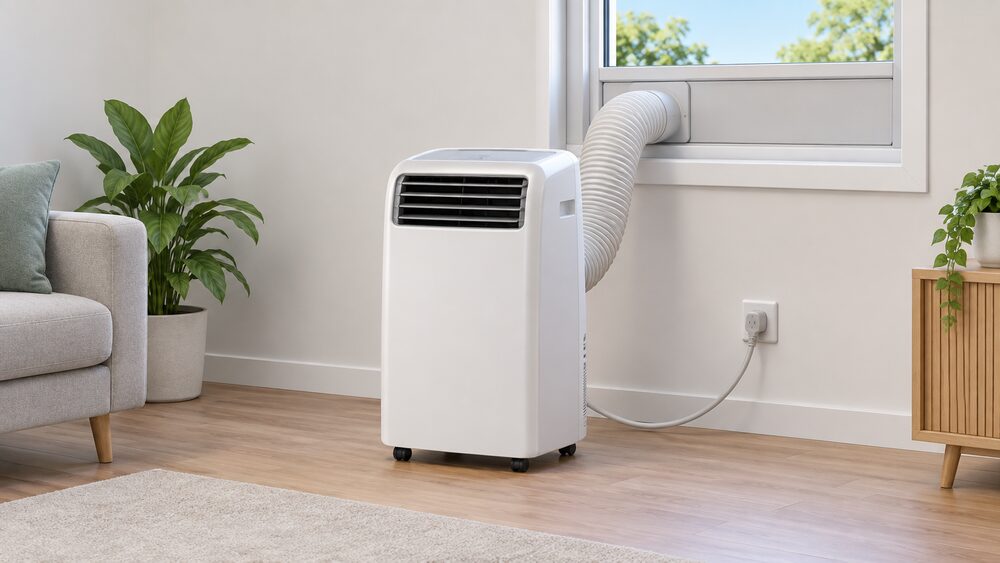 electriQ P12C 12000 BTU portable air conditionerSpecifications, cooling coverage, noise, venting and warranty for the electriQ P12C, a 12000 BTU single-hose portable air conditioner with heat pump.