
In this answer
Short answer
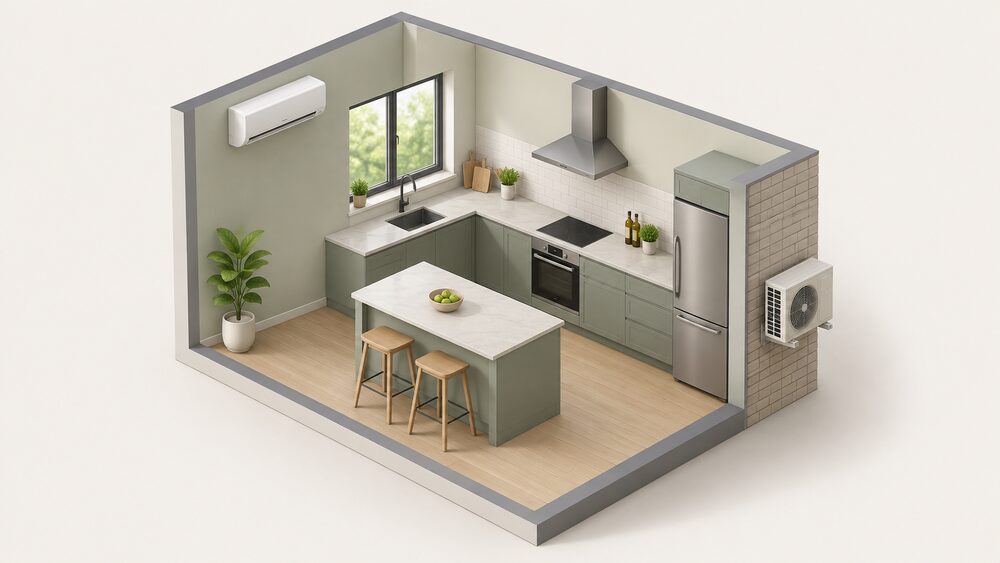
A kitchen is the hardest room in a UK house to cool, because it is the one room that makes its own heat. Ovens, hobs, kettles and fridges all add warmth while the room is in use, and UK homes were built to hold heat rather than shed it: most were designed to retain heat, not release it, making them prone to overheating during heatwaves1. Cooling a kitchen therefore means sizing for the heat gains, not just the floor area, and accepting that extraction and cooling pull in opposite directions.
The practical answer is a fixed split system sized for the room, with the indoor unit placed away from the hob and away from doors and windows, and extraction run while cooking rather than alongside the cooling. A portable unit can help, but a typical portable air conditioner draws 1,000 to 1,500W and costs around 26 to 39p per hour to run, roughly 14 to 20 times more than a fan2. That is the price of cooling one room hard.
Why a kitchen runs hotter than the rest of the house
Three things stack up. The first is the cooking itself: an oven preheated for 15 minutes and then run for an hour costs between 64p and £1.61 in electricity, and almost all of that energy ends up as heat in the room7. The second is the fabric of the building. UK homes were designed to retain heat, not release it, which is why they overheat in heatwaves1. The third is occupancy and equipment: some households rely on medical equipment such as oxygen machines, which can generate additional heat indoors1.
Kitchens also sit awkwardly in the way homes are heated and ventilated. Official guidance on decent homes treats the kitchen as a distinct building component alongside bathrooms and the central heating distribution system8, and rooms where steam will be produced, including kitchens, bathrooms and utility rooms, should be provided with higher levels of ventilation, normally mechanical fans and windows9. A kitchen is therefore already a room with a designed air path, and any cooling has to work with that path rather than against it.
Where the kitchen is open plan, the problem changes shape. It is not energy-efficient to try to heat just one room in an open-plan home or one with high ceilings10, and the same logic applies in reverse to cooling: a unit sized for the kitchen zone alone will be fighting a much larger volume of air. Air-to-air heating and cooling can be especially cost-effective in a smaller house or flat with relatively few rooms, especially homes that overheat in warm weather11, which describes many kitchens in modern flats.
Split, portable or window unit: which suits a kitchen
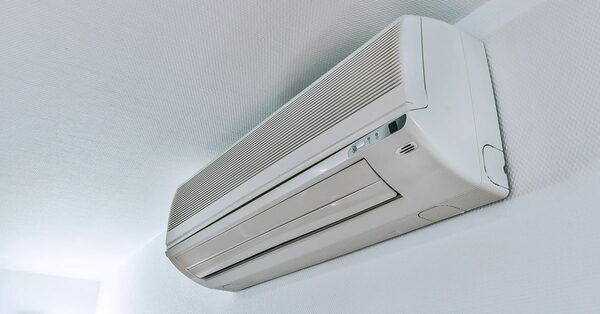
Single split wall mounted air conditioners are described by one maker as ideal for single rooms, while multi-split units can be used in various rooms throughout the house4. A kitchen is a single room, so a single split is the straightforward match where an outdoor unit can be sited. Where the kitchen is one of several rooms needing cooling, a multi-split shares one outdoor unit: the Daikin Multi+ range is described as a heat pump system that looks after heating, cooling and hot water from one outdoor unit, with an integrated domestic hot water tank12, and the outdoor units in that family are listed with cooling capacities of 5.2 to 9.0 kW13.
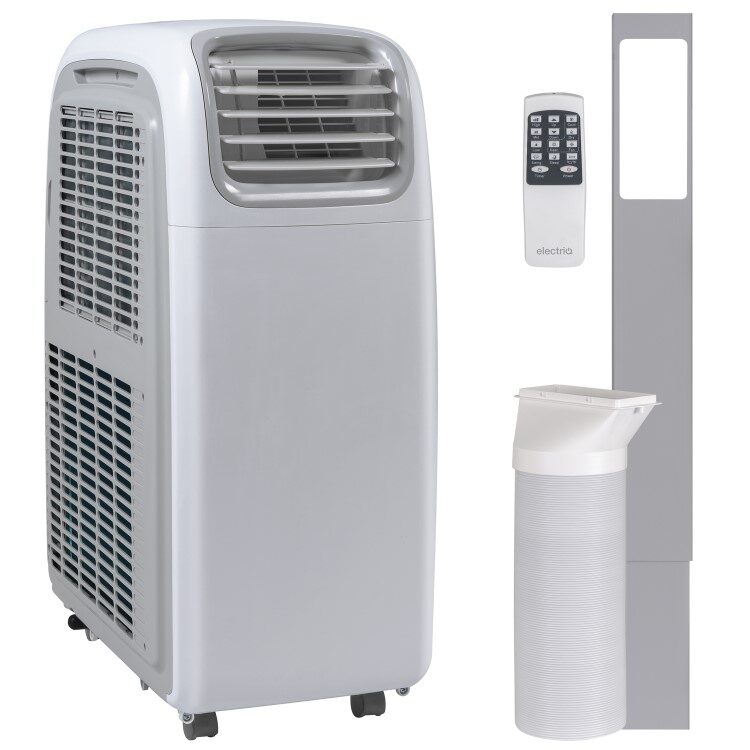
Portable units are the fallback where no outdoor unit is possible. Their limits are structural rather than a matter of quality: they sit in the room they are cooling, they need a duct to outside, and they draw 1,000 to 1,500W for the cooling they deliver2. Guidance on portable electric heaters notes that they are designed for small spaces and not a substitute for an efficient central heating system14; the same framing applies to portable cooling in a room with continuous heat gains.
Window units are uncommon in the UK because of window styles and because flats bring consent questions. The planning position is set out below. For a fuller comparison of the fixed options, see split air conditioning systems and multi-split air conditioning.
| Option | Best fit | Key constraint |
|---|---|---|
| Single split | One kitchen, outdoor unit possible | Needs a wall and an external position4 |
| Multi-split | Kitchen plus other rooms | One outdoor unit, capacities 5.2 to 9.0 kW13 |
| Portable | No outdoor unit permitted | 1,000 to 1,500W draw, 26 to 39p per hour2 |
| Ducted | Whole-home or concealed install | Ducts need ceiling voids or a plant space15 |
Cooling capacity: matching the unit to the room
Sizing starts with floor area and ceiling height, then adds for the kitchen's own heat. The published examples are American, from a maker's guidance citing US Department of Energy recommendations: a 600 sq ft space with an 8 ft ceiling needs a 12,000 BTU air conditioner, and a two-room apartment of 800 sq ft needs 16,000 BTU4. There is no equivalent UK kitchen figure in the published guidance, so these examples are the closest available benchmark and should be treated as such.
At the smaller end, newer small capacity air-to-air systems can provide up to around 3 kW of heating or cooling3. That is a useful ceiling for a single small room, and it is the figure to hold against a kitchen with an oven running. For the conversion between kW and BTU, and for room-by-room sizing, see what size air conditioner do you need.
The reason a kitchen needs more than its floor area suggests is that the heat gains are internal and intermittent. A 3 kW unit that holds a bedroom comfortably will lose ground against an oven, a hob and a fridge compressor cycling at the same time. Sizing for the peak, not the average, is what stops the unit running flat out and never reaching setpoint.
Where to place a unit in a kitchen
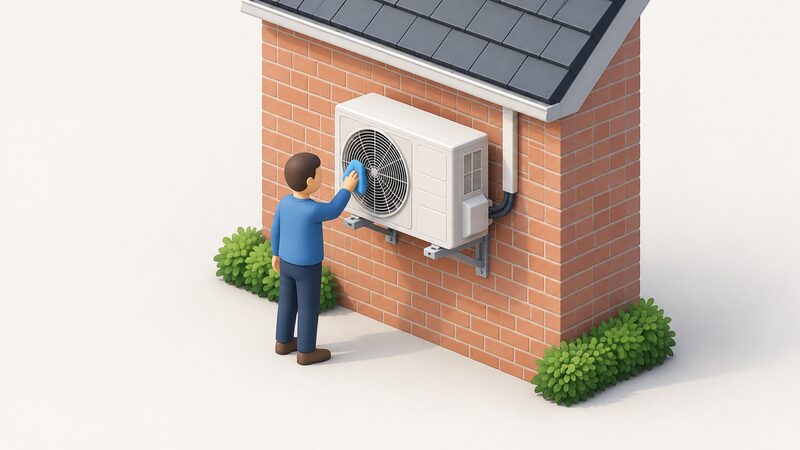
Placement guidance from a maker is specific. The outdoor unit needs to be placed in a safe, well-ventilated area with enough clearance to take in fresh air and release the heat from your home, and it should be somewhere easily accessible for cleaning and maintenance16. The indoor unit should not be positioned opposite a door or window, because these create opposing airflows that make the unit work harder, and its placement needs to ensure the unit is easily accessible for cleaning the filters and any other maintenance16.
In a kitchen those rules translate into a few practical positions. The indoor unit belongs on a wall that throws cooled air across the working area rather than into the doorway, and high enough to be out of splash and steam but reachable for filter cleaning. Directly above a hob is the worst case on both counts. The outdoor unit needs an external wall with clearance, and in a flat that means a balcony, a wall or a roof space that the lease allows.
Ventilation and extraction alongside air conditioning
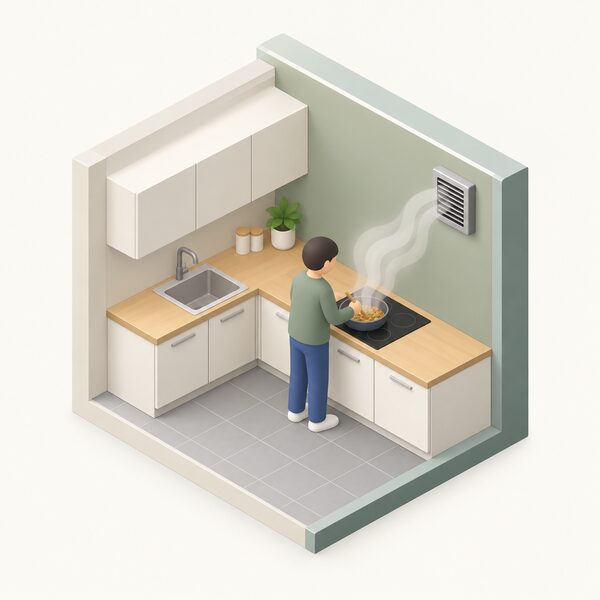
Extraction and cooling compete for the same air. In places where lots of moisture is produced, kitchens, bathrooms and utility rooms, extractor fans are required to remove the excess moisture, and where there is no extractor fan, opening a window will help17. Extract ventilation is applied in rooms where water vapour or pollutants are most likely to be released, for example bathrooms and kitchens, and extract fans can be intermittent or continuous18. Intermittent extract fans are relatively cheap to install and reasonably effective, but not always sufficient for very air-tight or damp-prone properties, while decentralised mechanical extract ventilation runs continuously at low levels and increases when the system senses high humidity17.
The consequence for a cooled kitchen is straightforward: every cubic metre of air an extractor removes has already been paid for. Running extraction during cooking and cooling afterwards avoids paying twice. Some ventilation is good, both to reduce condensation and to ensure the safety of open fires, stoves and gas appliances19, so sealing a kitchen to protect the cooling is not the answer either.
Ducting matters too. Hot and cold air ducting should be insulated along its whole length, and where it is used for both chilling and heating, the provision for chilled ducting should be adopted22. Ducted systems move air through slim pipes hidden in ceiling voids, with the air warmed in an air handling unit roughly the size of a boiler, normally in a loft or utility room15, and air-to-air heat pumps distribute air via a network of ducts and indoor units23. Exhaust air heat pumps need indoor space where all the ducts flow to and from, ideally close to an exterior wall24.
Where the hot air duct goes
A portable or ducted unit has to discharge its heat somewhere, and the only acceptable destination is outside the building envelope. A duct into a loft, a hallway or a neighbouring room moves the problem rather than solving it, and it also raises the temperature of the air the unit is drawing back in.
For ducted installations, the air handling unit is normally in a loft or utility room15, which keeps the machinery and its noise out of the kitchen. Exhaust air heat pumps need indoor space where all the ducts flow to and from, ideally close to an exterior wall24. Insulation along the whole duct run is a requirement, with the chilled provision adopted where the duct serves both heating and cooling22.
Is a window unit allowed in a flat?
Permitted development rights for air source heat pumps are withdrawn in specific circumstances. Development is not permitted if the air source heat pump would be installed on a building, or on land within the curtilage of a dwellinghouse or block of flats, that is a listed building6. The same listed-building curtilage restriction appears in the solar equipment class26. Outside those cases, flats bring lease terms, freeholder consent and, in some cases, the building's own management rules into play, none of which the planning system resolves.
For the nation-by-nation position, see air conditioning planning permission in England, Scotland, Wales and Northern Ireland. Flats specifically are covered in air conditioning in flats.
Running costs and what to expect in use
The running cost of kitchen cooling is dominated by the unit's draw and the hours it runs. A typical portable air conditioner at 1,000 to 1,500W costs around 26 to 39p per hour, roughly 14 to 20 times more than a fan2. For context on what else in a kitchen costs to run, an air fryer costs between 36p and 44p per hour of use27, and cooking fried chicken for 15 minutes consumes 0.35kWh28. An oven preheated for 15 minutes and run for an hour costs between 64p and £1.617.
Those figures put kitchen cooling in proportion. Cooling a kitchen for an hour costs roughly what cooking in it costs, and both are well above the cost of moving air with a fan. For a household weighing up the alternatives, air conditioning running costs sets out the wider picture, and air conditioning vs fans compares the two directly.
Noise is the other running characteristic. Air-source heat pumps create between 40 and 60 decibels on average, a similar noise level to a dishwasher or microwave5. Fan heaters are usually small, cheaper, provide instant heat but can be noisy29. In a kitchen, where conversation and cooking already generate noise, an outdoor unit on a wall near a neighbour's window is the placement question most likely to cause friction; air conditioning noise covers the detail.
Humidity, grease and maintenance in a kitchen
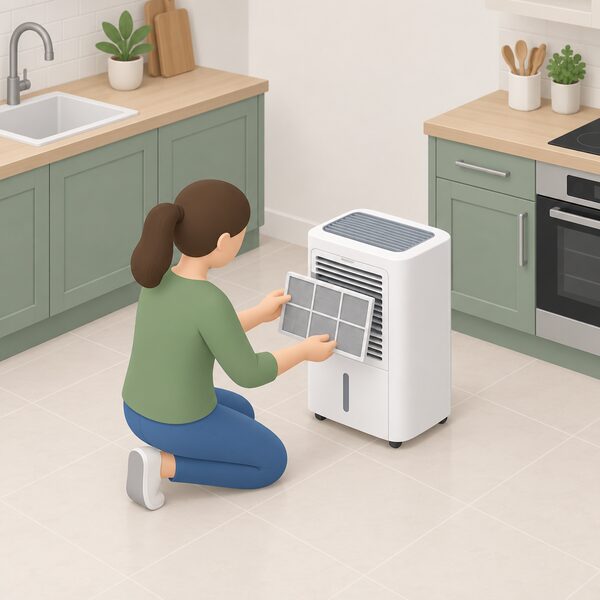
A kitchen combines moisture, grease and heat, which is an awkward mix for any cooling appliance. A dehumidifier draws moisture out of the air and can be particularly useful if clothes are dried inside the house30, and using one is a cheap way to dry clothes indoors compared with a tumble dryer31. Refrigerant dehumidifiers work best in warmer temperatures and are generally more energy-efficient in such conditions31. A dehumidifier does not lower air temperature, so it addresses the oppressive feel of a humid kitchen rather than the heat itself; air conditioning and humidity covers dry mode and humidity control.
Grease is a maintenance issue rather than a barrier. Placement guidance requires that the unit stays accessible for cleaning the filters and any other maintenance16, and in a kitchen that access matters more than in a bedroom because airborne cooking fat settles on filters and coils. Regular filter cleaning is the difference between a unit that holds its capacity and one that quietly loses it; air conditioning maintenance sets out the routine.
What kitchen cooling means for energy independence
Cooling a kitchen with a fixed split or air-to-air system keeps the household's comfort under its own control: the unit runs on the home's electricity, and where that electricity comes from solar panels the running cost is largely decoupled from a supplier. The dependence that remains is real, though. A portable unit still draws 1,000 to 1,500W from the grid2, a split system depends on a manufacturer for parts and on an F-gas certified engineer for refrigerant work, and a ducted system depends on the ducts and the air handling unit being installed correctly in the first place15.
There is also a seasonal asymmetry. A reverse-cycle air-to-air system provides heating as well as cooling, with small capacity systems delivering up to around 3 kW3, so the same hardware can displace some gas use in winter. That is the strongest independence argument for choosing a fixed system over a portable one. For the wider picture, see home cooling and energy independence and the pillar guide at home cooling.
Sources31 cited
- Fuel poverty in summer, National Energy Action, 2026-08-11
- Summer energy tips, National Energy Action, 2026-08-13
- Heat in buildings: multiple ownership and mixed use buildings, Scottish Government, 2023-11-28
- What size of air conditioner do I need, Hitachi Air Conditioning, 2026-09-17
- Heat pumps vs boilers, Which?, 2025-09-22
- Class G: air source heat pumps on domestic premises, legislation.gov.uk, 2026-09-17
- How much your appliances cost to run, Which?, 2026-10-01
- Heating cost comparison, OFTEC, 2026-09-17
- Building regulations: doors and windows, Welsh Government, 2026-09-17
- Heat the whole house or one room, Uswitch, 2026-08-20
- Summer CO awareness, Cadent Gas, 2026-09-20
- Daikin 4 port multi air conditioner, Quiet Mark, 2026-09-17
- How a heat pump can cool your home, Which?, 2026-07-17
- Portable heaters, Electrical Safety First, 2026-09-17
- Air-to-air heat pumps, Energy Saving Trust, 2026-09-11
- How to choose your air conditioner location, Daikin UK, 2026-09-20
- Ventilation advice, Centre for Sustainable Energy, 2025-07
- Ventilation, BESA, 2026-09-20
- How to reduce heat loss from sash windows, Historic Environment Scotland, 2026-09-20
- Fire safety in the home, Electricity North West, 2026-09-19
- Building regulations guidance Part J, Welsh Government, 2026-09-17
- HVAC legislation, MIMA, 2026-09-20
- How heat pumps work: a guide for homeowners, NICEIC, 2025-09-17
- Exhaust air heat pumps, Energy Saving Trust, 2025-06-05
- Class G: air source heat pumps on domestic premises, legislation.gov.uk, 2026-09-01
- Class A: solar equipment on domestic premises, legislation.gov.uk, 2026-09-17
- What appliances use more electricity, Smart Energy GB, 2026-03-16
- Saving hacks, AMDEA, 2026
- Daikin 5 port Class 90 multi air conditioner, Quiet Mark, 2026-09-17
- How to stop condensation, Which?, 2026-05-26
- Dehumidifiers, Electrical Safety First, 2026-09-19
 The Full Cooling and Air Conditioning GuideDo you really need air conditioning in a British summer, or would a fan and better shading do the job?
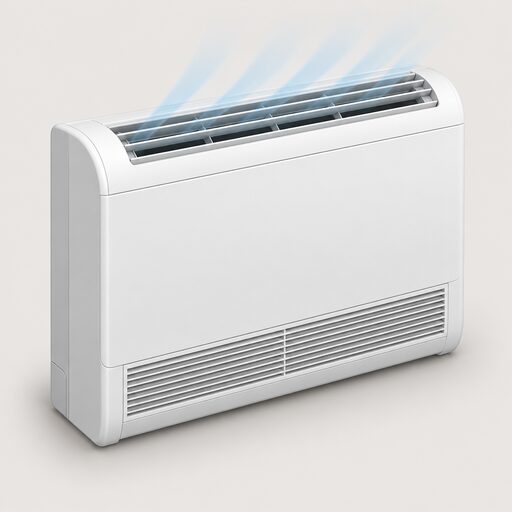 Split Air ConditioningA split air conditioning system cools or heats one room using an indoor unit and an outdoor unit linked by pipes.
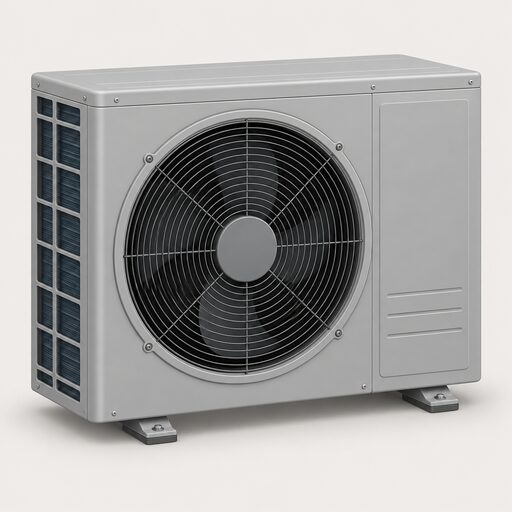 Cooling and Heat PumpsCan an air conditioner heat your home as well as cool it?
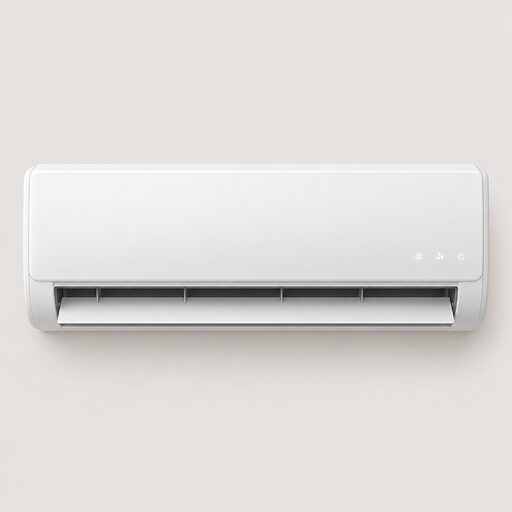 Air Conditioning CostPublished UK equipment prices and the parts of an installed price for portable, single split, multi-split and whole-house air conditioning.
 Passive Cooling at HomeKeeping a home cool without air conditioning comes down to blocking heat before it gets in, then letting trapped heat out.
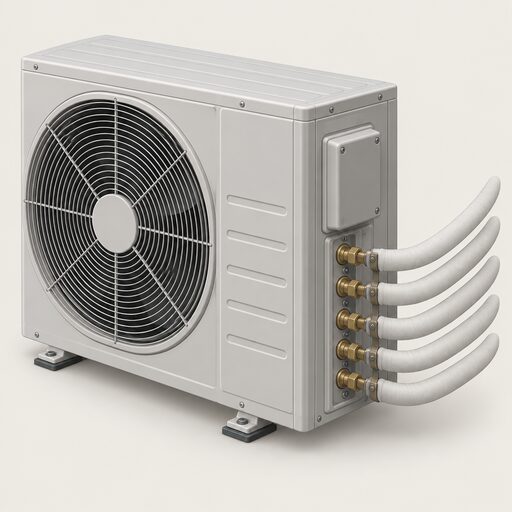 Multi-Split ACHow multi-split air conditioning works when one outdoor unit serves several indoor units: how many rooms one system can serve, independent room control, efficiency, outdoor unit size and sound, planning rules in England and Scotland, servicing and lifespan, the 0% VAT position and how it compares with separate single splits.