In this guide
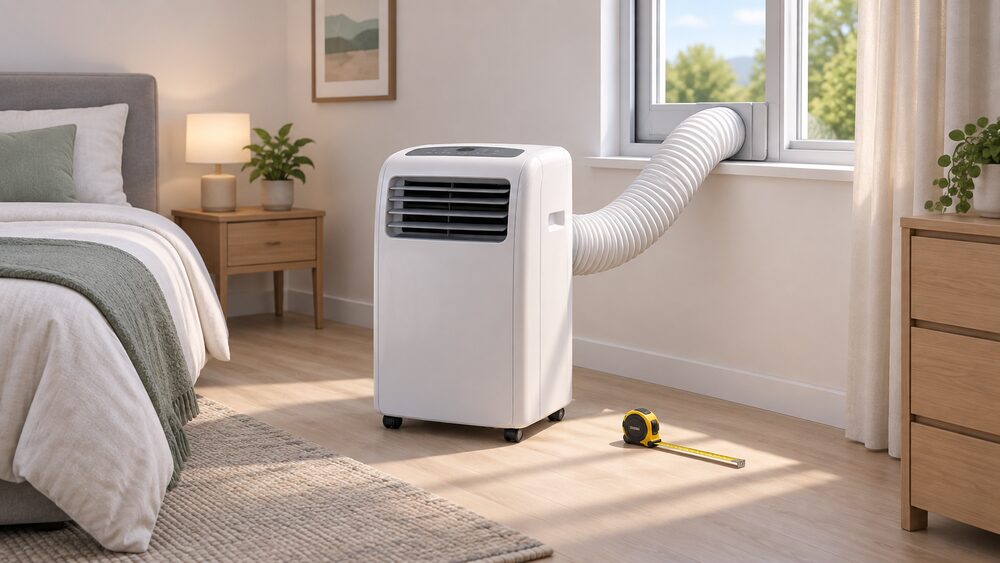
A 9,000 BTU air conditioner is generally described as suitable for rooms up to approximately 26 m², though that depends on insulation and other conditions, and it is the size most often sold for bedrooms, home offices, garden rooms, small living rooms, conservatories and flats1. In kilowatts, the two sizes most UK households choose between are 2.5 kW, which is often suitable for compact bedrooms and small offices, and 3.5 kW (12,000 BTU), which suits larger bedrooms, garden rooms, small living rooms and rooms with more sun and glazing and is listed for rooms up to 30 m²2.
Cooling output is given either in kilowatts (kW) or in British Thermal Units (BTU). To convert BTU to kW, multiply the BTU by 0.000293; to convert kW to BTU, multiply the kW by 3412.143. Floor area sets the starting point, but sunlight, glazing, insulation, ceiling height, the room's use and the number of people in it all move the answer, and the published room sizes differ between guides, sometimes by several square metres for the same output.
For energy independence the sizing decision matters more than it first appears. Every air conditioner runs on electricity, so the household stays tied to the grid and its supplier unless it has its own generation. A correctly sized unit keeps that dependence as small as the room allows; an oversized one adds to it.
Sizing table: room area to kW and BTU
The table below sets out one UK retailer's published guidance, drawn from its size guide and the matching table on its product pages2. Each figure is the largest room the output is stated to cool, based on standard room heights up to approximately 2.7 metres4. Rows marked4 appear only on the product-page version of the table.
| Cooling output (kW) | Cooling output (BTU) | Room up to (m²) | Room up to (ft²) |
|---|---|---|---|
| 1.5 kW | 5,000 BTU | 12 m² | 120 ft² |
| 2.0 kW | 7,000 BTU | 16 m² | 160 ft² |
| not stated | 9,000 BTU | 20 m²4 | 200 ft² |
| 3.5 kW | 12,000 BTU | 30 m² | 300 ft² |
| 4.5 kW | 15,000 BTU | 40 m² | 400 ft² |
| 5.0 kW | 18,000 BTU | 45 m² | 450 ft² |
| 6.2 kW | 21,000 BTU | 50 m² | 500 ft² |
| 7.0 kW | 24,000 BTU | 55 m²4 | 545 ft² |
| 8.0 kW | 27,000 BTU | 65 m²4 | 645 ft² |
| 10.0 kW | 34,000 BTU | 80 m² | 800 ft² |
| 12.5 kW | 43,000 BTU | 100 m² | 990 ft² |
| 14.0 kW | 48,000 BTU | 110 m² | 1,090 ft² |
Two points stand out. First, the same retailer puts 9,000 BTU at up to 20 m² in this table4 but at approximately 26 m² on its 9,000 BTU collection page1. The pages disagree, and the gap is exactly the sort of margin that sun, glass and insulation eat into. Second, the steps are not even: 6.2 kW is listed for rooms up to 50 m² and 7.0 kW for rooms up to 55 m², while 10.0 kW is listed for rooms up to 80 m² and 12.5 kW for rooms up to 100 m², so the room-size bands widen at the top of the range.
What moves a room up or down the table
Floor area alone does not set the load. Manufacturers list the main factors as the size of the room, outdoor temperatures through the year, the number of doors and windows facing outside, and which way the room faces relative to the sun5. Other guidance adds humidity, the insulation of the home, the size of windows or balconies and the quality of the glass, the orientation of the house, and the amount of electronic equipment running in the room6. Meaco states plainly that "Room sizes are approximate. Ceiling height, insulation, glazing and sun exposure can affect cooling performance."7 For readers doing their own conversion, a kW to BTU guide sets out the arithmetic.
Rules of thumb, and where they come from
A widely repeated rule is 20 BTU per square foot with an average ceiling height, which comes from a US Department of Energy recommendation rather than UK guidance8. Its worked examples are also American: a 600 sq ft space with an 8 ft ceiling needing a 12,000 BTU unit, and a two-room 800 sq ft apartment needing 16,000 BTU8. The one UK official limit on the other side of the question is Scottish: draft compliance guidance from 2010 says that "the cooling appliance should not be sized more than 120% of the design cooling load."9 Oversizing has a cost: a unit more powerful than the space needs will use more energy10. Against that, EDF's guidance recommends "going for a slightly larger BTU to ensure maximum comfort"11. The two positions pull in opposite directions, and the design cooling load is what reconciles them. Mitsubishi Electric states that an approved installer can calculate the best size of system for a property12.
A 9,000 BTU unit cools roughly 26 m²: bedrooms, offices and garden rooms
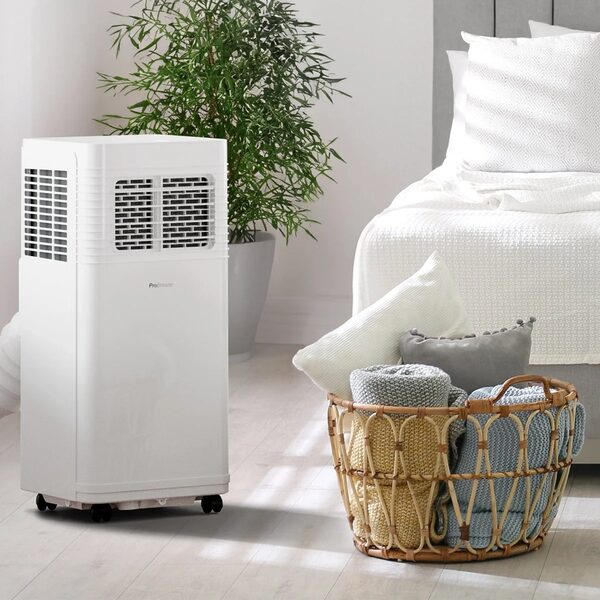
The 9,000 BTU class is the entry point for a single bedroom or study. The retailer that gives the 26 m² figure lists bedrooms, home offices, garden rooms, small living rooms, conservatories and apartments as typical uses1. Lux Air describes its 9,000 BTU size as "ideal for smaller bedrooms and home offices"13.
Individual models are rated more cautiously than the headline figure. The published room sizes for three portables are shown below.
| Model | Stated cooling output | Stated room size |
|---|---|---|
| Haverland IGLÚ-9 | 9,000 BTU/h14 | up to 18 m²15 |
| MeacoCool MC Series Pro 9000 BTU | 9,000 BTU | 16 to 26 m²16 |
| MeacoCool MC Series Pro 10000 BTU | 10,000 BTU | 18 to 28 m²17 |
The range for a nominal 9,000 BTU portable therefore runs from 18 m² at the top of Haverland's rating to 26 m² at the top of Meaco's. A maker's worked example for a 27 m² room gives the requirement in frigories, as 2700 frigories, rather than in BTU or kW6. For a room of about 26 m², the evidence places it at the upper edge of the 9,000 BTU class and within the 12,000 BTU (3.5 kW) band that runs up to 30 m²2. A south-facing room with large windows, a top-floor room under the roof, or a room with several people or computers in it is where the difference between those two sizes shows. Guidance on cooling a 20 m² room covers the next size down.
Stock and prices for 9,000 BTU units
On 23 September 2026 the retailer's 9,000 BTU collection showed "No products found"1. The MeacoCool MC Series Pro 9000 BTU was marked sold out at £389.9916, and Pro Breeze's 9000 BTU 3-in-1 Portable Air Conditioner with Wi-Fi was sold out at a sale price of £699.9918. Haverland lists the IGLU 9 through electronics shops, air conditioning shops, department stores and online stores14. None of these pages states whether the price includes VAT. Fixed wall-mounted units of this size are priced by installers on survey.
Portable or wall-mounted: which suits the room
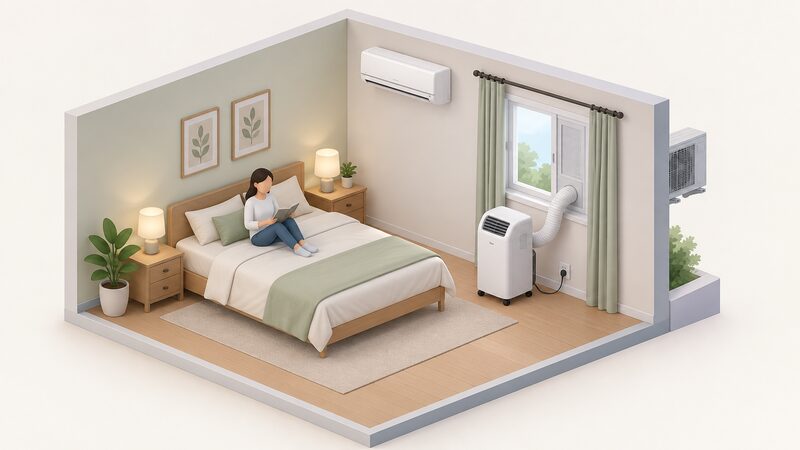
Air conditioners can be fixed or mobile, wall-mounted or ceiling-mounted as a cassette19. For a single room the practical choice is between a portable unit and a wall-mounted split system, and it affects how far the output can be trusted as well as how the unit is lived with.
Why a portable's BTU figure overstates what reaches the room
A portable sits inside the room it is cooling and pushes hot air out through a hose. The retailer's size guide warns that for this reason portables "may not feel as quiet or efficient as a fixed system"2. Packaged units in general have less cooling capacity than split systems: they suit small indoor areas but are not powerful enough to cool a large room20. This is why the same nominal 9,000 BTU is rated for 18 m² by one maker and 26 m² by another, while a 12,000 BTU-class electriQ model is sold for rooms up to 30 sqm and vents through a 150 mm (6 inch) hose21. More on this is on the page about portable air conditioners and whether a portable needs venting outside.
Portables plug into an ordinary wall socket11. Electrical Safety First lists a portable air conditioner at up to 2000 W and up to 9.3 A22; National Energy Action gives a typical portable as 1,000 to 1,500 W23. Retailers describe portables as suited to bedrooms, lounges, home offices and rented homes where fixed systems may not be possible24.
What a fixed wall unit offers
A wall-mounted unit is fixed, usually high on the wall of the room it cools19, and its indoor unit tends to be 80 cm wide, 30 cm tall and 20 cm deep25. Fixed systems are described as quiet and as performing better than portables26. The retailer's guide calls fixed wall-mounted air conditioning "usually better for regular use, especially in bedrooms, living rooms, offices and garden rooms"2. On bedrooms used by children, Hitachi states that portables "should be avoided, with wall-mounted split systems being the safest option"10.
| Portable | Wall-mounted split | |
|---|---|---|
| Where the machinery sits | All inside the room, venting through a hose2 | Indoor unit on the wall, outdoor unit outside26 |
| Power connection | Standard wall socket11 | Installed by an engineer |
| Rooms served | One, moved on castors20 | The room with the indoor unit26 |
| Fixed installation needed | No | Yes |
The comparison continues on the split versus portable page and in the guide to the quietest air conditioning for a bedroom.
Cooling only, or cooling and heating in one unit
Many units now both cool and heat. The 9,000 BTU class is sold with cooling and heating in a single unit1, and fixed wall-mounted systems can heat as well as cool on many models2. A reverse-cycle unit that heats is in effect an air-to-air heat pump, covered in air conditioning that heats.
Portables vary. Some portables are sold with cooling, heating, fan and dehumidifier modes27, and Aermec's PST portable is described for heating, cooling, dehumidification or ventilation at home and in the office15. Others do not heat: Haverland describes the IGLU 9 as a 3-in-1 unit that "cools, ventilates and dehumidifies"14.
Where a unit heats, the heating output is not the same as the cooling output. The electriQ AirFlex Smart 14000 BTU portable, for example, is stated by its maker to use 1.5 kW of power to produce 4 kW of cooling and 3.2 kW of heating28. A unit sized for summer cooling may therefore fall short as a winter heater in the same room, and the sizing tables above cover cooling only.
The system type also shapes how many rooms one purchase covers:
- A mono-split has one indoor and one outdoor unit joined by a pipe, and cools only the room with the indoor unit26.
- A single-packaged (monobloc) unit is suited to small areas up to 30 m²19.
- Single split wall units suit single rooms; multi-split systems serve several rooms8.
- Daikin states that one air conditioner may be all a smaller home, such as a two-bedroom flat, needs29.
The single split versus multi-split page compares the two in detail.
Where bigger rooms need bigger outputs: 12.5 kW and beyond
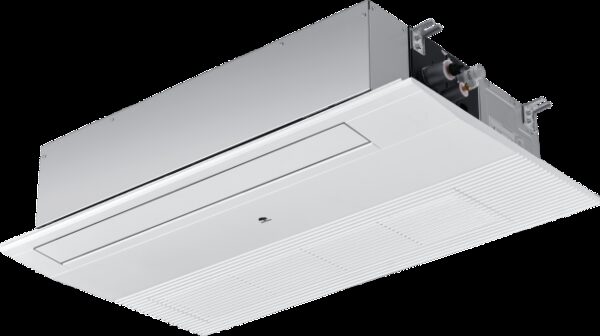
Above the single-room sizes, the tables climb steeply. The retailer lists 10.0 kW (34,000 BTU) for up to 80 m², 12.5 kW (43,000 BTU) for up to 100 m² and 14.0 kW (48,000 BTU) for up to 110 m²2. These outputs sit beyond portable units; the largest portable in the sources, the Meaco Cirro+ 16000 BTU, is rated for 35 to 40 m²30. Large open-plan areas are normally served by fixed systems such as ducted and cassette air conditioning or several indoor units on a multi-split.
The 12 kW inspection threshold
Output above 12 kW brings a legal duty. UK energy performance of buildings regulations state: "This Part applies to air-conditioning systems with an effective rated output of more than 12kW."31 Northern Ireland's 2008 regulations use the same threshold of more than 12 kW32. The inspection rules in these regulations apply to systems above that output, so a household moving from 10.0 kW to 12.5 kW in the sizing table crosses from one side of the line to the other.
For most homes this is academic, since typical bedroom and living room units are 2.5 kW to 3.5 kW. It becomes relevant where one system is sized to cool a whole large house or an extension with a big glazed area. The same US-based rule of thumb cited earlier gives 24,000 BTU for a large family house of 12,000 sq ft, a figure that shows how far generic rules can drift from UK tables8.
Wi-Fi and smart features: what they add
Smart air conditioners are controlled over Wi-Fi through a dedicated smartphone app, and through voice assistants such as Amazon Alexa or Google Assistant where compatible33. Features on sale include:
- Remote control and scheduling: Fujitsu General's wall ranges take an optional Wireless LAN Adapter and the AIRSTAGE Mobile app, with no technical work needed to fit the adapter34.
- Energy monitoring and sensor-based cooling: Daikin lists these alongside scheduling and voice assistant integration on its inverter units, with control through its Onecta app35.
- Built-in Wi-Fi on portables: the electriQ AirFlex Smart 14000 BTU has built-in Wi-Fi and is Alexa and Google Assistant compatible28; the iPAC-55 uses the Smart Life app27.
On energy use, makers present smart features as savers. electriQ states that "Smart scheduling saves energy."36 No figure for the electricity a Wi-Fi module itself draws is published in the guidance reviewed, and savings claims come from makers rather than independent tests. What smart control cannot do is correct a wrong size: an oversized unit uses more energy whatever controls it has10.
For independence, smart features add a dependence of their own. App control relies on the home's Wi-Fi, on the maker's app, and on the maker continuing to support it. Units with an optional adapter, such as the Fujitsu ranges, still work from their own remote without it34. The controls and Wi-Fi page covers the choices in more detail.
What owning an air conditioner means for energy independence
An air conditioner is not a source of energy but a way of moving heat, and Daikin states that air conditioners take 80% of the energy they need from the outside air37. The rest is electricity, and the same source adds that they "still require a reliable electr[icity supply]". A household that adds cooling adds a summer electricity load, on the grid or on its own generation, with the timing that goes with hot sunny afternoons; the page on running air conditioning on solar panels looks at that match.
Sizing is the lever the household controls:
- A unit more powerful than the room needs uses more energy10.
- Scottish draft guidance caps comfort cooling at 120% of the design cooling load9.
- Welsh draft guidance from 2019 sets a minimum energy efficiency ratio of 3.87 for air conditioners in cooling mode38.
- The Energy Saving Trust advises buyers to "consider the size of the appliance you need"39.
Meaco qualifies its own efficiency claims: savings "vary depending on room size, insulation, climate, usage patterns, and electricity tariffs" and the unit "must be correctly sized for the room"7. The factors that set the load (glazing, orientation, insulation, roof exposure) are also the ones that passive cooling and external shading act on. Reducing the heat reaching a room can bring it down a band in the sizing table, which means a smaller unit and less electricity.
The dependences that remain are real. The household relies on its electricity supplier and the grid for most running hours, on a manufacturer for parts and support, and on an app and cloud service for smart control. Fixed systems also need a qualified engineer to install and maintain them under the F-gas rules. The broader picture is set out in home cooling and energy independence and on the home cooling hub.
Sources39 cited
- 9,000 BTU air conditioners, CoolEasy
- Air conditioning size guide, CoolEasy
- What is BTU?, Viessmann, 2022-06-16
- LG Artcool Gallery wall-mounted indoor unit and size table, CoolEasy
- Total cooling or heating capacity, Hitachi
- How to calculate air conditioning power for a surface area, Hitachi
- Air conditioners, Meaco
- What size of air conditioner do I need?, Hitachi
- Draft Domestic Building Services Compliance Guide, Scottish Government, 2010
- 8 common air conditioning myths debunked, Hitachi
- Guide to air conditioning units, EDF, 2024-05-22
- M Series wall-mounted air conditioning, Mitsubishi Electric
- Lux Air portable air conditioning, CoolEasy
- IGLU 9, Haverland, 2025-01-13
- Portable air conditioners, Haverland, 2023-07-06
- MeacoCool MC Series Pro 9000 BTU portable air conditioner, Meaco
- MeacoCool MC Series Pro 10000 BTU portable air conditioner, Meaco
- Air conditioners, Pro Breeze
- How does air conditioning work?, Netatmo
- Packaged air conditioning, Netatmo
- electriQ P12C 12000 BTU portable air conditioner, electriQ
- Ratings of electrical appliances, Electrical Safety First
- Summer energy tips, National Energy Action
- Domestic portable air conditioners, CoolEasy
- Air-to-air heat pumps: common questions, Nesta, 2026-06-24
- Home air conditioning, Netatmo
- Landlord-friendly air conditioning and heat pumps, CoolEasy
- electriQ AirFlex Smart 14000 BTU portable air conditioner, electriQ
- How to choose your air conditioner location, Daikin
- Meaco Cirro+ 16000 BTU portable air conditioner, Meaco
- Energy Performance of Buildings Regulations 2012, Part 4, legislation.gov.uk
- Energy Performance of Buildings Regulations (Northern Ireland) 2008, Building Control NI, 2008-04-10
- Smart air conditioner, Netatmo
- Standard Series wall-mounted air conditioners, Fujitsu General
- Inverter air conditioners, Daikin
- Portable air conditioners, electriQ
- How the installation of an air-to-air heat pump works, Daikin
- Approved Document L draft consultation version, Welsh Government, 2019-12
- Buying energy efficient products, Energy Saving Trust, 2024-09-05
 Air Conditioning NoiseHow loud will an air conditioner be inside your home, and how much noise will the outdoor unit make for you and your neighbours?
 Types of Air ConditioningPortable, wall-mounted, multi-room or ducted: which air conditioning suits your home?
 Air Conditioning CostPublished UK equipment prices and the parts of an installed price for portable, single split, multi-split and whole-house air conditioning.
 Split Air ConditioningA split air conditioning system cools or heats one room using an indoor unit and an outdoor unit linked by pipes.
 Portable Power Station SizeHow big a portable power station does a home actually need, and how long will it keep things running in a power cut?
 Ducted and Cassette ACDucted air conditioning hides the unit in a loft or ceiling, while a ceiling cassette sits in the ceiling with only vents on show.