In this guide
Air conditioning noise is measured in decibels, and the figures that matter are the ones taken where people actually hear the unit. A modern indoor split head can run at 22 dB(A) on its quiet setting and 31 to 35 dB(A) on its middle setting, while the outdoor unit attached to the same system is typically listed at 46 to 51 dB(A)1. Portable units sit higher again: Meaco publishes 45 dB to 51 dB for its Cirro 12000 BTU and 52 dB to 54 dB for its MeacoCool MC Series Pro 9000 BTU4.
For context, a library is given as 35 dB, a business office as 65 dB and heavy traffic as 90 dB6. Air source heat pumps, which use the same outdoor compressor technology, are described as producing between 40 and 60 decibels on average, similar to a dishwasher or microwave7. That places a well-sited outdoor air conditioning unit in the same band as ordinary domestic appliances, and a poorly sited one in the band that generates complaints.
The practical question is rarely the number on the box. It is whether the unit can be heard in a bedroom at night, and whether the neighbour can hear it from theirs. Planning guidance for heat pumps sets a 42 dB limit measured one metre from a neighbour's habitable room window, and that threshold is the clearest published benchmark for outdoor plant in the UK8.
How loud air conditioning actually is, in decibels
Decibels are a logarithmic scale, so the gap between 45 dB and 55 dB is not a small one in perceived terms. The reference points published by the Mineral Wool Insulation Manufacturers Association run from 0 dB at the threshold of hearing, through 15 dB in a quiet forest, 35 dB in a library, 65 dB in a business office, 90 dB for heavy traffic, 105 dB for a pneumatic drill and 125 dB for a plane6. An air conditioner that runs at 45 dB sits between a library and an office; one at 55 dB is closer to the office end.
Air source heat pumps, which share the compressor and fan arrangement of an air conditioning outdoor unit, are given as producing between 40 and 60 decibels on average, a level compared to a dishwasher or microwave7. That range is wide because it covers different unit sizes, different fan speeds and different installation positions. A small unit on a low fan setting at the quiet end of the range is a different proposition for a neighbour than a large unit running flat out.
Two measurement conventions sit behind the numbers on a datasheet, and confusing them is the most common source of disappointment. Sound power level describes the total acoustic energy a unit emits, independent of where it is placed. Sound pressure level describes what a listener hears at a given distance, and it falls as the listener moves away. The European standard covering this equipment, BS EN 12102: 2008, is titled for the measurement of airborne noise and the determination of the sound power level for air conditioners, liquid chilling packages, heat pumps and dehumidifiers with electrically driven compressors for space heating and cooling11. A manufacturer quoting a sound power figure is describing the machine; a manufacturer quoting a sound pressure figure at one metre is describing what a person standing there would experience.
That distinction matters when comparing products. A unit with a low sound power level placed against a hard reflective wall can produce a higher sound pressure at a neighbour's window than a louder unit placed in the open. It also explains why the same model can appear with different numbers in different documents.
Indoor unit noise: what you hear in the room
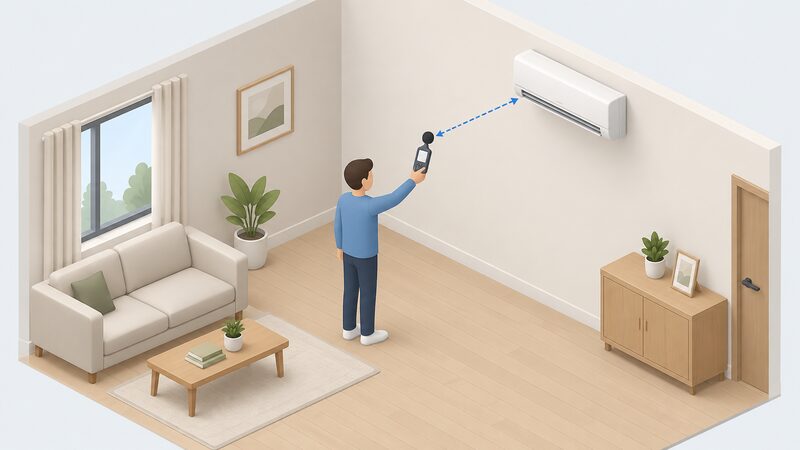
The indoor head is the part a household lives with, and the published figures are low. Fujitsu General lists its AGEG09KVCA floor console at 22 dB(A) on the quiet setting and 35 dB(A) on the middle setting1. Its AUXG09KVLA cassette is listed at 31 dB(A) on middle and 33 dB(A) on high2. Its ABEG22KRTA ceiling unit is listed at 31 dB(A) on the quiet setting3. Hitachi states that its wall-mounted units come equipped with a silent mode which means they can run as quietly as 19 dB12.
Those figures are sound pressure levels at the unit, and they are achieved by reducing the airflow rate. A quiet setting moves less air, so it cools the room more slowly. The trade-off is inherent: the same fan that makes the noise is the fan that distributes the cooled air.
Not every noise from an indoor unit is the fan. Hitachi's guidance on unusual sounds sets out what each one tends to indicate12:
- Whistling: a filter full of dust and debris restricting airflow, so air struggles to pass through it.
- Bubbling: usually linked to a refrigerant leak or water inside the system, or a clogged condensate drain line.
- Hissing: a refrigerant leak or air escaping from a damaged duct.
- Clicking: a thermostat malfunctioning, a fan blade becoming loose, or detritus caught in the vent.
- Clanking: something loose, detached or out of balance, such as the blower fan or fan blades.
- Chirping: dry bearings, friction between internal parts without correct lubrication, or a belt needing replacement.
- Popping: low refrigerant levels, ice forming inside the unit, or a malfunctioning thermostat.
Outdoor units have their own vocabulary. Grinding suggests trouble with the motor or other internal parts that may be loose or worn out; rattling suggests loose parts or debris caught in the unit; banging suggests a loose or broken part such as a compressor or fan; chirping points to friction between components12.
For a household's independence, the indoor unit is the part that runs on mains electricity and nothing else. It has no fuel supply, no flue and no dependence on a network beyond the grid and the manufacturer's warranty and spares. The dependence it does create is on the installer who commissioned it and, for refrigerant work, on a certified engineer.
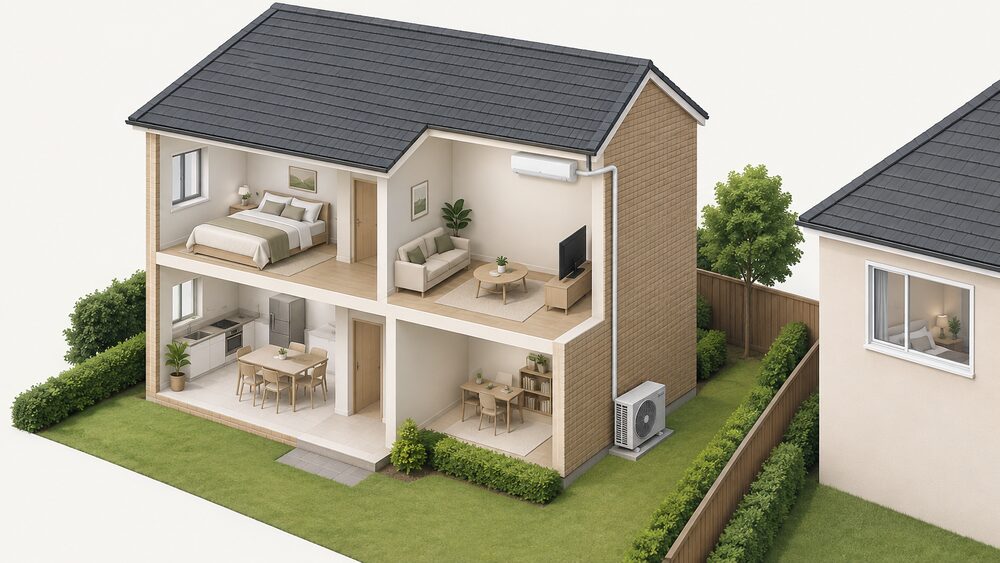
Outdoor unit noise: 45 to 55 dB at one metre, and what that means for neighbours
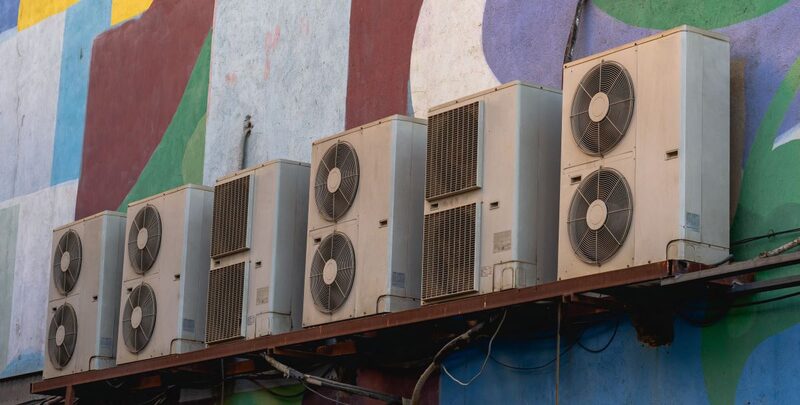
The outdoor unit is where air conditioning noise becomes a planning matter rather than a comfort matter. Fujitsu General lists its AUXG09KVLA outdoor section at 46 dB(A) in cooling2, and its ABEG22KRTA ceiling system outdoor section at 51 dB(A) in cooling3. Those are sound pressure figures at the unit, and they are the numbers a neighbour will hear at some distance through a wall, a fence or a window.
The benchmark that UK planning practice uses for outdoor plant is 42 dB. Cotswold District Council states that an air source heat pump cannot exceed 42dB at a distance of 1 metre from the centre of a neighbour's habitable room window, known as the assessment point13. Energy Saving Trust puts it in the same terms: a heat pump cannot normally be installed unless the noise level is 42dB or less when stood one metre from a neighbouring window8. Nesta describes current noise regulations as restricting heat pump noise to a maximum of 42dB within 1 metre of a neighbour's windows9.
The Microgeneration Certification Scheme approach uses a 42 decibel target external noise threshold, measured one metre from a neighbouring habitable room window14. Current noise regulations restrict heat pump noise to a maximum of 42dB within one metre of a neighbour's windows15. Modern outdoor units are very quiet, typically around 45 to 55 decibels at one metre distance16.
Distance does most of the work. A Scottish Government consultation on permitted development rights gives a worked example for a different technology: for a turbine with a sound power level of 85 decibels, reducing the separation distance from 100m to 16.5m would increase the noise for the receiver from 34dB to around 50dB16. The principle carries across: halving the distance to a source raises the level at the listener.
For a household, the outdoor unit is the point of dependence on a neighbour's tolerance and, in some cases, on planning consent. It is also the point where the system stops being self-contained. The unit needs an external wall, a clear air path and a position that does not put its noise into someone else's bedroom.
Portable air conditioners: the noisiest type, and why
Portable air conditioners are the loudest option in ordinary domestic use, and the reason is structural rather than a matter of build quality. The compressor and the condenser fan sit inside the room being cooled, so the household hears the machinery directly. The hot air they produce has to be pushed out through a duct, which adds fan load and, in a single-duct design, pulls cooled air out of the room at the same time.
Maker guidance is blunt about the trade-off. Fixed air conditioning is described as quiet, with better performance than portable units17. Portable air conditioning is described as an auxiliary device with limited cooling capacity that is noisier than a fixed unit17. That is the manufacturer's own comparison of the two categories, not a third-party judgement.
The electrical load explains part of the noise. A typical portable air conditioner is given as drawing 1,000 to 1,500W18, with a wider published range of 900 to 2000W, where the higher the BTUs the higher the power in watts19. The same source lists a portable air conditioner at up to 2000 W and up to 9.3 A19. A larger compressor moving more refrigerant makes more noise, and a portable unit has no acoustic enclosure beyond its own casing.
Some manufacturers address it directly. The De'Longhi Pinguino PAC EX93 Extreme is described as being designed for up to 70% less noise20. That is a maker's claim about its own product rather than a measured figure, and it does not state the baseline it is measured against.
The independence picture for a portable unit is mixed. It needs no installer, no planning consent in most cases and no fixed connection, so it can be bought, moved and removed by the household. Against that, it depends entirely on a mains socket, it is the least efficient way to move heat out of a room, and its noise is the price of having the machinery indoors.
Noise compared: Meaco's quietest portables at 45 to 54 dB
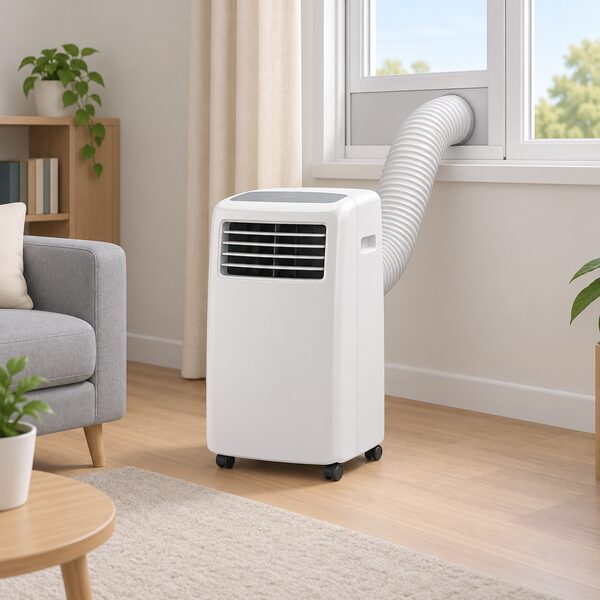
Meaco publishes noise figures for its portable range, and the two models sit in different bands. The Meaco Cirro 12000 BTU Super Quiet Smart Portable Air Conditioner & Heater is listed at 45 dB to 51 dB, with Super Quiet mode operating at just 45dB4. The MeacoCool MC Series Pro 9000 BTU Portable Air Conditioner is listed at 52 dB to 54 dB, and Meaco states that in low fan speed the new and reduced noise level of just 52 dB makes this an easy portable air conditioner to live with5.
| Model | Cooling capacity | Noise level | Price | Availability |
|---|---|---|---|---|
| Meaco Cirro 12000 BTU | 12000 BTU | 45 dB to 51 dB, Super Quiet mode 45 dB4 | £539.994 | Sold out, back in stock October 20264 |
| MeacoCool MC Series Pro 9000 BTU | 9000 BTU | 52 dB to 54 dB, low fan 52 dB5 | £389.995 | Sold out5 |
Both are listed as A rated for energy, and both use R290 refrigerant: 200g in the Cirro and 260g in the MC Series Pro4. The Cirro has a heating capacity of 10000 BTU and modes covering Cool, Fan, Dry, Sleep and Heat, while the MC Series Pro has no heating capacity and modes covering Cool, Fan, Dry and Sleep4. The Cirro is listed with a cooling power consumption of 1350 watts and a running cost of 35p per hour for cooling and 29p per hour for heating; the MC Series Pro is listed at 1005 watts and 25p per hour based on 24.67p per kWh4.
The Cirro is the quieter of the two on published figures, and it is also the larger and more expensive unit. It is not an inverter model, which the specification states plainly4. Its airflow maximum is 400m³ per hour against 310 m³ per hour for the MC Series Pro, and its stated room size is 20 to 30 m² against 16 to 26 m²4.
Warranty terms are the same across the Meaco portable range: a two-year parts and labour warranty, with the option to extend to a total of five years4. That is a maker's warranty on a maker's own product, and it is the main ongoing dependence a buyer of a portable unit takes on, alongside the app and voice control features, which the Cirro and the MC Series Pro both offer as optional4.
Sleep mode and quiet modes: how much difference they make
Quiet modes work by reducing the airflow rate, and the published reductions are modest but real. Daikin's Multi+ indoor units have a quiet operation mode which reduces the sound pressure by reducing the airflow rate, and the outdoor units have a night quiet mode setting to reduce the sound pressure during the night21. The same two features appear across the Class 68 and Class 90 ranges21.
A Welsh Government study of air source heat pump noise gives a measured figure for the equivalent function: for the silent mode, the sound power level is reduced by 5 dB10. Five decibels is a noticeable change in a quiet room, though it is not the difference between audible and inaudible.
Hitachi states that its wall-mounted units come equipped with silent mode which means they can run as quietly as 19dB12. That is the lowest indoor figure in the published material here, and it is a maker's claim for its own range.
The limits of quiet mode are worth stating. Reducing the airflow rate reduces the cooling delivered at the same time, so a unit in quiet mode takes longer to bring a room down to temperature. On a hot evening the household faces a choice between speed and silence, and no setting removes that. Night quiet mode on an outdoor unit has the same character: it lowers the sound pressure overnight, when the unit is also working against a smaller temperature difference.
For independence, quiet modes change nothing structural. They are firmware settings on a unit that still draws from the grid and still depends on the manufacturer for spares and, where an app is used, on a cloud service and a working home network.
Choosing a quieter unit: what the specification tells you
The specification sheet is where a household can compare noise before buying, provided the figures are read correctly. The first check is whether a number is a sound power level or a sound pressure level, and at what distance. BS EN 12102: 2008 is the standard that governs the measurement of airborne noise and the determination of sound power level for this equipment11, so a sound power figure is the one that can be compared across products without knowing the installation.
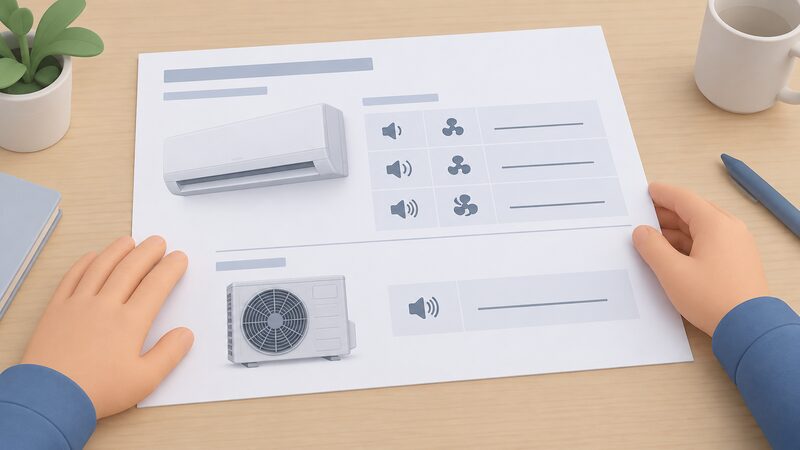
The second check is the fan speed the figure refers to. Fujitsu General publishes separate figures for quiet, middle and high on the same unit: 22 dB(A), 35 dB(A) and higher on the AGEG09KVCA, and 31 dB(A) on middle and 33 dB(A) on high for the AUXG09KVLA1. A single headline number without a stated fan speed tells the reader very little.
The third check is the outdoor unit, which is often listed separately from the indoor head and carries the figure that matters for neighbours. The AUXG09KVLA outdoor section is listed at 46 dB(A) in cooling2; the ABEG22KRTA outdoor section at 51 dB(A)3.
Efficiency and noise are related but not the same. Approved Document L sets a minimum seasonal energy efficiency ratio of 4.0 for an air conditioner working in cooling mode in a comfort cooling system24. Separately, some manufacturers such as Daikin publish air-conditioning unit specifications which state a seasonal COP of 5.225. A more efficient unit often runs at a lower speed for the same cooling output, which tends to make it quieter in use, but the datasheet noise figure is the direct measure.
Daikin's approach to reducing noise on its heat pump range is described as including a double injection compressor and a single fan, even on large capacity units, which help to reduce noise26. That is a design description from an independent news item about a Quiet Mark award, not a measured level.
Placement and ducting: reducing noise without buying a new unit
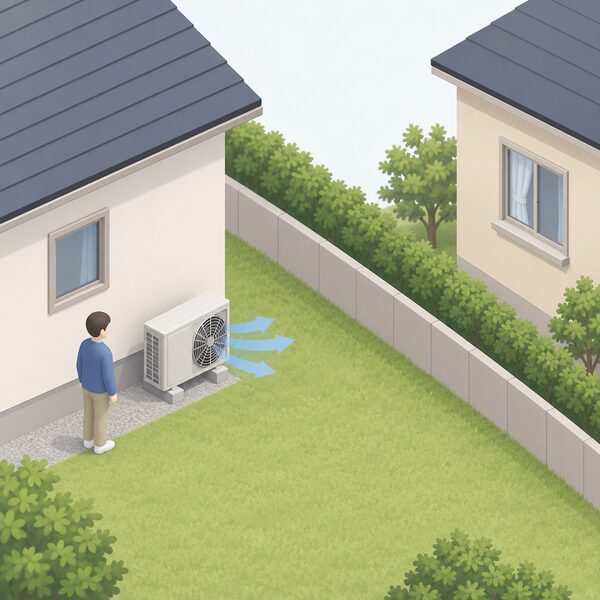
Placement is the cheapest noise control available, and it applies to both the outdoor unit and the portable. For an outdoor unit, the governing constraint is the 42 dB level at the neighbour's habitable room window8. Moving the unit further from that window, or turning it so the fan discharges away from it, reduces the level at the assessment point without changing the machine.
Acoustic treatment of the wall behind a unit has a small measured effect. A Welsh Government study gives a maximum of 2 dB(A) noise reduction if the heat pump is against a wall with acoustic absorbing material applied10. Two decibels is a marginal improvement, and it is worth knowing before spending money on it.
For a portable unit, the duct is the noise path as well as the heat path. The Meaco Cirro and the MeacoCool MC Series Pro both use a 15 cm duct of 1.8 m4. A longer or kinked duct increases fan load and noise, and the window kit is what allows the duct to be sealed into the opening rather than left hanging out of an open window. The Cirro ships with a standard window kit designed for sash windows and a flexible window kit that can be used with all window types; the standard kit's plates combine to 170 cm, and the flexible kit fits widths up to 39 cm and lengths up to 4 m4.
Building fabric does the rest. Mineral wool absorbs sound energy and improves the acoustic performance of walls, floors and roofs, restricting noise transfer within and between buildings and to and from the external environment27. The mechanism is friction between the air particles and the material's narrow airways, which dissipates sound energy as heat28. Separating walls built with mineral wool are described as absorbing sound and improving acoustic performance while providing thermal separation between adjoining properties29. External wall insulation can absorb sound waves and reduce the amount of noise entering a building, which is described as especially beneficial for homes near busy roads or train tracks30, though installation involves drilling, attaching insulation boards and pebble-dashing, so there will be some noise at those times31.
Windows are the other route. Trickle ventilators provide ventilation without the need to open windows, reducing noise levels as a consequence, and acoustic options are available in noisier locations32. Secondary glazing does not require any planning permission33. Natural ventilation has few moving parts, which also reduces the need for maintenance34.
The independence picture here is straightforward. Placement, ducting and fabric measures reduce noise without adding a fuel supply or a network dependency. They also reduce the household's exposure to the one thing an air conditioner cannot control: whether the neighbour objects.
Sources34 cited
- AGEG09KVCA floor console split, Fujitsu General, 2026
- AUXG09KVLA cassette split, Fujitsu General, 2026
- ABEG22KRTA ceiling split, Fujitsu General, 2026
- Meaco Cirro 12000 BTU Super Quiet Smart Portable Air Conditioner & Heater, Meaco, 2026
- MeacoCool MC Series Pro 9000 BTU Portable Air Conditioner, Meaco, 2026
- Jargon buster: noise levels, Mineral Wool Insulation Manufacturers Association, 2026
- Heat pumps vs boilers, Which?, 2025
- Heat pump fact check, Energy Saving Trust, 2026
- Planning is holding back heat pumps: here's how to fix it, Nesta, 2024
- Air source heat pump noise and permitted development rights in Wales: phase 1 report, Welsh Government, 2024
- Low carbon equipment and building regulations: ground source and water source heat pumps, Scottish Government, 2010
- AC noises: why does my air conditioner make weird sounds, Hitachi Air Conditioning, 2026
- Permitted development for air source heat pumps, Cotswold District Council, 2026
- Permitted development rights: impact assessments, Scottish Government, 2026
- Four realities for installing a heat pump in a flat, Nesta, 2026
- Scottish Government review of permitted development rights phase 3: analysis of responses, Scottish Government, 2024
- Home air conditioning comfort guide, Netatmo, 2026
- Summer energy tips, National Energy Action, 2026
- Ratings of electrical appliances, Electrical Safety First, 2026
- De'Longhi Pinguino PAC EX93 Extreme Portable Air Conditioner, Quiet Mark, 2026
- Daikin 4 port multi air conditioner 5MWXM68A9, Quiet Mark, 2026
- Daikin 5 port Class 90 multi air conditioner 5MWXM90A9, Quiet Mark, 2026
- Daikin 4 port multi air conditioner 4MWXM52A9, Quiet Mark, 2026
- Approved Document L: conservation of fuel and power, Volume 1: dwellings, HM Government, 2021
- UK solar homes power equivalent of five hours of daily air con use during heatwave, Ember, 2026
- Daikin heat pump gains the Quiet Mark, Quiet Mark, 2022
- The 4 benefits of mineral wool, Mineral Wool Insulation Manufacturers Association, 2026
- About mineral wool, Mineral Wool Insulation Manufacturers Association, 2026
- Separating wall insulation, Mineral Wool Insulation Manufacturers Association, 2026
- Benefits of external wall insulation, Solid Wall Insulation Guarantee Agency, 2026
- External wall insulation, Plymouth Energy Community, 2026
- Ventilation and trickle vents, Glass and Glazing Federation, 2026
- What is secondary glazing?, Glass and Glazing Federation, 2023
- Ventilation, Building Engineering Services Association, 2026
 How Noisy Is a Heat PumpHow loud a heat pump actually sounds when it is running, whether it will annoy your neighbours, and what the rules say about how close it can be to their windows.
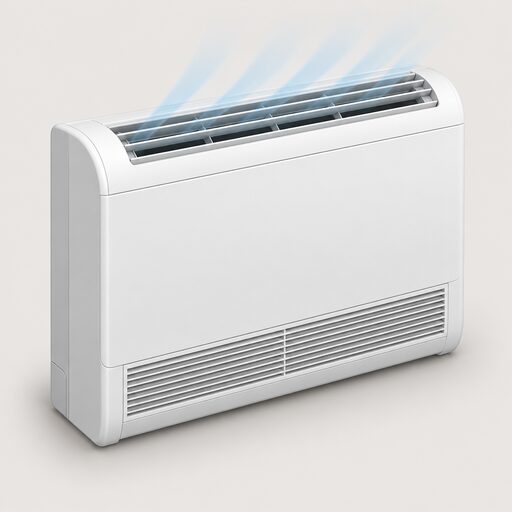 Split Air ConditioningA split air conditioning system cools or heats one room using an indoor unit and an outdoor unit linked by pipes.
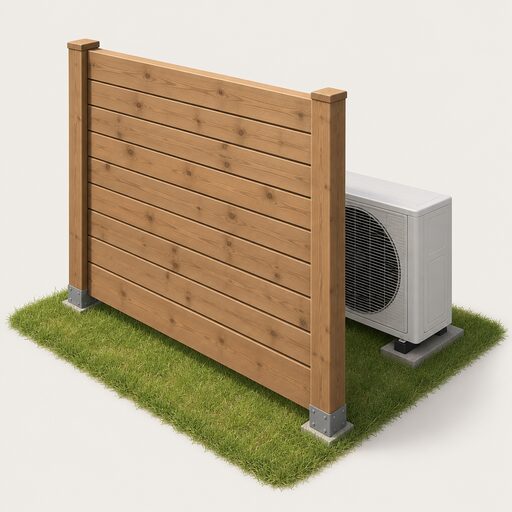 MCS 020 Noise AssessmentWill your air source heat pump be too noisy for next door?
 Air Conditioning SizingHow big an air conditioner does a room need?
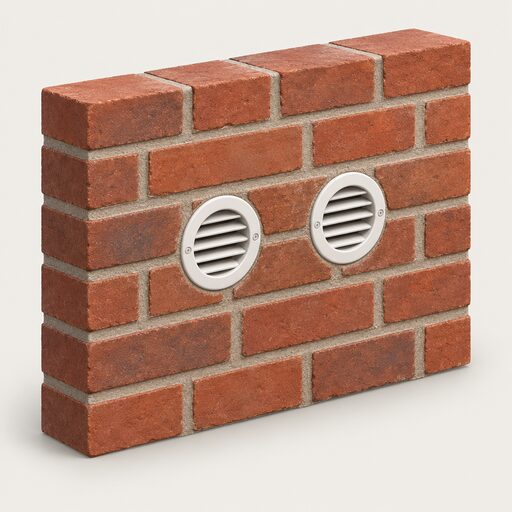 Without an Outdoor UnitFlats and listed homes often cannot have a box on the outside wall, so how does air conditioning work with everything indoors?
 Air Conditioning CostPublished UK equipment prices and the parts of an installed price for portable, single split, multi-split and whole-house air conditioning.