
In this answer
Short answer
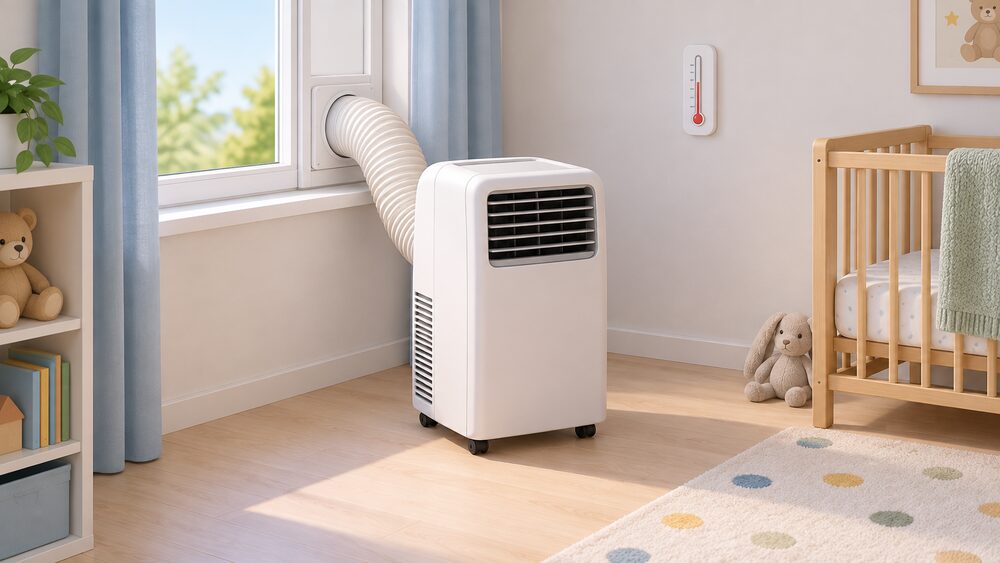
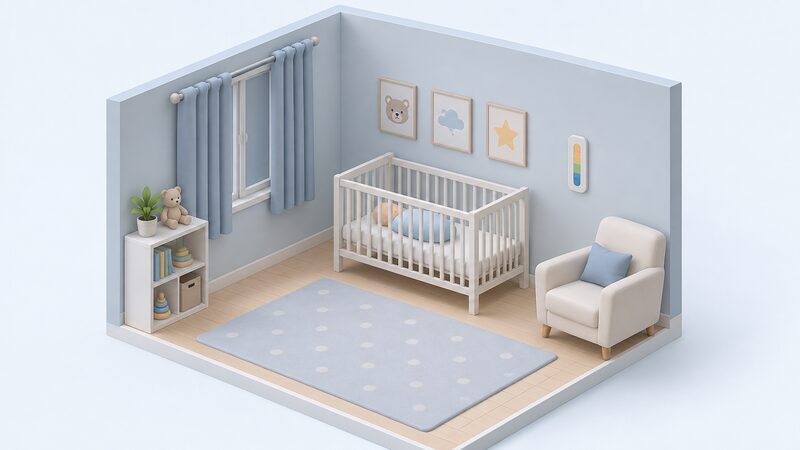
A portable air conditioner can hold a nursery at a safe sleeping temperature, but only if it is vented properly, sized for a small room and quiet enough not to disturb the baby. The target band is narrow: babies and young children should sleep in rooms at 16C to 20C, the range given to reduce the risk of sudden infant death syndrome1. A separate recommendation puts the night time bedroom at 18C, noting some people are more comfortable slightly cooler or warmer2. Babies are particularly vulnerable because they cannot regulate their temperature as well as adults1.
The case for cooling in a nursery rests on how babies regulate heat. Overheating risk in UK homes is not a fringe concern: the Climate Change Committee commissioned Arup to appraise the current and future risks posed by summertime overheating to the UK housing stock at scale, including what factors influence risk, how homes can be adapted or upgraded to mitigate the impacts and how much that costs3. CIBSE TM59 (2026) introduces a new bedroom overheating criterion, which matters because bedrooms are where the risk sits at night4.
What a portable unit does for independence is modest but real: it needs no outdoor unit, no refrigerant engineer and no landlord's consent for a fixed installation, and it can be moved between rooms. What remains is dependence on the electricity supply, on a window or wall for exhaust, and on the manufacturer for parts and warranty. It is an appliance, not a building upgrade.
What overheating in bedrooms means for babies, and why the risk is growing
The health case is straightforward. Babies cannot regulate their temperature as well as adults, which is why the guidance for babies and young children sets a sleeping range of 16C to 20C to reduce the risk of sudden infant death syndrome1. The general night time bedroom recommendation of 18C sits inside the baby range, so a nursery held at 18C satisfies both2.
The risk is growing because the housing stock was not designed for it. The Climate Change Committee commissioned Arup to appraise current and future summertime overheating risk across the UK housing stock at scale, covering the factors that influence risk, the adaptation and upgrade options, and their costs3. Assessment methodology has moved too: CIBSE TM59 (2026) sets out a new bedroom overheating criterion, which shifts attention from living rooms to the rooms people sleep in4.
For a household, this reframes cooling from a comfort purchase to a seasonal safety measure in the smallest room in the house. It also explains why the answer is not simply "buy a unit": the same evidence base that identifies the risk also identifies shading, ventilation and building fabric as the first line of defence, with mechanical cooling as the supplement. A portable unit addresses the symptom in one room on the hottest nights. It does not change the fabric of the home, and it does nothing about the rest of the house.
Noise: what Sleep Mode actually does at night
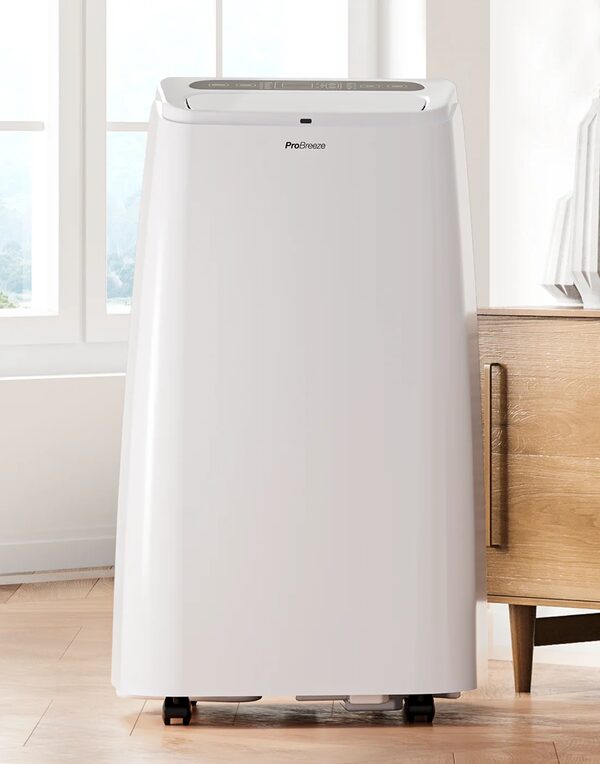
Noise is the practical objection to a portable unit in a nursery, and the figures are not flattering. Portable air conditioners are described as often operating at higher noise levels of up to 65 dB5. One maker's 12000 BTU portable unit states Super Quiet mode operating at just 45dB, which is the quietest portable figure here6. A retailer states that in Sleep Mode the fan operates at a low, consistent speed rather than ramping up and down, so the sound is steady rather than cycling8.
Fixed systems sit in a different band. Their indoor units have a quiet operation mode that reduces sound pressure by reducing the airflow rate, and their outdoor units have a night quiet mode setting to reduce sound pressure during the night9. That is a design difference, not a marketing one: the compressor sits outside the bedroom wall rather than on the nursery floor. Monobloc reverse cycle units are described as rather noisy because of their compact size and integrated motor10.
The trade-off for a nursery is therefore between a unit that can be installed without consent and one that is quieter but fixed. A portable unit's noise is continuous through the night, which is exactly when the room needs to stay in band. Where a household cannot accept that, the alternatives are a fixed system, or cooling the room before sleep and letting it drift, accepting that the temperature will rise.
Placement, venting and the drain hose: setting up in a small room
A portable unit is placed on the ground with no lengthy installation process required, and can be moved from one room to another11. Domestic portable units need no permanent installation: position the unit near a window, connect the exhaust hose and start cooling12. Pro Breeze states its portable air conditioners come with a window kit for quick setup and no permanent installation is needed13.
Venting is the part that decides whether the unit works at all. Portable units need to be properly vented to the outside using a special fitting for the window; if the vent is just put through an open window, heat is let back in14. That is the answer to the closed-window question: the hose still has to go outside, through a sealed fitting rather than a gap. Habitable rooms are expected to be ventilated directly to the open air by opening a window, so a permanently sealed nursery window is not the intent of the guidance either15.
Drainage is simpler than many buyers expect. One retailer states its AirFlex 15 is self-evaporating in cooling mode and needs a drain hose only when the tank is full, signalled by error code E4, or in dehumidifier mode8. Some portable air conditioners also double as dehumidifiers, cooling the room while helping reduce humidity and tackle damp13.
Placement inside the room matters for maintenance access: the unit needs to be easily accessible for cleaning the filters and any other maintenance16. In a nursery, that means not wedged behind a cot or a wardrobe.
Temperature control and humidity: what a portable unit can and cannot hold steady
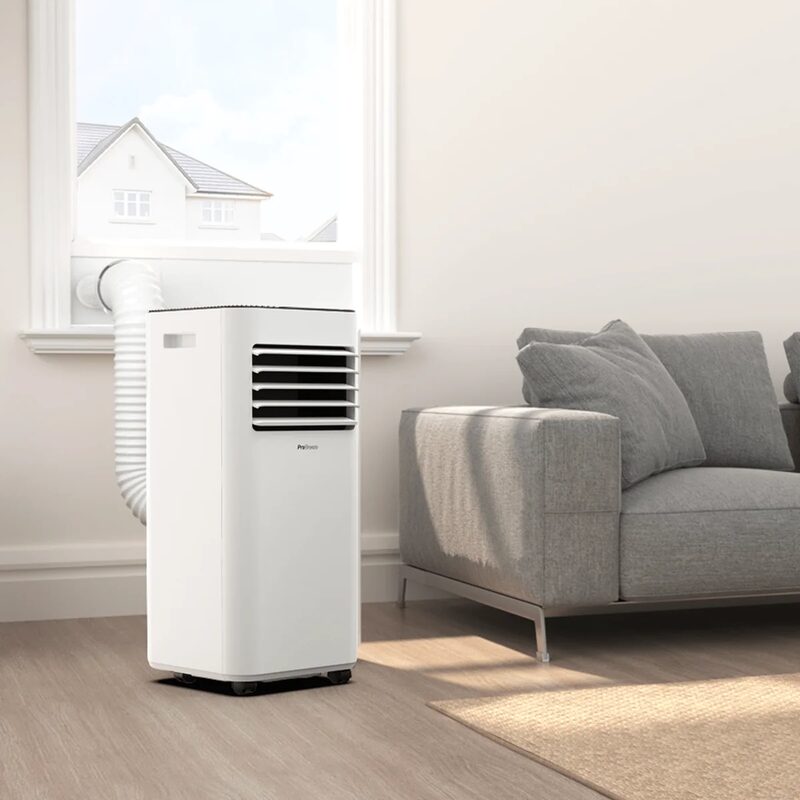
A portable unit is described by one maker as an auxiliary device with limited cooling capacity, and noisier than a fixed unit17. Sizing guidance places portable units in temporary set-ups or rooms under 10 m², noting that for longer-term use a fixed system is the better fit5. Independent guidance suggests aiming for 18,000 BTUs for the best results, and portable units typically draw 900 to 2000 W, with higher BTUs meaning higher power18.
The physical limit is that the main unit sits inside the room and vents through a hose, so it may not feel as quiet or efficient as a fixed system19. A single unit cannot cool multiple rooms at once, though wheeled models can be moved between rooms13. Domestic portable units are described as ideal for bedrooms, lounges, home offices and rental properties where fixed systems may not be possible12.
On humidity, a portable unit with a dehumidifying function can reduce damp while cooling13. What it cannot do is hold a precise band the way a fixed system with thermostatic room controls can. Approved Document L Volume 1 notes that thermostatic room controls may not be technically feasible in dwellings with low heat demand, for example less than 10W/m2, or dwellings with buffer zones of high thermal mass20. That is a heating-side rule, but it illustrates the principle: fine control depends on the system, not on the thermostat alone.
For a nursery, the practical expectation is that a portable unit will pull a small room down and hold it roughly, with the temperature drifting when the compressor cycles. A room comfort sensor measuring temperature, humidity and CO2 levels gives a household the readings to judge that drift rather than guess at it21.
| What a portable unit does | What it does not do |
|---|---|
| Cools one room, typically under 10 m²5 | Cool multiple rooms at once13 |
| Vents heat outside through a hose14 | Work with the window left open14 |
| Reduces humidity on dehumidifier models13 | Match a fixed system's quietness or efficiency19 |
| Moves between rooms on wheels13 | Hold a precise band like thermostatic controls20 |
Refurbished and pre-order units: what to check before buying for a nursery
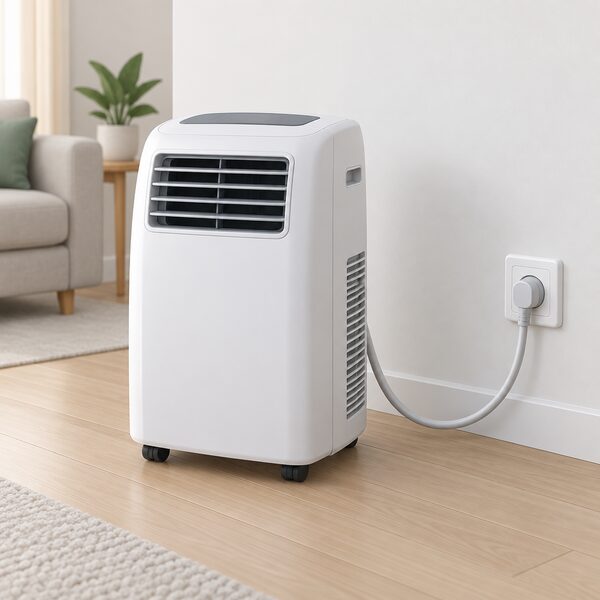
Electrical load is the first check. A portable air conditioner draws up to 9.3 A and up to 2000 W, which is a heavy load for a bedroom circuit shared with other appliances7. That figure applies to the appliance class, not to one model, so it is the ceiling to plan around.
Refurbished stock is sold as such. One seller confirmed a listed unit's condition as refurbished in response to a customer question8. There is no source here that certifies refurbished cooling equipment for nursery use, so the condition of the unit, its plug, its cable and the circuit it will run on is what a buyer can actually establish. A unit with a failure history needs care on the refrigerant side too: Panasonic's guidance on renewal systems states that if the compressor of the existing air conditioner has a failure history, new piping should be installed or the old piping washed through thoroughly before reuse22.
Two further checks apply to any cooling purchase. Traditional fixed air conditioning brings issues of cost, available space, installation disruption, aesthetics and air distribution performance that all need to be considered23. And where a unit is being fitted into an existing structure, the existing structure including foundations should be assessed by a suitably qualified professional such as a structural engineer to establish suitability for additional loadings24. That second point is about building work rather than a plug-in unit, but it is the standard applied when something new is added to a home.
Alternatives first: shading, ventilation and reducing overheating before plugging anything in
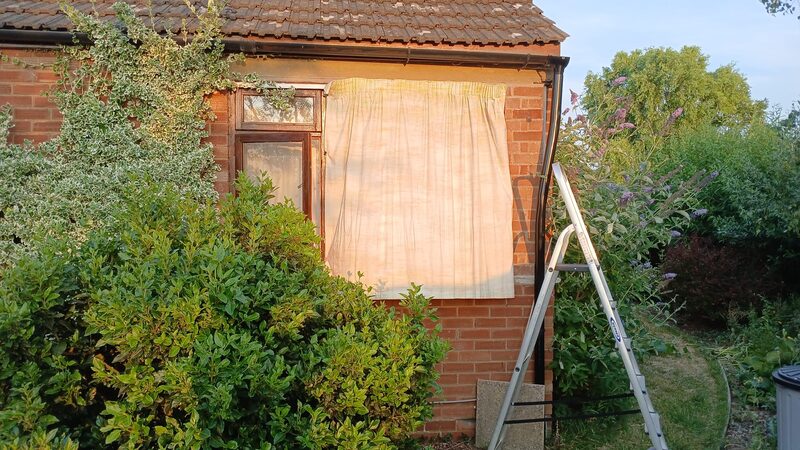
The evidence base points to building fabric and shading before mechanical cooling. Combining external shading with night-time ventilation can eliminate overheating risk in some homes, reducing indoor temperatures by 11-18°C according to Warm Homes Plan evidence25. That is a larger effect than any single portable unit achieves, and it costs nothing to run.
Design guidance is blunt about one cause: to reduce the risk of overheating, high daylight factors from oversized windows should be avoided26. Where the glazing already exists, external shading is the intervention. On ventilation, Passivhaus buildings use mechanical ventilation with a heat recovery system attached, which is a whole-home approach rather than a room appliance27.
Cheaper measures have their place. Air coolers use water to slightly cool air and are more effective than fans in dry conditions28. On the appliance side, an air fryer or microwave instead of an oven keeps cooking heat out of the kitchen29. Topping up wall, floor and loft insulation before installing a heat pump will help reduce its running costs, which is the fabric-first logic applied to heating and applies equally to keeping heat out30.
For a household weighing independence, these measures change the building rather than adding an appliance. They reduce the number of nights a unit is needed at all, and they work in every room rather than one. A portable air conditioner remains the fallback for the hottest nights in the smallest room, and it depends on the grid, a window and a manufacturer for as long as it is used.
Sources30 cited
- Tips for babies in a heatwave, National Energy Action, 2026-08-11
- Cold homes and health, Centre for Sustainable Energy, 2026-08
- Addressing overheating risk in existing UK homes, Climate Change Committee, 2026-09-19
- TM59 Overheating risk in dwellings, CIBSE, 2026-07
- Air-to-air heat pumps for small rooms, Daikin UK, 2026-09-17
- Meaco Cirro 12000 BTU portable air conditioner, Meaco, 2026-09-23
- Ratings of electrical appliances, Electrical Safety First, 2026-09-19
- electriQ AirFlex 15 air conditioner, electriQ, 2026-08-12
- Daikin 4 port multi air conditioner, Quiet Mark, 2026-09-17
- Reverse cycle air conditioner comfort guide, Netatmo, 2026-09-20
- How does air conditioning work, Netatmo, 2026-09-20
- Domestic portable air conditioners, CoolEasy, 2026-09-23
- Pro Breeze air conditioners, Pro Breeze, 2026-09-23
- How to keep your home cool in hot weather, Centre for Sustainable Energy, 2026-07
- Checking your home is fit to live in, nidirect, 2026-09-17
- How to choose your air conditioner location, Daikin UK, 2026-09-20
- Home air conditioning, Netatmo, 2026-09-20
- Is air conditioning worth it in the UK, Uswitch, 2026-07-14
- Air conditioning size guide, CoolEasy, 2026-09-23
- Building Regulations Approved Document L Volume 1, Welsh Government, 2026-04
- Passive House smart home, Loxone, 2026-02-09
- Reusing R22 piping, Panasonic, 2026-09-17
- HVAC choices for the home, CIPHE, 2024-03-12
- Replacement conservatory roofs, Building Control Northern Ireland, 2026-04
- Are London's homes ready for a heatwave, London Assembly, 2026-06
- AECB daylight guidance, AECB, 2025-10-15
- Passivhaus: what you need to know, Energy Saving Trust, 2026-02-16
- Summer energy tips, National Energy Action, 2026-08-13
- Cold weather energy saving tips, Energy Saving Trust, 2025-09-22
- Is now a good time to get a heat pump, Energy Saving Trust, 2025-12-12
 Air Conditioning SizingHow big an air conditioner does a room need?
 Air Conditioning NoiseHow loud will an air conditioner be inside your home, and how much noise will the outdoor unit make for you and your neighbours?
 Ventilation and TemperatureWhere can you put a home battery so it stays warm enough in winter and cool enough in summer?
 Thermostat and Room TemperaturesWhat temperature should a thermostat be set to, and does it differ from room to room?
 Running CostsA portable air conditioner costs roughly twenty to forty pence for every hour it runs, while a fixed unit uses far less electricity for the same cooling.
 Types of Air ConditioningPortable, wall-mounted, multi-room or ducted: which air conditioning suits your home?