
In this answer
Short answer
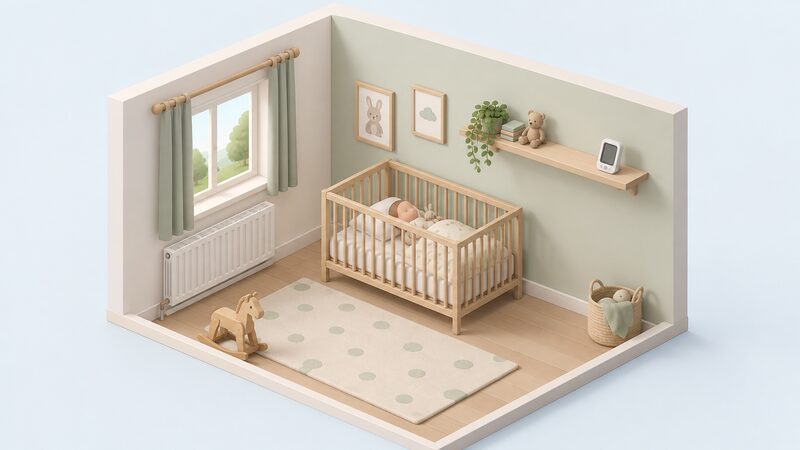
The safe room temperature for a baby is 16°C to 20°C. That is the range given for keeping a baby's room, and the same range is repeated specifically to reduce the risk of sudden infant death syndrome: babies should sleep in rooms heated 16C to 20C1. NHS guidance for households with a baby gives the same figure, between 16 and 20 degrees3.
That baby-specific range sits inside a wider healthy-home range that most UK energy bodies converge on: 18°C to 21°C4. The two are not in conflict. The baby range is narrower and lower at the bottom, and the general range is what applies to the rest of the house. Where a room is used by a baby, the 16°C to 20°C figure is the one that applies.
The reason the range matters more for a baby than for an adult is stated plainly: babies are particularly vulnerable because they cannot regulate their temperature as well as adults1. Overheating is the risk that gets less attention than cold, and guidance treats it as a health hazard rather than a question of comfort: where temperatures exceed 25°C, there is an increase in mortality and the incidence of strokes6. Excessively high temperatures can also cause accidental burns, especially in homes with children6.
Why overheating raises the risk of SIDS
The link between room temperature and sudden infant death syndrome is the reason the 16°C to 20°C figure exists at all. The guidance is explicit that babies should sleep in rooms heated to that range to reduce the risk2. The mechanism behind it is temperature regulation: babies cannot regulate their temperature as well as adults, which is what makes both ends of the range consequential1.
Overheating is not a marginal concern. Guidance on excess heat states that where temperatures exceed 25°C, there is an increase in mortality and the incidence of strokes9. That figure is for the general population rather than for babies specifically, but it establishes that sustained heat in a dwelling is a health hazard rather than a comfort issue. Excessively high temperatures can also cause accidental burns, especially in homes with children or elderly people10, and official advice has called for further research to understand when overheating occurs in existing homes, including ongoing monitoring of temperatures in the housing stock11.
The built environment makes this harder to manage than it sounds. Overheating in UK homes is a recognised policy problem: the Climate Change Committee has published on the risks to health, wellbeing and productivity from overheating in buildings10, and CIBSE publishes a design-stage methodology for assessing overheating risk in dwellings11. A consultation response on the Decent Homes Standard recommended reviewing the reliance on the Housing Health and Safety Rating System to limit overheating risk, and the option to strengthen the standard's requirements12. In other words, the regulatory framework that governs how warm homes get in summer is still being tightened.
For a household, the practical consequence is that a baby's room needs managing in both directions. Cold is the risk that winter advice addresses; heat is the risk that summer advice addresses, and it is the one where a room can drift out of range without anyone noticing, because a warm room does not feel like a hazard.
Checking and controlling the room: thermometers, heating and ventilation
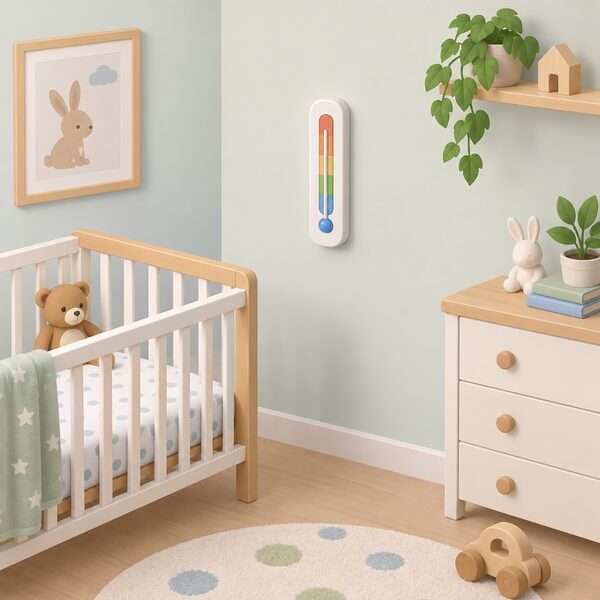
Knowing the temperature is the precondition for controlling it. Checking temperature by feeling the chest or the back of the neck is the recommended way to judge how a baby is coping1, and it catches a baby who is too warm even when the room reads correctly. It does not tell you what the room is doing, which is what a thermometer is for.
Placement matters. The best place to put a smart thermostat is in a place where the temperature is relatively consistent13, and the same logic applies to a baby's room thermometer: away from radiators, windows, direct sun and draughts, and at the height the baby sleeps. A room thermostat should be set to the lowest comfortable temperature, which for most people is between 18°C and 21°C14, and the same 18°C to 21°C setting is given for a main room thermostat15.
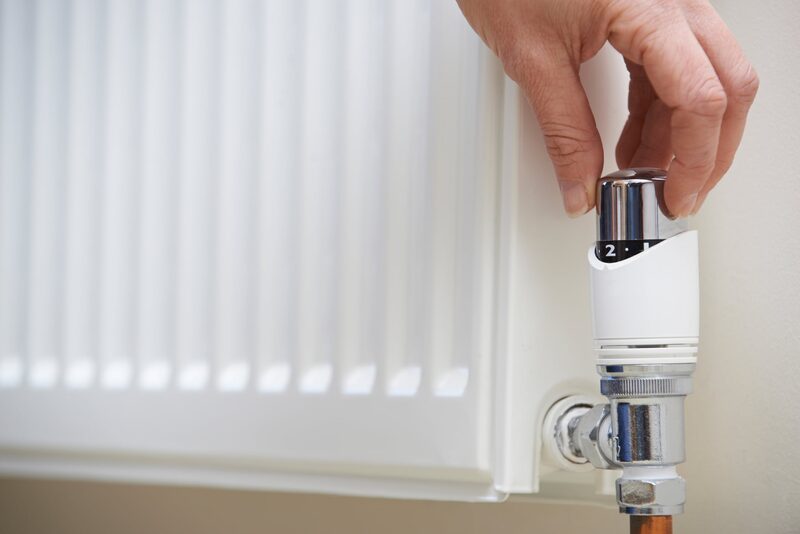
Heating controls are what make a room-by-room approach possible. The recommended set is a time-controlled programmer, at least one room thermostat, thermostatic radiator valves if there are radiators, and a cylinder thermostat if the system has a hot water cylinder16. Their function is to control when the heating operates and the temperature in each room16, which allows a baby's room to be held in range while unused rooms are set lower17.
Ventilation is the other half of control. Keeping temperatures in all rooms above 18°C when they are in use reduces condensation19, and the same leaflet sets a floor of at least 15°C to prevent condensation20. Those two figures do different jobs: 18°C is the comfort and condensation target for rooms in use, 15°C is the minimum to stop moisture problems taking hold.
Safe room temperature for a baby: 16 to 20°C
The headline range is repeated across independent sources with unusual consistency. Keeping room temperature between 16°C and 20°C is the formulation used in heatwave guidance for babies1, and the same range appears in the context of reducing SIDS risk2. NHS guidance for households with a baby gives between 16 and 20 degrees3.
The wider healthy-home range is 18°C to 21°C, and it appears in a long list of independent sources: a healthy and comfortable room temperature is between 18 and 21°C5, a safe room temperature is between 18 and 21°C4, a sensible room temperature is between 18 and 21°C22, and recommended temperatures for a healthy home are between 18°C and 21°C23. The same range is given for the room you spend most time in, to avoid potential health problems24, and as the ideal temperature for the home25.
| Guidance | Temperature | Applies to |
|---|---|---|
| Baby room range | 16°C to 20°C | Babies and young children, to reduce SIDS risk1 |
| NHS advice for households with a baby | 16 to 20 degrees | Households with a baby3 |
| Wider healthy-home range | 18°C to 21°C | General indoor comfort4 |
| Safe room temperature for most people | 18 to 20 degrees | Most people26 |
| Recommended night time bedroom | 18°C | Bedrooms at night6 |
| Bedroom design temperature | 18°C | Age Band A to J27 |
The ranges differ because they answer different questions. The 16°C to 20°C figure is a baby-specific safety range, set by the risk of SIDS at the top end and by the general cold-weather threshold at the bottom. The 18°C to 21°C figure is a general healthy-home range for adults, and it is the one that applies to living rooms and the rest of the house. A household with a baby is managing both at once: the baby's room held in the narrower band, the rest of the home in the wider one.
For energy independence, this is a case where the household's own control is the whole answer. A room thermometer and working TRVs let a household hold one room in a tight band without heating the whole house to the same level, which is the difference between heating a home and heating a nursery.
Is 21 degrees too warm for a baby's room?
No, but it is at the top of the general range rather than in the middle of the baby range. The baby-specific figure is 16°C to 20°C1, and the wider healthy-home figure runs to 21°C4. A room at 21°C is therefore inside general guidance and one degree above the baby-specific ceiling.
The figure that matters more is what happens above the range. Rooms lived in most are put at 18°C to 21°C to keep occupants warm and avoid damp building up, and 21°C is the stated minimum for people with health concerns or who are vulnerable due to age6. So 21°C sits at the top of the range that guidance endorses rather than beyond it. The practical reading is that 21°C is not a danger for a baby, but it is warmer than the 16°C to 20°C band and is not where the room needs to sit if it can be brought down.
Where a household has health concerns or is vulnerable due to age, the recommended minimum is 21°C28, which shows how the same number can be a floor in one context and a ceiling in another. For a baby's room, the direction of travel is downward within the safe band.
Is 16 degrees too cold for a baby to sleep?
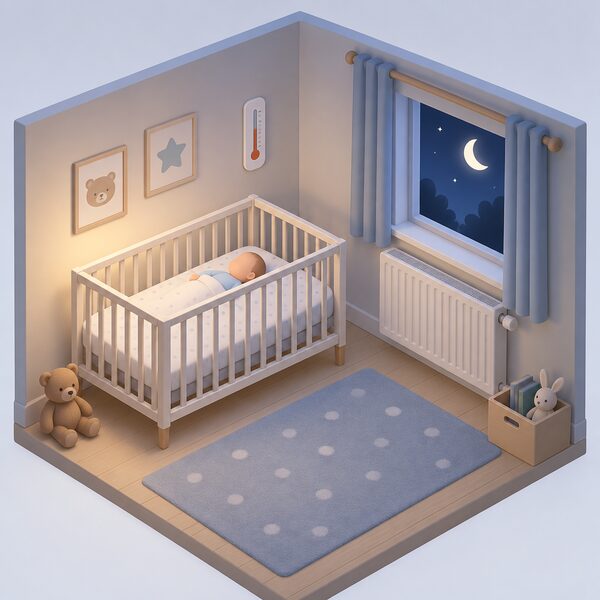
16°C is the bottom of the recommended baby range, so it is within guidance1. General bedroom guidance puts sleep at 16°C to 18°C, and notes this may be slightly higher for older adults17. The recommended night time bedroom temperature is 18°C, though some people may be more comfortable in a slightly cooler room6.
Below 16°C is where the thresholds change. NHS advice places the figure at not below 16°C for older people or those with impaired mobility29, and the World Health Organisation recommends a room temperature of 18°C for healthy individuals8. NHS advice is to keep the home at least 18°C during colder weather, especially if someone in the household is older or more vulnerable to the cold17.
For a baby's room, the working position is that 16°C is the floor of the safe band and 18°C is the target. A room that sits at 16°C is not outside guidance, but it has no margin, and any further fall takes it below the range.
Should a baby's room be heated overnight in winter?
Official winter guidance is to heat the home to a temperature of at least 18°C7. Overnight, people who are 65 and over or who have pre-existing health conditions may find bedroom temperatures of at least 18°C helpful7. For households with health issues, elderly people or young children, the advice is to heat occupied rooms to at least 20°C8.
That places a baby's room in the heated part of the home overnight rather than in the part that is allowed to fall away. The 16°C to 20°C baby range and the 18°C overnight figure overlap comfortably: holding a nursery at 18°C satisfies both.
There is a countervailing consideration. Turning a boiler's flow temperature down carries a stated risk that the house, or some rooms in it, might not get warm enough30, and if the house gets too cold it could be dangerous for older residents, people with health conditions and anyone living in a home that is already underheated30. A household managing a baby's room overnight is managing that trade-off directly.
What to do when the room can't be kept in range
Not every home can hold a room in a tight band, and the guidance anticipates that. Unused rooms can be set lower where appropriate17, and storage rooms with a floor area of not more than 4m² do not need to be maintained at the standard temperatures31. Rooms that are occupied, and especially a baby's room, are the ones that stay in range.
The floors below the comfort range are about fabric protection rather than comfort. Rooms should be kept warm enough, at least 5°C, to avoid pipes freezing or damp and mould developing8. Unused rooms can be set lower than occupied ones, and there is no need to maintain these temperatures in storage rooms with a floor area of not more than 4m²32. For renters with health concerns, who are elderly or who have small children, the advice is not to go below 18°C33.
In summer the problem inverts. Keeping blinds down and windows closed when the temperature outside is warmer than inside holds the cooler temperature in the home34. Ventilation is for the hours when outside air is genuinely cooler. The wider context is that UK homes overheat: the Climate Change Committee has documented the health risks10, and CIBSE's design-stage methodology exists because overheating is a predictable property of a dwelling rather than an accident of weather11.
Where a room cannot be kept in range, the honest position is that the household is managing a building problem, not a thermostat problem. A room that overheats in summer or will not hold heat in winter is a fabric and ventilation issue, and the controls can only work within what the building allows.
Clothing and bedding: matching layers to room temperature
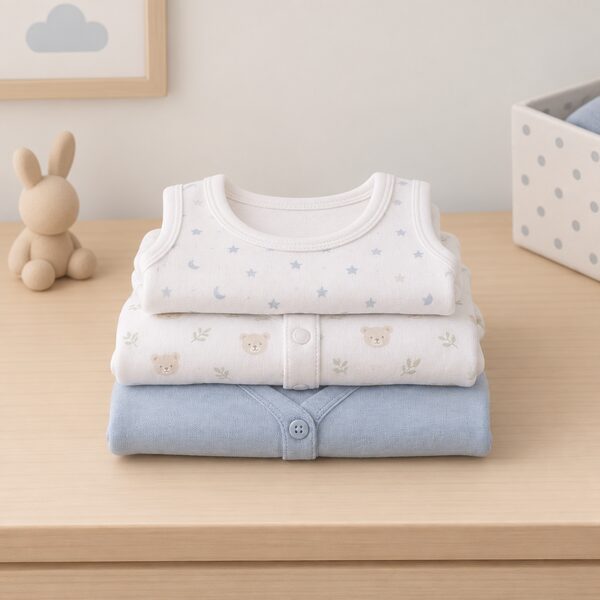
Clothing is the layer of control that sits between the room and the baby, and it is the one a household can adjust immediately. In hot weather the guidance is to dress babies in lightweight, breathable clothing1. More generally, a few light layers of clothing keep you warmer than one thick layer because they trap the warm air35.
At 18°C, which is the recommended night time bedroom temperature6, light layers rather than a single heavy layer match that principle. The check that goes with it is feeling the chest or the back of the neck1, which tells you whether the baby is too warm or too cool regardless of what the thermometer reads.
| Room temperature | What the guidance supports |
|---|---|
| 16°C to 18°C | Bottom of the baby range and the general sleep range1 |
| 18°C | Recommended night time bedroom temperature, and the bedroom design temperature for age bands A to J6 |
| 18°C to 21°C | Wider healthy-home range4 |
| 20°C | Occupied rooms for households with young children8 |
| 21°C | Bedroom design temperature from age band K onwards18 |
The independence point is straightforward. A room thermometer, working TRVs and a layered approach to bedding let a household hold a nursery in the safe band without heating the whole home to the same level. What remains outside the household's control is the building itself: a flat that overheats, a rented home with no TRVs, or a heating system that cannot be zoned. Those are the limits, and they are the reason the guidance gives a range rather than a single number.
Sources35 cited
- Tips for babies in a heatwave, National Energy Action, 2026-08-11
- Advice from the NHS, Electricity North West, 2026-09-19
- Cheap ways to stay warm this winter, Which?, 2026-01-29
- Understanding smart meters, National Energy Action, 2026-04-21
- Testing the air quality, temperature and humidity of your home, Centre for Sustainable Energy, 2026-08
- Cold homes and health, Centre for Sustainable Energy, 2026-08
- Keeping your home warm in winter, Met Office, 2026-09-20
- No cost and low cost energy saving advice, Low Carbon Hub, 2026-08-05
- Overheating guidance, BRE Group, 2026-09-17
- Risks to health, wellbeing and productivity from overheating in buildings, Climate Change Committee, 2026-09-19
- TM59 Overheating risk in dwellings: a design stage methodology, CIBSE, 2026-07
- A reformed Decent Homes Standard consultation response, CIBSE, 2026-09-17
- What are smart thermostats?, Uswitch, 2026-02-05
- Thermostats and heating controls, Energy Saving Trust, 2026-02-10
- Energy savings tips, British Gas Energy Trust, 2026-02-27
- Thermostats and heating controls, Home Energy Scotland, 2026-09-20
- Maintaining the ideal home temperature, Smart Energy GB, 2026-08-17
- Building Regulations Approved Document L Volume 1, Welsh Government, 2026-04
- Dealing with condensation and mould, National Energy Action, 2026-09-07
- Make home warmer, Home Energy Scotland, 2026-09-20
- Frequently asked questions about smart meters, National Energy Action, 2024-05-03
- Energy saving myths, Centre for Sustainable Energy, 2026-07
- Preparing for winter, National Energy Action, 2025-10-14
- Energy efficiency, Northern Gas Networks, 2026-06-25
- Energy saving tips, Scope, 2026-09-01
- Summer fuel poverty, National Energy Action, 2026-08-11
- Design conditions, MCS Certified, 2026-09-17
- Switching on your heating, Act on Energy, 2026
- Common heating mistakes and how to avoid them, Which?, 2026-01-16
- Should I turn my boiler's flow temperature down?, Energy Saving Trust, 2026-05-20
- Building standards technical handbook 2022: domestic, Scottish Government, 2022-06-01
- 10 top tips for homes to save on heating bills this Christmas, OFTEC, 2024-12-20
- Energy saving advice for renters, Centre for Sustainable Energy, 2026-08
- Keeping cool, Electricity North West, 2026-09-19
- Spread the warmth, Electricity North West, 2026-09-20
 Thermostat and Room TemperaturesWhat temperature should a thermostat be set to, and does it differ from room to room?
 Heatwaves and HealthWhich homes get dangerously hot in a heatwave, and which rooms?
 Air Conditioning SizingHow big an air conditioner does a room need?
 Ventilation and TemperatureWhere can you put a home battery so it stays warm enough in winter and cool enough in summer?
 Cold Homes and HealthCold homes cause real harm, especially to older people and anyone with a heart or lung condition.
 Flow TemperatureTurning down your boiler flow temperature can cut your gas bill, but how low can you go before the house feels cold?