In this guide
The short answer to what temperature a thermostat should be set to is between 18°C and 21°C. That band is repeated across UK guidance: Energy Saving Trust calls it the lowest comfortable temperature for most people1, British Gas Energy Trust gives the same range2, Cadent says the thermostat should be set between 18 and 21°C to keep occupants safe and well3, and Oftec frames 18°C to 21°C as the range that avoids potential health problems in the room used most4. Within that band, the setting is a comfort choice, not a technical one.
What the number buys is a switch position, not a rate of heating. A room thermostat turns the boiler on and off automatically when the room reaches the level chosen5. It does not make the boiler work harder, and a higher setting does not warm a room faster. Every degree above the comfortable minimum is paid for: turning the thermostat down from 22°C to 21°C is put at £120 a year in Great Britain and £80 in Northern Ireland1, and Energy Saving Trust estimates a one degree reduction saves about 10 per cent on heating bills6.
The rest of this page sets out the room-by-room figures, the setback and frost protection settings, where the thermostat belongs, how many zones a home needs, and how the thermostat relates to the boiler thermostat and the cylinder thermostat, which are separate controls doing separate jobs.
What the thermostat actually does
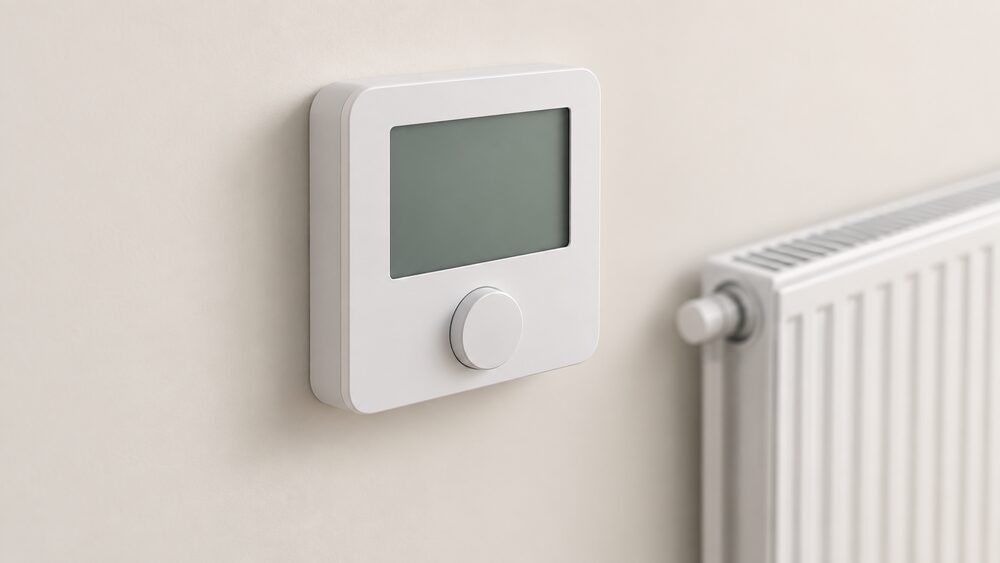
A room thermostat is a temperature-operated switch. It turns the boiler on and off automatically when the room temperature reaches the level chosen5. It senses air temperature in one place and calls for heat until that place reaches the set point, then stops calling. Nothing about the setting changes the speed at which the boiler delivers heat.
That is why the thermostat is only one of several controls, and why confusing them causes most of the trouble. The boiler thermostat changes the temperature of the water in the system9, and it controls the temperature of the water flowing through the heating system rather than the temperature inside rooms10. A cylinder thermostat stops the cylinder becoming hotter than it needs to be, and once the water reaches the set temperature the heat supply from the boiler is turned off1. A timer controls when heating or hot water turns on and off each day5.
A smart thermostat does the same switching job with more ways to set and adjust it: it controls heating and helps manage how the central heating is set and adjusted11. A wireless thermostat usually sends a signal to a receiver connected to the boiler, which then tells the boiler when to turn the heating on or off, with no direct wired connection between thermostat and boiler11. Digital electric storage heaters use a thermostat in the same sense, letting the household set the temperature the heater warms the room to12.
The practical consequence for a household is that the room thermostat is the control that decides when the boiler stops, and therefore the control that decides most of the gas bill. The boiler thermostat decides how hot the water in the radiators is, which affects how quickly a room reaches the set point and how efficiently a condensing boiler runs. Adjusting one without the other can produce unexpected results: if the heating controls are not set correctly when the boiler thermostat is adjusted, the results may not be as expected9.
The short answer: 18°C to 21°C
The 18°C to 21°C band is the most repeated figure in UK heating guidance, and it comes from several directions. Energy Saving Trust states the thermostat should be set to the lowest comfortable temperature, which for most people is between 18°C and 21°C1, and repeats the range in its take-control guidance13. British Gas Energy Trust gives the same band2, Cadent gives 18 to 21°C3, and Energy Saving Trust's Christmas guidance says between 18°C and 21°C is suitable for most people to be comfortable14.
The lower end of the band is not arbitrary. The NHS advises keeping the home at at least 18°C in rooms regularly used such as a bedroom or living room, and says this matters especially for vulnerable household members7. Cadent repeats the 18 to 21°C range in its guidance on damp and mould15, which links the setting to condensation control as well as comfort. Confused.com cites the World Health Organisation position that the figure can be reduced to as little as 18°C for healthy adults16.
Above the band, the cost rises and the comfort gain flattens. Energy Saving Trust estimates that turning the thermostat up by one degree costs an additional £90 a year in heating6. Below the band, the risk is cold-related ill health and, in some homes, condensation on cold surfaces.
The range is a starting point rather than a target. Myson's support guidance suggests setting low temperatures first, say 18°C, then turning them up by one degree per day until the comfort level is reached17. That approach finds the household's own minimum rather than assuming the middle of the national band.
What one degree is worth: around £120 a year in GB and £80 in NI
The value of a single degree is the most quoted number in this subject, and the sources agree on the headline while differing on the detail. Energy Saving Trust gives £120 a year in Great Britain and £80 in Northern Ireland for turning the thermostat down from 22°C to 21°C1, and repeats the same pair in its rented-homes guidance18 and its EPC guidance19. British Gas Energy Trust gives the same figures2, and Smart Energy GB reports the same £120 and £80 split7.
The percentage framing is consistent too. Northern Ireland's official insulation guidance says turning the thermostat down by one degree Celsius could save as much as 10 per cent on heating bills20, and the same wording appears in the equivalent Northern Ireland Direct page21. Which? reports the Energy Saving Trust estimate that turning down the main thermostat by one degree could save about 10 per cent6.
Other estimates are lower or expressed differently. Ivie puts the saving at between 4 and 8 per cent on the heating bill for every degree the thermostat is lowered22. Confused.com cites a figure of up to £90 a year for a one degree reduction16. Northern Gas Networks frames it as up to a hundred pounds every year, with the caveat that the minimum temperature should be maintained23. Energy Saving Trust's own figure for the cost of going the other way is £90 a year additional heating cost per degree of increase6.
The differences come from the baseline. A percentage saving depends on what the household was spending, and a cash saving depends on the tariff and the region. The £120 and £80 figures are modelled for a drop from 22°C to 21°C, so they describe a household already heating above the recommended band. A household already at 19°C has less headroom, and the saving from a further degree is smaller in cash terms even if the percentage holds.
For energy independence, the thermostat setting is the one lever that works without any purchase, any installer and any app. It reduces the volume of gas or electricity drawn from a supplier, and it works identically in a flat, a terraced house or a rural property off the gas grid.
Daytime, night-time and away-from-home settings
Guidance does not give a single night-time figure, and the reason is that the right setting depends on the household. What the sources describe is a setback: a period at a lower temperature than the daytime setting, with the heating either off or held at a floor.
The floor has a figure. UK guidance cites 16°C as the minimum setback temperature. A setback of 2 or 3 degrees below the comfortable temperature is the other formulation used, which for a household at 20°C means 17°C or 18°C. The two approaches do not always produce the same number, and the documents do not resolve which should take precedence.
For homes without frost protection, Home Energy Scotland gives a specific instruction: set the heating thermostat to 10°C and switch on the programmer, or set it to 24 hours to achieve a similar effect24. That is a frost protection setting rather than a comfort one, intended to keep pipes from freezing when the house is cold.
When the home is empty over winter, the guidance is firmer. Oftec advises leaving the temperature set between 12-15 degrees when away, to avoid the risk of burst pipes during freezing weather4. That is above the 10°C frost protection figure and below any comfort setting, and it applies to the Christmas period when homes are often empty and the weather is at its coldest.
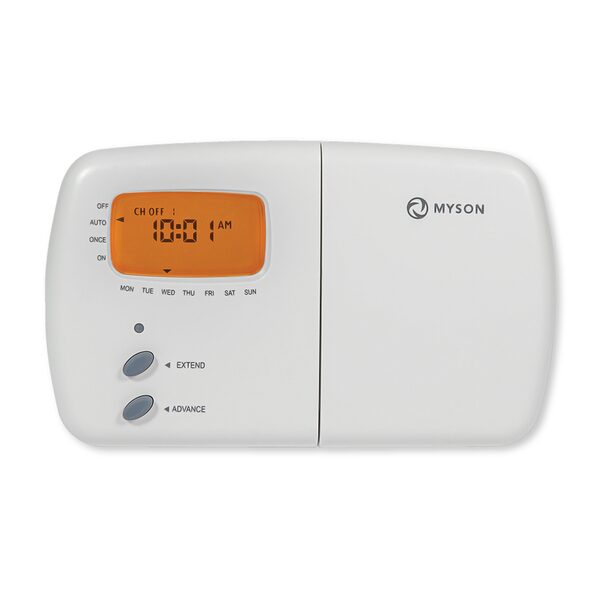
Smart thermostats make the schedule easier to hold. Most allow multiple routines to be programmed, so the home is at the desired temperature when occupied and lower when not25. That is a scheduling convenience rather than a different physical principle: the thermostat still switches the boiler at the set point.
Room-by-room temperatures: living rooms, bedrooms, bathrooms and vulnerable occupants
The 18°C to 21°C band applies to the room the household spends most time in. Oftec states that to avoid potential health problems, the room used most should be kept between 18°C and 21°C4. That is the living room in most homes, and it is the room where the main thermostat is usually sited.
Bedrooms are set cooler. Smart Energy GB suggests 16°C to 18°C for a bedroom8. That is below the health floor for regularly used rooms, which is why the bedroom figure is a comfort suggestion rather than a health minimum, and why it sits alongside the 16°C minimum setback temperature rather than contradicting it.
Bathrooms are not given a separate figure in the guidance. The practical position is that a bathroom is heated for short periods and is usually served by a thermostatic radiator valve or a separate zone rather than by the main thermostat, which is not sited there. Northern Ireland's Technical Booklet F1 requires thermostatic radiator valves on radiators in rooms without a thermostat, except bathrooms26, which reflects the fact that a bathroom radiator is often left uncontrolled or controlled locally.
Vulnerable occupants change the calculation. The NHS advises at least 18°C in rooms regularly used, and says this is especially important for vulnerable household members7. Cadent frames the 18 to 21°C range as a way to keep occupants safe and well3, and its damp guidance links the same range to preventing condensation15. For a household with an infant, an older person or someone with a respiratory or circulatory condition, the lower end of the band is a floor rather than a target.
The room-by-room picture is therefore not a single number but a set of floors and suggestions:
| Space | Figure | Basis |
|---|---|---|
| Room used most | 18°C to 21°C | Health and comfort guidance4 |
| Regularly used rooms | At least 18°C | NHS advice, especially for vulnerable occupants7 |
| Bedroom | 16°C to 18°C | Comfort suggestion8 |
| Empty home in freezing weather | 12-15 degrees | Burst pipe prevention4 |
| Home without frost protection | 10°C with programmer on | Frost protection24 |
Where to put the thermostat: central, 1.5 metres up, away from heat, sun and draughts
Placement decides whether the thermostat controls the house or just the patch of wall it is mounted on. Smart Energy GB advises that the thermostat should not be blocked by furniture or curtains, should be kept away from heat sources such as electric fires or heaters, and should be protected from draughts and placed away from sources of draughts such as windows or the front door7. Uswitch gives the same guidance for smart thermostats: the best place is somewhere the temperature is relatively consistent25.
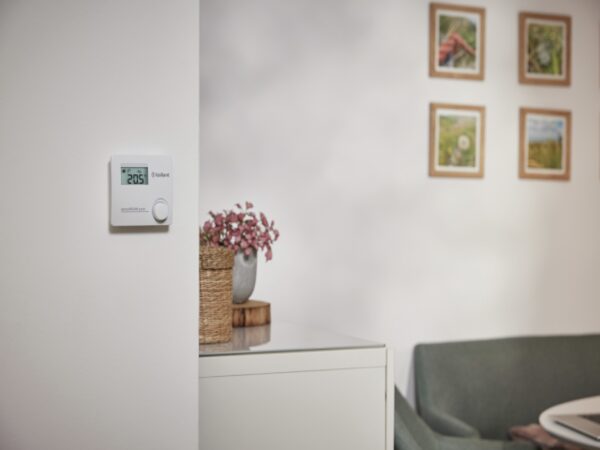
The height figure comes from Myson: the ideal installation location is around 1.50 metres high, out of sunlight and draught17. That height puts the thermostat in the occupied zone of the room, where it reads air at the temperature a seated or standing occupant experiences, rather than in the stratified warm layer near the ceiling or the cold layer near the floor.
The consequences of getting it wrong are concrete. Ideal Heating describes a thermostat placed somewhere warm, such as a utility room that is frequently above 20°C, with the result that the central heating never turns on27. The reverse also applies: a thermostat in a cold hallway or beside a draughty door can leave the radiators running when the rest of the house is well above the set temperature.
A secondary heat source in the same room is the other common fault. Uswitch advises that if additional heating is used in one room, the thermostat should not be in that room, because the local heat will disrupt control, and a wireless thermostat can be moved out of the locally heated room28.

One thermostat or zoning: how many your home needs
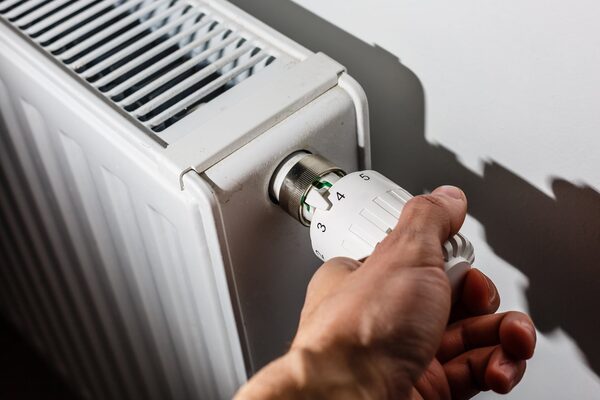
A single thermostat controls the temperature where it is sited and lets the rest of the house follow. Zoning splits the home into separately controlled areas, each with its own thermostat and, in most cases, its own motorised valve.
The building regulations set a floor for new work. Northern Ireland's Technical Booklet F1: 2022 states that central heating systems should be provided with a minimum of two independent heating zones, each controlled by a room thermostat, with thermostatic radiator valves on radiators in rooms without a thermostat except bathrooms26. That is a stricter baseline than the common trade rule of thumb, under which a house below 150 square metres is treated as needing one heating zone and therefore one thermostat, and a house above 150 square metres two zones and two thermostats25. The practical consequence is the same in larger homes, where an upstairs and a downstairs circuit are expected to be controlled separately rather than from a single sensor in the hall.
In practice, a two-zone arrangement usually means the living area on one thermostat and the sleeping area on another, with the cylinder or hot water on a separate timed circuit. That matches the room-by-room figures above: the living area held at 18°C to 21°C, the bedrooms allowed to run cooler.
Zoning is not free, and it is not always worth it. The gain is largest where a home has rooms that are used at different times, a home office, or a large temperature difference between floors. The gain is smallest in a small, well-insulated flat where one thermostat and balanced radiators already hold an even temperature. Balancing the radiators is the cheaper first step: Which? describes a balance test in which all radiator thermostats are turned to 0 and then set to 2, starting from the radiator furthest from the boiler29.
For a household's independence, zoning reduces the volume of heat delivered to rooms that are not in use, which reduces the fuel drawn from the supplier. It does not change the fuel source. The controls decide how much of the heat the boiler makes is actually needed.
Myths and mistakes: cranking it up doesn't heat the house faster
The most common mistake is treating the thermostat as a throttle. It is a switch. Turning it to 30°C does not make the boiler fire harder or the radiators heat faster; it only means the boiler keeps running past the point the household wanted, until the room reaches 30°C or the schedule ends. The result is a hotter house than intended and a larger bill.
The second mistake is adjusting the wrong control. The boiler thermostat changes the temperature of the water in the system9, and it does not control the temperature inside rooms10. Raising the boiler flow temperature makes radiators hotter and can make a room reach its set point sooner, but it also affects how efficiently a condensing boiler runs, and Energy Saving Trust notes that if the heating controls are not set correctly when the boiler thermostat is adjusted, the results may not be as expected9.
The third mistake is siting the thermostat badly and then compensating with the setting. A thermostat in a warm utility room can leave the central heating never turning on27; a thermostat in a cold hall can leave radiators running when the house is already warm. Neither is fixed by changing the number.
The fourth is assuming a smart thermostat changes the physics. It does not. A smart thermostat controls heating and helps manage how the central heating is set and adjusted11, and it will not be a barrier to switching energy deal25, but it still switches a boiler at a set point. The savings come from the schedule and the set point, not from the connectivity.
"It turns your boiler on and off automatically when the room temperature reaches the level you've chosen."
Checking your thermostat is reading true, and when to replace it
A thermostat that reads two degrees high will hold the house two degrees cooler than the setting suggests, and the household will compensate by turning the setting up. The fault is invisible unless the reading is checked.
Which? tests smart thermostats in a temperature-controlled chamber, measuring how accurately they record the temperature and how quickly they respond27. That is the reference method for comparing models. At home, the equivalent check is to place a separate thermometer near the thermostat, clear of radiators, sunlight and draughts, and compare the two readings over a day. A persistent difference of more than a degree or two points to a calibration or siting problem.
Timing matters for replacement. Ivie advises looking into replacing an old thermostat before it gets too cold, before the autumn gets too chilly30. That is practical rather than technical: a thermostat that fails in December leaves the household without heating control at the point of highest demand, and a replacement booked in autumn is easier to arrange than one booked in a cold snap.
For a household's independence, an accurate thermostat is the difference between the setting and the outcome. A thermostat that reads true means the number on the display is the temperature in the room, and the schedule delivers the saving it promises. A thermostat that reads false means the household is paying for a temperature it is not getting.
Thermostats, timers and hot water: what each control does
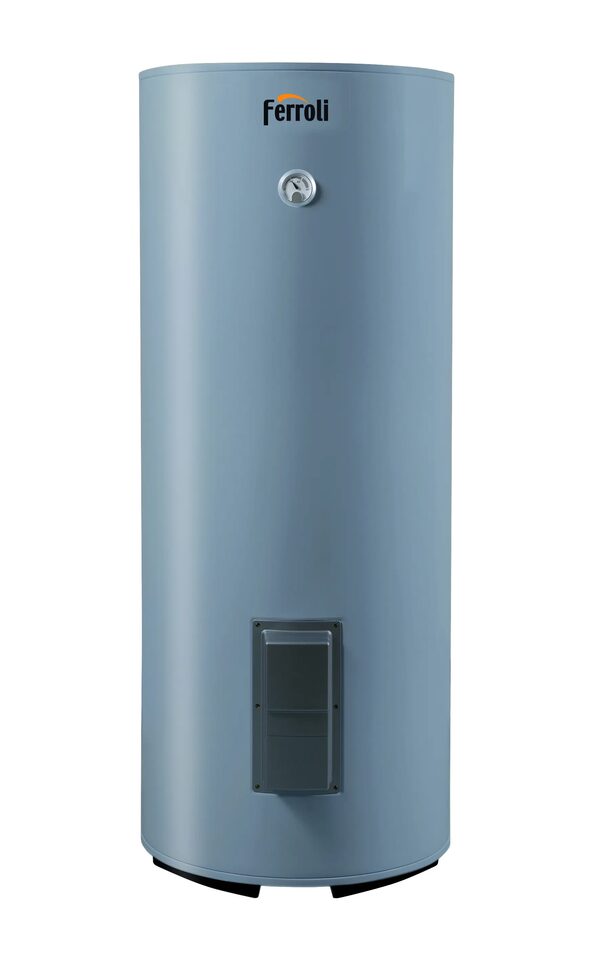
The controls in a heating system do different jobs, and the temperature settings for each are different figures.
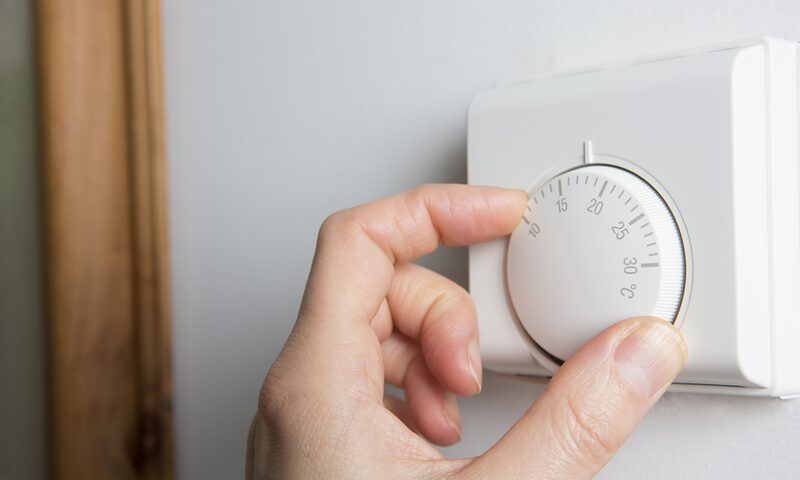
The room thermostat sets the air temperature in the space it serves, and the 18°C to 21°C band applies to it1. The boiler thermostat sets the temperature of the water flowing through the heating system, not the room temperature10. The cylinder thermostat sets the stored hot water temperature, and Energy Saving Trust advises setting it between 60°C and 65°C1. The timer sets when each circuit runs5.
Hot water has its own floor. A cylinder thermostat should be set to at least 60°C, the figure repeated across consumer guidance31, and Energy Saving Trust gives 60°C as fine for most people5. Where a regular boiler serves a separate cylinder, there is only one control for both radiators and hot water, and it should be set no lower than 65°C so it can heat the cylinder to 60°C1. British Gas Energy Trust gives the same 65°C minimum for a conventional boiler with a hot water cylinder14, and Citizens Advice repeats both figures: the cylinder thermostat at least 60°C and the boiler at least 65°C31.
Homes with separate cylinders need a cylinder thermostat to stop heating water once it reaches the correct temperature, plus time controls or programmers to schedule hot water only when needed10. Once the water reaches the set temperature, the heat supply from the boiler is turned off, so the cylinder does not become hotter than it needs to be10. On a regular boiler there is only one control for both radiators and hot water, and it should be set no lower than 65°C so the cylinder can reach 60°C10.
Some smart thermostats extend into hot water control. Which? lists the Hive Thermostat V4 and the Google Nest Learning Thermostat (Gen 3) as able to control hot water27. That is a separate channel from room temperature sensing, and it does not remove the need for a cylinder thermostat set to at least 60°C.
| Control | What it sets | Figure |
|---|---|---|
| Room thermostat | Air temperature in the space it serves | 18°C to 21°C1 |
| Boiler thermostat | Water temperature in the heating system | Not a room figure10 |
| Cylinder thermostat | Stored hot water temperature | 60°C to 65°C1 |
| Boiler serving a cylinder | Flow temperature to reach 60°C in the cylinder | No lower than 65°C1 |
| Timer or programmer | When heating and hot water run | Schedule, not temperature5 |
The independence point is that these are local controls. A room thermostat, a cylinder thermostat and a timer work without a supplier, a network connection or an app. A smart thermostat adds scheduling and remote adjustment, and with it a dependence on the maker's cloud service and app, which is a different kind of dependence from the gas itself. For the household, the temperature settings are the part that reduces the fuel drawn; the connectivity is the part that adds a service to maintain.
Sources31 cited
- Thermostats and heating controls, Energy Saving Trust, 2026-02-10
- Energy savings tips, British Gas Energy Trust, 2026-02-27
- Energy efficiency, Cadent Gas, 2026-09-20
- 10 top tips for homes to save on heating bills this Christmas, Oftec, 2026-06-25
- How to use your heating controls, Age UK, 2026-03-23
- Tips to reduce your heating bills, Which?, 2025-09-16
- Turning down thermostats, Smart Energy GB, 2026-04-22
- Maintaining the ideal home temperature, Smart Energy GB, 2026-08-17
- Should I turn my boiler's flow temperature down?, Energy Saving Trust, 2026-05-20
- Smart heating controls: what they do and why they matter, BEAMA, 2025-04-07
- What is a smart thermostat?, Smart Energy GB, 2026-08-19
- A guide to using electric storage heater controls, Energy Saving Trust, 2026-05-21
- Take control of your heating at home, Energy Saving Trust, 2026-09-11
- Christmas energy saving tips, Energy Saving Trust, 2026-05-20
- Damp, Cadent Gas, 2026-09-20
- Energy saving tips for the home, Confused.com, 2025-10-14
- Knowledge and FAQ, Myson, 2026-09-20
- How to save energy and money if you rent your home, Energy Saving Trust, 2025-11-14
- Tips to improve the EPC rating of your home, Energy Saving Trust, 2026-08-03
- Insulation, nidirect, 2026-09-02
- Getting your broken boiler repaired or replaced, nidirect, 2026-09-02
- The best way to run your central heating to save money, Ivie, 2026-09-20
- Energy efficiency, Northern Gas Networks, 2026-06-25
- Protect pipes in winter, Home Energy Scotland, 2025-12
- What are smart thermostats?, Uswitch, 2026-02-05
- Technical Booklet F1: 2022, Building Control Northern Ireland, 2022-06
- How to buy the best smart thermostat, Which?, 2026-09-17
- Heat the whole house or one room?, Uswitch, 2026-08-20
- How to balance your radiators, Which?, 2025-09-16
- How a smart thermostat can save you money this winter, Ivie, 2025-11-18
- Getting your broken boiler repaired or replaced, Citizens Advice, 2024-08-16
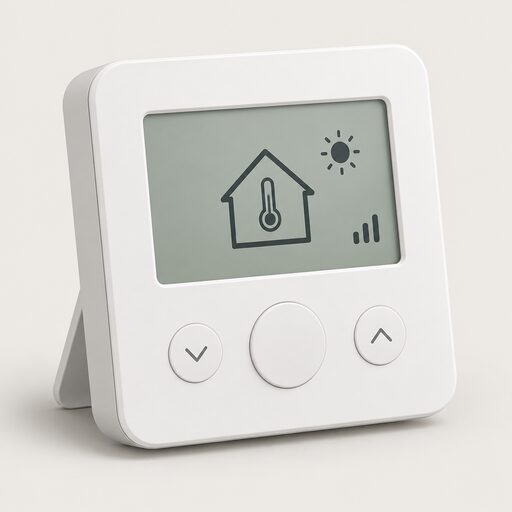 Room Thermostats ExplainedExplains mechanical, digital, programmable, wired, wireless and smart room thermostats, how they call for heat and switch it off, where to site them, how many zones a home needs under the building regulations, and what one degree on the dial is worth.
 Smart Thermostats ExplainedWhat does a smart thermostat actually do, and is it worth it?
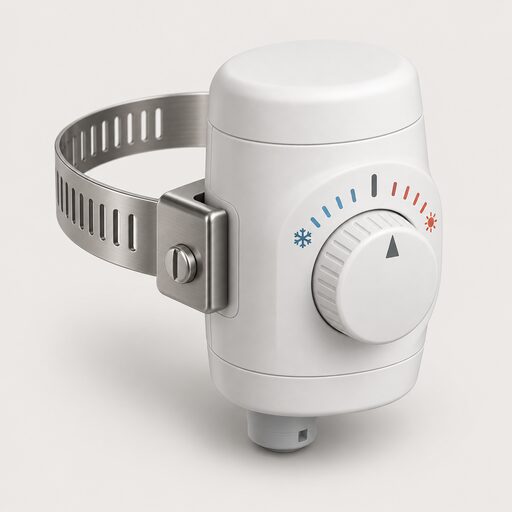 Hot Water Cylinder ControlsWhat temperature should a hot water cylinder thermostat be set to, and does it need its own timer apart from the heating?
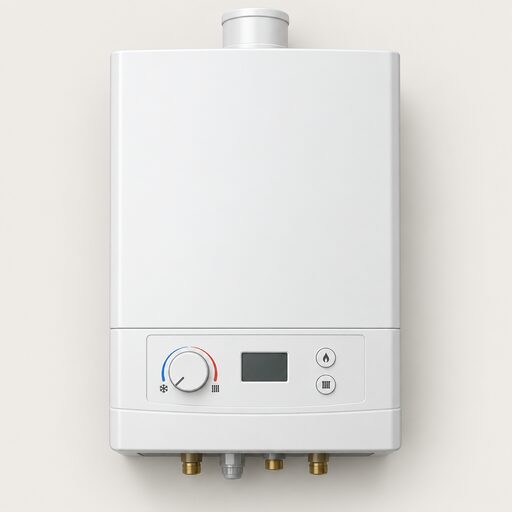 Flow TemperatureTurning down your boiler flow temperature can cut your gas bill, but how low can you go before the house feels cold?
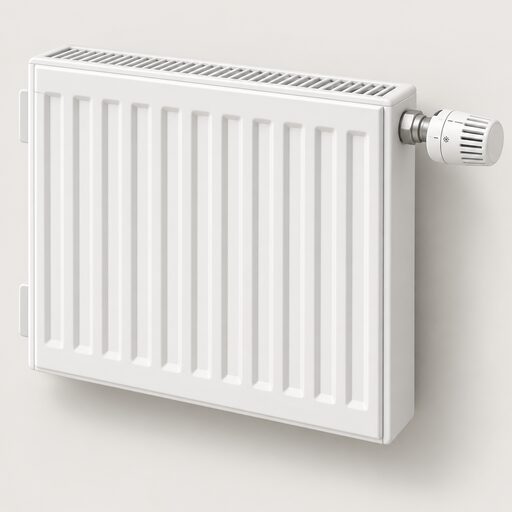 Changing Habits SavingsWhat the evidence says behavioural change saves: around £90 to £120 a year for one degree off the thermostat, £100 to £110 a year for using a full set of heating controls, and £304 to £351 a year for a bundle of small changes.
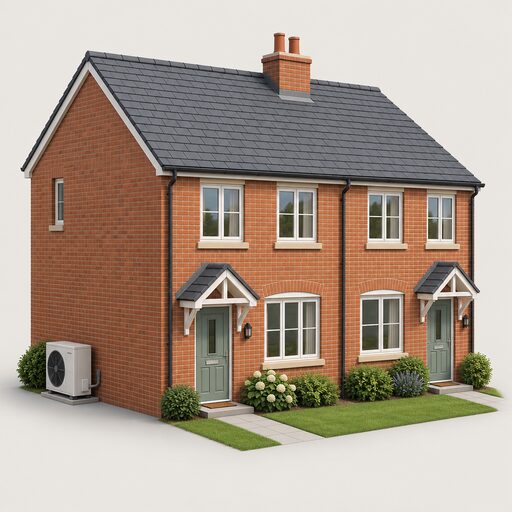 Which Homes Suit a Heat PumpMost UK homes can have a heat pump fitted, so the real question is whether yours makes it easy or expensive.