In this guide
Underfloor heating controls are what turn a floor full of pipes or cables into a heating system that can be set, zoned and limited. Every underfloor heating system should have controls to adjust the operating temperature, and the Approved Document L route to compliance is explicit that all installed equipment in underfloor heating systems should be commissioned in accordance with BS EN 1264-41.
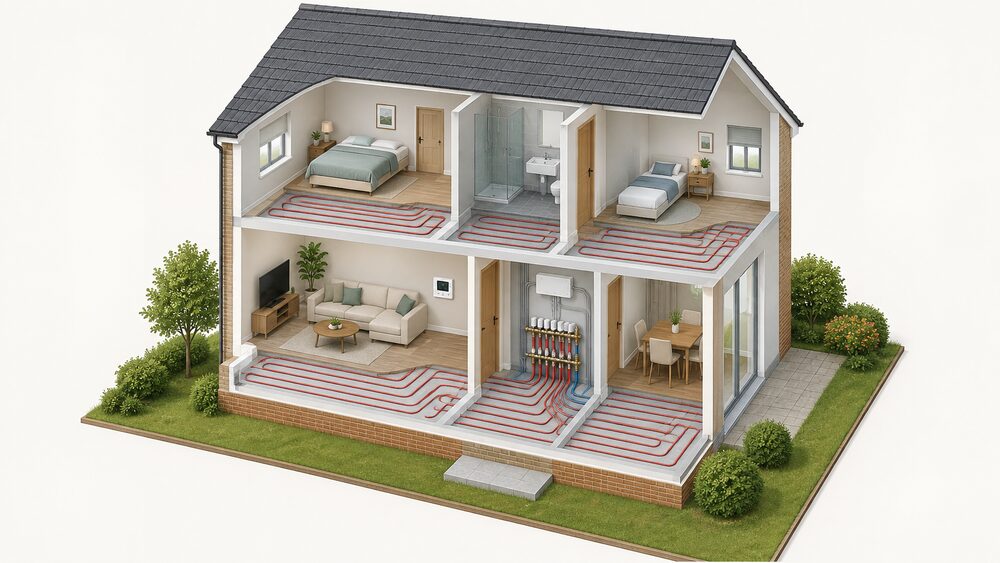
The control chain differs by system. A wet system runs heated water through reinforced polythene piping, usually with separate circuits for different rooms or areas, each connecting to a manifold with regulating valves and a thermostat3. An electric system uses mats or cables laid under the floor, controlled by a thermostat that reads both air and floor temperature4.
What the controls deliver is zone-by-zone command of a heat source that runs cool. Underfloor heating typically runs at around 35°C compared with 55 to 65°C or higher for radiators, which is why it pairs well with heat pumps and why the controls, not the pipework, decide how the system behaves in practice6.
What underfloor heating controls do, and why every system needs them
A floor heating system without controls is either on or off, and neither state is useful. The Approved Document L position is that all underfloor heating systems should have controls to adjust the operating temperature, and that all installed equipment should be commissioned in accordance with BS EN 1264-41. That is a compliance requirement, not a comfort preference.
The reason controls matter more here than with radiators is thermal mass. Underfloor heating in wet systems generally takes much longer to heat up and cool down than traditional radiators, partly because most systems are embedded in screed or concrete3. Once running, Which? reports that underfloor heating takes between an hour and 90 minutes to heat a room, with electric systems slightly quicker than water6. A system that responds slowly has to be controlled predictively, by schedule and by zone, rather than switched on when a room feels cold.
Zoning is the main lever. Modern control systems allow underfloor heating to operate independently in different zones, meaning it can work alongside other heat sources10. NICEIC notes that zoning allows the temperature of individual rooms to be controlled, and that smart, programmable thermostats can keep a home heated on a schedule to help minimise bills5. In a home with underfloor heating downstairs and radiators upstairs, that separation is what stops one circuit dictating the other.
There is also a comfort argument that shows up in the control strategy. Underfloor heating delivers radiant heat from the floor, absorbed by people, furniture and surfaces before it raises air temperature, and because that radiant heat is distributed more evenly it can achieve the same level of thermal comfort at a lower air temperature than conventional systems11. Controls set to air temperature alone therefore tend to overheat a floor-heated room, which is why floor sensing and flow temperature limiting sit alongside the room thermostat.
For a household, the independence question is straightforward. Underfloor controls are local: a thermostat, a wiring centre and a manifold do their work inside the home, with no supplier, cloud service or subscription in the loop. What remains dependent is the heat source itself, whether that is a gas boiler, a heat pump or the electricity grid.
Electric or water underfloor heating: which system, which controls
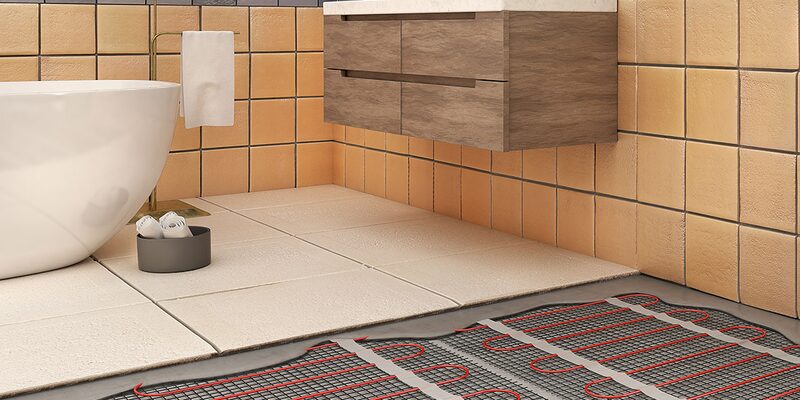
The two families of underfloor heating use different hardware and therefore different controls. Underfloor heating consists of either electric heating cables or water-filled pipes installed beneath the floor surface11. Dry systems are made up of electric heating mats or cables laid underneath the floor that generate heat when electricity is fed through them; wet systems have a series of pipes laid underneath the floor, connected to the heating source, which sends warm water through the pipes4.
The control consequence is that electric systems are controlled electrically at the thermostat, while wet systems are controlled hydraulically at the manifold, with the thermostat switching an actuator rather than the heat itself.
| Electric (dry) | Water (wet) | |
|---|---|---|
| Heat source | Electric mats or cables under the floor4 | Pipes connected to the heating source4 |
| Control point | Thermostat switching the mat directly5 | Manifold with regulating valves and a thermostat per circuit3 |
| Installation cost | £50 to £85/m²4 | £85 to £110/m²4 |
| Heat retention | Cools relatively quickly | Stays warmer for longer, as hot water remains in the pipes after switch-off12 |
| Efficiency | Lower | Higher than electric and radiators, as the system runs at a lower temperature7 |
Which? reports that electric underfloor heating is generally slightly cheaper to install than water underfloor heating, and that wet systems stay warmer for longer because the hot water remains in the pipes even after the system switches off12. The Centre for Sustainable Energy puts dry installation at £60 to £85 per square metre and wet at £90 to £110 per square metre, noting possible extra labour costs on top for wet systems as they are more complicated to install3. The two independent ranges differ slightly and both are given here.
NICEIC distinguishes two electric modes that shape control choice: comfort heating, or underfloor warming, which takes the chill off the floor on cold days, and space heating, where the floor is the room's heat source5. A comfort system needs a floor sensor and a modest setpoint; a space heating system needs a properly sized mat and a thermostat that can hold a room temperature.
Thermostats: the Warmup 4iE and 6iE in detail
Warmup is one of the makers whose control range is documented in detail. The company states that it offers underfloor heating controls for both electric and water systems as well as controllers for traditional central heating systems13. Its smart thermostats can be connected to the MyWarmup online portal and the MyHeating smartphone app to manage and monitor heating settings and energy usage remotely13.
The 6iE Mini WiFi Thermostat is described by the maker as providing smart control for floor heaters in a compact package, and as able to be set up in seconds and installed with ease14. Warmup states that the 6iE Smart WiFi Thermostat allows automatic heating by learning routines and setting accurate temperatures without the need to set a schedule13. The maker also states that using the 6iE with a Warmup floor heater alongside the MyHeating and AutoSwitch apps can save over £400 a year on energy bills; that is a maker's claim about its own products and apps, not an independent measurement13.
The 4iE appears in Warmup's troubleshooting guidance. Two causes are given for a screen that will not power on: if the pins are damaged or not making contact correctly, the thermostat screen will not power on, and incorrect wiring will cause the screen to not illuminate15. Both are physical faults at the mounting plate rather than software problems.
Setback is a setting on the 6iE Mini, and the maker publishes a walkthrough for changing it14. Energy Saving Trust describes setback as a minimum temperature the home should not drop below, giving the example of not below 16°C overnight or when out16. Some storage heaters use the same word differently: setback is the temperature the heater will try to keep the room at while it is set to heating off17. The two definitions are close but not identical, and the thermostat's own menu is the authority for which applies.

Manifolds and wiring centres: how multi-zone water systems are controlled
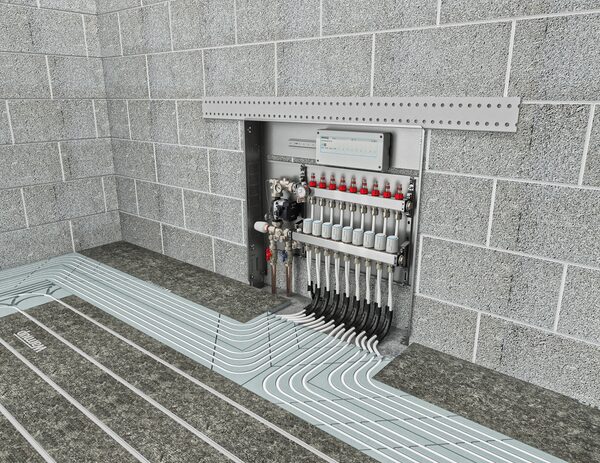
A wet underfloor system is a set of circuits, not a single loop. Heated water circulates through reinforced polythene piping, usually with separate circuits for different rooms or areas, each connecting to a manifold with regulating valves and a thermostat3. The manifold is where the hydraulic control happens: each circuit has a valve, and each valve is opened or closed by an actuator head driven from the room thermostat.
The wiring centre is the junction between the thermostats and those actuators. It takes a call for heat from a room thermostat, opens the corresponding actuator, and signals the heat source or pump to run. In a mixed system, where underfloor loops and radiators share a boiler, the wiring centre also has to arbitrate between the two, which is the same logic that governs zoned radiator systems. The principles of S-plan and Y-plan wiring, zone valves and wiring centres are set out in heating control wiring.
Building Regulations set a floor for zoning in new dwellings. Approved Document L states that for wet heating systems in new dwellings with a floor area of 150m² or greater, a minimum of two independently controlled heating circuits should be provided2. That is a minimum, not a target, and it applies to the wet heating system as a whole rather than to underfloor heating specifically.
Where underfloor heating and radiators are combined, the control architecture can be integrated rather than separate. A documented Edinburgh renovation uses underfloor heating and radiators zone controlled with individual room temperature controllers integrated into the wall switches18. That is a case study rather than a general rule, but it shows the pattern: one controller per zone, whatever the emitter.
Sensors and floor limits: protecting wood, laminate and vinyl floors
Underfloor heating is compatible with more floor coverings than households expect, but the limits are real and they are set by the covering's insulation, not by the heating system's power. Which? states that underfloor heating can be used with most types of thin carpet, engineered wood, vinyl and laminate6. NICEIC lists stone or ceramic tiles, wood or engineered timber, laminate, vinyl and luxury vinyl tiles, and carpet of 2.5 tog and under5.
Carpet is where the numbers bite. Which? states that carpets should not be too thick, and that a tog rating over 1.5 is generally classified as too thick8. MCS guidance adds a correction that matters when reading a carpet label: effective tog is around 1.0 tog lower than the manufacturer's stated tog, with a typical effective tog rating for carpet and underlay of 1.5 tog19. A carpet sold as 2.5 tog may therefore perform closer to 1.5 tog in service, which is why the two figures sit alongside each other rather than contradicting.
The control mechanism that protects the floor is the floor sensor and its limit. A thermostat with a floor probe holds the floor surface at or below a set maximum, independent of the air temperature the room is calling for. That is what allows timber, laminate and vinyl to sit over a heated floor without the surface temperature exceeding what the covering tolerates.
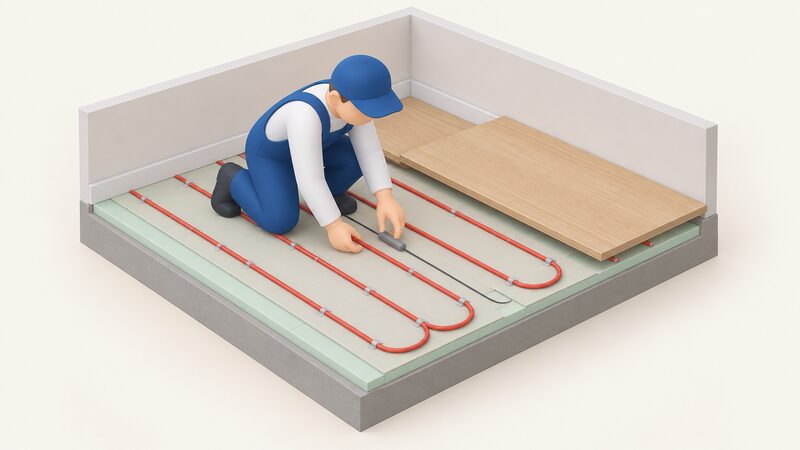
Insulation beneath the system matters for the same reason. Which? notes that where underfloor heating is the only source of heat in a room, insulation boards need to be installed beneath it to reduce the amount of heat being lost downwards6. Heat that goes down is heat the controls cannot recover, and it shows up as a floor that never reaches setpoint.
Flow temperatures: 25 to 75°C depending on the heat source
The flow temperature a wet underfloor system runs at is the single figure that determines both its efficiency and its compatibility with the heat source. Energy Saving Trust states that the flow temperature of underfloor heating tends to be around 45°C2. Which? gives a typical figure of 35°C for underfloor heating compared with 55 to 65°C or even higher for radiators6, and separately notes that the water in the system can be much cooler, as low as 35°C7.
The heat pump case is where the range narrows. The Centre for Alternative Technology states that underfloor heating is a good option with a flow temperature of 35°C to 40°C20. The Chartered Institute of Plumbing and Heating Engineering notes that underfloor heating systems work particularly well with heat pumps because they provide consistent warmth at lower temperatures, and that existing radiators may need upgrading or resizing21.
The spread between 35°C and 45°C is not a disagreement about physics so much as a difference in what is being described: a well-insulated new floor running from a heat pump sits at the lower end, while a retrofit running from a boiler may need the higher figure to reach setpoint on a cold day. The controls decide which applies, through the mixing valve or blending set on the manifold and the weather compensation curve set at the heat source. How that curve is configured is covered in weather compensation.
For a household, the practical consequence is that underfloor heating is a low-temperature emitter, and low temperature is what makes a heat pump efficient. It is also what makes the controls load-bearing: a system running at 35°C has little margin, so a zone left open, a floor covering too thick or a flow temperature set too low all show up as a cold room rather than as a slightly slower warm-up.
Smart features: apps, Alexa, IFTTT and geolocation
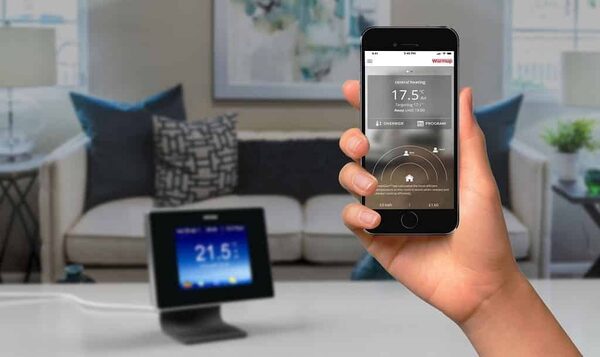
Smart control of underfloor heating is the same category of product as smart control of radiators, with the same benefits and the same dependencies. Energy Saving Trust notes that smart heating controls allow temperature settings to be accessed using a mobile app22. BEAMA states that underfloor heating can be controlled using simple dial thermostats or more advanced smart controls via smartphone, tablet or home automation systems23.
The maker features sit on top of that. Warmup's smart thermostats connect to the MyWarmup portal and the MyHeating app for remote management and monitoring13, and the 6iE learns routines without a schedule being set13. The 6iE Mini is described as settable in seconds14.
The independence question is sharper here than anywhere else on the page. A dial thermostat and a manifold work with no network, no account and no app. A smart thermostat adds convenience and remote access, but it also adds a manufacturer's cloud service, an app that must keep working, and a company that must keep supporting the product. Where the thermostat's learning runs on the device, as Warmup states for the 6iE, basic heating survives a lost connection13. Where control depends on the app, it does not. The wider trade-off between local control and cloud dependence is set out in heating controls and energy independence, and the security and support side in smart heating control security and data.
Smart meters are a related but separate layer: they report what the heating has used rather than controlling it24. For a household weighing up whether the app is worth it, the honest position is that the app changes how the system is operated, not how well the floor emits heat.
Installation, wiring and the rules: Part P, BS EN 1264-4 and competent persons
Underfloor heating controls sit at the junction of two regulatory regimes: building regulations for the heating system, and electrical rules for the wiring that drives it.
On the heating side, the requirement is commissioning. Approved Document L states that all installed equipment in underfloor heating systems should be commissioned in accordance with BS EN 1264-42. The same wording appears in the Welsh Government's consultation version of Approved Document L Volume 125. For work carried out by a registered competent person, the installer should install and commission the system to the standards set out in the approved document, give notice to the building control authority that commissioning has been carried out, and give the certificate, or a copy of the information on it, to the building control authority1.
On the electrical side, electric floor or ceiling heating systems are named among the special locations and installations for which adding electrical work or new installations requires notification to Building Control26. That work can be done by a member of the competent persons scheme, who can self-certify it27. The practical effect is that a thermostat swap on an existing circuit and a new electric mat installation are treated differently, and the second needs a route through Building Control or a registered competent person.
There is also a scheme condition that catches heating work more broadly. The Warm Home Discount (England and Wales) Regulations 2026 require that the boiler or central heating system is installed by, or under the responsibility of, a person who is registered with TrustMark, with a certificate of lodgement issued by the operator of TrustMark28. That applies to boiler and central heating installations rather than to underfloor controls alone, but it shows the direction of travel for installer registration.
Costs: thermostats from £155, installers at £200 to £400 a day
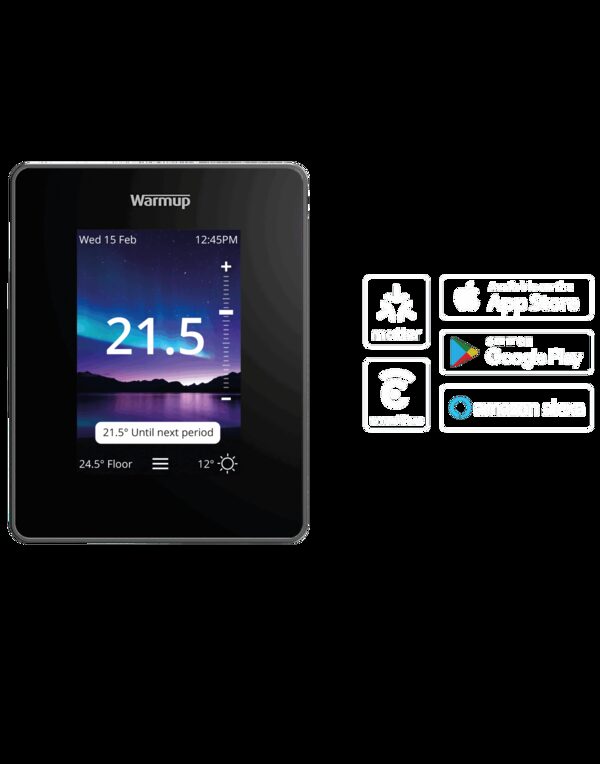
Control costs sit inside the wider cost of the floor. Energy Saving Trust gives installation at £50 to £85/m² for dry electric systems and £85 to £110/m² for wet water systems4. The Centre for Sustainable Energy gives £60 to £85 per square metre for dry and £90 to £110 per square metre for wet, with possible extra labour costs on top for wet systems3. The two independent ranges differ and both are stated here.
Running costs depend on the system and the room. Which? gives a worked example for a semi-detached house of 41.5m² across four rooms, with electric underfloor heating running at £4.57 a day12. That is one modelled case, not a general figure, and it reflects electric resistance heating at whatever tariff applied.
For controls specifically, Which? reports that most smart thermostats cost between £100 and £200, with add-ons such as installation pushing the total higher9. Energy Saving Trust gives around £600 to fully install a full set of heating controls comprising a programmer, room thermostat and TRVs for all radiators29. That figure covers a radiator system rather than underfloor zones, and it is the closest published comparison point for a full control set.
Where a wet system needs a manifold, actuators, a wiring centre and one thermostat per zone, the control cost scales with the number of zones rather than with floor area. Prices for that work are installer-quoted, and no published range for a complete underfloor control installation is given here. The general cost landscape for controls is covered in how much do heating controls cost.
| Item | Published figure | Source |
|---|---|---|
| Smart thermostat | £100 to £200 | Which?9 |
| Full radiator control set, installed | around £600 | Energy Saving Trust29 |
| Electric underfloor installation | £50 to £85/m² | Energy Saving Trust4 |
| Wet underfloor installation | £85 to £110/m² | Energy Saving Trust4 |
| Electric underfloor running cost, 41.5m² example | £4.57 a day | Which?12 |
Troubleshooting and day-to-day use
Most underfloor control faults fall into three groups: no power at the thermostat, no heat at the zone, and heat that will not stop.
No power is the simplest to diagnose. Warmup's guidance for the 4iE gives two causes for a dark screen: damaged or poorly contacting pins, and incorrect wiring15. Both are at the mounting plate, so the thermostat and its backplate are the place to start rather than the app.
No heat at a zone in a wet system points to the chain from thermostat to wiring centre to actuator head to manifold valve. Because each circuit connects to a manifold with regulating valves and a thermostat3, a single cold room with the rest of the floor warm narrows the fault to that circuit's actuator, valve or thermostat rather than to the heat source.
Heat that will not stop usually traces back to a floor sensor or a setpoint. A thermostat holding a floor limit will keep the zone open until the floor reaches its target, and a system embedded in screed will keep releasing heat after the call for heat ends, because wet systems generally take much longer to heat up and cool down than radiators3.
Day to day, the controls that matter most are the schedule and the zone. Energy Saving Trust notes that heating controls help control when the heating system operates and the temperature in each room16, and that thermostatic radiator valves adjust the temperature in different rooms so that unused spaces are not heated more than necessary30. Underfloor zoning does the same job through the manifold. A rural off-gas case study describes a thermostat in each room, which reduces the temperature overnight31. The settings themselves, including setback and schedules, are covered in heating schedules and setback and what temperature to set the thermostat and each room.
Sources31 cited
- Approved Document L Volume 1: Dwellings, GOV.UK, 2026
- Energy saving upgrades for home renovation, Energy Saving Trust, 2026-05-05
- Underfloor heating, Centre for Sustainable Energy, 2025-11
- Underfloor heating, Energy Saving Trust, 2025-10-02
- Underfloor heating system, NICEIC, 2026-09-17
- Underfloor heating pros and cons, Which?, 2026-05-27
- Electric vs water underfloor heating compared, Which?, 2026-05-27
- Underfloor heating, Uswitch, 2025-12-10
- What are smart thermostats, Uswitch, 2026-02-05
- How underfloor heating works, BEAMA, 2024-07-08
- What is underfloor heating, Warmup, 2026-09-20
- Underfloor heating costs, Which?, 2026-05-27
- Thermostats buying guide, Warmup, 2026-09-20
- 6iE Mini WiFi Thermostat, Warmup, 2026-09-20
- 4iE black screen troubleshooting, Warmup, 2026-09-20
- Thermostats and heating controls, Energy Saving Trust, 2026-02-10
- Dimplex Quantum night storage heaters, Centre for Sustainable Energy, 2026-06
- Luxury home renovation, Edinburgh, KNX Association, 2026
- Domestic Heat Pump Guide, MCS Certified, 2024-04-02
- Heat pumps, Centre for Alternative Technology, 2025-06-27
- Is your home suitable for a heat pump, Chartered Institute of Plumbing and Heating Engineering, 2026-02-18
- Guide to smart meters, Energy Saving Trust, 2026-07-15
- Underfloor heating FAQs: floor coverings, controls and acoustic systems, BEAMA, 2025-09-01
- A guide to using electric storage heater controls, Energy Saving Trust, 2026-05-21
- Approved Document L Volume 1 consultation version, Welsh Government, 2025-08
- Building Control application guidance notes, London Borough of Bromley, 2026-09-17
- Do I need Building Regulations approval to add underfloor heating, Planning Portal, 2026
- Boiler Upgrade Scheme regulations: approved standards, grant categories and grant levels, legislation.gov.uk, 2026-03-27
- Tips to improve the EPC rating of your home, Energy Saving Trust, 2026-08-03
- Maintaining the ideal home temperature, Smart Energy GB, 2026-08-17
- Air source heat pump for rural off-gas home, Energy Saving Trust, 2026-01-05
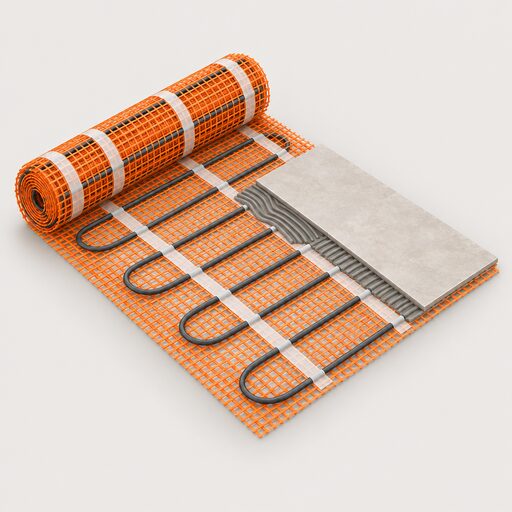 Underfloor Heating SystemsWhich rooms suit electric underfloor heating and which need a wet system?
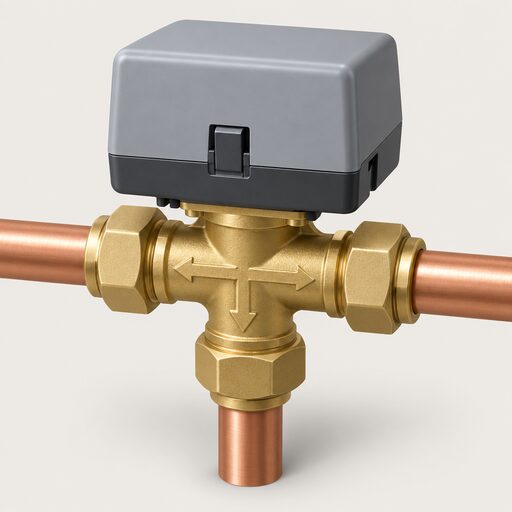 Heating Control WiringYour heating and hot water come on together when you want them apart, and the wiring is usually why.
 Radiators and EmittersWill your radiators still heat the house properly with a heat pump?
 Controls, Thermostats and TRVsWhich heating controls actually cut your bills, and what does each one do?
 Hot Water Cylinder ControlsWhat temperature should a hot water cylinder thermostat be set to, and does it need its own timer apart from the heating?
 Room Thermostats ExplainedExplains mechanical, digital, programmable, wired, wireless and smart room thermostats, how they call for heat and switch it off, where to site them, how many zones a home needs under the building regulations, and what one degree on the dial is worth.