
In this guide
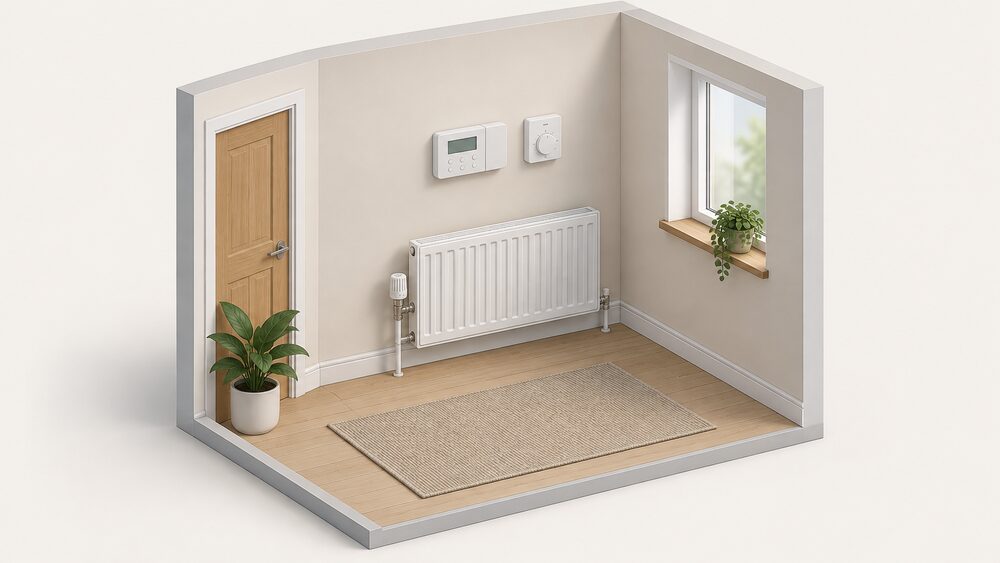
A heating programmer is the time control of a central heating system: it decides when the heating, and usually the hot water, comes on and goes off1. In its simplest form it is a timer that lets a household set when heating or hot water turns on and off each day2. In its fuller form, a seven-day programmer allows heating and sometimes hot water to switch on and off at different times and on different days of the week3. One manufacturer describes a programmer as a device for controlling heating levels throughout a home, room by room, by time of day4.
Time control on its own is only part of a working control set. Guidance from a consumer energy charity states that, as a minimum, a home with a new boiler should have a room thermostat and a programmer, or a programmable room thermostat5. A gas network operator describes a full set of heating controls as a programmer, thermostatic radiator valves and a room thermostat6. The programmer answers "when"; the thermostat answers "how warm"; the valves answer "which rooms".
For a household thinking about energy independence, the honest summary is narrow. A programmer gives local, in-the-home control of when fuel or electricity is burned or drawn, and it works whether or not there is broadband, an app or a smart meter. What it does not do is generate energy, store it, or cut the household's reliance on a supplier. The wider benefits that time control can unlock, off-peak running and time-of-use tariffs, depend on metering and tariffs that sit outside the home entirely.
What a heating programmer does
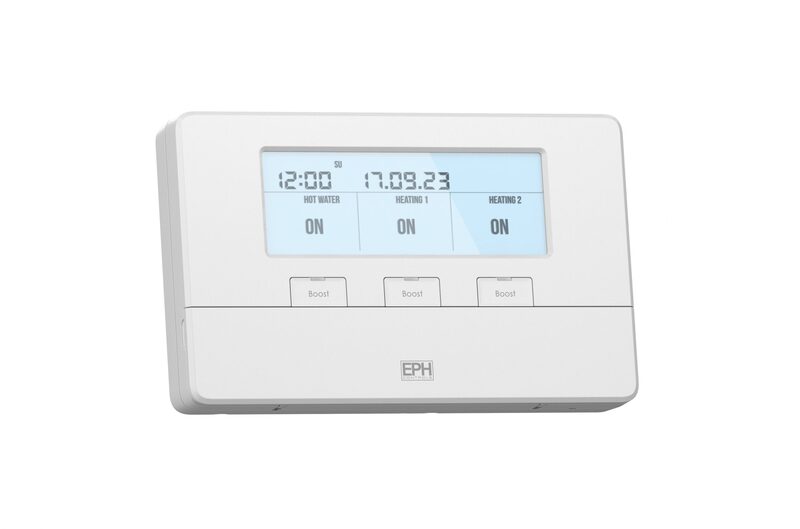
A timer or programmer controls when the heating comes on and off1. That is the whole of its job in a conventional wet system: it closes and opens a control circuit at set times, and the room thermostat and cylinder thermostat then decide whether the boiler actually needs to fire. Age UK describes a timer as letting a household control when heating or hot water turns on and off each day2. On digital electric storage heaters, the same component sets specific times for when heating comes on and off11.
The value of that timing is not only comfort. A boiler manufacturer notes that modern programmable controls have timing functions so a boiler can be set to switch on overnight, for example to take advantage of cheaper off-peak energy tariffs12. The same principle drives immersion heating: with a timer or controller, an immersion heater uses off-peak electricity to heat a full cylinder overnight, which is then stored for use the following day and evening13.
Three points are worth separating. First, a programmer is a scheduling device, not a temperature device: without a room thermostat it will run the system for the period set regardless of how warm the house already is. Second, the schedule is only as good as the household's knowledge of its own routine, which is why guidance treats time control and temperature control as a pair. Third, programmers are a recognised retrofit measure in their own right: the programmer and room thermostat combination appears in Ofgem's ECO4 measures table as a distinct measure type14.
Programmer or programmable thermostat: where the line falls
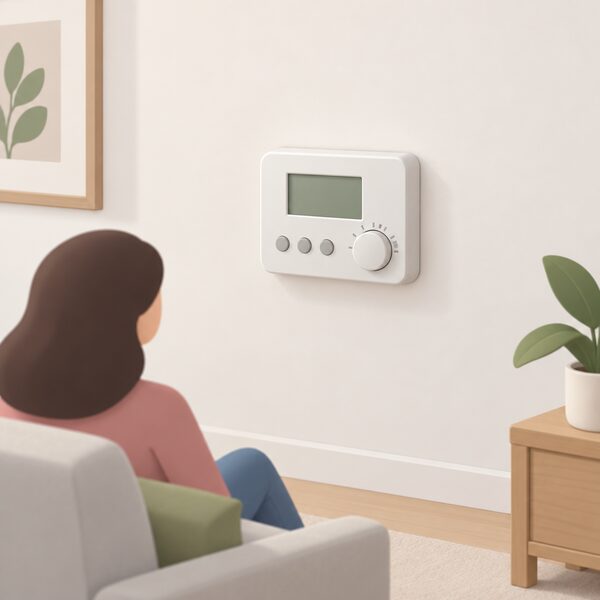
A programmable room thermostat combines time and temperature controls in a single unit, and can set different temperatures for different times of the day1. A boiler maker describes the same control type as combining a boiler programmer and room thermostat together, allowing different room temperatures to be set for different times of day and night3. One manufacturer goes further and treats the words as interchangeable, calling a heating programmer essentially another term for a programmable thermostat4.
The distinction that matters in practice is what the device decides. A plain programmer decides only time. A programmable room thermostat decides time and target temperature together, which is why guidance accepts it as an alternative to fitting a separate programmer and thermostat when a new boiler goes in5. Grant-funded work uses the separate pairing as its unit of measurement14.
Manufacturers also sell both routes for the same appliance. One combi range is listed as suitable for either a plug-in programmer or a wireless programmable thermostat, which shows the choice is usually a matter of how the control is mounted and powered rather than a difference in what the boiler can do.
Where a household is comparing a traditional time control with an internet-connected one, the difference set out by the Energy Saving Trust is that smart controls are connected to the internet and offer more functionality1. Some smart controllers are designed not to need programming at all: one maker states its smart controller "does not require programming and works automatically" to control the heating system15. That is a genuine functional difference, and also a new dependency: on an app, a maker's servers and a home broadband connection. The trade-offs are set out on smart thermostats and in the comparison of a smart thermostat and a traditional programmer.
Single, twin and three-channel: matching the programmer to the system
Channels are the number of independent on and off schedules a unit can run. The pattern follows the heating system rather than the size of the house.
| Channels | What it controls | Typical system |
|---|---|---|
| Single | One circuit, normally space heating alone | A combi with no hot water cylinder |
| Twin | Heating and hot water on separate schedules | System or regular boiler with a cylinder; many heat pumps16 |
| Three | Hot water plus two separate heating zones, for example upstairs and downstairs1 | System or regular boiler with zoned circuits |
For heat pumps, one manufacturer describes the typical arrangement as a simple two-channel programmer controlling when the heat pump provides space heating and when it heats hot water16. That separation matters more on a heat pump than on a boiler, because the machine runs at different temperatures for the two duties.
Where a home is split into zones, the Energy Saving Trust explains that zone controls heat different rooms at different times of day automatically, using separate programmable heating circuits for different parts of the house1. Scottish compliance guidance for community heating states that in dwellings with a floor area over 150 square metres, time control for separate space heating zones can be provided using a single multi-channel programmer17. In underfloor systems, zoning allows the temperature of individual rooms to be controlled, and programmable thermostats keep the home heated on a schedule18. More detail sits on heating zones and underfloor heating controls.
The practical consequence for replacement is simple: the number of channels, and the backplate the old unit sits on, decide how straightforward a swap is. A single-channel unit cannot drive a cylinder circuit that a twin-channel unit was driving, and a household replacing a programmer needs the channel count to match the system's wiring rather than the look of the front panel. Heating control wiring covers the circuits behind the backplate.
Time control within a full set of heating controls
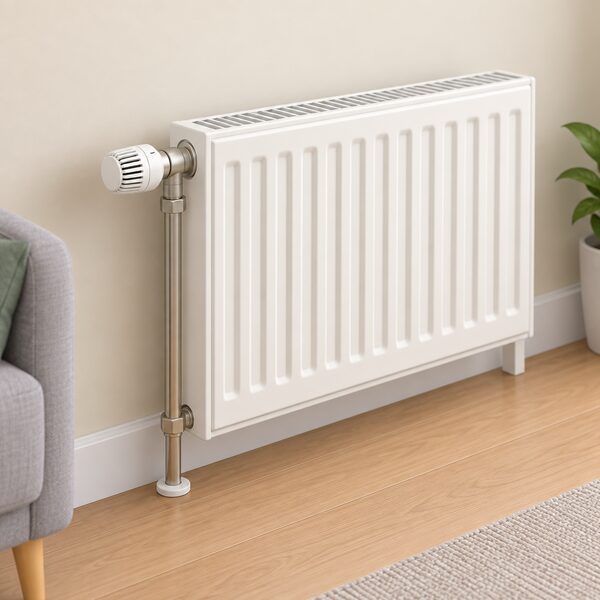
Home Energy Scotland lists the recommended controls as a time-controlled programmer, at least one room thermostat, thermostatic radiator valves if there are radiators, and a cylinder thermostat if the system has a hot water cylinder19. The Energy Saving Trust gives the same core three for a boiler system: a programmer for time control, at least one room thermostat and TRVs1. Cadent's version is identical in substance6.
Heat pumps are treated separately in official guidance. OFTEC states that heat pump systems are typically controlled by the end user via weather compensation or internal temperature control, such as a room thermostat, together with a timer or programmer to control space heating20. Approved Document L guidance reproduced by BEAMA sets this out as a requirement: the heat pump should have external controls that include weather compensation or internal temperature control, and a timer or programmer for space heating21. So time control is not optional on a heat pump installation; it is part of the compliant control package. See weather compensation and building regulations for heating controls.
Electric heating uses time control differently again. Digital storage heaters include a programmer or timer to set when heating comes on and off11, and an immersion timer shifts cylinder heating into the off-peak window13. In those systems the programmer is doing the economic work directly, because it decides which price band the electricity is bought in. That is covered further under storage heater controls and hot water controls.
A smart meter and a smart control are not the same thing
The Energy Saving Trust is explicit: smart meters are different to smart heating controls, and one can be used without the other22. Welsh Government guidance makes the complementary point, that while smart meters are independent of smart heating controls, combining the two can enhance a household's ability to manage heating and energy use remotely23.
What a smart meter adds is measurement and tariff access rather than control. Ofgem states that a smart meter automatically sends electricity and gas meter readings to the supplier, so bills are based on accurate readings rather than estimates, and that a household can access more flexible tariffs, including dual-rate tariffs24. MCS notes that smart meters can help consumers make heat pumps more efficient and cost-effective25.
The dependency runs one way, and it is firm. Smart Energy GB states that a smart meter working in smart mode is needed to take part in flexible schemes, and a smart meter is needed for most flexible tariffs26. Participation in the Demand Flexibility Service similarly requires a working smart meter so the supplier can accurately and quickly measure energy use27. A household can therefore run a perfectly good programmer with no smart meter at all, but cannot be paid for shifting demand without one. That is a dependence on a supplier and on a national data network, not on the heating system.
Time-of-use tariffs: what they need and what they offer
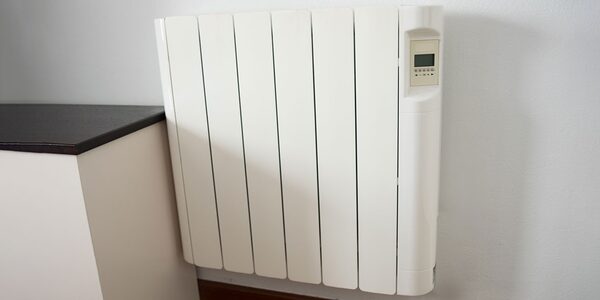
A time-of-use tariff is a plan where the price of a unit of energy varies during a 24-hour period28. The Energy Saving Trust describes such tariffs as encouraging energy use outside peak times, with lower energy costs as a result29. For storage heaters, Which? states that a time-of-use tariff such as Economy 7 or Economy 10 is needed to access cheaper electricity prices30.
The risk is stated just as plainly in official work on the heat pump transition: where heating patterns are not well aligned to the tariff, time-of-use tariffs can increase fuel bills31. The same report recommends that such tariffs be recommended to low-income households only where the household has expressed clear confidence in managing the more complex arrangement, or where automatic optimisation software or hardware is installed alongside31.
"Monitoring a time-of-use tariff once it is set up can also require a greater level of engagement than consumers may be used to."
Smart Energy GB accepts that time-of-use tariffs will not be appropriate for all consumers26. The household-level conclusion is that a programmer is the tool that makes a time-of-use tariff pay: the tariff sets the prices, the programmer decides whether the heating or the cylinder actually runs in the cheap window. Without disciplined scheduling, the tariff transfers risk to the household rather than value. See using heating controls with time-of-use tariffs.
Monitoring use: what the in-home display shows
An in-home display allows a household to monitor energy usage and spending33, showing how much energy is being used during the day24. Smart Energy GB describes it as showing use in near-real time and the cost in pounds and pence, with settings to view usage by day, week or month34. National Energy Action gives the same three periods, energy used and what it costs, on a daily, weekly or monthly basis35.
The display is a feedback device, not a control. It cannot turn the boiler down. Its value for a household running a programmer is that it shows what a schedule change actually cost, which is the only way to test whether a setback, an earlier off time or a shift into an off-peak window made any difference. Ofgem's framing is careful: a household could find ways to save money using up-to-date information on its energy use33.
Cost and who pays
There is no upfront charge for a smart meter10, and Ofgem's guidance is to contact a supplier to get one for free33. For renters, installation is at no extra cost to the tenant or the landlord where the bills are in the tenant's name. Heating programmers are a different matter: they are bought and fitted as part of a heating installation or a retrofit, and prices here are installer-quoted, so no range is given. The programmer and room thermostat pairing does appear as a fundable measure under ECO414, which means some households receive it through a scheme rather than paying directly.
What a programmer will not do
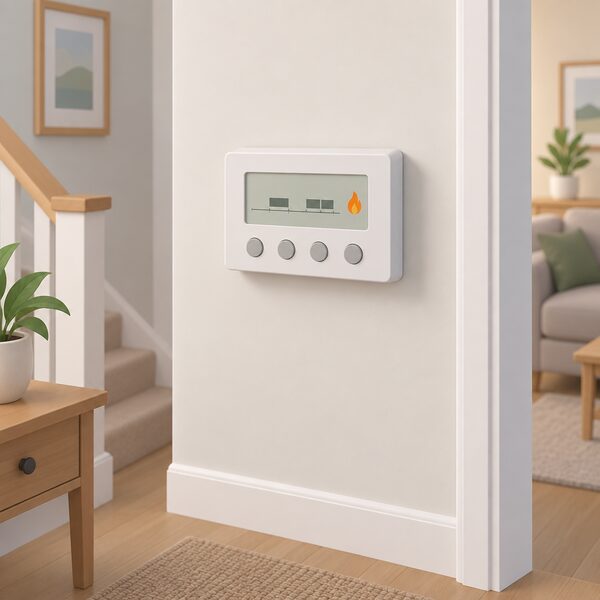
A programmer has no view of how warm a room is and no view of the weather. It will run the system exactly as told, including on a mild day. Savings attach to the combination of controls rather than the timer alone: Home Energy Scotland estimated in July 2024 that installing a programmer and thermostat could save around 65 pounds a year7.
Nor does time control suit every heat source equally. Advice for heat pump homes is that money can be saved by leaving the heating on all day, because heat pumps function differently to boilers and rely on good insulation to work efficiently. A rigid boiler-style on and off schedule can work against a heat pump, which is why weather compensation or internal temperature control appears alongside the timer in the control requirement rather than instead of it21. This is explored on heating schedules and setback and do smart heating controls actually save money.
Some smart controls claim to close that gap by automatically optimising heating settings to save money and energy22, and one maker's smart controller is described as working automatically without programming15. Those claims are the makers' and the advisory bodies' own framing, and they exchange a manual schedule for reliance on software, an app and a connection.
Where smart meters work, and the right to refuse
Refusal is a right, stated consistently. Citizens Advice: a household does not have to accept a smart meter if it does not want one36. Which?: a household has the right to refuse a smart meter10. The Energy Saving Trust: installation is not compulsory and a supplier's offer can be refused22. House of Commons Library material on the Energy Bill confirms there are no provisions allowing anyone to enter a property by force to install a smart meter, and that consumers retain the right to refuse installation37.
Coverage is not universal: there are certain homes and locations where a smart meter will not currently work39. For households on the Radio Teleswitch Service, where signal is poor, a supplier may install a meter with the tariff pre-programmed; manual readings then have to be sent in and the full benefits of a smart meter are not available, but the heating continues to work40. See the Radio Teleswitch Service switch-off.
Tenure is not a barrier either. Private renters can choose a smart meter if the energy bills are in their name or they prepay for energy, after checking the tenancy agreement and letting the landlord know38. Any household that pays for its energy, whether owning or renting, should be able to book an installation where a meter is expected to work at the property9. More on this in heating controls in rented homes.
Lifespan and replacement
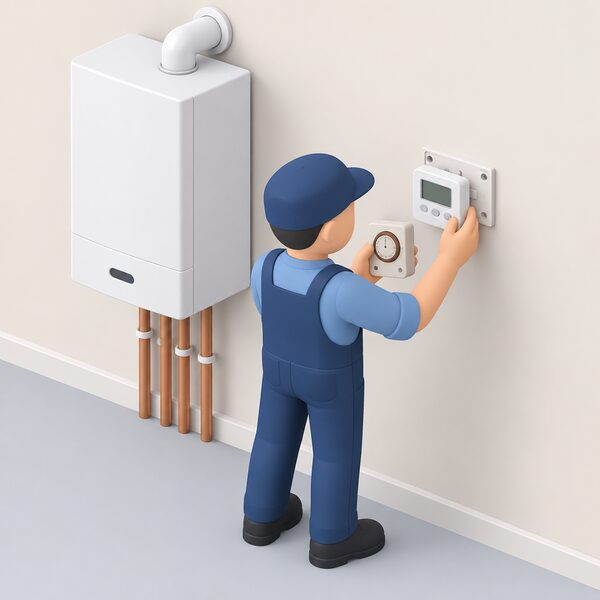
Programmers are usually replaced with the system rather than on their own schedule. The Planning Portal puts the current lifespan of a boiler at around 15 years. A European solar heat industry body gives an average lifetime of 15 to 20 years for heating systems generally8; that figure is not UK-specific and is the only one available here.
Replacement is also the moment when compliance bites. A new boiler should, as a minimum, be fitted with a room thermostat and a programmer, or a programmable room thermostat5. In practice this means the old time switch rarely survives a boiler change unless it already meets that standard and matches the new system's channel needs. A like-for-like swap of a failed unit turns on three things: the number of channels, the backplate the existing unit is mounted on, and whether the system has a cylinder to control. Installing and replacing heating controls covers the process, and heating control faults the symptoms of a failing time control.
For a household weighing independence, the programmer is one of the few parts of a heating system that is genuinely self-contained: it holds its schedule locally, needs no account, no subscription and no network, and keeps working when broadband does not. Everything that extends its reach, tariff switching, flexibility payments, remote control, adds a dependency on a supplier, a data network or a manufacturer's software. The broader picture is set out on heating controls and energy independence and the heating controls guide.
Sources40 cited
- Thermostats and heating controls, Energy Saving Trust, 2026-02-10
- How to use your heating controls, Age UK, 2026-03-23
- Boiler controls explained, Worcester Bosch, 2026-09-17
- Heating controller guide, Netatmo, 2026-09-20
- Upgrading and replacing your boiler, Centre for Sustainable Energy, 2026-06
- Energy efficiency advice, Cadent Gas, 2026-09-20
- Top five ways to make a tenement more efficient, Home Energy Scotland, 2024-07
- Heating system lifetimes article, Solar Heat Europe, 2026-09-17
- Smart meters: your rights and expectations, UK Government, 2025-08-08
- Do I have to accept a smart meter?, Which?, 2026-05-12
- A guide to using electric storage heater controls, Energy Saving Trust, 2026-05-21
- 12 ways to improve energy efficiency, Ideal Heating, 2026
- Getting the most from Economy 7, National Energy Action, 2026-09-10
- ECO4 measures table v4.0, Ofgem, 2025-07-29
- Central heating thermostats, Warmup, 2026-09-20
- Heat pumps and hot water performance, Grant UK, 2026-09-20
- Draft Domestic Building Services Compliance Guide, Scottish Government, 2010
- Underfloor heating systems, NICEIC, 2026-09-17
- Thermostats and heating controls, Home Energy Scotland, 2026-09-20
- Your home guide to heat pumps, OFTEC, 2026-09-17
- Controls guide for air to water heat pump systems, BEAMA, 2024-10
- Guide to smart meters, Energy Saving Trust, 2026-07-15
- Smart meters, Welsh Government, 2026
- Get help with your smart meter, Ofgem, 2026-09-17
- Smart meters, MCS, 2026-07-24
- Using energy flexibly, Smart Energy GB, 2026-04-14
- Demand Flexibility Service, Energy Saving Trust, 2026-05-21
- Energy tariffs and time-of-use pricing, UK Parliament POST, 2026
- How to ensure a heat pump runs efficiently, Energy Saving Trust, 2026-05-19
- Storage heaters, Which?, 2026-06-01
- Call for evidence report: heat pump transition, UK Government, 2026-05
- Smart timing: making time-of-use tariffs work for consumers, Citizens Advice, 2025-09-09
- Getting a smart meter, Ofgem, 2026
- Myth busting smart meter problems, Smart Energy GB, 2026-09-17
- Understanding smart meters, National Energy Action, 2026-04-21
- Getting a smart meter installed, Citizens Advice, 2026-09-17
- Energy Bill research briefing, House of Commons Library, 2026-09-20
- Smart meters, Energy Ombudsman, 2026-09-20
- The best way to start saving energy and money, ivie, 2026-09-20
- The RTS switch-off, Home Energy Scotland, 2026-09-20
 The Full Heating Controls GuideA room thermostat, a programmer and valves on your radiators are the basics.
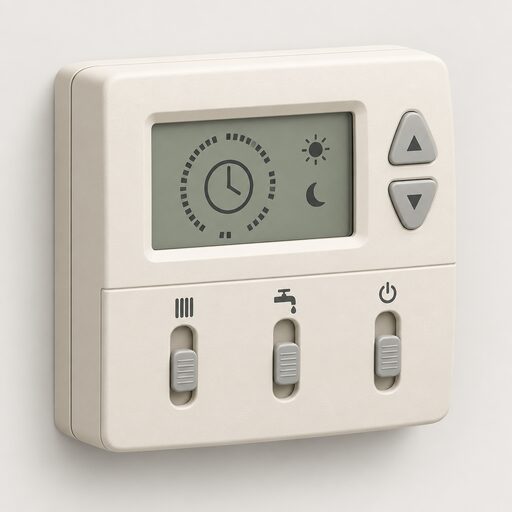 Controls, Thermostats and TRVsWhich heating controls actually cut your bills, and what does each one do?
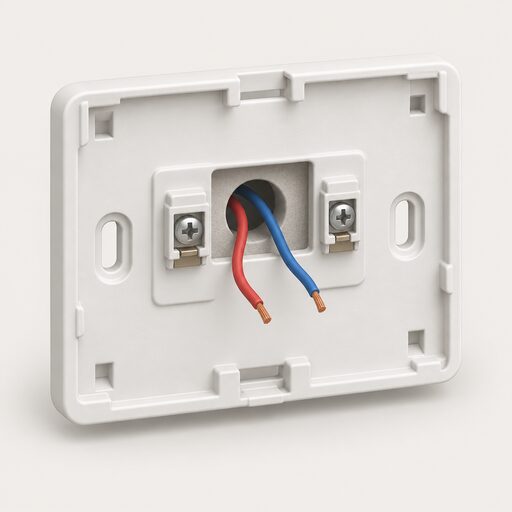 Installing Heating ControlsSwapping a thermostat or programmer looks simple, but which jobs can you safely do yourself and which need a registered installer?
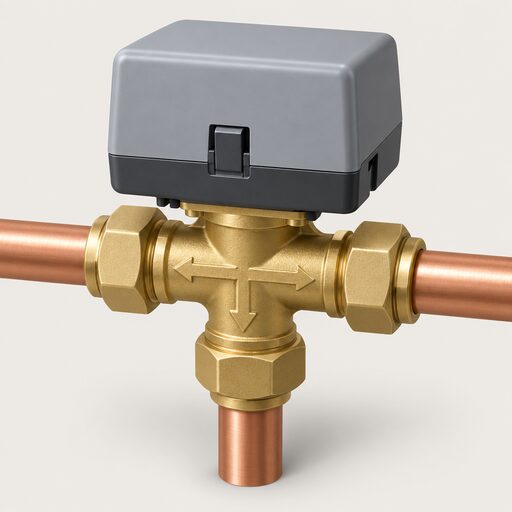 Heating Control WiringYour heating and hot water come on together when you want them apart, and the wiring is usually why.
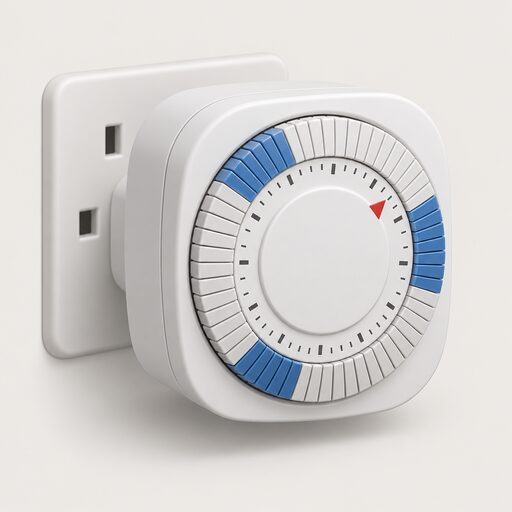 Controls and Time-of-Use TariffsCheaper electricity at night only saves money if your heating actually uses it then.
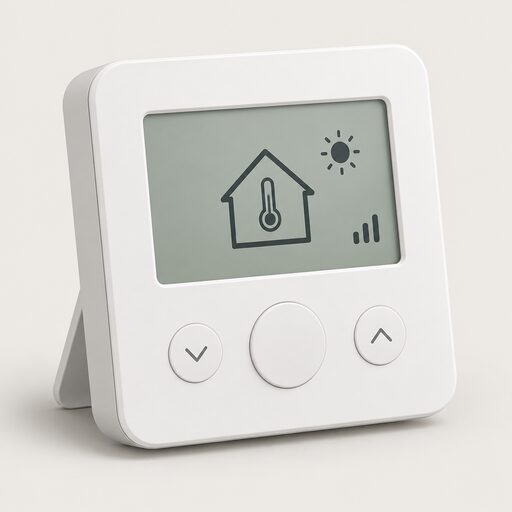 Room Thermostats ExplainedExplains mechanical, digital, programmable, wired, wireless and smart room thermostats, how they call for heat and switch it off, where to site them, how many zones a home needs under the building regulations, and what one degree on the dial is worth.