In this guide
A thermostatic radiator valve (TRV) is a self-regulating valve fitted to a radiator on a wet heating system that controls the temperature of a room by changing the flow of hot water into that radiator1. It senses the air temperature around it, not the temperature of the radiator or the water, and opens and closes automatically to hold the room near the temperature set on its dial1. Unlike a room thermostat, it has no communication with the boiler3.
That distinction governs everything else on this page. A TRV throttles one emitter. It cannot start the heating, and it cannot stop the boiler firing for the rest of the house: if the main thermostat says the heating is off, no amount of adjustment of the TRV will change the temperature in that radiator4. What a TRV does is stop rooms that are already warm enough from being heated further, which is why guidance treats a full set of correctly set valves as room by room trimming rather than as zoning in the full sense.
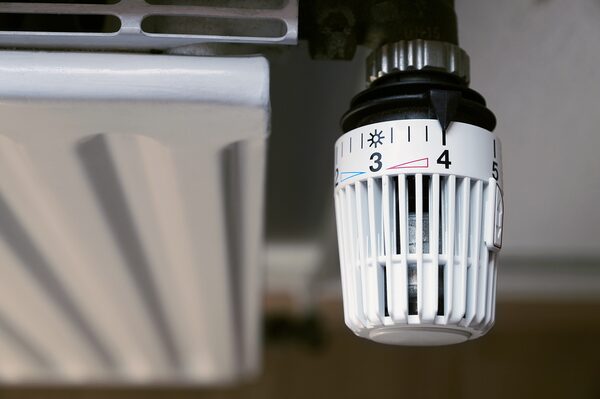
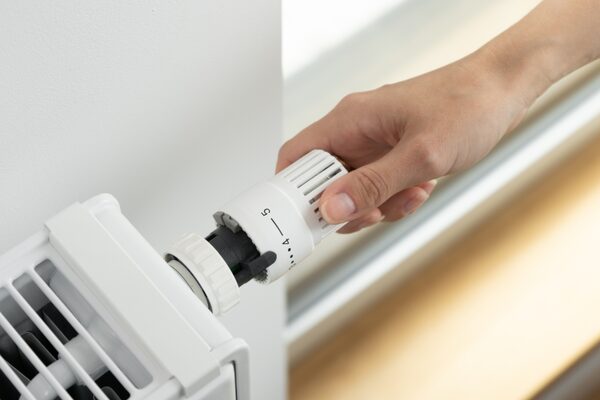
Most TRVs do not display temperatures. They use numbered settings that correspond to a temperature range, usually a scale from 0 to 6 where zero is off and six is fully open, or a 1 to 5 scale with a frost position1. The numbers are calibration marks, not thermostat readings, and different manufacturers assign different temperatures to the same number, which is the single most common source of confusion about these valves.
What a thermostatic radiator valve does
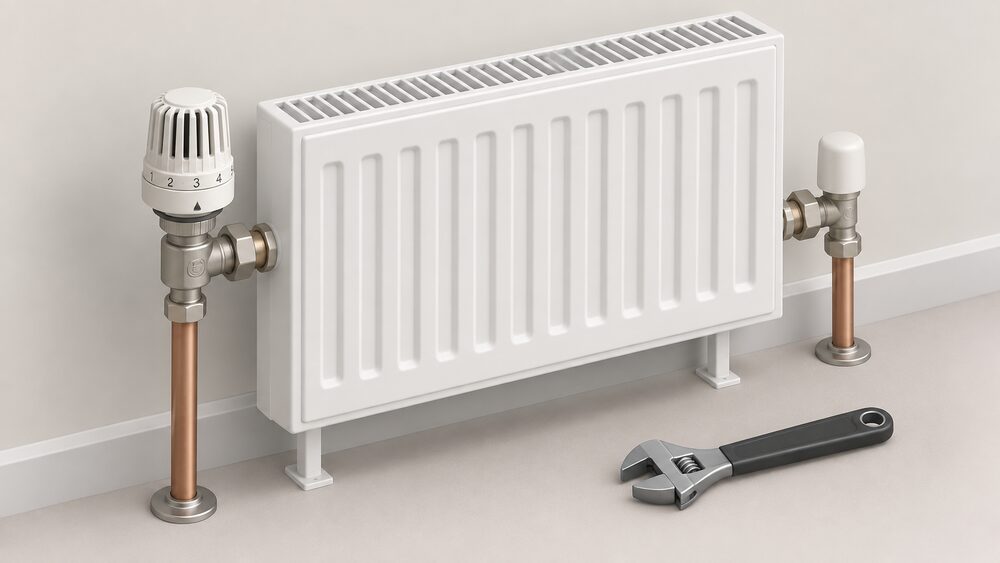
A TRV replaces the manual wheel valve on the flow side of a radiator. Radiators usually have two valves, a control valve and a lockshield valve11. The control valve is the one a household adjusts and the one a TRV occupies; the lockshield is set once during balancing and then left alone under its cap. A TRV is easy to recognise on sight: it sits next to the inlet pipe, is larger than a standard on/off valve, and has a rotating head with numbers showing4.
Functionally, the valve regulates the flow of water inside the radiator and therefore the heating power it delivers. It opens and closes automatically, and it can also be manually adjusted to different settings to change the flow of hot water through the radiator it is fitted to3. The result is control over individual room temperatures rather than a single whole house setting, allowing a household to heat only the rooms it is using and not pay to heat empty ones12.
Because a TRV acts on water flow, it works with any hot water radiator regardless of the heat source: solar, oil, gas, wood or heat pump9. It is fuel agnostic in a way that few controls are. The limits are equally plain. A TRV cannot make a radiator hotter than the water arriving at it, it cannot call for heat, and it has no clock. Programmable TRVs exist, being TRVs with timing control that let each radiator come on at different times and heat each room separately13, and smart TRVs add app and hub control on top, but a plain mechanical TRV is a temperature limiter and nothing more.
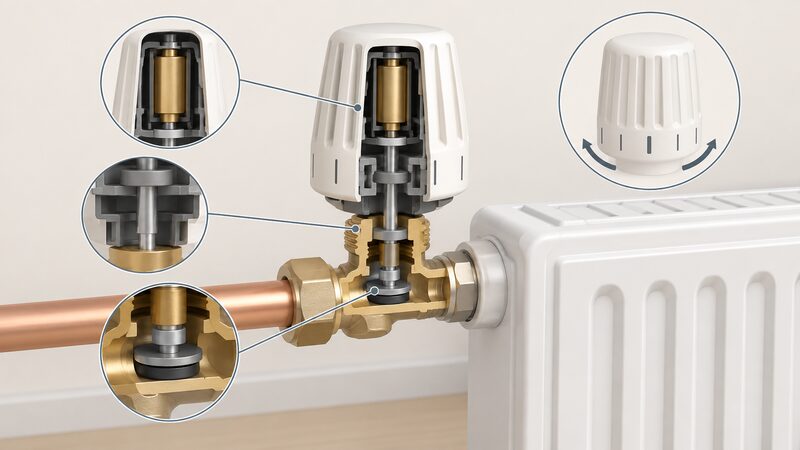
How the thermostatic head works: the sensor and the numbered dial
The device is in two parts. Each TRV consists of a valve, a sensor, and a handle for manual control9. The valve body is plumbed into the pipework and stays put; the head, which contains the sensing element and the dial, screws onto it and can be changed separately.
Inside the head is a fluid or wax element designed to expand more or less according to the ambient temperature measured by the probe, and that expansion drives a pin that throttles the hot water flow14. When the room warms, the element expands, the pin closes the valve and the radiator cools. When the room cools, the element contracts and the valve reopens. Nothing is powered: a mechanical TRV needs no batteries, no wiring, no hub and no app, which is a real point in its favour for a household concerned with dependence on a manufacturer's cloud.
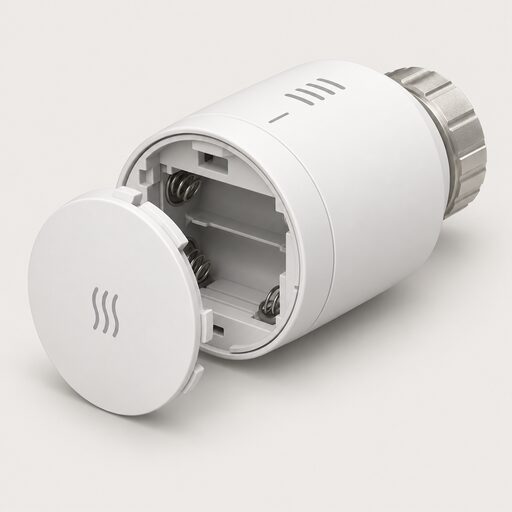
Digital and smart heads replace the wax element with an electronic sensor and a motor. Smart radiator valves use sensors to monitor the room temperature and adjust the heat output accordingly, typically connect to home wifi and often link to a central smart heating system1. The maker of one digital range states that digital heads offer very high precision, to half a degree in temperature difference, and can be programmed on an hourly or weekly basis, and remotely, while manual heads are entirely non-digital and cannot be programmed remotely15. Digital heads are described by that maker as more modern, less common and carrying a higher price tag15.
One practical rule applies to head swaps: make sure that the valve heads purchased are compatible with the existing thermostatic radiator valves15. Bodies use different thread and pin standards, and a smart head such as the Hive Radiator Valve requires a compatible thermostatic radiator valve body16.
What the numbers mean: settings from frost to fully open
There is no single UK standard for what each number means, and published charts disagree. The table below sets three out side by side, each labelled with its source.
| Dial position | EPH Controls datasheet17 | Citizens Advice18 |
|---|---|---|
| 0 | 0˚C (off) | off |
| Snowflake / * | 7˚C | not listed |
| 1 | 12˚C | 10 degrees Celsius |
| 2 | 16˚C | not listed |
| 3 | 20˚C | 20 degrees Celsius |
| 4 | 24˚C | 25 degrees Celsius |
| 5 | 28˚C | 30 degrees Celsius |
The three agree closely at setting 3, around 20°C, and diverge at the extremes. The safest way to read a dial is therefore relative rather than absolute: one setting change roughly corresponds with a temperature difference of 3 to 5°C, and most TRVs have five or six settings7. The Energy Saving Trust describes the usual scale as 0 to 6, with zero off and six fully open5, while other manuals describe a 1 to 5 scale with frost protection, 1 the lowest and 5 the highest19. Higher numbers mean a hotter room, so five is the hottest setting on a 1 to 5 valve20.
Setting 5 or 6 is not a "boost". It sets the radiator to maximum and holds it there, and prolonged use of that position is discouraged by one maker14. A radiator at full open simply takes longer to satisfy the valve; it does not warm the room faster than the water and the emitter allow.
The snowflake or frost position
The lowest mark, typically a snowflake or asterisk, is frost protection. One manufacturer's datasheet states plainly:
"This will allow the valve to open if the temperature falls below 7°C."
Other guidance places frost protection at around 5 to 7°C21, and one boiler maker gives the snowflake as usually set to 5°C, meaning the radiator is effectively off20. Home Energy Scotland describes adjusting TRVs to the frost setting so that radiators use the minimum amount of energy needed to protect the home22. The purpose is a trickle of flow through pipes and radiators to keep them from freezing during an absence, not comfort heating.
Where a TRV helps, and where it should not be fitted
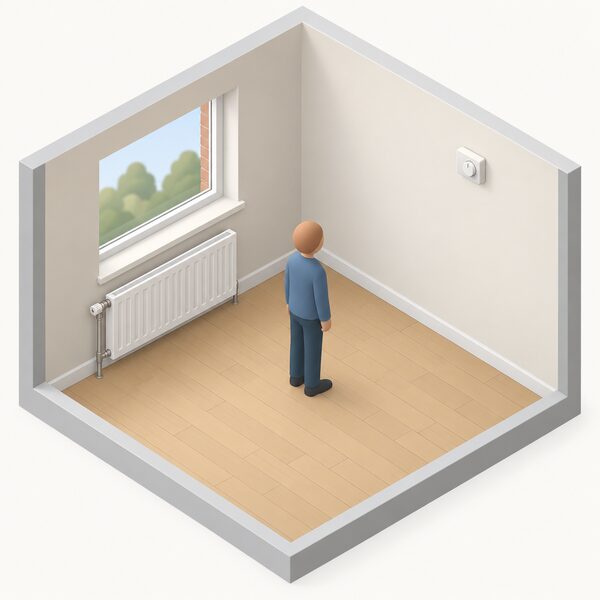
The clearest placement rule in the regulations concerns the room containing the room thermostat. Approved Document L Volume 1 states:
The rule is set out in Approved Document L Volume 1: thermostatic radiator valves should not be used in the same room as the thermostat, and heat emitters in that room should have manual controls instead23. The reason is competition between two devices measuring the same air: if the valve closes first, the room thermostat may never reach its target and the boiler can keep firing for the rest of the house.
Heat emitters in that room should have manual controls instead23. The reason is competition between two sensors in one space: consumer testing explains that TRVs and the thermostat will fight each other24, and a control maker warns that if the thermostat is positioned in the same room as a radiator controlled by a TRV, the thermostat may not reach its target temperature and the heating could stay on25. One boiler manufacturer repeats the rule bluntly: a TRV should not be fitted on a radiator in the same room as a room thermostat26. The corollary is that there is no need to have a TRV in the same room as the thermostat27.
Bathrooms are a genuine point of disagreement. Consumer guidance says TRVs are not recommended in bathrooms, as humidity will interfere with their perception of the air temperature24, and one boiler maker states TRVs should not be installed on bathroom radiators or towel rails at all27. Against that, a control head maker says heads can be installed on hot water radiators including radiator towel rails15.
Radiators that are hard to reach are a further case. Valves with remote temperature sensors and remote valve control options are described by their maker as ideal for regulating inaccessible radiators, such as those behind cabinets or heavy furniture, or placed high up28.
- Good candidates: bedrooms, spare rooms, hallways and dining rooms that are occupied intermittently1
- Avoid: the room containing the room thermostat23
- Contested: bathrooms and towel rails24
- Special case: obstructed or high level radiators, where a remote sensing head helps28
TRVs and the main thermostat: who controls what
A common misunderstanding is that TRVs make a room thermostat redundant. They do not, and the regulations assume both. Typically both room thermostats and thermostatic radiator valve controls are required29. The division of labour is simple: the room thermostat decides whether the system runs at all, and the TRVs decide which radiators accept heat while it does. Just like the main thermostat, TRVs measure the temperature in the air, not the radiator4.
Because a TRV has no communication with the boiler3, a house fitted only with TRVs can end up with the boiler firing into a circuit where every valve has closed. That is why a TRV should be installed with a room thermostat to provide boiler interlock, the arrangement that shuts the heat source down when no heat is called for27. Householders who want per room timing beyond simple temperature limiting are looking at programmable valves or heating zoning rather than at mechanical TRVs.
Smart valves change the balance again. A smart TRV, meaning a smart thermostatic radiator valve19, can report room temperature back to a hub and in some systems influence when the boiler runs, turning each radiator into a controllable room. One trial set out to determine the potential benefits of a smart thermostat with smart TRVs on radiators to allow different temperatures in different rooms. The independence trade is direct: the mechanical valve depends on nothing, while the smart valve depends on batteries, wifi, a hub and a manufacturer's app and servers. That dependence is covered in more detail on heating controls and energy independence.
Savings: the figures and why they vary so widely
Published savings for TRVs range from a few pounds to a fifth of a heating bill, because the studies measure different things.
| Claim | Figure | Source type |
|---|---|---|
| Adding TRVs to a system that already has a programmer and thermostat | £30 a year in GB, £40 in NI5 | Independent guidance, 2026 |
| Correctly set TRVs in rooms other than the living room | 19% reduction in energy use30 | Industry body, 2021 (2018 study) |
| Turning down valves outside the living room by one setting | additional £78 per household a year7 | Independent, 2023 |
| Lowering the setting on TRVs, UK-wide | 13.8 TWh/year, £1.5bn/year, 5.5% of a household bill31 | Independent statistics, 2024 |
| Using TRVs and heating controls properly | around £100 a year32 | Independent charity, 2025 |
| TRV trimming on air source heat pump systems | 6 to 8% space heating energy saving33 | Industry body test, Salford Energy House, 2026 |
The £30 to £40 figure is the marginal value of adding valves to a home that already has good controls, and it is the most conservative and the most recent independent number5. The larger percentages assume the valves are then actually turned down in unoccupied rooms, which is a behaviour change rather than a hardware change: Nesta's figure is explicitly for readjusting existing TRVs outside the living room to 1.5°C cooler than before7. The Salford test, on heat pump systems, also found that TRV use resulted in a reduction in the air temperatures of adjoining zones33, a reminder that rooms leak heat into each other and that savings measured room by room do not simply add up.
For a broader treatment of the evidence, see do TRVs save energy and gas?.
When a TRV is required: Building Regulations across the UK
For extensions and new radiators, the position is stated directly in official guidance for England and for Wales: any new radiator installed will require a thermostatic radiator valve to be installed, and it is also encouraged to place TRVs on existing radiators10. Approved Document L Volume 1 adds the placement exception for the room containing the thermostat23.
In Scotland, the technical handbook requires that any conservatory with heating installed should have controls that regulate it from the rest of the dwelling, for example a TRV to each radiator35. Earlier Scottish draft compliance guidance concluded that, in normal circumstances, the installation of thermostatic radiator valves in wet central heating systems is likely to be economically feasible, which is the test that decides whether self-regulating devices must be retrofitted36. In Northern Ireland, the building regulations discussion document states that thermostatic control measures typically require both room thermostats and thermostatic radiator valve controls29.
The detail of each nation's rules is set out on Building Regulations for heating controls across the UK and TRV requirements under building regulations.
Choosing a TRV: types, price and lifespan
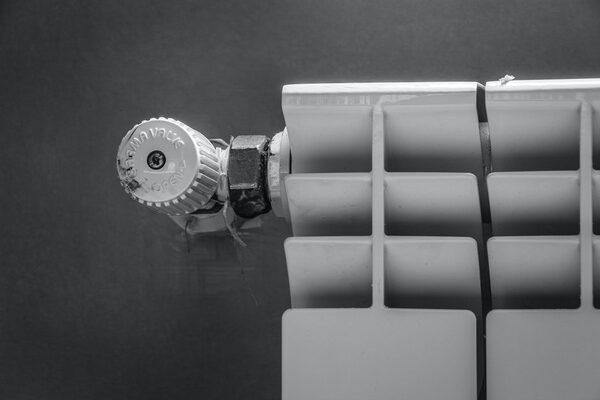
Three broad types are sold in the UK. The simplest and most common are valves with an incorporated probe, installable on all types of radiator in the home28. Next are valves with a remote sensor or remote adjuster on a capillary, for obstructed radiators28. Third are digital and smart heads, described by one maker as the most advanced thermostatic radiator valves, offering remote and scheduled programming15.
| Type | Indicative price | Notes |
|---|---|---|
| Manual TRV | from around £1037 | No power, no app, no scheduling |
| Normal thermostatic radiator valve | about £158 | Price for the valve only, 2025 |
| Smart radiator valve | £35 to £80 each24 | About five times the cost of a traditional TRV24 |
Prices are for hardware. Fitting is quoted by the installer and depends on the size of the home and how many radiators are involved38. Choice of valve depends on budget, heating preferences and the surface area of the rooms concerned, and heads are commonly finished in white, chrome or nickel15.
On life expectancy, a manufacturer states that thermostatic radiator valves last a very long time, usually at least fifteen years9. That is a maker's figure for its own products rather than an independent test result. The underlying technology is old: the first TRV prototype dates from 1943. Costs across the whole control set are compared on how much do heating controls cost?.
Fitting a TRV: installation and care
Changing a head is a different job from changing a valve body, and the distinction decides whether a plumber is needed.
- Head only. A smart or replacement head can be installed without a professional if the radiator already has a TRV24. One maker states its radiator valves can be self-installed if TRVs are already present16. The system does not need draining.
- Whole valve. Replacing manual valves will likely need a plumber24. The sequence a maker describes is: drain the radiators and central heating circuit as needed, disassemble the current valve, unscrew the nut connecting the old valve, secure and seal the new valve, then tighten the ring to fix it to the radiator9.
- Pair with the lockshield. The opposite end of the radiator keeps its lockshield valve, set during balancing11.
Care is mostly about the radiator rather than the valve. If the top of a radiator is cool, or much colder than the bottom, trapped air is the likely cause and bleeding usually clears it39. The opposite symptom, hot at the top and cold at the bottom, points to sludge or debris in the system, which can be flushed out by a professional39; other guidance describes this as an indication that a power flush is needed40. Checking radiators at least once a year to see if they need bleeding is the usual advice40. Keeping radiators unblocked by furniture matters too, since a blocked radiator cannot circulate warm air and the room takes longer to reach the valve's set point.
What TRVs do, and do not do, for household independence
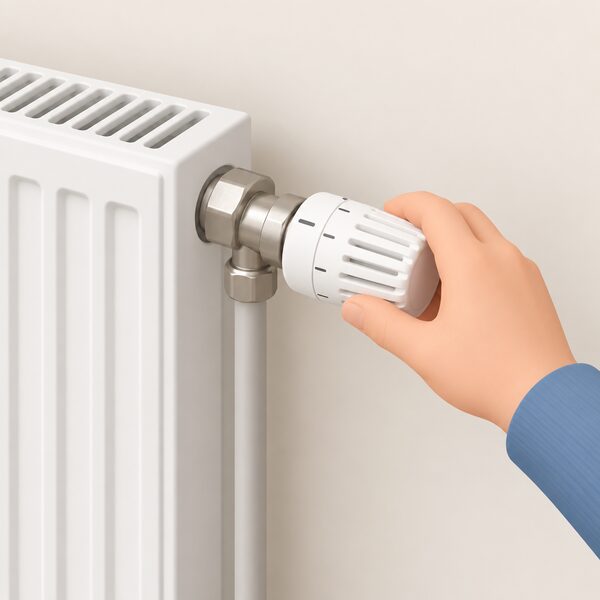
A mechanical TRV is one of the few heating controls that adds nothing to a household's list of dependencies. It needs no electricity, no battery, no wifi, no account and no subscription, it works with any wet system whatever the fuel, and it keeps working if the broadband fails or a manufacturer withdraws an app. Its effect is to cut the amount of heat a home needs in the first place, which is the part of energy demand a household actually controls.
What it does not do is make a home self-sufficient in heat. The boiler or heat pump still needs fuel or electricity from a supplier; the valve only rations where that heat goes. It has no communication with the boiler3, so it cannot on its own satisfy the interlock requirement or provide timed zoning. And smart versions reintroduce exactly the dependencies the mechanical valve avoids: batteries, a hub, a wireless network and a manufacturer's cloud service. Both are legitimate choices, and the difference is worth understanding before a whole house is fitted with either.
Sources40 cited
- Radiator valves explained, Smart Energy GB, 2026-04-22
- Retrofit jargon buster, Retrofit Academy, 2019-09-06
- ECO4 new measures and products guidance v3.0, Ofgem, 2026-03-26
- Boiler thermostats: a complete guide, Ideal Heating, 2026-09-17
- Take control of your heating at home, Energy Saving Trust, 2026-09-11
- Lockshield and drain-off valve datasheet, EPH Controls, 2026
- Wallet warmers: British families can save £160 on annual bills, Nesta, 2023-09-26
- Boiler prices: how much does a new boiler cost, Which?, 2025-09-17
- Thermostatic taps and radiator valves, Netatmo, 2026-09-20
- Building regulations and energy efficiency for additional storeys, Planning Portal, 2026
- Radiator thermostats explained, tado°, 2026-07-07
- Keeping warm in winter, CIPHE, 2022-12-19
- Thermostats and heating controls, Energy Saving Trust, 2026-02-10
- How smart radiator valves work, Netatmo, 2026-09-20
- Thermostatic control heads, Netatmo, 2026-09-20
- Hive Radiator Valve, Hive, 2026-09-17
- Thermostatic radiator valve datasheet, EPH Controls, 2026
- Heat your home efficiently, Citizens Advice, 2022-12-21
- Understanding smart TRVs, Drayton Wiser, 2024-12-01
- Radiator valves explained, Viessmann, 2022-05-31
- Thermostatic radiator valve guide, Fuse Energy, 2026-06-30
- Protect your pipes this winter, Home Energy Scotland, 2025-12
- Approved Document L Volume 1, 2026, Welsh Government, 2026-04
- Best smart radiator valves, Which?, 2026-09
- Hive Thermostat Stand, Hive, 2026-09-17
- Boilers explained, Worcester Bosch, 2026-09-17
- What is boiler interlock, Viessmann, 2022-05-31
- Thermostatic valves, Netatmo, 2026-09-20
- Building regulations discussion document and pre-consultation, Department of Finance Northern Ireland, 2023-10-11
- The power at our fingertips: a manifesto for best practice heating controls, BEAMA, 2021-10
- Boiler statistics, Uswitch, 2024-01-04
- Energy saving tips for winter, Centre for Sustainable Energy, 2025-12-10
- Summary of BEAMA air source heat pump TRV Salford Energy House test, BEAMA, 2026-04
- Building regulations for extensions: energy efficiency, Welsh Government, 2026-09-17
- Building standards technical handbook 2022: heating system, Scottish Government, 2022-06-01
- Draft domestic building services compliance guide, Scottish Government, 2010
- No-cost and low-cost energy saving, Low Carbon Hub, 2026-08-05
- How to use your heating controls, Age UK, 2026-03-23
- How to bleed a radiator, Smart Energy GB, 2026-08-17
- Boiler maintenance guide, Uswitch, 2026-09-03
 The Full Heating Controls GuideA room thermostat, a programmer and valves on your radiators are the basics.
 Smart TRVs ExplainedSmart radiator valves let you heat one room without heating the rest, on a schedule you set from your phone.
 Controls, Thermostats and TRVsWhich heating controls actually cut your bills, and what does each one do?
 Boiler Interlock ExplainedWhy does your boiler keep firing when nothing is calling for heat?
 Room Thermostats ExplainedExplains mechanical, digital, programmable, wired, wireless and smart room thermostats, how they call for heat and switch it off, where to site them, how many zones a home needs under the building regulations, and what one degree on the dial is worth.
 Hot Water Cylinder ControlsWhat temperature should a hot water cylinder thermostat be set to, and does it need its own timer apart from the heating?