

In this comparison
A smart TRV controls one radiator. A smart thermostat controls the whole heating system. That single difference decides most of what follows: the valve gives room-by-room temperature control, the thermostat gives central scheduling, remote control and the boiler interlock that the rest of the system depends on.
A smart thermostat is an internet-connected thermostat that gives you digital control over your home's central heating, and it connects to Wi-Fi, which allows it to form part of a more connected home heating system1. A smart TRV, short for smart thermostatic radiator valve, does something narrower: it regulates the flow of hot water to a single radiator based on that room's temperature2. Neither replaces the other, and most homes that want genuine room-by-room control end up with both.
The choice matters for energy independence because it decides how much of the system stays under local control. A thermostat that needs a hub, a router and a manufacturer's cloud service is dependent on all three. A valve that runs on its own schedule, or a control that works without a smartphone or internet connection, keeps more of the decision-making inside the house. The sections below set out what each device does, how they combine, what they cost in installation terms, and where the limits fall.
Smart TRV or smart thermostat: what each one does
The two devices sit at different levels of the same system. A thermostatic radiator valve gives better control over the individual room temperatures, which is the function the Welsh Government's building regulations guidance describes when it explains why new radiators must have one4. A smart thermostat controls heating and helps you manage how your central heating is set and adjusted, and it does so from one point rather than many1.
The practical difference is what happens when a room gets too warm. A TRV closes down the water flow to its own radiator and nothing else changes. A thermostat reaches its setpoint and shuts the boiler down, stopping heat to every radiator on the circuit. That is why the two are complementary rather than competing: the thermostat sets the ceiling for the whole house, and the valves trim individual rooms below it.
Smart versions of both add connectivity. A smart thermostat connects to Wi-Fi and can be programmed or remotely controlled to manage the home's temperature quickly and easily7. Smart TRVs go further than a plain valve: some learn about your habits and your home's thermal performance, and over time predict when to adjust settings8. Some smart TRVs will also automatically sense whether a room is occupied and adjust the temperature of that room accordingly9.
For a household thinking about independence, the split matters. The thermostat is the device most likely to depend on a hub, an app and a manufacturer's servers. The valve is the device most likely to keep working as a local control even if the app is retired, because its job is mechanical: open or close the water.
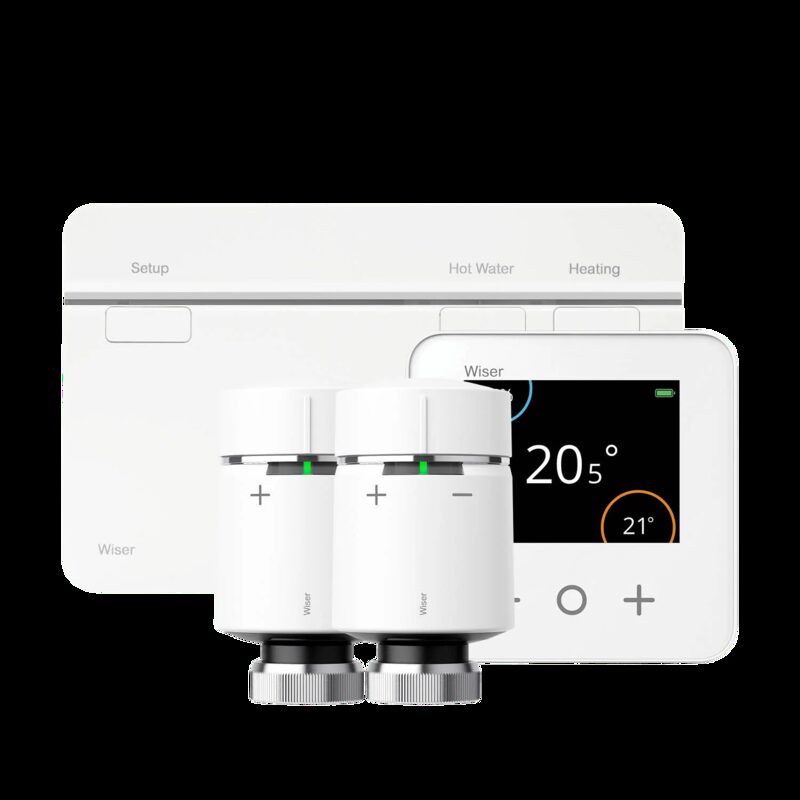
What a smart TRV is and how it controls a single radiator
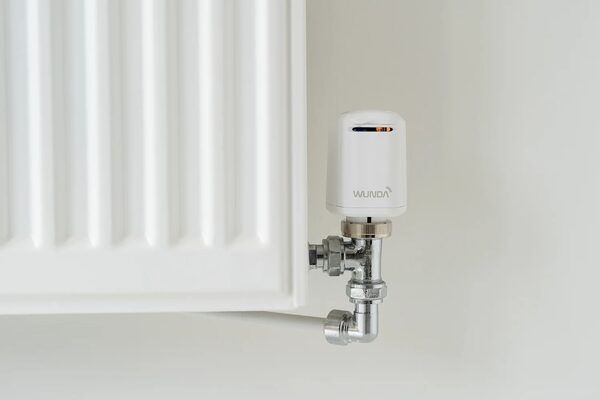
A thermostatic radiator valve works by regulating the flow of hot water to the radiator based on the room's temperature2. The head sits on the valve body at the end of the radiator and expands or contracts to open and close the water path. A smart TRV is the same mechanism with a motor, a sensor and a radio inside, so the setpoint can be changed from an app or a schedule rather than by hand.
The range of behaviour across models is wide. Programmable thermostatic radiator valves are TRVs with timing control as well: they let you set each radiator to come on at different times and heat each room separately3. At the top end, smart TRVs create zones within a home, with the ability to program each device to heat individual rooms with custom schedules8. Bosch's own smart TRVs are described as smart thermostatic radiator valves which, in combination with the EasyControl, allow you to control the heating in each individual room, and they include a child-lock setting controlled through the EasyControl, an integrated sensor that continuously monitors room temperature, and several time-controlled settings per day with different times for every day of the week10.
Two siting rules apply to any TRV, smart or not. Thermostatic radiator valves should not be used in the same room as the thermostat, and heat emitters in that room should have manual controls instead6. They are also not recommended in bathrooms, as the humidity will interfere with their perception of the air temperature5. Both rules exist because a TRV reads the air around it; put it somewhere unrepresentative and it will misjudge the room.
For independence, a smart TRV is a modest gain: it lets a household stop heating rooms it is not using, without touching the boiler. What it does not do is remove the dependence on the boiler, the gas supply or the electricity that runs the valve's motor and radio.
What a smart thermostat controls and where it sits in the system
A smart thermostat is the system's brain. It controls heating, and it manages how the central heating is set and adjusted1. It also holds the boiler interlock: when the thermostat is satisfied, the boiler stops firing, which is the mechanism that turns a temperature setting into a fuel saving.
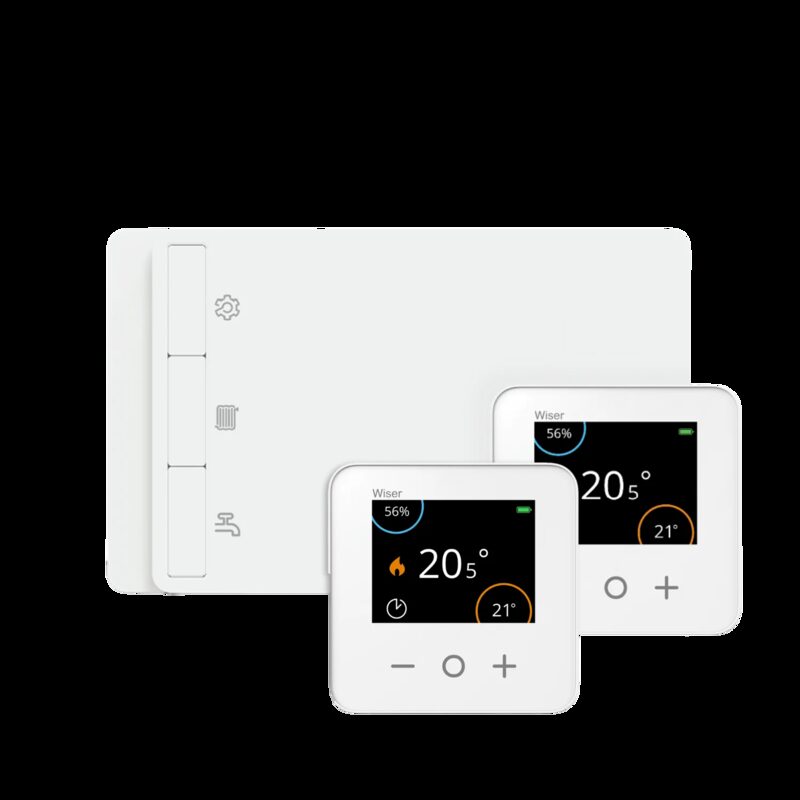
Most smart thermostats are made up of three parts: a hub, a receiver, and the smart thermostat itself11. The hub connects to the router and allows control of the heating and other connected devices; the receiver wires into the heating system; the thermostat measures and sets. Installation follows that order: set up the hub, wire the receiver up to the heating system, then finish setting up using the app12.
Placement is not arbitrary. The best place to put a smart thermostat is in a place where the temperature is relatively consistent13. A hallway away from draughts and direct sun is the usual answer, and it is also the room where a TRV must not be fitted, for the reason given above.
The controls a system is expected to have are set out independently. Energy Saving Trust lists a programmer for time control, at least one room thermostat, thermostatic radiator valves if there are radiators, and a cylinder thermostat if the system has a hot water cylinder3. Home Energy Scotland gives the same core list7. A smart thermostat replaces the programmer and the room thermostat in that list; it does not replace the TRVs.
The independence question is sharpest here. Smart thermostats such as Hive and Nest connect to your Wi-Fi so you can control your heating and hot water through your smartphone, tablet or desktop14. That is convenient, and it also means the household's control passes through a router, a broadband connection and a manufacturer's service. Some controls are built the other way round: the Passiv Smart Thermostat provides full control of heating and hot water without a smartphone or internet connection, and the maker states there are no ongoing charges and every feature is included for free15.
Using both together: room-by-room control with central management
The combination is where the design intent shows. Smart and connected TRVs provide additional controllability by allowing you to set the temperature in each room from a central point and allowing each room to have different temperatures at different times throughout the day9. The thermostat supplies the central point; the valves supply the room-by-room resolution.
The rules that make this work are the same ones that apply to ordinary TRVs. Approved Document L Volume 1 states that thermostatic radiator valves should not be used in the same room as the thermostat6. In practice that means one radiator, usually where the thermostat is sited, keeps a manual valve or a plain lockshield, and every other radiator can carry a smart TRV.
A workable arrangement for a typical home looks like this:
- The smart thermostat sits in the most representative room and holds the whole-house setpoint.
- The radiator in that room has manual control, not a TRV.
- Smart TRVs go on the radiators in rooms with different occupancy patterns, such as bedrooms and a home office.
- Bathrooms are left on manual or fixed settings, because humidity interferes with TRV sensing5.
- Schedules are set per room rather than per house, which is the point of the exercise.
The gain is that unoccupied rooms stop drawing heat while the rest of the house stays warm. The dependence that remains is unchanged: the boiler still fires, the gas still arrives from a supplier, and the valves still need power and, in most systems, a hub and a working app.
Compatibility: not all smart TRVs work with all smart thermostats
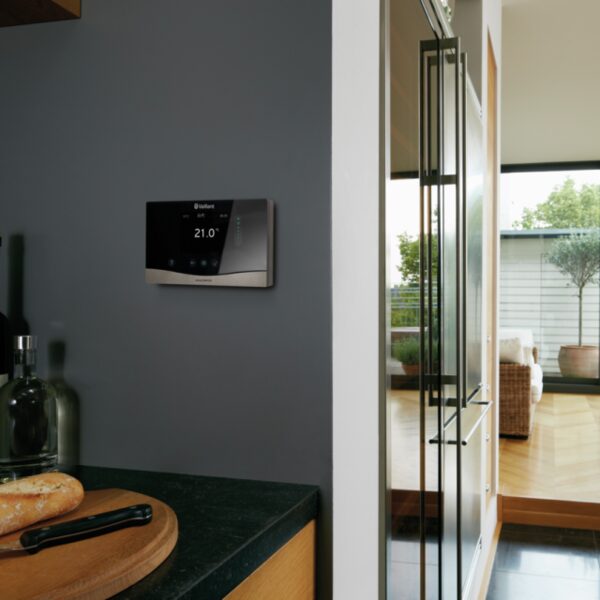
This is the constraint that decides most purchases. Most smart radiator valves will not work with another manufacturer's smart thermostat and connecting device, so the valve and the thermostat generally have to come from the same stable5. A household that already owns a thermostat is therefore largely committed to that maker's valve range.
The thermostat side has its own checks. Before buying a smart thermostat, check that it is compatible with your boiler and heating system, usually in the product description or on the thermostat manufacturer's website1. Hive states that if your boiler works with a standard room thermostat or programmer, then Hive can control it11. Vaillant's guidance is that not every boiler is compatible, but most are, and the boiler manufacturer should be checked before committing to the purchase16. Hive's system does not work with storage heaters or individual plug-in electric room heaters11.
Most smart thermostats work with gas and electric boilers and heat pumps, but some systems such as wet or hydronic underfloor heating and very old wired setups may need relays, actuators or a compatible receiver12. Smart thermostats and heating controls can be used with all types of heat pumps, including air source, ground source and water source heat pumps16.
Where a maker sells both halves, the pairing is documented. Bosch Smart TRVs work with the EasyControl for individual room control10. The EasyControl itself is a smart connected thermostat which makes it easy to control heating and hot water, and Which? lists it as requiring professional installation, with hot water control, modulating operation, GPS tracking, a motion sensor, weather-responsive behaviour and program modes10.
Installation: what needs a professional and what you can do yourself
The two device types sit at opposite ends of the DIY scale. A smart radiator valve can be installed without a professional if the radiator already has a TRV, because the valve body is already in place and only the head is swapped. If you are replacing a manual valve, that will likely need a plumber, since the radiator has to be isolated or the system drained5.
Smart thermostats are heavier work. Most wired thermostats require electrical work and are best handled by a professional, while some wireless thermostats and TRVs are DIY-friendly12. Hive recommends professional installation of its smart thermostats17, and its own guidance is that if you are experienced with electrical wiring then technically you can install a thermostat yourself, but professional help is always recommended12. Google Nest recommends professional installation of the Nest Learning Thermostat, but self-installation of the Smart Thermostat E should be achievable for most17. The Nest Learning Thermostat requires professional installation13. Vaillant states that, depending on the configuration of the heating system, a smart thermostat should be fitted by a Vaillant installer16. The Passiv Smart Thermostat requires professional installation15.
Cost follows the same split. If you want a smart thermostat, you may have to pay for the device, and the installation18. Smart TRVs bought as heads only avoid that labour where the valve body already exists.
Pairing smart TRVs with a heat pump

Heat pumps run at lower flow temperatures for longer, so the way TRVs interact with them has been tested rather than assumed. The Energy House Labs testing project was designed to assess the impact of analogue and smart TRVs on air source heat pump performance and to inform future modelling of TRVs deployed alongside heat pump systems19.
The results cut both ways. The tests found that trimming internal temperatures with both traditional and smart TRVs reduced air source heat pump space heating energy, and did not significantly impact the heat pump's coefficient of performance19. But using smart TRVs on all radiators to provide a setback between heating periods significantly increased heat pump cycling19. In other words, room-by-room trimming helps; using the valves as a whole-house on/off mechanism works against the heat pump.
That distinction matters for a household weighing independence. A heat pump already reduces dependence on gas, but it increases dependence on electricity and on a well-set control system. TRVs that trim individual rooms support that; TRVs that shut most of the system down and force the compressor to cycle do not.
Which setup suits which home
The choice follows occupancy patterns more than house size. A flat or a small house where every room is used at the same time gains little from room-by-room valves, because there is no unheated space to create. A house with a home office, spare bedrooms or a room over a garage gains more, because those rooms can be held lower while the rest stays warm.
Where a household already has a smart thermostat, the practical route is that maker's own TRVs, given the compatibility limit5. Where there is no thermostat yet, the decision is whether the household wants central scheduling with room-level trimming, or a simpler arrangement of programmable TRVs with timing control on each radiator3.
Evidence on satisfaction is limited but positive for at least one system. In a case study of the Passiv Smart Thermostat, most users were satisfied compared to their previous heating setup, and were likely to recommend their Passiv controls20. That is one system, and it is a control that works without a smartphone or internet connection15.
Two cautions apply to any purchase. A smart thermostat could save you money, but savings aren't guaranteed, and any cost benefit comes from reducing wasted heating rather than from the thermostat itself, so results will vary from home to home1. And smart thermostats such as Hive and Nest can be expensive and have an installation cost, and having one means you are only tracking your heating, so you cannot keep an eye on your electricity and gas usage14.
For the wider picture on how these devices fit with programmers, zoning and boiler interlock, see heating controls, smart thermostats and smart TRVs. Households weighing the two device types against a conventional time control may find smart thermostat vs traditional programmer useful, and those with a heat pump should read why TRVs are often left off heat pump installations.
Sources20 cited
- What is a smart thermostat, Smart Energy GB, 2026-08-19
- Radiator valves, Smart Energy GB, 2026-04-22
- Thermostats and heating controls, Energy Saving Trust, 2026-02-10
- Building regulations: energy efficiency, Welsh Government, 2026-09-17
- Best smart radiator valves, Which?, 2026-09
- Approved Document L Volume 1 2026, Welsh Government, 2026-04
- Thermostats and heating controls, Home Energy Scotland, 2026-09-20
- Understanding smart TRVs, Drayton Wiser, 2024-12-01
- Heating controls buyers' guides, BEAMA, 2020-11-27
- Bosch EasyControl, Worcester Bosch, 2026-09-17
- How does a smart thermostat connect to a boiler, Hive, 2025-12-17
- A simple guide to smart thermostats, Hive, 2025-11-20
- What are smart thermostats, Uswitch, 2026-02-05
- Ultimate energy saving tips guide, Smart Energy GB, 2026-04-24
- Passiv Smart Thermostat, Passiv UK, 2026-09-04
- What is a smart thermostat and are they worth it, Vaillant, 2026
- How to buy the best smart thermostat, Which?, 2026-09-17
- Do I already have one, Smart Energy GB, 2026-03-16
- BEAMA air source heat pump TRV Salford Energy House test, BEAMA, 2026-04-16
- Passiv smart thermostat research, Centre for Sustainable Energy, 2025-05-29
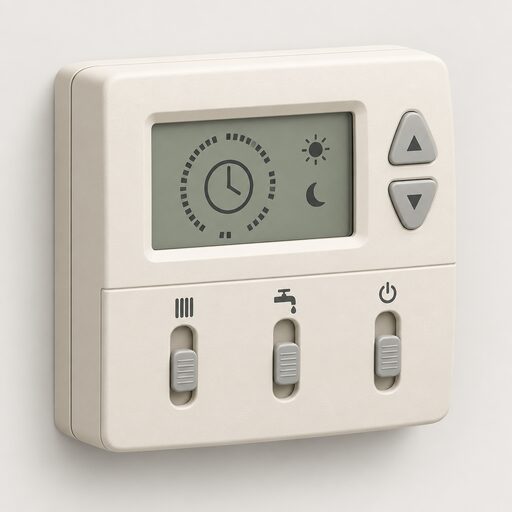 Controls, Thermostats and TRVsWhich heating controls actually cut your bills, and what does each one do?
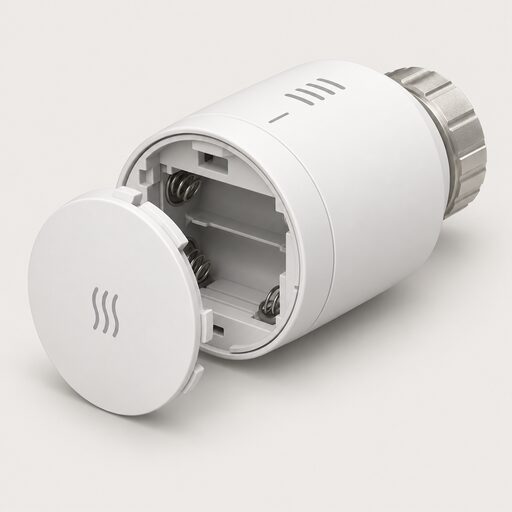 Smart TRVs ExplainedSmart radiator valves let you heat one room without heating the rest, on a schedule you set from your phone.
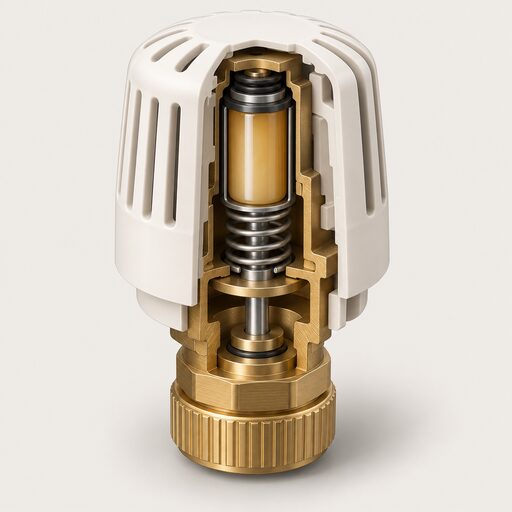 Thermostatic Radiator ValvesHow a thermostatic radiator valve senses room air temperature and throttles flow to a single radiator, what the numbered settings mean, where TRVs should and should not be fitted, and what the Building Regulations require across the UK.
 The Full Heating Controls GuideA room thermostat, a programmer and valves on your radiators are the basics.
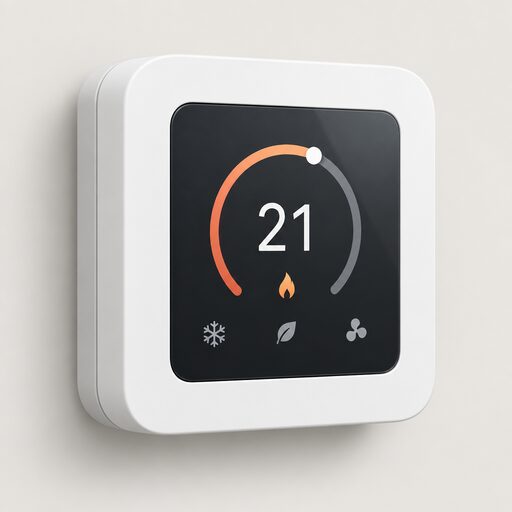 Heating Controls CostA smart thermostat usually costs between about a hundred and two hundred and fifty pounds, but fitting can push that higher.
 Smart Thermostats ExplainedWhat does a smart thermostat actually do, and is it worth it?