
In this guide
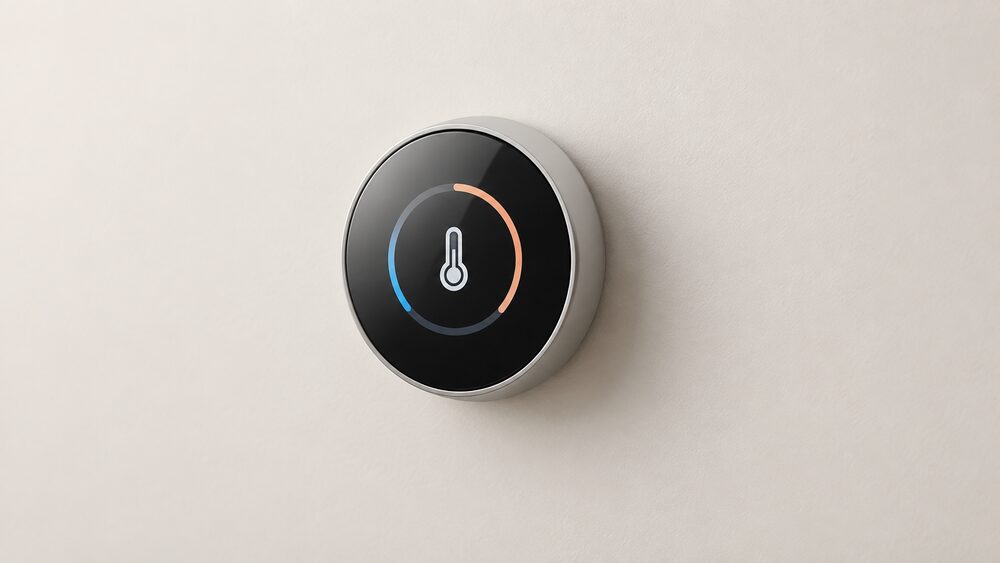
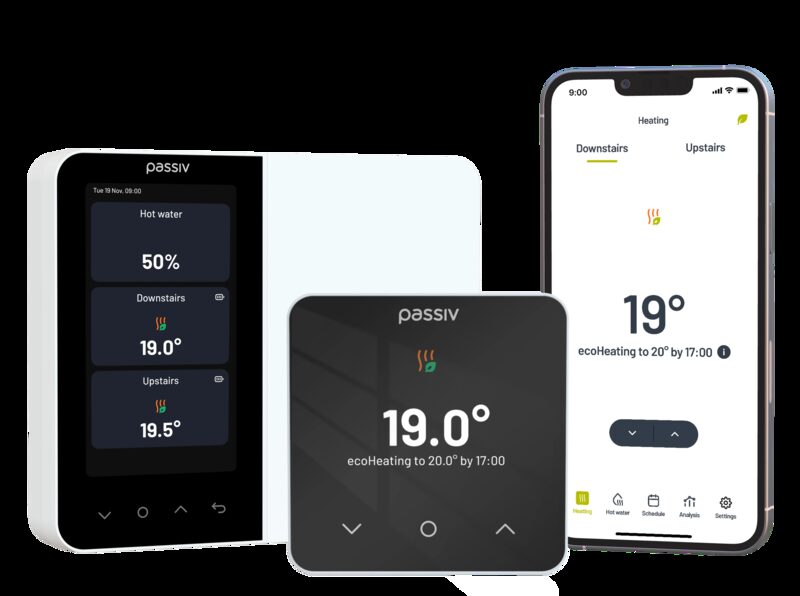
The Passiv Smart Thermostat is a heat pump control made by Passiv, a UK company that led the Smart Temperature Automation Technology project under the government's Heat Pump Ready Programme, with new heat-pump controls launched in 20241. It is not a general-purpose consumer thermostat. It is a control designed to sit on a heat pump and run it better, using either RS485 Modbus or relay wiring, and it is sold through plumbers' merchants and renewable distributors rather than through retail shelves2.
The headline claims are specific. Passiv states the thermostat reduces energy bills by up to 30%, and that Modbus control delivers an EST validated COP improvement of 17%1. The Centre for Sustainable Energy was commissioned by Passiv to research how the device performs with real households, and published its findings in May 20253.
For a household weighing energy independence, the appeal is straightforward: a control that optimises a heat pump against weather, tariffs and grid conditions can lower the running cost of an electrically heated home, and Passiv states the thermostat provides full control of heating and hot water without a smartphone or internet connection2. The dependence that remains is on the heat pump itself, on the installer who commissions the control, and on whichever flexibility arrangement pays the household for shifting load.
What the Passiv Smart Thermostat is and who makes it
Passiv is the lead partner on the Smart Temperature Automation Technology project funded through the Heat Pump Ready Programme, and the thermostat is the commercial product to come out of that work, with the controls launched in 20241. The Centre for Sustainable Energy, an independent charity, was commissioned by Passiv to research the device in use, and published its case study in May 20253.
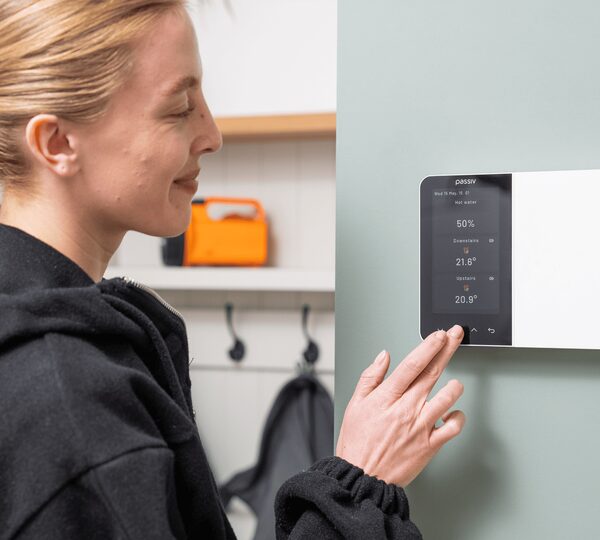
The category it belongs to is wider than the product. A smart thermostat is defined in independent guidance as an internet-connected thermostat giving digital control over a home's central heating4. Most smart heating controls link to a phone, and heating can be controlled via smartphone, tablet or laptop, or by voice through a smart speaker5. Passiv's positioning is deliberately different: it states that unlike other smart thermostats, the device provides full control of heating and hot water without a smartphone or internet connection2.
That matters for the independence question. A control that needs a broadband connection, a manufacturer's cloud service and a working app introduces three points of failure between a household and its heating. A control that runs locally does not. The trade-off is that remote access, monitoring and any cloud-based optimisation are not part of the offer in the same way.
The thermostat also appears in scheme documentation. Under the ECO4 measures table it is listed as a Smart Thermostat measure, with the measure type given as Smarttherm6. That places it within the framework of measures that can be installed under energy efficiency obligations, rather than only as a private purchase.
How it works: machine learning, flow-temperature optimisation and preheating
The mechanism behind controls of this kind is weather and load compensation. Independent guidance explains that load and weather compensation adjust the boiler flow temperature to maximise efficiency, and that a smart thermostat is probably the easiest way to add compensation to an existing system5. The same principle applies to a heat pump, where flow temperature is the single biggest determinant of efficiency.
Smart heating thermostats may interpret inputs such as preferred room temperature, learn from what you do, react to other data such as weather forecasts, and some have a learning function that predicts behaviour from how you set and adjust heating and how you occupy the home5. That is the general description of the category; Passiv's own claim is that the thermostat optimises heat pumps according to the weather, energy prices and other inputs, and that Modbus control delivers the best level of bill savings2.
Preheating is the flexibility half of the story. Heat pumps and smart thermostats can pre-heat or cool a home before peak hours, then ease off when the grid is under pressure7. That is what turns a control into something a household can be paid for, and it is the mechanism behind Greener Grid Payments.
"Heat pumps and smart thermostats can pre-heat or cool your home before peak hours, then ease off when the grid is under pressure."
The practical effect is that the control is doing two jobs at once: trimming flow temperature to raise efficiency, and moving demand in time to cut cost. Neither is a substitute for correct sizing, emitter capacity or insulation, and a control cannot make a badly sized heat pump efficient.
Efficiency and bill savings: up to 17% more efficiency and up to 30% off bills
The two figures that matter are a 17% COP improvement and a bill reduction of up to 30%. The COP figure is described as EST validated, and it applies to RS485 Modbus control1. The bill figure is Passiv's own, stated as reducing energy bills by up to 30% through optimising heat pumps according to the weather, energy prices and other factors2.
Those are different kinds of number. A COP improvement is a measure of how efficiently the heat pump converts electricity into heat. A bill reduction depends on the tariff, the household's pattern of use and the price of electricity, so the same efficiency gain can produce very different bill outcomes. Independent guidance is explicit that a smart thermostat could save money but that savings are not guaranteed and depend on the home, heating habits, existing controls, energy prices and how the thermostat's features are used4.
For context on what controls can deliver generally, the Energy Saving Trust estimates savings of around £75 per year with a smart thermostat8. That is a much smaller figure than a 30% bill reduction, and the two are not directly comparable: the £75 estimate covers a boiler-based home with a conventional thermostat, not a heat pump running on a time-of-use tariff with a control optimising flow temperature.
| Claim | Figure | Basis | Source |
|---|---|---|---|
| COP improvement | 17% | EST validated, RS485 Modbus control | Passiv, via Heat Pump Ready1 |
| Bill reduction | up to 30% | Maker's claim, smart controls and tariff optimisation | Passiv2 |
| Typical smart thermostat saving | around £75 per year | Energy Saving Trust estimate | CPA8 |
| Savings guarantee | none | Depends on home, habits, controls, prices | Smart Energy GB4 |
The honest reading is that the 17% figure is the one with independent validation behind it, and the 30% figure is the ceiling of a maker's claim that assumes tariff optimisation as well as efficiency gains. A household on a flat-rate tariff will not see the tariff half of that.
Modbus or relay: which control method fits which heat pump
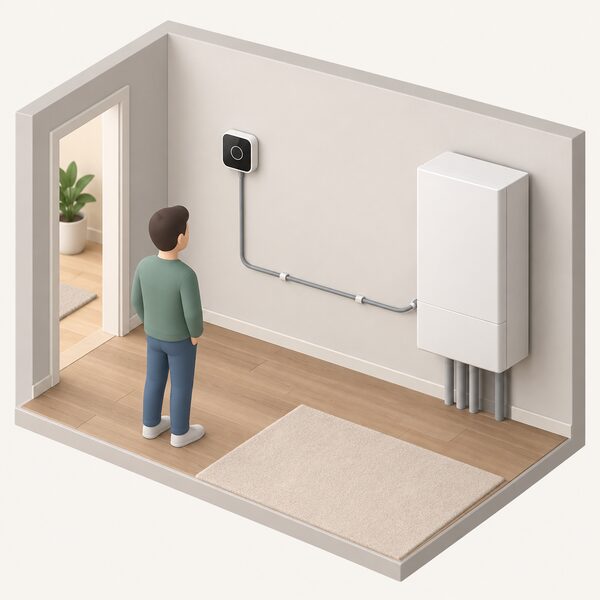
The thermostat can control a heat pump in one of two ways: RS485 Modbus or relay2. The choice determines both the level of control and what the thermostat can manage.
Modbus is a digital communications protocol. Passiv states that control via RS485 Modbus is possible with many leading heat pump brands and delivers the best level of bill savings, including the 17% efficiency gain2. Because it is a data connection rather than a switch, the thermostat can read and set parameters inside the heat pump rather than simply calling for heat.
Relay control is the simpler method. Passiv states that control via relay is possible with all heat pump makes and models2. That universality is the advantage, and the limitation is stated just as plainly: with relay control, the thermostat will only control space heating and not hot water2.
| Control method | Compatibility | Hot water | Claimed performance |
|---|---|---|---|
| RS485 Modbus | Many leading heat pump brands2 | Not stated as excluded | Best bill savings, 17% COP gain1 |
| Relay | All heat pump makes and models2 | Space heating only, not hot water2 | Not stated |
Modbus is not unique to Passiv. SolaX Thermal R290 Series air-to-water heat pumps list Modbus TCP/RTU and SG Ready compatibility9. SG Ready is a separate grid-signal interface, and its presence on a heat pump is relevant to flexibility arrangements.
The practical consequence is that the control method should be settled before installation, because it determines whether the household gets hot water control and whether the efficiency claim applies. A relay-wired installation on a heat pump with a cylinder leaves hot water to the heat pump's own controls.
Compatibility: 17 heat pump manufacturers, Kensa and Worcester Bosch out of the box
Passiv states that relay control works with all heat pump makes and models, and that Modbus works with many leading brands2. The practical compatibility list is narrower than that, because it depends on which brands have been integrated and which installers fit the device.
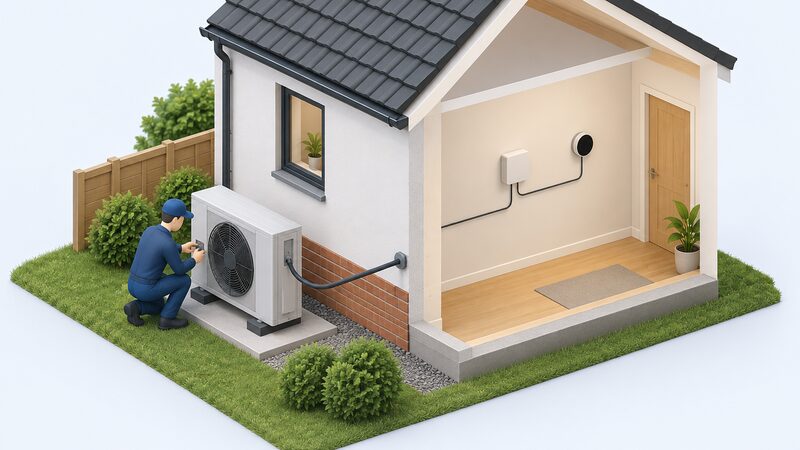
Kensa lists the Passiv Smart Thermostat among its accessories, which places it alongside Kensa's ground source heat pumps11. British Gas, described as the UK's largest heating installer, fits the Passiv Smart Thermostat with Worcester Bosch heat pumps2. E.ON Next, an energy supplier, installs the thermostat alongside Worcester Bosch heat pumps2. Those two routes mean a household buying a Worcester Bosch heat pump through either installer may be offered the control as part of the package.
For other brands, the position is that Modbus integration exists for many leading manufacturers but the specific list is not published in the material available here. A household should confirm compatibility with the heat pump model and the installer before committing, which is standard practice for any smart thermostat: independent guidance advises checking that a thermostat is compatible with the boiler and heating system before buying, usually in the product description or on the manufacturer's website4.
Tariff optimisation, solar integration and Greener Grid Payments
The thermostat's value depends heavily on the tariff it is working against. Smart meters allow households to access more flexible tariffs, including dual-rate tariffs12, and they enable innovative tariffs such as time-of-use tariffs13. Without a smart meter, a control that shifts load has nothing to shift it against.
That is where solar and battery storage come in. Independent advice covers how to use heat pump controls, shift electricity usage to use as much solar generation as possible, sign up to export tariffs, and which heat pump or time-of-use tariffs might be suitable15. A household with solar panels and a heat pump can use the control to run the heat pump when generation is high, and a time-of-use tariff lets the same control preheat when electricity is cheap.
The evidence base for this is growing. One modelling exercise tested more than a million scenarios across different home types and energy use behaviours to see how heat pumps, solar panels and battery storage affect household energy16. A separate project examined smart time-of-use electricity tariffs offered by suppliers and suited to different technologies, including tariffs for storage heaters, heat pumps, solar PV and batteries, and electric vehicles17.
Greener Grid Payments is Passiv's own route into this. The company states that households can earn money with Passiv's Greener Grid Payments as a thank you for helping balance the electricity grid2. The mechanism is the flexibility described above: preheating before peak hours and easing off when the grid is under pressure7. The terms, rates and eligibility are set by the provider, and the material available here does not give figures.
Kits, components and installation: what an installer fits and how
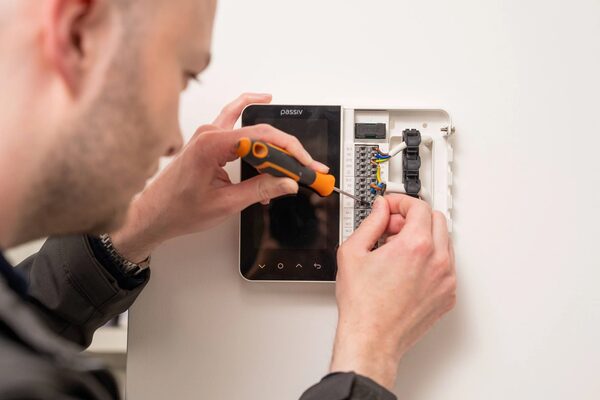
Professional installation is required for the Passiv Smart Thermostat2. That is consistent with the wider category: Hive recommends professional installation of its smart thermostats18, and independent guidance notes that many boilers are not Wi-Fi-enabled, so smart or wireless thermostat systems often include a receiver or hub that must be wired to the boiler, with wiring done by a trained professional4.
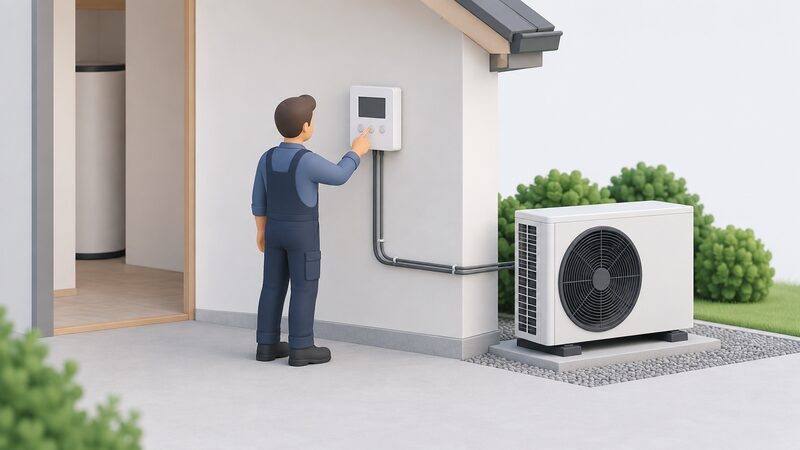
The components an installer works with are the thermostat itself, the Passiv Programmer, and the wiring to the heat pump, whether that is a Modbus data connection or a relay switch. Passiv states that the system can be commissioned from the Passiv Programmer in under two minutes without the need for a smartphone or internet connection2. That is the commissioning step, not the whole installation.
Passiv offers free installation training, available at its Newbury head office, at the installer's premises, or remotely via video call2. That training route matters because the control method determines the outcome: an installer who wires relay where Modbus was possible leaves the efficiency claim and hot water control on the table.
For households, the sequence is familiar from any heat pump installation. The heat pump is installed and commissioned, the control is wired and configured, and the system is handed over. The Centre for Sustainable Energy's research identified handover as a key intervention point for maximising outcomes, and identified some easy-win recommendations3. In other words, how well the household understands the control at handover shapes how much benefit it delivers.
Cost, availability and no ongoing subscription
Passiv does not publish a price for the thermostat on its buy-now page2. For context, most smart thermostats cost between £100 and £200, though some have add-ons such as installation that push the total higher19. Independent guidance on boiler heating controls puts a smart thermostat at around £100 to £25020, and one study puts a customer's outlay for a smart thermostat at as little as £10021.
Those are category figures, not Passiv's price. Because professional installation is required and the device is sold through trade channels, the fitted cost is installer-quoted. Households should expect the thermostat to be priced as part of a heat pump installation rather than as a standalone retail purchase.
| Item | Figure | Basis |
|---|---|---|
| Passiv Smart Thermostat | Not published | Sold through merchants and distributors2 |
| Smart thermostats generally | £100 to £200 | Independent guidance19 |
| Smart thermostat for heating controls | around £100 to £250 | Independent guidance20 |
| Customer outlay, one study | as little as £100 | Nesta, HeatFlex21 |
| Ongoing charges | None stated | Every feature included for free2 |
On subscriptions, Passiv states there are no ongoing charges and that every feature is included for free2. That is a maker's statement. The general position in the category is different: energy monitors and smart thermostats generally come at an additional cost, with subscription costs for premium services, operated via a mobile app22. A control with no subscription is a meaningful difference for a household planning running costs over a decade.
Availability is through plumbers' merchants and renewable distributors across the UK2. Kensa lists it among its accessories11, and it is fitted by British Gas and E.ON Next alongside Worcester Bosch heat pumps2.
What independent user research found
The Centre for Sustainable Energy was commissioned by Passiv to research the thermostat, and published its findings in May 20253. The research was conducted with three main groups of people: users, installers and non-users3. That structure matters, because it captures not only what households using the device thought but also why households not using it had not adopted one.
The headline finding reported from that work is strong satisfaction, with 73% finding the controls easy to use, and widespread support for smart flexibility features3. The research also identified handover as a key intervention point for maximising outcomes, and identified some easy-win recommendations3.
"feedback identified handover as a key intervention point for maximising outcomes and identified some 'easy-win' recommendations"
The practical reading is that the control performs well when it is explained properly at handover, and that the gap between a good and a poor outcome is often about understanding rather than hardware. That is consistent with the wider evidence on smart thermostats, where savings depend on how the thermostat's features are used4.
For a household, the independence picture is mixed in a useful way. The thermostat runs locally, so heating and hot water control survive a broadband outage2. It optimises a heat pump, which lowers the running cost of an electrically heated home and reduces exposure to gas prices. What remains is dependence on the heat pump manufacturer for the Modbus integration, on the installer for correct wiring and handover, and on a flexibility provider for any Greener Grid Payments. The control improves the economics of a heat pump; it does not remove the household from the electricity grid or from a supplier. For the wider context, see heat pump controls and heat pumps and household energy independence.
Sources22 cited
- Heat Pump Ready Programme Stream 2 Wave 2 projects, GOV.UK, 2026
- Passiv buy now, Passiv UK, 2026
- Passiv Smart Thermostat research, Centre for Sustainable Energy, 2025
- What is a smart thermostat, Smart Energy GB, 2026
- Smart homes and lower carbon footprint, Energy Saving Trust, 2026
- ECO4 Measures Table v4.0, Ofgem, 2025
- What is flexibility, FlexAssure, 2026
- Make your home more energy efficient, CPA, 2023
- SolaX Thermal R290 Series 8kW air to water heat pump, Quiet Mark, 2026
- SolaX Thermal R290 Series 14kW air to water heat pump, Quiet Mark, 2026
- Kensa accessories, Kensa, 2026
- HeatFlex: the untapped potential of automated heat pump flexibility, Nesta, 2024
- Getting a smart meter, Ofgem, 2026
- Smart meters, MCS Certified, 2026
- Smart Energy Action Plans, Centre for Sustainable Energy, 2026
- Clean tech combo could help households beat rising energy bills, Energy Saving Trust, 2026
- Evaluating solar PV with electric heating, National Energy Action, 2025
- How to buy the best smart thermostat, Which?, 2026
- What are smart thermostats, Uswitch, 2026
- Boiler prices: how much does a new boiler cost, Which?, 2025
- Best smart radiator valves, Which?, 2026
- How to use your smart meter, Smart Energy GB, 2026