
In this answer
Short answer
The Electrification of Heat Demonstration Project was led by Energy Systems Catapult with support from LCP Delta and Oxford Computer Consultants, and its headline finding was that the majority of heat pumps performed well, with efficiencies comparable to three times that of modern gas boilers1. The project also showed that heat pumps can operate with good efficiencies and provide positive consumer heating experiences2.
The trial matters less for that single number than for how it was obtained. It was a monitored demonstration rather than a modelled exercise, and the measurement methods it used, SMETERs among them, have since been taken up in official scheme rules and in the debate about what an Energy Performance Certificate should measure3.
Who ran the trial, and on whose authority
Energy Systems Catapult describes itself as an independent research and technology organisation, and elsewhere as not-for-profit, independent and technology-agnostic6. Its Markets, Policy and Regulation team is described as its centre of excellence for energy policy and regulatory knowledge, offering independent and technology-agnostic evidence, analysis and thought leadership8. That combination, an independent body with a policy-facing team, is why the trial's outputs carry weight in regulatory discussion as well as in engineering.
The project's Management Contractor was a consortium led by Energy Systems Catapult in partnership with Delta-EE and Oxford Computer Consultants2. The published summary reports and datasets name the lead as Energy Systems Catapult with support from LCP Delta and Oxford Computer Consultants1. The two descriptions reflect the same arrangement at different points in the project's life, and the naming of Delta-EE and LCP Delta reflects a change of name rather than a change of party.
The Catapult's wider research base is not limited to this one project. It runs trials with energy companies in its Living Lab of over 1,000 homes, including work on Heat-as-a-Service models9. It has also completed commissioned work for government, including a report on home energy information, advice and guidance10. A household reading the trial's findings is therefore reading an independent research organisation's monitored results, funded through a government demonstration programme, not a manufacturer's laboratory figure.

Why real-world measurement mattered

The case for monitoring rather than modelling rests on a gap that the industry has named. Retrofit assessment identifies theoretical performance and does not consider the performance gap, the difference between calculated and actual11. That gap is the reason a certificate or a design calculation can be right on paper and wrong in a cold February.
The trial's stated aim was to better understand how the rollout of heat pumps in homes across the UK could be sped up12. Its finding that heat pumps can operate with good efficiencies and provide positive consumer heating experiences is a measured result, not a modelled one2. Independent analysis of the heat pump transition has recommended improving the measurement of building performance rather than using estimations, monitoring the performance of installed heat pumps, and sharing the results through a database of case studies13.
The scale of the difference between monitored fleets is instructive. Systems on the Heat Pump Monitor platform operate, on average, at 39% higher efficiency than systems installed under the Electrification of Heat programme14. That is not a contradiction of the trial's positive findings; it is evidence that installation quality and system design move real performance by a wide margin, and that a single average conceals a distribution.
Official thinking has moved the same way. The Energy Company Obligation consultation proposed pay-for-performance arrangements using advanced measurement methods to better assess the performance delivered by energy efficiency measures, informed by monitoring hardware such as smart meters and in-home temperature sensors15. Measurement, in other words, is becoming the basis on which money is paid, not an academic add-on.
"This does not consider the "performance gap", the difference between calculated and actual."
SMETERs, digital building passports and the case for a live EPC
SMETER stands for Smart Meter Enabled Thermal Efficiency Ratings. Official scheme rules describe it as a cost-effective approach for assessing energy performance while the home is in use and occupied, using smart meters and other low-cost data sources to produce energy performance metrics such as the rate of heat loss3. Grant recipients may choose to use SMETER in the evaluation of retrofit, and doing so helps them deliver and receive points under the Innovation Strategic Priority3.
The Home Energy Model is the calculation methodology designed to assess the energy performance of homes that sits behind the next generation of assessment4. SMETER and the Home Energy Model are complementary rather than competing: one measures a home as occupied, the other provides the standardised calculation framework.
Energy Systems Catapult's recommendation to government was to embed real-world data into EPC assessment wherever possible, by using SMETERs and monitoring the efficiency of low-carbon technologies16. That is the substance of the live EPC idea: a certificate that reflects how a home actually performs in use, refreshed from metered data, rather than a snapshot produced at a point of sale.
The current certificate does something different and does it deliberately. EPCs are produced using standard information about buildings, allowing buyers and tenants to compare energy efficiency and likely heating and lighting costs before entering a contract17. They are produced for buildings when constructed, sold or let18. Standardisation is what makes comparison possible; it is also what makes the certificate stale the moment a heat pump, a cylinder or a fabric measure is installed.
Government research has already compared modelled energy use with monitoring data to identify inaccuracies in EPCs and propose improvements19. The direction is consistent across official, independent and research sources: measure more, model less, and keep the certificate current.
What the evidence fed into: EPC reform and its metrics
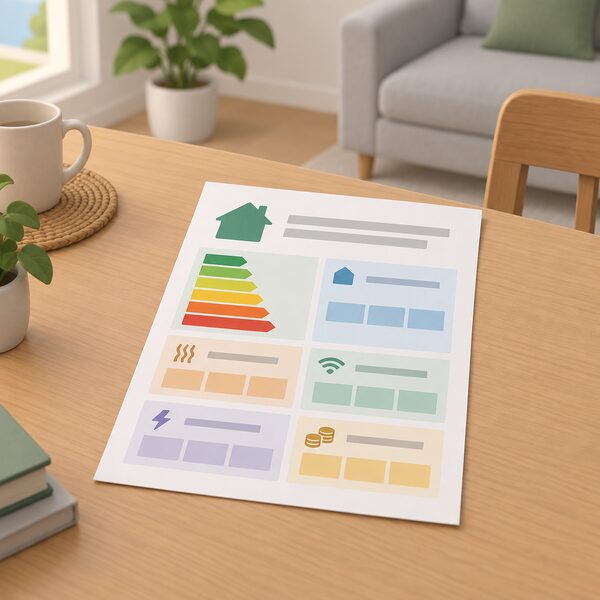
Reformed domestic EPCs are expected to report several metrics, including fabric performance, heating-system performance and smart readiness20. Government's consultation outcome states that the existing single cost metric will be replaced with four new headline metrics: energy cost, fabric performance, heating system and smart readiness5.
Energy Systems Catapult recommended four primary metrics using real-world units and clear simple names21:
| Metric | What it measures | Unit |
|---|---|---|
| Energy | Total energy use intensity | kWh/m2/yr |
| Fabric | Space heating demand intensity | kWh/m2/yr |
| Heating | Heating system type, ranked in categories from 1 to 6 | rank 1 to 6 |
| Cost | Energy cost intensity | £/m2/yr |
The Scottish Government's EPC reform consultation proposed a set of headline metrics comprising Fabric Rating, Cost Rating and Heating System Type22. The heating metric in that set is defined as heating system type, being categories of heating system ranked from 1 to 623.
Government is explicit that this is new ground: heating system type is a new metric, and there is not currently a heating metric in use on EPCs24. The Committee on Climate Change, in its letter on reform of domestic EPC rating metrics, set a condition rather than an objection: reforms to EPC rating metrics should be applied alongside wider improvements to the EPC system to improve the quality of assessments and use of data21.
The limit of a heating-system metric is that it describes what is installed, not how well it performs. A ranked category cannot distinguish a well-designed installation from a poor one, which is precisely the distinction the 39% efficiency spread between monitored fleets demonstrates14. That is the argument for pairing any heating metric with measured performance data rather than relying on the category alone.
EPC statistics for England and Wales are published as Official Statistics, which sets the quality standard for the data that any reformed metric would sit alongside25.
Consumer protection, fairness and tariff design
Energy Systems Catapult's position on consumer protection is that transparency, consent, user control, safety and fair exit must be guaranteed, with attention to enabling participation from small and innovative market participants26. In its response to Ofgem's call for input on energy consumer outcomes, it argued that regulation should focus on fairness, simplicity and meaningful outcomes such as bill clarity, value and access to support, rather than overly prescriptive processes, and that a more outcomes-based, diversity-friendly regulatory framework is needed to enable innovation and market growth while ensuring consumer protection, trust and clarity of accountability across an increasingly fragmented energy ecosystem27.
On standing charges specifically, it supported Ofgem's intent to improve fairness and consumer choice by requiring suppliers to offer a lower-standing-charge tariff, while viewing the proposal as a positive interim step that lacks clarity on risks28. Its recommendation was that Ofgem must enable diverse retail offerings and drive efficiency across wholesale, network and policy costs for meaningful progress on fairness and affordability28. The underlying research on Innovating Beyond Retail and Inclusive Smart Solutions found that retail reform must enable innovation in tariff design, reform cost recovery for whole-system efficiency and decarbonisation, and protect consumers equitably28.
Ofgem's own work in this area includes a split part standing charge tariff trial, whose objective is to explore how domestic consumers respond to a tariff design that introduces a separate element to their standing charge that varies with their electricity usage during peak periods29. Participants in that trial will be able to reduce their daily standing charge if they use less energy at peak times29. The consultation itself sits under the topic of energy pricing rules30.
The relevance to a household considering electrified heat is direct. A heat pump shifts a home's energy use towards electricity, and the standing charge and tariff structure determine what that shift costs before a single unit is consumed. Catapult's policy brief on local energy markets and fairness sets out insights for smart local energy systems, extending the same fairness questions to market design below the national level8.
What the trial's approach means for a household
The practical lesson of the Electrification of Heat programme is that measured performance, not modelled performance, is the number that matters. The majority of heat pumps performed well, with efficiencies comparable to three times that of modern gas boilers, and the trial showed they can operate with good efficiencies and provide positive consumer heating experiences2. The same body of monitoring shows a 39% efficiency gap between two monitored fleets, which means the installation and the system design carry as much weight as the appliance14.
For energy independence, the picture is mixed and worth stating plainly. A heat pump moves a home's heating off gas and onto electricity, which removes direct dependence on the gas network and on gas imports. It does not remove dependence on the grid, on a supplier, or on the tariff structure that supplier applies. A home with a heat pump and no on-site generation is more exposed to electricity price movements than a home burning gas is to gas price movements, because the standing charge and unit rate both apply to a single fuel.
The measurement agenda changes what a household can know. SMETER assessment while the home is in use and occupied produces metrics such as the rate of heat loss from smart meter data and low-cost sources3. A live EPC built on that data would tell an occupant how their home actually performs, rather than how a standardised model predicts it should. Until that exists, the certificate a buyer or tenant sees remains a comparison tool produced from standard information at the point of construction, sale or let17.
Support policy is moving in the same direction as the technology. The Northern Ireland consultation on support for low carbon heating in residential buildings was held to evaluate support options for low carbon heating technologies within the residential sector, and the consultation showed support for widening eligibility to a range of low-carbon technologies31. Wider eligibility across technologies, combined with measured rather than assumed performance, is the shape the evidence points to.

Sources32 cited
- Electrification of Heat summary reports and datasets, Energy Systems Catapult, 2024-12-19
- Electrification of Heat Demonstration Project, Energy Saving Trust, 2024-12-19
- Warm Homes Social Housing Fund wave 3 scheme guidance addendum, GOV.UK, 2026-06
- Home Energy Model technical paper 12: heat pump methodology, GOV.UK, 2026-01
- Reforms to the Energy Performance of Buildings Regime: partial government response, GOV.UK, 2026-03-09
- Warm Home Prescription, Energy Systems Catapult, 2025-11-13
- Fair Futures, Energy Systems Catapult, 2025-06-04
- Local energy markets and fairness: insights for smart local energy systems, Energy Systems Catapult, 2022-03-30
- Decarbonisation of heat, Energy Systems Catapult, 2025-06-27
- Home energy information, advice and guidance, GOV.UK, 2026-03-11
- How home retrofit can transform energy efficiency in the UK, Stroma, 2024-04-08
- From flats to terraced houses, heat pumps are suitable for all property types, Energy Saving Trust, 2024-04-05
- Monitoring your heat pump's performance, Catapult, 2025-06-29
- Accelerating the transition to heat pumps, GOV.UK, 2026-05
- Energy Company Obligation 4 and the Great British Insulation Scheme mid-scheme changes consultation, GOV.UK, 2024-11-14
- Response to DESNZ Home Energy Model methodology: dwelling new Energy Performance Certificates metrics, Energy Systems Catapult, 2026-04-01
- Energy Performance Certificates, nidirect, 2026-02-26
- Energy Performance of Buildings (England and Wales) Regulations 2024 explanatory memorandum, legislation.gov.uk, 2026-09-17
- Energy Performance Certificate (EPC) accuracy research, GOV.UK, 2026-05-26
- The Warm Homes Plan, Elmhurst Energy, 2026-07
- Letter on reform of domestic EPC rating metrics to Lee Rowley MP, Climate Change Committee, 2026-09-19
- Scottish Government Energy Performance Certificate (EPC) reform consultation, CIBSE, 2026-09-17
- Letter on reform of domestic EPC rating metrics to Patrick Harvie MSP, Climate Change Committee, 2026-09-19
- Technical annex for chapter 2: what EPCs measure, GOV.UK, 2026-03-09
- Energy Performance of Building Certificates in England and Wales, April to June 2025, GOV.UK, 2025-07-31
- Response to DESNZ SSES first phase energy smart appliances regulations, Energy Systems Catapult, 2026-02-13
- Response to Ofgem call for input on energy consumer outcomes, Energy Systems Catapult, 2026-02-13
- Response to Ofgem's consultation on requirement to offer lower standing charge tariffs, Energy Systems Catapult, 2025-11-10
- Split standing charge tariff trial, Ofgem, 2025-06-20
- Requirement to offer lower standing charge tariffs, Ofgem, 2025-09-24
- Consultation on support for low carbon heating in residential buildings, Northern Ireland Executive, 2026-09-19
- Minister publishes response to consultation on low carbon heating support, Northern Ireland Executive, 2026-01-26
 Demonstration and Test HomesBefore new heating systems reach your home, they get tested in real houses with real people living in them.
 Heat Battery Trials and ResultsDo heat batteries actually work in real UK homes, and what did the trials find?
 How They Perform in UK HomesHow well do heat pumps really work in UK homes, and why do some run far better than others?
 Public Attitudes to Home EnergyWhat do people in the UK really think about heat pumps, solar panels and smart meters?
 The Full Heat Pumps GuideWill a heat pump keep my house warm in winter, and what does one cost to buy and run?
 Which Homes Suit a Heat PumpMost UK homes can have a heat pump fitted, so the real question is whether yours makes it easy or expensive.