In this guide
- UK Air Conditioning Ownership
- Heat, Health and Cool Homes
- How an Air Conditioner Works
- Cooling Only or Heat Pump
- Efficiency and Electricity Draw
- Buying and Running Costs
- Planning Permission Rules
- Building Regulations
- Choosing a Unit
- UK Brands and Product Ranges
- Warranty and Servicing
- Looking After Your Units
- Dehumidification and Dry Mode
- Lifespan and Energy Independence
Home Cooling and Air Conditioning: The Full UK Guide
Air conditioning for UK homes is still unusual but no longer rare. An estimated 3% of UK homes have it1, other estimates put the figure at fewer than 5% of homes, with just 4% in England2, and in the winter 2025 public attitudes tracker 5% of households said they used air conditioning as a cooling method. London is the outlier: approximately 32 per cent of households there report owning air conditioning, around three times higher than in several other UK regions3. Much of the growth is in portable units: 2.2 million homes have a portable air conditioner, which uses 1 kW of power, and increased working from home and rising summer temperatures may be behind the rise4.
The choice for a household runs from the cheapest and least dependent measures, shading, night ventilation and fans, through evaporative coolers, to portable air conditioners and finally fixed split systems that can both cool and heat. A fixed air-to-air heat pump has typical installation costs ranging from £2,400 in a one bedroom flat to £8,800 in a four bedroom house5; portable units are bought off the shelf and plugged in. Fixed units bring the planning and Building Regulations rules into play: adding air conditioning may be permitted development provided all the limits and conditions in the legislation are met, with permission required in a Conservation Area and listed building consent for a listed building6, and putting in a fixed air-conditioning system is an alteration that needs Building Regulations approval7.
For energy independence the picture is mixed. Cooling is electric, so a home with solar generation can run it partly on its own power at exactly the time of day when the sun is strongest, and an air-to-air unit that also heats reduces reliance on gas. But every air conditioner adds a new electrical load, a new refrigerant-handling dependence on certified engineers, and, for fixed systems, a dependence on the maker for parts and warranty. This guide sets out the numbers, the rules in each nation and the limits, and links to the detailed pages in the home cooling section.
How many UK homes have air conditioning, and why that is changing
The estimates of ownership differ because they measure different things. The figure of 3% of UK homes is an industry estimate of installed air conditioning1. The figure of fewer than 5% of homes, and 4% in England, comes from reporting on academic research into who has cooling2. The winter 2025 public attitudes tracker asked households which cooling methods they used, and 5% said air conditioning8. The Uswitch survey behind the 2.2 million portable-unit figure was carried out online by Opinium between 16 and 24 December 2025 among 4,000 UK residents, weighted to be nationally representative, so it captures portable units that an installed-systems estimate would miss4. Read together, the sources describe a small but growing minority, concentrated in the capital.
The base is uncertain too. The documents give the total number of UK homes as 25 million9, c.29 million10 and roughly 30 million11; they disagree, and any percentage applied to them should be treated as an order of magnitude rather than a count.
Two forces are pushing ownership up. The first is climate: 22% of the UK's housing stock will likely need active cooling, such as AC, to cope with 2C of global warming2. The second is behaviour: increased working from home and rising summer temperatures may be behind the rise in portable units4. The London evidence adds a third: homes created through permitted development conversions, and flats on heat networks, overheat more, and the capital's ownership rate of approximately 32 per cent reflects that3. The dedicated page on climate and cooling demand goes further.
The heating side of the same transition matters for cooling because the equipment overlaps. Roughly 30 million homes in the UK exist and 85% of them rely on natural gas for heating11; only 9% of UK homes have low carbon heating today12; and more than 90% of UK households that currently rely on gas or oil heating will need to make the change to low carbon heating13. An air conditioner that also heats is one route into that change, which is why planning rules now favour units with a heating function.
Heat, health and what a cool home is for

Cooling is not only comfort. The London call for evidence brought together research on overheating in permitted development homes (published May 2023), on thermal comfort in homes created by change of use, and on the health of older people in hot flats, and it argues that overheating is now a health issue for the capital3. The page on heatwaves and health at home covers who is at risk and what indoor temperatures mean.
Cost pressure shapes how people cool as much as how they heat. 83% of UK adults say they have changed how they heat or ventilate their home this winter due to cost, and 41% regularly ventilate rooms14. In the London evidence, 13% of survey respondents reported higher energy bills associated with efforts to cool homes, including the use of fans and air-conditioning3. Independent summer advice sets out the ladder of options, from fans and shading through evaporative coolers, which use water to slightly cool air and are more effective than fans in dry conditions, to air conditioners, which actively remove heat and reduce room temperature15.
Public understanding lags behind: 64% of consumers recognise that energy efficiency measures help keep homes warmer "at least quite a bit", but fewer than half (42%) understand that the same measures can help keep homes cool in summer3. Insulation, shading and ventilation are the first line of independence from any powered cooling; see passive cooling and external shading, shutters and awnings.
How an air conditioner works: a refrigerator without the box
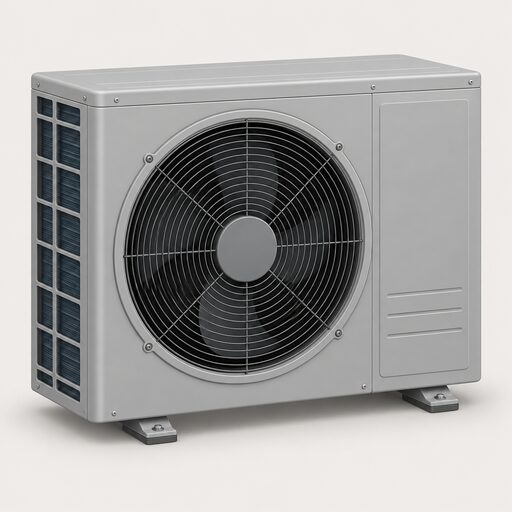
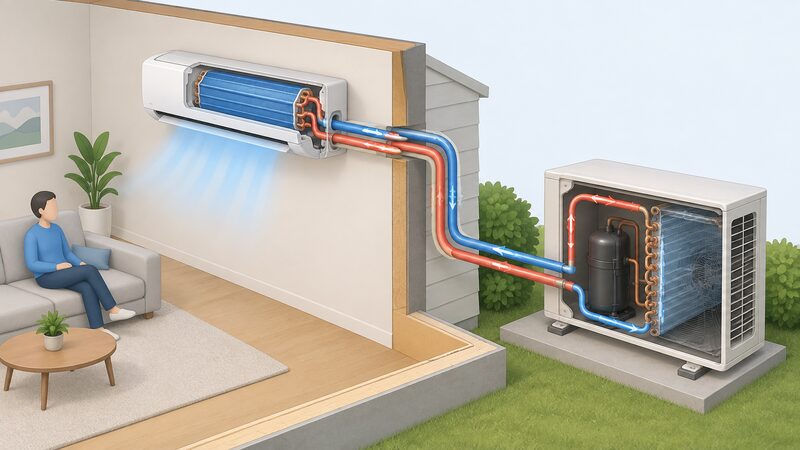
An air conditioner is a heat pump. A compressor circulates a refrigerant round a sealed loop; the refrigerant absorbs heat from the room air at the indoor coil, is compressed, and releases that heat at the outdoor coil. The room gets cooler because heat has been moved outside, not destroyed. That is why an air conditioner, unlike a fan, can actively remove heat and reduce room temperature15, and why every air conditioner needs somewhere to reject heat: an outdoor unit for a split system, an exhaust hose through a window for a portable one, or, for units without an outdoor unit, a pair of holes through the wall.
The refrigerant itself is regulated. Meaco's Cirro+ 14000 BTU portable unit uses R290, a charge of 200g, one of the low global warming potential refrigerants now used in portable units16. Fixed systems are charged on site, which is why the F-Gas rules restrict who may open the circuit.
The official notional dwelling used to set the energy target for a new home in England assumes no air conditioning at all17; the regulations expect a new home to stay cool by design. Independent building guidance takes the same view for existing homes: in the UK's mild climate it is usually appropriate to have some form of passive ventilation, with warm air rising through the building and replacement fresh air coming ideally through a buffer space such as a south-facing conservatory18. Air conditioning is the tool for the hours that design cannot cover, and the pages on night ventilation and cooling by home type show where those hours fall.
Cooling only, reverse cycle or heat pump: which system fits which home
Three families of equipment share the same refrigeration cycle but do different jobs.
Cooling-only units include most portable air conditioners and some fixed splits. They remove heat and dehumidify and do nothing in winter. Reverse-cycle units, marketed in the UK as air-to-air heat pumps, run the cycle backwards: they can also function in reverse, pushing hot air outside to keep the home cool in summer, while heating it in winter19. Air-to-water heat pumps heat radiators and hot water and do not normally cool rooms; they are the most common type of heat pump currently installed in UK properties19, and low temperature air-to-water monobloc systems represent 69% of the total UK heat pump market as of June 202520.
| System | Cools | Heats | Hot water | Typical fit |
|---|---|---|---|---|
| Portable air conditioner | Yes | Some models | No | One room, rented homes, no fixed installation |
| Fixed split, cooling only | Yes | No | No | One room where heating is already covered |
| Air-to-air heat pump (reverse-cycle split) | Yes | Yes | Most UK models do not21 | Smaller properties, electric-heated homes, flats21 |
| Air-to-water heat pump | No | Yes | Yes | Whole-house wet heating, 69% of UK heat pump market20 |
The air-to-air route is the one that matters for cooling. Independent guidance describes air-to-air heat pumps as a highly effective, low-carbon solution for decarbonising heating and cooling in UK homes, particularly in smaller properties and those with electric heating systems, though most models currently available in the UK do not provide hot water21. The London evidence adds that they are suitable for flats, can contribute to grid balancing, and deliver app-based temperature management and the ability to pre-heat or pre-cool a home3. Against that, the Energy Saving Trust notes that indoor heat pump technologies, both air-to-water and air-to-air, have currently not a very active supply chain in the UK22, so a household may find fewer installers and models than for a conventional split.
The planning rules draw a hard line: an air source heat pump under permitted development must not be used solely for cooling purposes23. That pushes a fixed installation towards a reverse-cycle unit. The separate pages on types of air conditioning, split systems, multi-split systems and air conditioning that heats describe each in detail. For a home with a gas boiler, an air-to-air unit reduces gas use in the shoulder seasons but the boiler, and the gas supply, remain for hot water.
Efficiency and electricity draw
Because an air conditioner moves heat rather than making it, each unit of electricity delivers more than a unit of cooling or heating. Efficiency is expressed in seasonal ratings on the energy label, and the page on efficiency ratings explains SEER, SCOP and EER and how the label classes are set. The test standard for the equipment is the same one used under the Boiler Upgrade Scheme, BS EN 14511-4:2018, which covers air conditioners, liquid chilling packages and heat pumps with electrically driven compressors for space heating and cooling24.
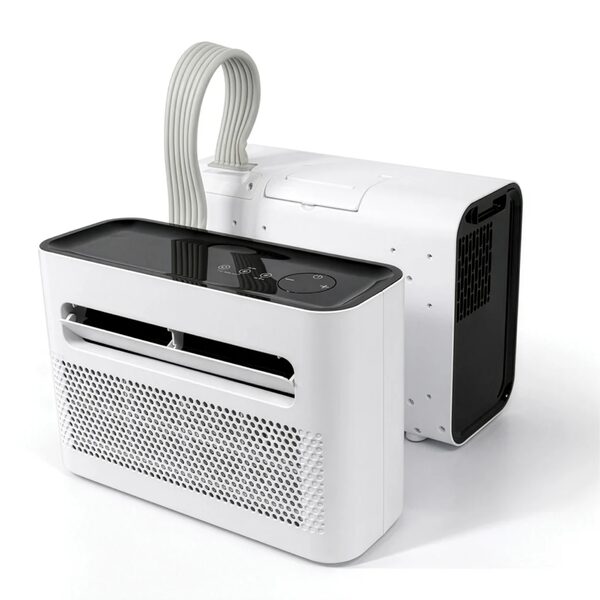
The one electrical figure that matters most to a householder is the draw. Portable units use 1 kW of power4, and independent summer advice puts a typical portable air conditioner at 1,000 to 1,500 W15. That is the load a home's solar array or battery would have to meet to run one unit off-grid for an afternoon, and it is the reason the page on running air conditioning on solar panels treats cooling as one of the better matched loads: peak cooling demand and peak solar output fall in the same hours.
Efficiency on the label is measured in a laboratory. In practice the figure depends on how far the unit must lift or drop the temperature, how well the home holds cool air, and whether the outdoor unit can breathe. A portable unit is the least efficient of the family because its exhaust hose is warm and, on single-hose designs, the room air it blows outside is replaced by warm air drawn in from elsewhere in the house; the single hose versus dual hose page explains the difference. Independence follows efficiency: every kilowatt-hour saved is one that neither the grid nor the battery has to supply.
What air conditioning costs to buy and run
Fixed air-to-air heat pumps have typical installation costs ranging from £2,400 in a one bedroom flat to £8,800 in a four bedroom house5. That is an independent estimate from January 2025; installer quotes vary with pipe runs, the number of indoor units, the electrical supply and access for the outdoor unit. Portable air conditioners are retail products with published prices that move with stock; the cost to buy and install page tracks both.
Running cost is electricity used multiplied by the tariff. With a portable unit drawing 1 kW4, or 1,000 to 1,500 W15, an hour's running consumes about that many kilowatt-hours; the running costs and cost per hour pages set out the arithmetic against current unit rates. The effect on bills is already visible: 13% of respondents in the London evidence reported higher energy bills associated with efforts to cool homes, including fans and air-conditioning3.
Grants are limited. The Boiler Upgrade Scheme in England and Wales funds heating systems built to the approved standards, and its notice of standards lists BS EN 14511-4:2018 for air conditioners and heat pumps with electrically driven compressors24, but the scheme is directed at replacing fossil-fuel heating rather than adding cooling. The page on grants for air conditioning gives the position in each nation. For a household weighing independence, the relevant comparison is against the alternative: the Energy Saving Trust's modelled energy efficient house of the future is estimated to save around £1,378 a year compared to a typical gas-fuelled home with none of the upgrades, and 3,766 kg of CO2 a year based on how Great Britain's electricity is currently generated26. Cooling that runs on self-generated electricity sits inside that kind of whole-house plan rather than as a separate bill.
Planning permission and permitted development: when installation needs no application
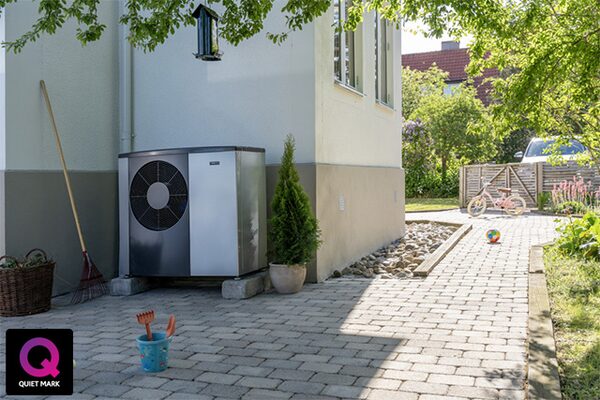
Permitted development rights let certain types of minor changes be made to a house without applying for planning permission27. For air conditioning in England, the Planning Portal states that adding it may be considered permitted development provided all the limits and conditions set out in the legislation are met, and that those limits cover the function, size, placement and quantity of units6. Independent reporting summarises the effect as most AC units falling under permitted development rights, meaning no planning application is required to install them2.
The conditions that most often catch a household are these:
- Heating function. The rights only apply if the system provides a heating function, including if it can provide both heating and cooling28. A cooling-only split needs an application. The air source heat pump rules say the same: not used solely for cooling purposes23.
- Number and location. The amended English rules allow up to two air source heat pumps on detached dwellinghouses, allow cooling and heating but not solely cooling, and removed the one metre boundary restriction29.
- Size. The outdoor compressor housing, the box within which the machinery sits, is not to exceed 0.6 cubic metres30.
- Protected buildings. Permission is required in a Conservation Area, and a listed building needs listed building consent6. The legislation for air source heat pumps does not permit installation on a building or on land within the curtilage of a dwellinghouse or block of flats that is a listed building31.
"The rights only apply if the system provides a heating function (including if it can provide both heating and cooling)."
The rules are devolved. The English limits above come from the 2015 General Permitted Development Order as amended; Scotland has consulted on its own domestic permitted development rights and describes the English changes in its impact assessment30; Wales and Northern Ireland have separate orders, Northern Ireland's dating from 2015 and removing the need to apply for planning permission for classes of development within it32. Because the size limits, the boundary distances and the treatment of flats differ, the four pages on planning permission in England, Scotland, Wales and Northern Ireland should be read for the home's own nation. Portable units need no planning permission anywhere; leaseholders in flats have a separate consent question, covered on air conditioning in flats.
Building Regulations: Part L, Part O and what applies to existing homes
Planning and Building Regulations are separate regimes and both apply. The official list of alterations needing Building Regulations approval includes putting in a fixed air-conditioning system7, and the Planning Portal states plainly that the installation of air conditioning must comply with building regulations28.
Part L, conservation of fuel and power. In England, Part L sets standards for the energy performance of new and existing buildings33, comprising higher standards for windows and for the efficiency of heating, domestic hot water systems, mechanical ventilation, air conditioning and lighting as well as the building fabric34. Its requirements apply to buildings, extensions and work to or in connection with a building where the building is a roofed construction having walls and uses energy to condition the indoor climate35. Part L was initially introduced in 1995 for new buildings and revised in 2005 to include existing dwellings where works are carried out in homes over 25 m23. Approved Document L Volume 1: Dwellings gives the guidance for England, with sections 4, 5, 6, 10 and 11 covering extensions to and work on existing dwellings17. Wales is reviewing its own Part L for 2025, with changes to Part F (Ventilation), Part O (Overheating) and the associated Approved Document guidance36; its draft Approved Document keeps the conservatory and porch exemption for structures at ground level, under 30 m2, thermally separate from the heated dwelling and with no fixed heating appliance or extension of the heating system37, a point that matters for anyone thinking of cooling a conservatory.
Part O, overheating. Part O of the Building Regulations was introduced in 2022 to address the risk of overheating in new homes, and came into force in England on 15 June 20223. It requires new-build homes across England to address overheating through energy-efficient design, prioritising passive cooling, with air conditioning as a last resort2. Its limit is its scope: Part O does not currently apply to retrofit work undertaken to existing homes3, which is why the London evidence cites the 2005 extension of Part L to existing dwellings as a precedent for extending it. Scotland and Northern Ireland set overheating standards through their own building standards; see Part O, overheating standards in Scotland and Northern Ireland and CIBSE TM59.
For an existing home adding a fixed unit, the practical consequences are that the electrical work is notifiable, the installer's competent-person registration or a building control application covers it, and the unit's efficiency is expected to meet the Part L guidance for air conditioning in existing dwellings. The installation page describes the survey, pipework, drainage and commissioning steps.
Choosing a unit: portable and fixed systems compared
The choice between a portable air conditioner and a fixed split is the first decision most households make, and the trade-offs are clear even though few published figures set the two side by side.
| Factor | Portable | Fixed split or air-to-air heat pump |
|---|---|---|
| Purchase | Retail, off the shelf | Installer-quoted; £2,400 to £8,800 typical for air-to-air5 |
| Electrical draw | 1 kW4; 1,000 to 1,500 W typical15 | Depends on rating; see sizing |
| Heat rejection | Exhaust hose through a window | Outdoor unit on wall or ground |
| Planning | None | Permitted development if conditions met, heating function required6 |
| Building Regulations | None | Fixed system needs approval7 |
| Heating | Some models | Reverse-cycle units heat in winter19 |
| Refrigerant work | Factory sealed | F-Gas certified engineer |
| Independence | Movable, no installer, no fixed dependence | Higher efficiency, can displace gas heating, but ties the home to an installer and maker |
A portable unit is the least committed option: no application, no installer, and it goes with the household when it moves, which is why it suits rented homes (see portable air conditioners in a rental). The costs are noise, the warm hose, a window that cannot be fully closed, and the lowest efficiency in the family. The portable air conditioners page and the split versus portable comparison set out the limits.
A fixed system is quieter indoors, more efficient and, if reverse-cycle, a heating appliance that reduces gas use. Nesta's independent guidance describes air-to-air heat pumps as particularly suited to smaller properties and homes with electric heating21. The London evidence adds flats to that list, together with the ability to pre-cool a home before a heatwave and to respond to grid signals3.
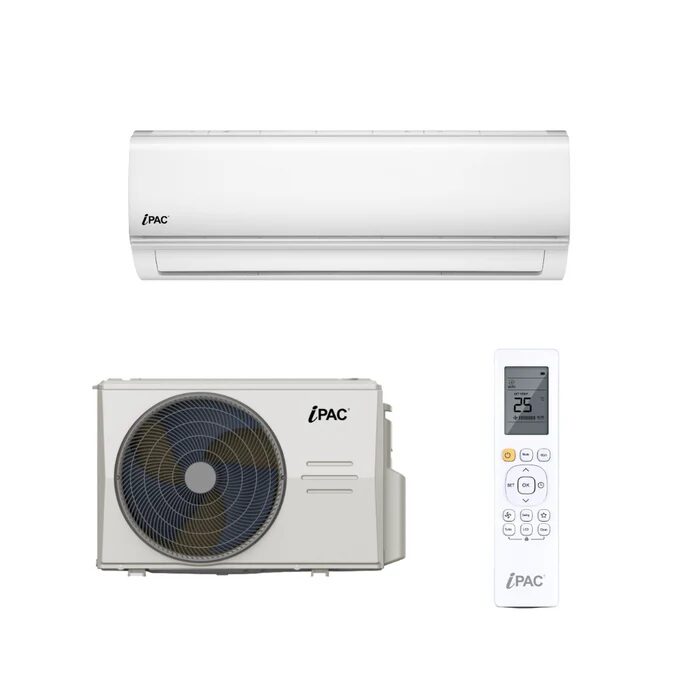
Sizing comes before brand. The capacity a room needs depends on its floor area, glazing, orientation and how well it holds heat; the sizing page and the kW to BTU page give the method. Noise matters for bedrooms: Meaco's Cirro+ 14000 BTU portable runs at 42 to 51 dB according to the maker16, and the noise page compares indoor and outdoor units. Controls, Wi-Fi and voice assistants add convenience and an app dependence; see controls and Wi-Fi.
Brands and product ranges sold in the UK
Fixed split systems in the UK come from the large Japanese and Korean makers, each with a range of wall-mounted, ceiling cassette and ducted indoor units served by single and multi-split outdoor units: Daikin, Mitsubishi Electric, Fujitsu General, LG, Samsung, Panasonic and Toshiba. These are sold and installed through the trade rather than at retail, and their warranties normally depend on installation and registration by an accredited installer. The brands page describes each range without ranking them.
Portable air conditioners are a retail market with a different set of names: Meaco, Lux Air, Honeywell, De'Longhi, Duux and electriQ among them, with Dyson in fans and purifier-fans and Powrmatic in through-wall and ventilation products.
The one portable model with maker figures to hand illustrates what a specification sheet contains:
| Meaco Cirro+ 14000 BTU Portable Air Conditioner | Maker's figure |
|---|---|
| Noise level | 42 to 51 dB |
| Refrigerant | R290, 200g |
| Warranty | Two years parts and labour, extendable to a total of five years |
| UK availability, 23 September 2026 | Sold out, back in stock April 2027 |
All figures from the maker's product page16. The stock position shows the seasonal nature of the portable market: a unit sold out in September may not return until the following spring, and a household planning for next summer's heat has to buy before the season starts. Air-to-water heat pumps, such as the Ideal Logic Air 4kW, are heating products designed for the UK climate and do not cool rooms38; they appear here only because "heat pump" is used loosely to cover both families.
Warranty and servicing: F-Gas engineers and annual maintenance
Warranty terms are set by the maker and differ between the portable and fixed markets. Meaco states that all its portable air conditioners come with a two-year parts and labour warranty, with the option to extend to a total of five years16. Fixed split makers typically offer longer terms conditional on installation by an approved installer and registration; the five-year warranty page lists what each requires. A warranty depends on the company still trading; where a maker has failed, its warranty cannot be relied on, and the brand pages say so where it applies.
Servicing has no statutory annual requirement for domestic air conditioning of the kind that applies to gas. For comparison, HSE strongly advises that all gas appliances, flues and pipework be installed, regularly maintained and serviced at least annually by a Gas Safe registered engineer, and landlords must have an annual gas safety check carried out every 12 months39; Public Health Wales likewise advises that fuel-burning appliances such as boilers and wood burners are serviced once a year by a properly qualified engineer40. An air conditioner burns nothing and produces no carbon monoxide, which is one of its safety advantages over combustion heating, but it has a pressurised refrigerant circuit.
What a maker's warranty usually requires is an annual service by a qualified engineer and a record of it; that is a cost to add to the running cost, and a dependence on a local engineer that a portable unit does not carry. Portable units have factory-sealed circuits and a Meaco-type parts and labour warranty covers the whole unit; a fault is normally dealt with by return rather than by an engineer's visit. The maintenance page gives the filter and coil routine for both. Some householders look to pre-charged and easy-fit systems to avoid the installer; the page explains what such kits do and do not allow under the rules.
Looking after the outdoor and indoor units: airflow, pipe length and cleaning
An air conditioner's efficiency depends on air moving freely over both coils. Indoors, the filter in front of the coil collects dust and, in homes with damp, the spores that come with it, and the coil behind it collects the condensate that dehumidification produces. Outdoors, the coil sees leaves, grass cuttings, pollen and, if the unit is low on the ground, splashed soil. Cleaning is routine work, but its frequency is set by the home: 39% of UK households say they have been letting clothes dry naturally around the home more frequently this winter41, and drying clothes indoors can add up to 10 to 15 litres of water into a home every week42, all of which passes over the indoor coil if the unit runs in Dry mode.
Pipe length matters at installation. Split systems have a minimum as well as a maximum refrigerant pipe run, and an outdoor unit placed directly behind the indoor unit's wall can be too close; the minimum pipe length page explains why. Longer runs need additional refrigerant charge, which is F-Gas work. Placement also brings in the planning limits: the outdoor compressor housing must not exceed 0.6 cubic metres30, and the amended English rules removed the one metre boundary restriction29, but neighbours and noise remain the practical constraint.
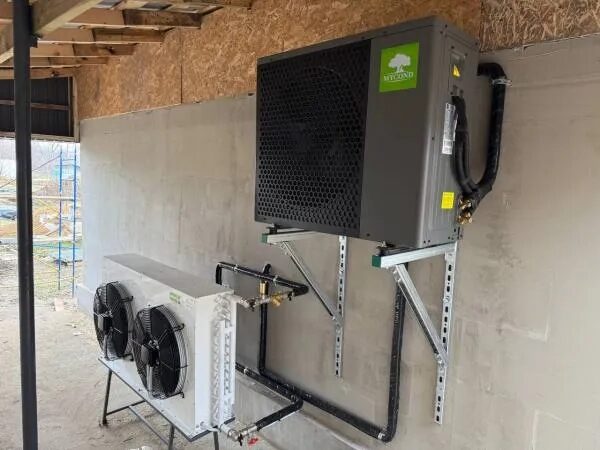
For portable units the equivalents are the exhaust hose and the window kit. The hose should be as short and straight as the maker allows, because every metre is a warm surface inside the room, and the window seal should close the gap around it. The tank or drain needs emptying as the unit signals. None of this needs an engineer, which is part of the case for portables in a home that wants to keep its dependence on trades to a minimum.
Dehumidification and the Dry mode

Every air conditioner dehumidifies as a side effect: warm air passing over a cold coil drops its moisture as condensate. Dry mode makes that the primary job, running the compressor and fan at lower speed so that the coil stays cold while the room is cooled only slightly. The humidity page explains the settings.
The reason Dry mode matters in the UK is the state of the housing stock. More than 18 million homes, 64% of households, are struggling with condensation, damp and mould this winter, and 7% of households avoided turning on heating to dry out damp rooms41. The 39% drying clothes indoors more often41 and the 10 to 15 litres of water a week that adds42 explain where the moisture comes from. An air conditioner or air-to-air heat pump in Dry mode is one way to take it out, though a dedicated dehumidifier is the more usual and cheaper tool in winter.
Dry mode is also where the drain question arises. In cooling mode a portable unit generally evaporates its condensate through the exhaust hose, according to makers' own instructions; in Dry mode, or when the tank fills, a drain hose or emptying is needed. Fixed units drain continuously through a condensate line installed with the system. The drain hose page covers the arrangements model by model.
Expected life and what ownership means for energy independence
None of the official or independent sources here gives a service-life figure for domestic air conditioning, and the page does not invent one; makers' warranty terms of two years, extendable to five for Meaco's portables16, are the only dated commitment available, and the efficiency ratings and maintenance pages explain what determines whether a unit outlasts its warranty.
What can be said firmly is where cooling sits in a household's independence. On the positive side: cooling is electric, its demand peaks with solar output, and a reverse-cycle unit displaces gas for heating in a home that is one of the 85% relying on natural gas11. The policy direction runs the same way: all new homes built in England will be required to use low-carbon heating systems, with heat pumps anticipated to be the primary route to compliance for the vast majority of new homes43, and over the next 10 years many UK households will need to move from gas and oil central heating to electrified heating such as a heat pump44. Air-to-air units can contribute to grid balancing and pre-cool a home ahead of a heatwave3, which is the behaviour a home with a battery and a time-of-use tariff wants.
The dependencies that remain are real. An air conditioner needs electricity every hour it runs, so a home without generation and storage is fully exposed to the tariff, and the 13% reporting higher bills from cooling3 shows the effect. A fixed system depends on an F-Gas certified engineer for any refrigerant work, on the maker for parts and warranty, and, where Wi-Fi control is used, on the maker's cloud service. Most air-to-air models do not provide hot water21, so the boiler stays. And the equipment supply chain for indoor heat pump technologies is not yet very active in the UK22.
The least dependent measures cost the least: shading, night ventilation, insulation that keeps heat out as well as in, and fans. The regulations for new homes already order the options that way, with passive cooling first and air conditioning as a last resort2. For an existing home the same hierarchy applies by choice rather than rule, and the page on cooling and energy independence works through it.
Sources44 cited
- Can the grid keep up?, CIPHE, 2025-10-22
- Eight facts about air conditioning, Carbon Brief, 2026-07-10
- Are London's homes ready for a heatwave: collated call for evidence, Greater London Authority, 2026-06
- The cost of keeping cool, Uswitch, 2026-04-30
- Should I choose an air source or an air-to-air heat pump?, Nesta, 2025-01-21
- Is permission needed for air conditioning and other common works?, Planning Portal, 2026
- Building regulations approval, GOV.UK, 2026-09-17
- Public Attitudes Tracker: heat and energy use in the home, Winter 2025, Department for Energy Security and Net Zero, 2025
- If nothing else works, Energy and Utilities Alliance, 2026-09-14
- Heat pump supply chain readiness to deliver net zero homes, Heat Pump Association, 2025-02
- The role of gas heating in homes, Energy UK, 2025-04-15
- What the UK needs from the Warm Homes Plan, Energy Saving Trust, 2025-04-17
- Annual sustainability report 2024: home insulation and heating, Which?, 2024-11-07
- Mouldy nation report, Uswitch, 2026-02-23
- Summer energy tips, National Energy Action, 2026-08-13
- Meaco Cirro+ 14000 BTU portable air conditioner, Meaco, 2026-09-23
- Approved Document L, Volume 1: Dwellings, 2021 edition incorporating 2023 amendments, GOV.UK, 2026-09-17
- Low energy buildings, Centre for Alternative Technology, 2025-06-27
- How heat pumps work: a guide for homeowners, NICEIC, 2025-09-17
- Energy Innovation Needs Assessment 2025: heat and buildings, GOV.UK, 2025-06
- Air-to-air heat pumps, Nesta, 2026-09-17
- Heat pump questions answered, Energy Saving Trust, 2026-05-27
- Planning permission for an air source heat pump, Planning Portal, 2026-09-17
- Boiler Upgrade Scheme: notice of standards, GOV.UK, 2026-07-21
- VAT on energy-saving materials, HM Revenue and Customs, 2026-09-20
- The energy efficient house of the future, Energy Saving Trust, 2026-07-15
- Do I need planning permission?, Cornwall Council, 2026-09-09
- What rules apply to installing an extractor fan or air conditioning?, Planning Portal, 2026-09-17
- Permitted development rights to support the provision of new homes: consultation, Scottish Government, 2025-09-03
- Permitted development rights: impact assessments, Scottish Government, 2026-09-17
- Class G: installation or alteration of air source heat pumps on domestic premises, legislation.gov.uk, 2026-09-01
- The Planning (General Permitted Development) Order (Northern Ireland) 2015: explanatory memorandum, legislation.gov.uk, 2026-09-17
- Building Regulations Part L 2026 amendments, International Energy Agency, 2026
- Thermal regulations, Mineral Wool Insulation Manufacturers Association, 2026-09-20
- Building regulations: Part L, Planning Portal, 2026
- Building Regulations Part L: 2025 review, Welsh Government, 2025-08-26
- Approved Document L Volume 1: consultation version, Welsh Government, 2026-09-17
- Ideal Logic Air 4kW heat pump, Quiet Mark, 2026-09-17
- Domestic gas safety FAQs, Health and Safety Executive, 2026
- Carbon monoxide, Public Health Wales, 2025-12-08
- Condensation nation, Uswitch, 2026-02-23
- Dealing with condensation and mould, National Energy Action Northern Ireland, 2026-09-07
- What the Future Homes Standard means for homeowners, NICEIC, 2026-04-22
- Transforming EPCs: consumer research insights, Which?, 2024-09