

In this answer
Short answer
A portable air conditioner is the cooling option that fits a tenancy, because it is an appliance rather than a fixture. It stands on castors, plugs into an existing socket and rejects its heat through a hose and a window kit, so nothing is drilled, wired or mounted on the building. Maker guidance describes the format plainly: the unit is on castors so it can be wheeled from one room to another, but it can only cool small spaces1.
The one hard requirement is a window that can take the vent. Independent guidance states that portable units need to be properly vented to the outside using a special fitting for the window, and that a vent simply put through an open window will let heat back in2. Private rented housing fitness guidance in Northern Ireland requires that all habitable rooms should be ventilated directly to the open air by opening a window, so the opening normally exists3.
Permission is a separate question from the appliance. A freestanding unit that is not fixed does not alter the property, but independent guidance on rented homes is explicit that if outdoor plug sockets need to be installed or any drilling needs to take place, the landlord's permission is required4. The trade-off is efficiency: portable units use 30 to 50 per cent more electricity than fixed systems2.
Why a portable unit suits a rented home
The case for a portable air conditioner in a tenancy rests on reversibility. Nothing about the installation outlives the occupant. The unit arrives with exhaust hoses and window kits, and the maker describes these as easy to install7. When the tenancy ends, the appliance, the hose and the window panel leave with the tenant, in the same way that removable insulation can be taken to the next address by a renter who cannot make permanent changes8.
That matters because the alternative, a fixed system, is a capital improvement to somebody else's building. A tenant who pays for a split system pays for equipment that stays behind, and the consent process for fixed equipment is heavier. Leaseholders may need to get permission from the landlord, freeholder or management company before work goes ahead9, and the same logic applies to a tenant seeking to alter the fabric of a rented flat.
There is a wider policy backdrop. Official statistics from summer 2025 record that 32 per cent of people living in rented accommodation said they needed to change how their home is heated for net zero, against 48 per cent in owner-occupied homes, and the figure was lower for social renters at 27 per cent10. Renters are less able to act on the building itself, which is precisely the gap a plug-in appliance fills.
The dependence that remains is worth stating. A portable unit depends on the grid and on a supplier for every hour it runs, on a window that opens, and on the building's electrical installation being sound. It does not reduce a household's exposure to electricity prices, and it does not cool a whole home. What it does is give a tenant a cooling option without asking the landlord for a permanent change.

Where a portable unit works best: bedrooms, lounges and home offices
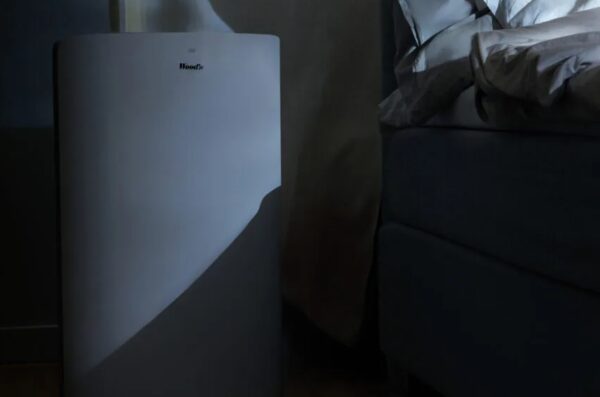
Portable units are single-room appliances. Maker guidance is direct about the limit: the unit can be wheeled from room to room, but it can only cool small spaces1. That shapes where it earns its place. A bedroom used at night, a home office occupied through the working day, or a lounge in the evening are the natural locations, because the unit can be moved to whichever room is in use rather than left to cool an empty one.
The pattern of use matters more than the room label. A portable unit that runs for a few hours in an occupied room is doing a different job from a fixed system holding a whole flat at a steady temperature. Because the appliance is on castors, one unit can serve a bedroom by night and a living room by day, which is the practical answer for a tenant who cannot install anything in either.
There is a design argument for not relying on mechanical cooling at all where it can be avoided. Independent guidance on conservatories notes that designing in natural ventilation such as trickle ventilators, top opening windows or roof vents is far more economical, and environmentally friendlier, than air conditioning11. For a rented home, that points to using the openings the building already has before buying an appliance, and treating the portable unit as the supplement for the hottest room rather than the first move.
Air-to-air heat pumps, the fixed equivalent, are described in a London retrofit consultation as suitable for flats, able to contribute to grid balancing, and able to deliver app-based temperature management and pre-cooling12. Those are capabilities a portable unit does not have. A tenant weighing the two is choosing between a movable appliance with a single-room reach and a fixed system with controls and efficiency that the tenancy may not permit.
Ventilation: the one thing a rental window must provide
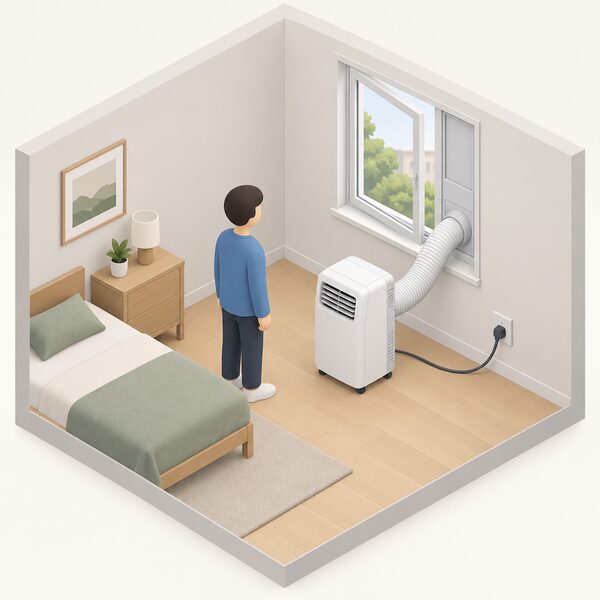
The vent is the whole installation. Independent guidance is unambiguous that a portable unit must be properly vented to the outside using a special fitting for the window, and that if the vent is just put through an open window, heat comes back in2. The window kit exists to close that gap: the panel fills the opening around the hose so the room is not left open to the outside air.
The building regulations framework treats ventilation as a condition of habitable space rather than an optional extra. Private rented housing fitness guidance states that all habitable rooms should be ventilated directly to the open air by opening a window3. The same guidance requires that all rooms containing an open flue gas heating appliance, and all kitchens, bathrooms and toilets, should be provided with enough suitable permanent ventilation by air brick or similar3. A rented home therefore normally has both an opening window and some permanent ventilation.
Where a window is unsuitable, the options narrow. Independent guidance on home ventilation notes that the simplest way of ventilating a home is to open the windows, but that there is no guarantee the fresh air reaches the places that need it, and that opening windows in winter can lead to significant heat loss13. That is the same trade-off a vent kit manages: it keeps the opening small and directed rather than throwing the window wide.
Moisture is the other half of the picture. Independent guidance on damp lists portable gas or paraffin heaters, drying wet clothes on radiators without opening a window, and using a tumble dryer with no outside vent, unless it is a self-condensing type, as sources of moisture in the home16. A portable air conditioner produces condensate of its own, which is why drainage has to be managed alongside the exhaust.
What to check with your landlord before installing anything
The dividing line is between plugging in and fixing. Independent guidance on rented homes states that if outdoor plug sockets need to be installed or any drilling needs to take place, the landlord's permission is required4. Guidance on plug-in solar for renters goes further and notes that permission is needed, and that under the Renters' Rights Act 2025 a landlord cannot unreasonably refuse17. A portable air conditioner that is merely plugged in and vented sits on the near side of that line.
Where consent is not strictly required, telling the landlord remains the recommended course. Smart meter guidance for renters states that a tenant who rents their home should discuss any changes with the landlord, as each meter may form part of the tenancy agreement18, and separate guidance notes that while it is technically the tenant's choice, letting the landlord know before installation is recommended19. The same practice applies to a cooling appliance that will sit in a window.
Several tenancy-side rules show how the pattern works in practice. Guidance on locking cooker valves states that if the property is rented, the tenant must check with the landlord before works take place20. Guidance on clip-on radiator reflector panels says it is best to check with the landlord to get permission before installing them21. Guidance on domestic wind turbines says to always check with the local planning authority about planning issues before installation22, and guidance for leaseholders notes that permission may be needed from the landlord, freeholder or management company9.
The landlord's own obligations run in parallel. Private rented housing fitness guidance sets out what a landlord should do in a property rented to tenants, including making sure roof spaces are insulated, replacing draughty and ill fitting windows and doors, draught proofing external doors and windows, insulating exposed water pipes, and fitting the hot water tank with a good quality insulation jacket3. Before letting, the landlord should ask a qualified surveyor to check the condition of the property3. Electrical safety is a statutory duty: legislation requires a landlord to ensure every electrical installation in the residential premises is inspected and tested by a qualified person before a specified tenancy commences23, and at regular intervals thereafter24.
Costs and running considerations for tenants
Running cost is where the portable format gives back some of what it saved on installation. Independent guidance states that portable units use 30 to 50 per cent more electricity than fixed systems2. A typical portable air conditioner drawing 1,000 to 1,500W is estimated at around 26 to 39p per hour, which the same guidance describes as roughly 14 to 20 times more than a fan5. Electrical ratings guidance lists portable air conditioners at up to 2000W6, so the circuit load is significant while the unit runs.
Those figures are estimates and the guidance is explicit about why. Actual costs will vary depending on the home's insulation, temperature settings, energy prices and how the system is used25. A tenant in a well insulated flat running the unit for two hours in the evening is in a different position from one in a draughty conversion running it all night, and the tariff matters as much as the appliance.
For tenants, the capital cost sits with the occupant rather than the building. That is the opposite of the grant landscape, which is aimed at landlords and owners. The Private Rented Sector Landlord Loan provides loan finance to private registered landlords to enable them to invest in improving the energy efficiency of their properties and install clean heating systems26. The Affordable Warmth Scheme requires a private tenant to obtain the landlord's consent for work to take place in their property27. Neither route funds a tenant's portable appliance.
There is a live policy question about who bears upfront cost in the rented sector. Independent research recommends exploring business models such as leasing or time of use and heat as a service tariffs that could reduce the upfront costs of heat pumps and provide reassurance about ongoing maintenance, particularly among professionalised and HMO landlords28. The same logic, shifting capital cost away from the occupant, is what a portable unit avoids by keeping the outlay small and the asset movable.
One administrative point is worth separating out. Guidance for renters states that a tenant does not need the landlord's permission to switch to paying by credit for energy29. That is a billing change, not a physical one, and it sits alongside the appliance question rather than inside it.
Portable versus fixed air conditioning in a rented home
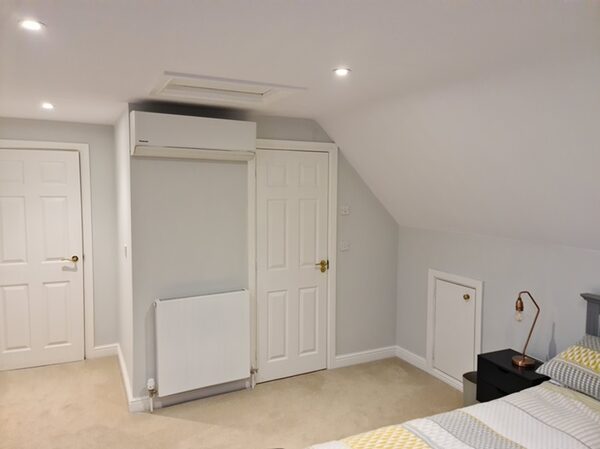
The comparison turns on three things: who owns the equipment, how efficient it is, and whether the tenancy allows it. Maker guidance states that a fixed wall mounted air conditioner costs more than a portable model but is generally more efficient at cooling the home1. Independent guidance puts the efficiency gap in numbers, with portable units using 30 to 50 per cent more electricity than fixed systems2.
| Consideration | Portable unit | Fixed system |
|---|---|---|
| Installation | None; plugs in and vents through a window kit7 | Fixed to the building; consent needed9 |
| Efficiency | 30 to 50% more electricity than fixed systems2 | More efficient at cooling the home1 |
| Reach | One small space at a time1 | Whole-home or multi-room capability12 |
| Ownership on moving out | Travels with the tenant7 | Stays with the property |
| Permission | Needed for sockets or drilling4 | Needed from landlord, freeholder or management company9 |
The permission asymmetry is the decisive one for many tenancies. A fixed system is a permanent alteration, and the consent chain can run beyond the landlord to a freeholder or management company9. A portable unit avoids that chain entirely, at the cost of efficiency and reach.
Planning rules illustrate how differently fixed equipment is treated. Official guidance states that adding air conditioning to a home may be considered permitted development provided all the limits and conditions set in legislation are met, and those limits cover the function, size, placement and quantity of units30. Solar equipment has its own permitted development classes, covering installation on a dwellinghouse, a block of flats, or a building within their curtilage31, and separately on a building other than a dwellinghouse or block of flats32. None of this touches a plug-in appliance, which is the point.
For a household's energy independence, the honest summary is that a portable air conditioner adds a cooling capability without adding a fixed asset. It leaves the home dependent on the grid, on a supplier and on the building's wiring for every hour of operation, and it is less efficient than the fixed alternative. What it removes is the dependence on a landlord's consent for a permanent change, and it keeps the equipment with the tenant when the tenancy ends.
Sources32 cited
- Packaged air conditioning, Netatmo, 2026-09-20
- How to keep your home cool in hot weather, Centre for Sustainable Energy, 2026-07
- Checking your home is fit to live in, nidirect, 2026-09-17
- Plug-in solar, Centre for Sustainable Energy, 2026-09
- Summer energy tips, National Energy Action, 2026-08-13
- Ratings of electrical appliances, Electrical Safety First, 2026-09-19
- Portable air conditioners, Honeywell Air Comfort, 2026-09-23
- Insulation and energy saving, Smart Energy GB, 2026-03-16
- Solar panels and planning permission, Cornwall Council, 2026-09-17
- Public attitudes tracker: heat and energy use in the home, summer 2025, Department for Energy Security and Net Zero, 2025
- Conservatories, Glass and Glazing Federation, 2026-09-20
- Are London's homes ready for a heatwave?, London Assembly Planning and Regeneration Committee, 2026-06
- Ventilation, Centre for Sustainable Energy, 2025-07
- Building regulations: rooflights, Planning Portal, 2026
- Building regulations: roof, further information, conversion projects, Welsh Government, 2026-09-17
- Repairs damp, Citizens Advice, 2026-09-20
- Plug-in solar explained, Low Carbon Hub, 2026-07-09
- How to get a smart meter, Smart DCC, 2026
- Renting, Smart Energy GB, 2026-04-24
- Locking cooker valves, Cadent Gas, 2026-09-20
- Radiator reflector panels, Energy Saving Trust, 2025-10-31
- Wind turbines, Planning Portal, 2026-09-17
- The Electrical Safety Standards in the Private Rented Sector (England) Regulations 2020, regulation 3, legislation.gov.uk, 2026-09-17
- The Electrical Safety Standards in the Private Rented Sector (England) Regulations 2020, regulation 3 (made), legislation.gov.uk, 2026-09-17
- Electric wallpaper explained, Energy Saving Trust, 2026-03-26
- Scottish Government response to the Green Heat Finance Taskforce, Scottish Government, 2025-12-17
- Affordable Warmth Scheme, Northern Ireland Housing Executive, 2026-09-17
- Understanding barriers to heat pump uptake in the private rental sector, Nesta, 2025-11-11
- Moving home: dealing with your energy supply, Citizens Advice, 2026-09-20
- Is permission needed for installing new roof tiles?, Planning Portal, 2026
- Solar PV and solar thermal equipment on non-domestic buildings, legislation.gov.uk, 2026-09-17
- Class A: installation or alteration of solar equipment on domestic premises, legislation.gov.uk, 2026-09-17
 Air Conditioning in FlatsExplains the lease, freeholder and landlord consents that govern fixed air conditioning in flats, and building safety points for higher-risk buildings.
 Passive Cooling at HomeKeeping a home cool without air conditioning comes down to blocking heat before it gets in, then letting trapped heat out.
 The Full Cooling and Air Conditioning GuideDo you really need air conditioning in a British summer, or would a fan and better shading do the job?
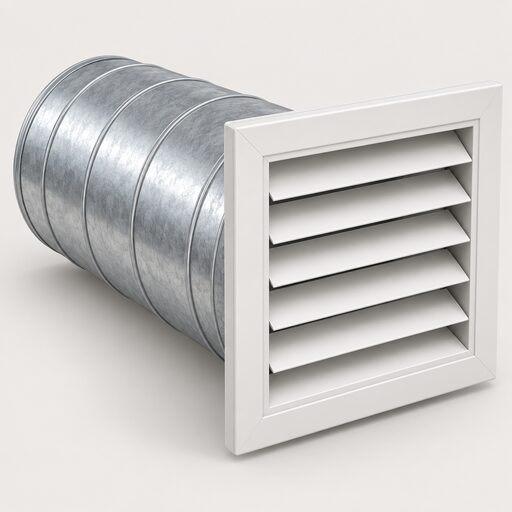 Types of Air ConditioningPortable, wall-mounted, multi-room or ducted: which air conditioning suits your home?
 DIY Air ConditioningExplains which air conditioning can be fitted without a refrigerant engineer, including portable, through-wall and pre-charged quick-connect split kits, and where the limits lie.
 Renting and Home EnergyThe position of a tenant in a privately rented home: which measures need no permission, which are fixtures the landlord controls, and what the law says about heating, insulation, certificates and bills across the four UK nations.