
In this guide
Landlords in England must have the electrical installations in their rented properties inspected and tested by a qualified person at least every five years, and must give tenants proof that the work has been done1. The duty began for the private rented sector under the Electrical Safety Standards in the Private Rented Sector (England) Regulations 2020, and those regulations were updated in 2025 to extend the same requirement to the social rented sector, coming into force for social landlords on 1 November 20251. The report produced is an Electrical Installation Condition Report, or EICR, also known as a Periodic Inspection Report3.
The five-year interval is now close to standard across Great Britain. Electrical Safety First states that tenants in both the private and social rented sectors across the whole of Great Britain are protected by five-yearly electrical installation safety checks, carried out by a competent and qualified person4. Northern Ireland's private rented sector joined on 1 April 2025, with checks at least once every five years on more than 100,000 privately rented homes there; social rented housing in Northern Ireland still has no specific legal requirement for regular electrical checks5.
The stakes are set out by the charity itself: every year, half of accidental domestic fires in the UK are caused by electricity, and that figure is not changing7. In the first year of the English private rented sector rules, checks across 98 local authorities uncovered nearly 7,000 electrical faults5. For a household, the inspection is one of the few safety duties that touches the fabric of the electrical supply itself, and it remains wholly in the landlord's gift to arrange.
What an EICR is and what the inspection covers
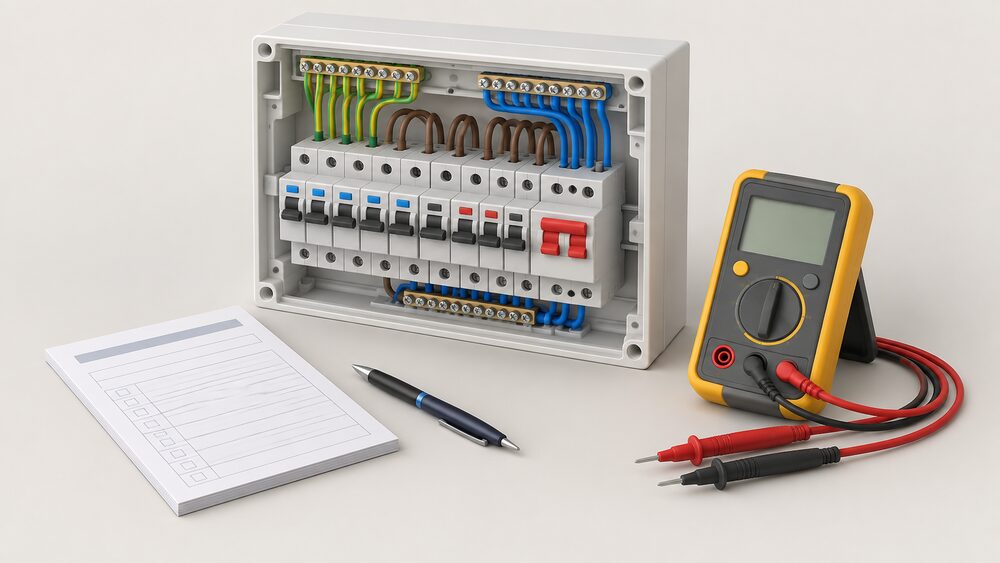
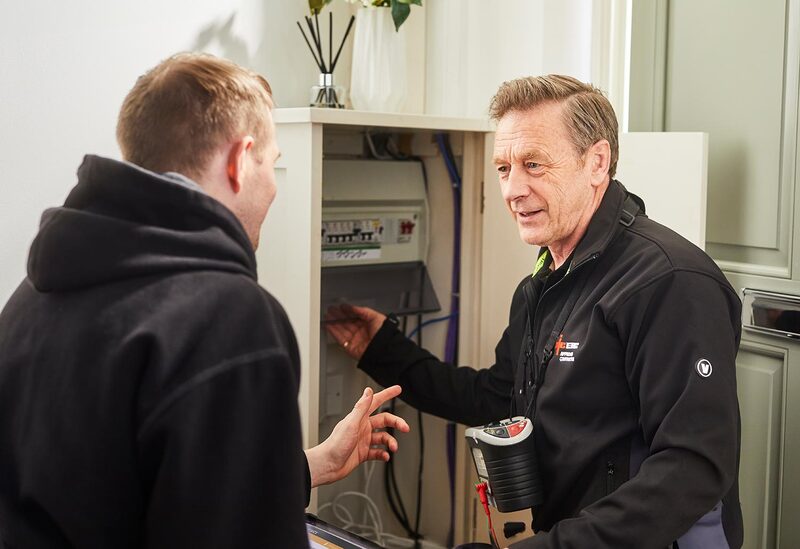
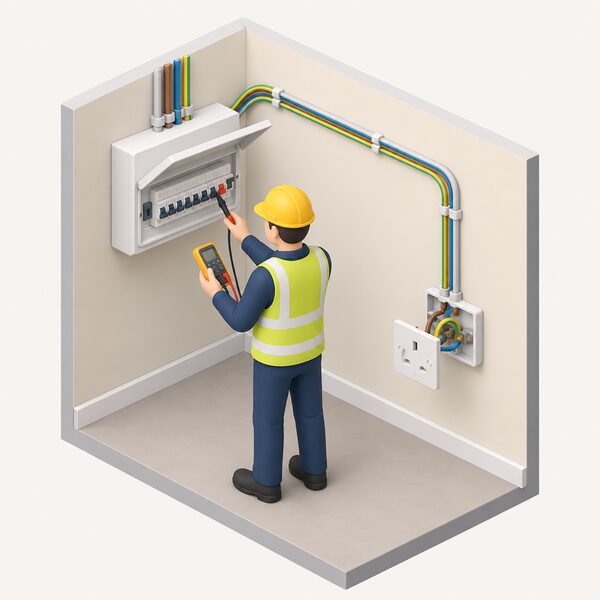
An EICR is an electrical survey that reveals whether electrical circuits are overloaded, finds potential hazards in the installation, highlights any lack of earthing or bonding, and carries out tests on the fixed wiring3. It is also known as a Periodic Inspection Report, or PIR, and older paperwork may use that name3.
The scope is the fixed installation rather than the movable contents of the home. Electrical Safety First describes the checks as covering key elements of a home's electrical system, including socket outlets, consumer units and fixed wiring4. The Northern Ireland regulations use almost identical language, mandating safety checks on the electrical installation of a property, such as the socket outlets, consumer unit and wiring5.
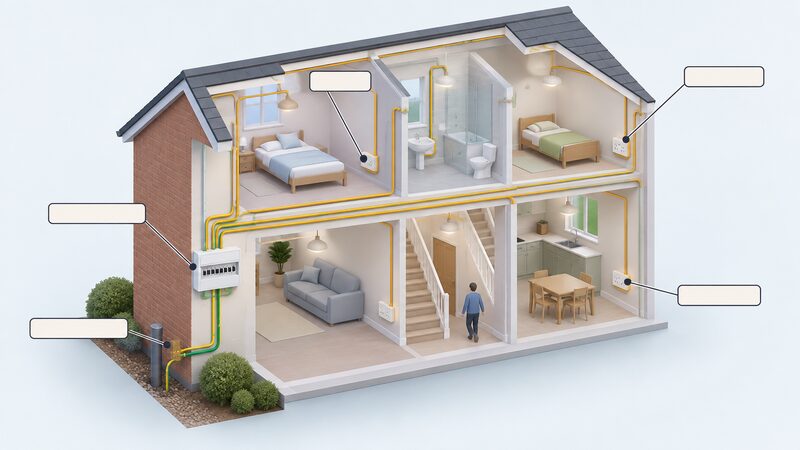
Earthing and bonding matter because they are invisible to a tenant. A worn cable behind a wall, a missing main bond to incoming services or a circuit carrying more load than it was designed for produce no symptom until something fails. That is why the inspection is periodic and instrumented rather than a visual walk round, and why the law specifies both inspection and testing.
Appliances are a separate matter. Portable appliance testing deals with what the landlord supplies loose in the property, and Electrical Safety First says appliances provided in rented accommodation should have up to date PAT stickers, not required if the appliance is new and has not been used before, and should be in good working order10. Tenants arrange checks on any appliances they own themselves11. The distinction is set out further in PAT test stickers on rented appliances.
The law in England: five-yearly checks, and what the regulations say
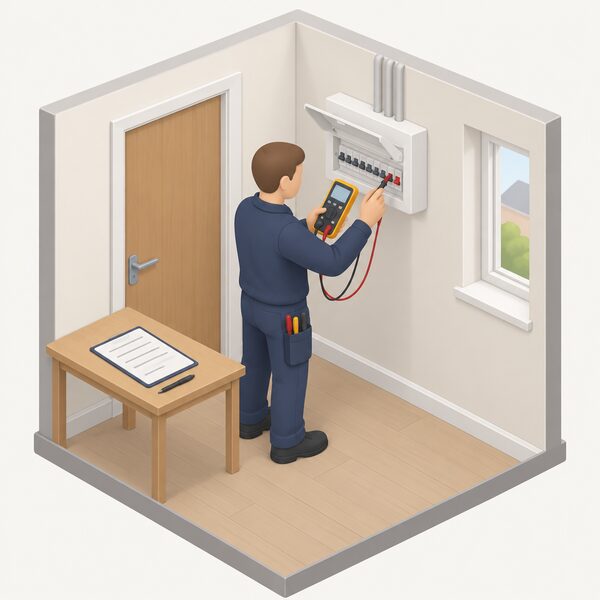
The Electrical Safety Standards in the Private Rented Sector (England) Regulations 2020 place two linked duties on a private landlord. The landlord must ensure that the electrical safety standards are met during any period when the residential premises are occupied under a specified tenancy, and must ensure every electrical installation in the residential premises is inspected and tested at regular intervals by a qualified person12. The same regulation requires inspection and testing before the specified tenancy commences12.
Government guidance puts the interval plainly: landlords are required to have the electrical installations in their properties inspected and tested by a qualified person at least every five years1. Following the inspection, the landlord must obtain a report from the person conducting it, which gives the results and the date of the next inspection and test13.
The 2025 amendment regulations extended the framework to the social rented sector in England, coming into force for that sector on 1 November 20251. Social landlords have a six-month transitional period until 1 November 20264. Social landlords who provide electrical equipment must also have this tested, at least every five years, and for the social rented sector a record must be provided covering the details of any electrical equipment provided by the landlord, including its condition, whether it is suitable for use in the property, and the outcome of the checks1.
Electrical Safety First reported that respondents to its consultation on the social sector were overwhelmingly in favour of mandatory five-yearly checks for all social housing tenants, and that many local authorities and housing associations already undertook regular checks but considered a defined legal requirement would provide clarity14. Related duties on heating, alarms and fitness are gathered in landlord duties on energy, heating and home safety and energy in social housing.
Who the rules apply to
The government guide for England is addressed to landlords, tenants and local councils, which is a fair summary of who has a part to play: the landlord arranges and pays, the tenant receives the report and grants access, the council enforces1.
| Sector and nation | Five-yearly installation check | Landlord-supplied equipment |
|---|---|---|
| Private rented, England | Required1 | Checked at least every 5 years where provided1 |
| Social rented, England | Required, in force 1 November 20251 | Must also be tested1 |
| Private and social rented, Wales | Committed by Welsh Government, once every five years15 | Not stated |
| Private rented, Northern Ireland | Required from 1 April 20255 | Not stated |
| Social rented, Northern Ireland | No specific legal requirement6 | No specific legal requirement6 |
A tenant who sub-lets does not shed the original landlord's duties, and the principle is well established in the parallel gas regime, where the original landlord remains responsible for safety checks and cannot transfer that responsibility to the tenant who is subletting17. Shared houses raise their own questions of who holds the report and which circuits are common: see electrical safety responsibilities in an HMO and energy and safety in HMOs and shared houses.
How the check is carried out and who can do it
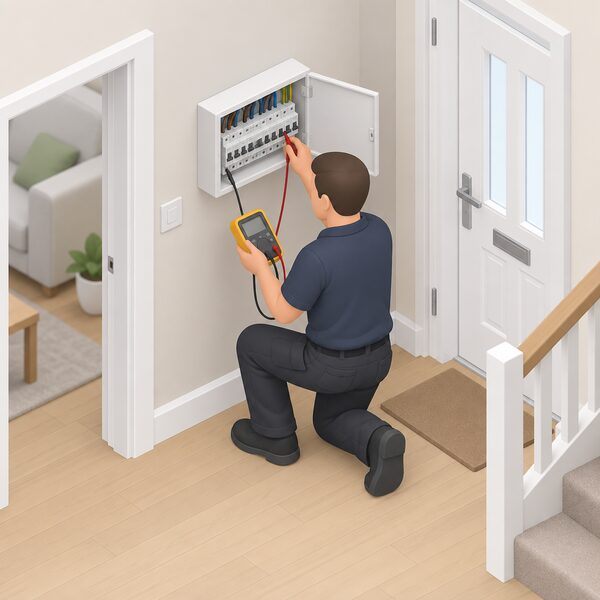
The regulations name a qualified person and leave the detail to competence schemes12. Electrical Safety First recommends landlords use a qualified electrician, competent in electrical installation safety inspections, who is registered with a competent person scheme, and its wider campaign message is simply to always use a registered electrician4. In Northern Ireland the checks must be carried out by a competent and qualified person at least once every five years5. In Wales the work will have to be carried out by a qualified individual, such as a registered electrician, who assesses the safety of the installation16.
A practical sequence for a let property runs like this:
- Inspection and testing of the installation by a qualified person, before the tenancy commences and then at regular intervals12.
- Issue of the report, giving the results and the date of the next inspection and test13.
- Remedial work where dangerous conditions are found, within 28 days4.
- Supply of the report to the existing tenant within 28 days of the inspection and test, and to new tenants at the start of the tenancy8.
Newly built or completely rewired premises are treated differently. Where an Electrical Installation Certificate has been issued, the landlord is not required to carry out further checks or provide a report for five years after the EIC has been issued2.
Access is the common friction point. Electrical Safety First states that landlords will not be in breach of the regulations if they can demonstrate they have taken all reasonable steps to comply, with documented communications kept as evidence8. For tenants weighing what they can and cannot arrange themselves, renting and home energy sets out the boundary.
What happens if a report finds faults
An unsatisfactory report is not the end of compliance, it is the start of a clock. Where dangerous conditions are identified that result in a failed inspection, they must be rectified within 28 days4. In England, private landlords are required by law to submit EICRs that have identified C1 or C2 electrical hazards to the local authority, along with confirmation or proof that these have been fixed19. Electrical Safety First adds that a failed EICR alongside documentation of remedial work completed will be enough to satisfy and comply with the regulations, with copies provided to the local authority and the tenant8.
The volume of faults found shows the checks are not a formality. Nearly 7,000 electrical faults were uncovered through the new checks rolled out across 98 local authorities in England in the first year after introduction5. The same laws in England for private renters led to thousands of dangerous faults being identified in rented homes across the country in that first year16.
Wales sets a tighter deadline for handing over the paperwork in one case: where an electrical safety inspection is carried out after the occupation date, the contract-holder must be given a copy of the electrical condition report before the end of the period of 14 days starting with the day on which the inspection was completed20.
Penalties and enforcement
Electrical Safety First states that landlords of privately rented properties in England that fail to comply or have necessary repairs undertaken could face fines of up to £30,0009, and puts the figure at up to £30,000 for non-compliance where no attempt has been made to complete necessary remedial work8. For the social rented sector in England the charity warns of fines of up to £40,000, and states that failing to meet the duties under the new regulations is a criminal offence4.
| Breach | Maximum penalty stated | Who |
|---|---|---|
| Non-compliance, private rented England | Up to £30,0009 | Private landlords |
| Non-compliance, social rented England | Up to £40,0004 | Social landlords |
| Non-compliance, Northern Ireland | Level 5 fine on conviction5 | Private landlords |
Enforcement is local. In Northern Ireland, where councils believe an offence has been committed they may impose a fixed penalty notice or take the landlord to court for non-compliance, for which the maximum penalty is a Level 5 fine5. Prosecutions do happen: in January, a landlord in Harrow was taken to court and fined £9,000 after failing to provide an electrical safety certificate4.
The £20,000 figure sometimes quoted in older material for this duty is not supported here. The published maximums in the sources are £30,000 for the private rented sector in England and £40,000 for the social rented sector9.
Records and reports: what a tenant should receive

Landlords must give their tenants proof that they have had installations and equipment inspected, tested and checked1. The English guidance sets the deadline: supply a copy of the report to the existing tenant within 28 days of the inspection and test2. New tenants must be supplied with a copy of the current EICR at the start of their tenancies, and a copy must be provided to both new and retained tenants8.
In Wales, the landlord must ensure that there is a valid electrical condition report in respect of the dwelling during each period of occupation, with the 14-day rule applying where the inspection falls after the occupation date20.
For a household, the report is the only document that describes the condition of the wiring it depends on. It states the results of the inspection and test and the date of the next inspection and test, so a tenant can see when the installation was last examined and when it is due again13. If a tenant believes the home does not meet the fitness standard, the route in Northern Ireland is to tell the council's Environmental Health office22. Related evidence trails for other hazards are covered in damp and mould in rented homes and smoke and carbon monoxide alarm rules.
Why electrical fires make the checks matter
Electrical Safety First, a UK charity dedicated to reducing and preventing damage, injuries and death caused by electricity, states that every year half of accidental domestic fires in the UK are caused by electricity, and that the figure is not changing9. It attributes those fires to misuse of appliances, poor regulation of electrical safety checks, particularly in the private rented sector, and faulty appliances7. It also records over five fires a day in England caused by white goods such as tumble dryers, washing machines and dishwashers7.
That split, between the installation and what is plugged into it, is why the EICR alone does not make a home electrically safe. The charity's household guidance includes plugging tumble dryers directly into a wall socket rather than an extension lead, which can be overloaded and overheat, cleaning the lint filter after every use, registering appliances with the manufacturer and checking for recalls, and ensuring working smoke alarms on every floor in the home23. For plug-in heaters it advises placing the heater on a level surface well away from anything that could knock it over, keeping it well away from combustible materials such as paper, furniture or curtains, never using it to dry clothes, never leaving it unattended for long periods or while asleep, and never powering it from an extension lead24.
Tenants using electric heating because they are worried about bills are a particular concern the charity has raised, and its cost of living material covers running appliances at cheaper times25. Where heating a rented home falls back on portable electric heaters, the risk profile changes: see energy independence when you rent or live in a flat.
Scotland, Wales and Northern Ireland
Scotland. Electrical Safety First states that tenants in both the private and social rented sectors across the whole of Great Britain are now protected by five-yearly electrical installation safety checks4. Industry guidance lists Scotland's coverage as extending to privately and socially rented homes and short-term lets, with an EICR every five years or at change of tenancy3.
Wales. The Welsh Government has committed to introduce regulations for mandatory five-yearly electrical safety checks on properties in the private and social rental sectors through the Renting Homes (Wales) Act15. Under that Act, landlords of both private and social rented properties will have to undertake electrical safety checks of their properties once every five years, carried out by a qualified individual such as a registered electrician16. The Fitness for Human Habitation guidance for Welsh landlords names ensuring the inspection and testing of the electrical installation among a landlord's actions26. Electrical Safety First has criticised delay in commencing the Welsh provisions, noting the English laws for private renters led to thousands of dangerous faults being identified in their first year16. The charity is recognised by the Welsh Government and industry as the leading campaigning charity and technical authority on electrical safety in the home15. See also fitness for human habitation in Welsh rented homes.
Northern Ireland. New laws introduced from 1 April 2025 will protect more than 100,000 privately rented homes in Northern Ireland, mandating safety checks on the electrical installation of a property, such as the socket outlets, consumer unit and wiring, by a competent and qualified person at least once every five years5. The underlying regulations require the landlord to ensure that the electrical safety standards are met during the period when the dwelling-house is let under the private tenancy, and to ensure every electrical installation in the dwelling-house is inspected and tested at regular intervals by a qualified person27. Social rented housing in Northern Ireland has no specific legal requirements for regular electrical checks, and Electrical Safety First is calling for forthcoming legislation to include mandatory electrical safety checks there6.
What it means for a household's independence
An electrical safety check is a dependence, not a freedom. The installation belongs to the landlord, the inspection is commissioned by the landlord, and the report is issued to the landlord who then passes it on. A tenant's leverage is documentary: the right to receive the report within 28 days of the inspection, or at the start of a tenancy, and the council's enforcement powers where it is not produced2.
That matters more as households electrify. A home moving from gas to electric heating, adding a heat pump, or charging a vehicle puts far more load through the same consumer unit and fixed wiring that the EICR examines. Where circuits are already close to their limit, the report is the document that says so, since the survey exists precisely to reveal whether circuits are overloaded and to highlight any lack of earthing or bonding3. A tenant proposing improvements has a stronger case when the installation's condition is documented: the route is covered in asking a landlord for energy improvements, and landlords looking at funding for the wider fabric will find it in funding energy upgrades as a landlord.
What remains outside the report is as important as what is in it. An EICR says nothing about the tenant's own appliances, nothing about the supply from the grid, and nothing about the tariff. It is a five-year snapshot of fixed wiring, and Electrical Safety First's own figure, that half of accidental domestic fires in the UK are caused by electricity and the figure is not changing, is the reason the interval is a floor and not a ceiling7.
Sources27 cited
- Electrical safety standards in the private and social rented sectors: guidance, GOV.UK, 1 November 2025
- Electrical safety standards guidance, full text, GOV.UK, 1 November 2025
- How to work with your tradesperson, NICEIC, 17 September 2026
- Millions of social renters to be protected from electrical faults as new laws come into force, Electrical Safety First, 19 September 2026
- Landlords risk fines as new safety laws to protect thousands of private renters loom, Electrical Safety First, 19 September 2026
- New Northern Ireland housing report, Electrical Safety First, 19 September 2026
- 10 ways to avoid electrical fires in your home, Electrical Safety First, 19 September 2026
- Electrical checks in privately rented homes: your questions answered, Electrical Safety First, 19 September 2026
- Landlords urged to comply with new safety laws or risk fines, Electrical Safety First, 19 September 2026
- Charity campaigns for safer electrics in rented homes, Electrical Safety First, 19 September 2026
- Householders and landlords help hub, NICEIC, 17 September 2026
- The Electrical Safety Standards in the Private Rented Sector (England) Regulations 2020, regulation 3, legislation.gov.uk, 2020
- Regulation 3 as made, legislation.gov.uk, 2020
- Improving safety for social renters, Electrical Safety First, 19 September 2026
- Policy and research: Wales, Electrical Safety First, 17 September 2026
- Renters put at unnecessary risk due to Welsh Government legislation delay, Electrical Safety First, 19 September 2026
- Gas safety: landlord frequently asked questions, Health and Safety Executive, 2026
- You wouldn't trust, Electrical Safety First, 19 September 2026
- New law sees thousands of dangerous electrical faults identified in privately rented homes, Electrical Safety First, 19 September 2026
- The Renting Homes (Fitness for Human Habitation) (Wales) Regulations 2022, regulation 6, legislation.gov.uk, 2022
- Electrical checks in privately rented homes: what you need to know, Electrical Safety First, 12 January 2021
- Checking your home is fit to live in, nidirect, 17 September 2026
- Tumble dryer safety guidance, Electrical Safety First, 19 September 2026
- Potential risk to households this winter as millions use electrical heaters, Electrical Safety First, 19 September 2026
- A costly saving: dangerous energy-saving devices put consumers at risk of fire, Electrical Safety First, 19 September 2026
- Fitness for human habitation: guidance for landlords, Welsh Government, 13 January 2022
- The Private Tenancies (Electrical Safety Standards) Regulations (Northern Ireland) 2024, legislation.gov.uk, 27 November 2024
 Gas Safety in the HomeYour landlord has to arrange a yearly gas safety check by a Gas Safe registered engineer and give you the record if you rent.
 Rented Homes and Landlord MetersWho is responsible for the energy in your rented home?
 HMOs and Shared HousesWho is responsible for the electrics, the gas and the fire alarms when you rent a room in a shared house?
 Renting and Home EnergyThe position of a tenant in a privately rented home: which measures need no permission, which are fixtures the landlord controls, and what the law says about heating, insulation, certificates and bills across the four UK nations.
 Landlord Energy and SafetyWhat a landlord must provide and maintain across the four nations: working heating and hot water, an EPC before letting, alarms, gas and electrical safety, and fitness for habitation, with the points where Scottish, Welsh and Northern Irish duties differ from England.
 Product RecallsHow recalls and safety notices work for energy equipment in UK homes, who issues them, how to check a product, and what replacement, repair and refund routes exist.