
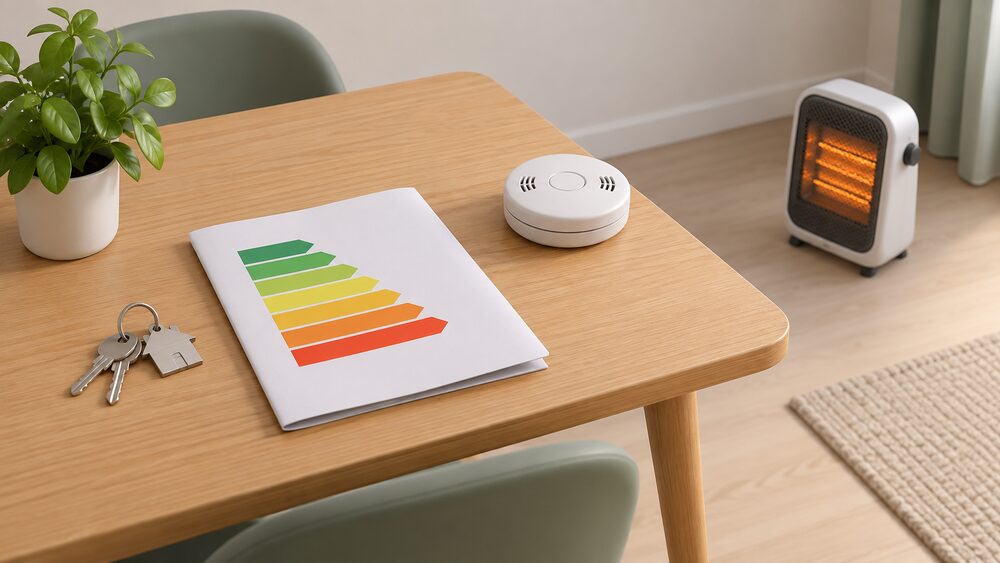
In this guide
Student accommodation is rented for a few months at a time, usually by a group with no individual control over the building, and often in older stock that a family buyer would have refurbished. The main document a student gets before signing is the Energy Performance Certificate. It is a legal requirement whenever a home is advertised for sale or let, it was introduced in 2007, and it records the estimated energy performance of the building and its main heating systems, rated from A to G with G being the least energy efficient1.
Two figures matter most before a contract is signed. A domestic private rented property in England and Wales must have an EPC rating of E or above to be let at all, unless a valid exemption is registered4. And the certificate itself is valid for a maximum of ten years, or until a newer one is commissioned for the same building, so a certificate handed over in a viewing may describe insulation and heating as they were a decade ago5.
The safety side is narrower but more urgent. Portable heaters should be kept at least one metre away from combustible materials and should not be powered from an extension lead; there should be at least one smoke or heat alarm per floor, tested at least once a month; and an audible carbon monoxide alarm meeting the BS Kitemark or EN 50291 costs from £15 to around £206. Those are the checks a group of tenants can carry out in an afternoon, in a building they cannot otherwise alter.
What the EPC tells you before you sign
An EPC must be provided when a building is advertised for sale or for let to a new tenant, and in Scotland also on completion of construction of a new building2. In Scotland the certificate must be provided to a new tenant free of charge9. That timing matters for students, because student lets are frequently advertised and reserved many months before occupation: the certificate should be available at the point of advertising, not produced later on request.
The assessment behind the rating records specific information: dwelling type, floor area, construction type, insulation, heating, ventilation and lighting10. That tells a prospective tenant a good deal about a house that is otherwise hard to judge on a ten minute viewing. A solid wall Victorian terrace with no recorded wall insulation and an old heating system will show up in the assessment even when the rooms have been freshly painted. Each certificate also comes with a report setting out cost effective measures to improve efficiency and rating, such as low energy bulbs or upgrading insulation5. Reading that improvement list is often more informative than the band itself, because it names what the building lacks.
The certificate's coverage in shared housing follows the unit, not the person. A certificate is required for each self-contained dwelling, including licensed houses in multiple occupation let under a joint tenancy agreement, and bedsits or similar units let as a whole; each individual flat in sheltered housing or in separate buildings on a campus requires its own certificate9. Where a tenant rents a room with shared access to facilities such as a bathroom, kitchen or living area, no certificate is required for that letting9. Communal areas such as corridors, staff offices and lounges only need assessing if the whole building is being sold or let as a single unit9. In a purpose-built block let room by room, that means the corridors, plant room and shared kitchens a resident actually depends on may never have been assessed.
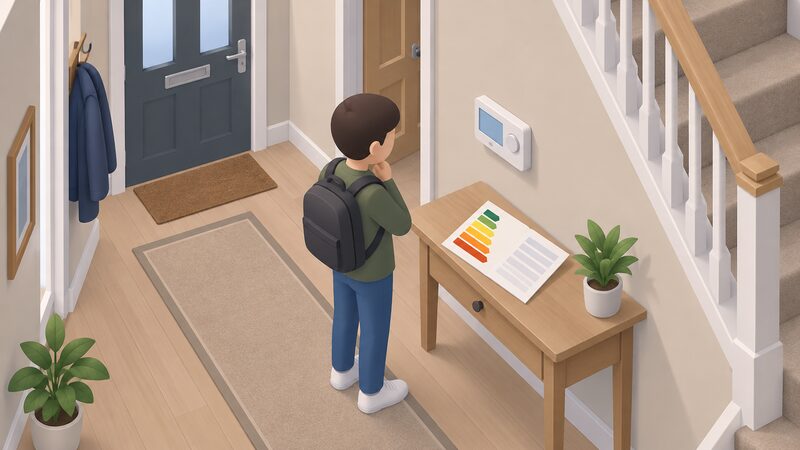
EPC bands run A to G, and E is the floor for private lets

The rating scale runs from A to G, with G the least energy efficient11. For domestic private rented property in England and Wales, the minimum standard is a rating of E or above, set by the 2018 Minimum Level of Energy Efficiency standard12. Guidance is direct: no property without at least an E rating can be rented out unless an exemption applies4. A landlord currently letting an F or G rated property must improve it to at least E or register an exemption where applicable12, and the exemptions register is the public record of those claims14.
The floor is rising. Under the clean flexibility work published in 2026, landlords will be required to ensure properties meet a minimum score of EPC C against the fabric performance metric and either the heating system or smart readiness metric, with that requirement dated to 1 October 203015.
Scotland and the Scottish proposals differ. Scottish policy has set out a requirement for all private rented sector properties to reach a minimum standard equivalent to EPC C by 2028 where technically feasible and cost-effective, at change of tenancy, with a backstop of 2028 for all remaining existing properties16. Consultation proposals went further: properties in the private rented sector not meeting the energy efficiency standard by the end of 2028 would not be allowed to be leased to a new tenant, and private rented properties would still be required to meet the minimum energy efficiency standard even where a clean heating system had already been installed17. An alternative compliance route was proposed based on an EPC assessment demonstrating a home required less than 120kWh/m2/year for space heating17.
Scottish policy on heating systems has moved. An earlier proposal was to prohibit the use of polluting heating systems after 2045, and before then at the point of property purchase or when a heat network connection is available in a Heat Network Zone18. The Heat in Buildings Bill as described in January 2026 takes a different line:
"In response to concerns about affordability and fairness, the Bill will not prohibit the use of polluting heating systems in individual homes or buildings"
The Bill instead introduces powers to set minimum energy performance standards for all buildings with a polluting heating system in future regulations, allowing exemptions and alternative compliance routes, targeted towards owner-occupied homes and non-domestic buildings19. Social housing has been treated separately, remaining subject to a separate but equivalent regulatory standard17. For students, the practical point is that the band floor for the house they rent this year is E in England and Wales, and the tighter standards fall on landlords over the years ahead rather than on current occupants.
Estimated energy costs on the certificate, and why the bill differs
The certificate contains information on potential energy costs and carbon dioxide emissions, with a coloured chart showing how energy efficient the building is or could be5. Those figures are produced using standard information about buildings, which is what allows buyers and tenants to compare energy efficiency and likely heating and lighting costs before entering a contract5. Comparability is the strength and the limit at once.
The current Energy Efficiency Rating is derived from estimated regulated energy use per unit floor area20. Under reform, domestic certificates will show ratings for heat retention, heating system and energy costs21, and the new system is intended to give clearer information on the fabric energy efficiency of a property, the emissions, efficiency and running costs of its heating system, and the cost of energy to run the home to standardised conditions22. The Energy Cost Rating will be based on the cost of energy to run the dwelling to standardised conditions, modelled on UK-wide fuel cost factors and normalised climate data, and will show a current and a potential rating23.
"Standardised conditions" is the reason a student house rarely matches its certificate. The model assumes a standard heating pattern and standard occupancy. A six-bedroom house with six laptops, six phone chargers, showers spread across eighteen hours and bedroom doors closed on unheated rooms does not behave like the model, and nor does a house left empty over the Christmas and Easter vacations. Nor do the published statistics cover everything: the official England and Wales certificate statistics state that they do not cover the entire building stock24.
| What the certificate gives | What it does not settle |
|---|---|
| Band A to G and a coloured chart11 | The actual bill for a particular group of occupants |
| Modelled cost to standardised conditions23 | Who pays, and on what tariff |
| An improvement report naming cost effective measures5 | Whether the landlord will carry any of it out |
| A record of insulation, heating and ventilation as assessed10 | Changes made since lodgement, up to ten years ago5 |
Bills-included lets, shared liability and heat networks
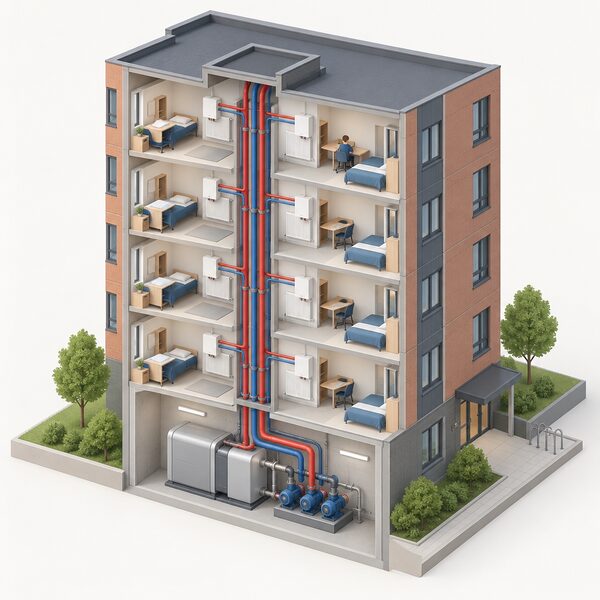
Whether the certificate reflects the tenant's exposure depends on who pays for energy. Where a tenant has to pay the energy bills, they can choose to switch supplier or tariff at any time25. Where the rent includes bills, that choice sits with the landlord, and the tenant's only lever over cost is consumption. Reform proposals for short-term lets take the view that a valid certificate is required when let irrespective of who is responsible for meeting energy costs26, which is a useful principle: the building's performance is disclosable even when the occupant does not see a meter reading.
A certificate also cannot be used to work out how a shared house divides its costs. The regulations require the certificate to carry the address of the building and forbid it from containing any information or data, other than the address, from which a living individual other than the assessor or their employer can be identified27. It is a document about a building, not about a household.
Purpose-built student blocks frequently take heat from a communal system rather than individual boilers, and the consumer protection position there is distinct. Ofgem's consumer protection guidance for heat networks covers standards of conduct, quality of service, billing and transparency, back-billing, heat supply contracts, protections for vulnerable consumers and security of supply28. That guidance matters more than usual in a communal building, because the household's relationship is with whoever operates the network rather than with a supplier it has chosen, and the usual route of comparing tariffs does not apply. For a student household the practical consequences are that heat charges may arrive bundled into a service charge or rent rather than as a separate metered bill, that queries about accuracy go to the operator or the landlord rather than to an energy supplier, and that any dispute follows the heat network route rather than the gas and electricity one. The building's certificate still describes the fabric and the heating system in the usual way, and the recommendations report attached to it still sets out cost effective measures such as low energy bulbs or upgrading insulation23, but none of those measures are in a tenant's gift on a communal system. What a prospective tenant can do before signing is establish, in writing, how heat is charged, whether it is metered, and what is included in the rent.
For what tenants can and cannot alter in a rented property, see renting and home energy and energy independence when you rent or live in a flat. Shared houses have their own rules, set out in energy and safety in HMOs and shared houses.
Electrical safety in rented and shared homes
The duty sits with the landlord. In England, a private landlord must ensure that the electrical safety standards are met during any period when the residential premises are occupied under a specified tenancy29. Northern Ireland regulations made in 2024 impose the equivalent duty for the period when the dwelling-house is let under a private tenancy30. The government guidance on electrical safety standards in the private and social rented sectors is written for landlords, tenants and local councils, so a student tenant is an intended reader of it31.
The division of responsibility is where student houses go wrong. Official guidance states plainly:
"Tenants are responsible for making sure that their own electrical equipment is safe."
In a house of five or six students, most of the electrical load is tenant-owned: laptops, chargers, kettles, hair dryers, games consoles, sometimes a heater bought in November. None of that falls inside the landlord's fixed installation check, and all of it is on circuits the tenants did not choose.
In Scotland, the Repairing Standard requires that installations for the supply of electricity in private rented houses include a residual current device33. More broadly, the building rules for electrical work exist to help reduce the number of deaths, injuries and fires caused by faulty installations34. The checks themselves are covered in electrical safety checks in rented homes, with a shorter answer at what to check for electrical safety in student accommodation.
Portable heaters: the rules that prevent fires
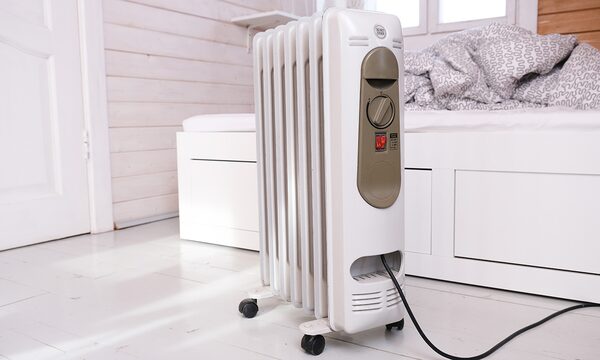
Portable heaters are the standard response in a cold student house, particularly where heating is centrally timed or a bills-included let restricts the thermostat. Independent safety guidance sets out the conditions that keep them from causing a fire: keep the heater at least one metre away from combustible materials, avoid powering it from an extension lead, use smoke alarms or heat detectors nearby, and buy from a reputable retailer rather than a third-party seller online6.
Each of those bears on the way students actually live. A one metre clearance is difficult in a bedroom that doubles as a study and a drying room; damp clothes on or near a heater and bedding within reach of an element are the recurring pattern. The extension lead point matters because student bedrooms are usually short of sockets and long on devices: a heater is a sustained high-current load and is not a device to run from the same trailing lead as a monitor and a phone. The retailer point matters because the cheapest heaters on a marketplace listing are also the ones with the least accountable supply chain, and because a heater bought by a tenant is the tenant's own equipment for safety purposes32.
Heating a single room electrically rather than the whole house can be cheaper on a cold week in an under-insulated building, but it shifts load onto electricity at a higher unit cost than gas and does nothing about the fabric. The limits of the fabric are the real constraint: a house at band E is legal to let and still expensive to heat. Where rooms are cold and unheated, condensation follows, which is covered in damp and mould in rented homes and what causes condensation damp in a rented property.
Carbon monoxide alarms: the one device that detects an invisible gas
Placement is set by where combustion happens, not by where people sleep. Guidance states an alarm meeting European Standards should be fitted in any room that contains a gas fuel burning appliance, such as a boiler or gas fire, and a solid fuel burning appliance35. Northern Ireland private tenancy regulations require an alarm installed in any room or circulation space of the dwelling-house containing a fixed combustion appliance or a flue36. Where a new or replacement fixed solid fuel appliance is installed in a dwelling, building guidance requires an alarm in the room where the appliance is located, complying with BS EN 50291:200137. Landlord guidance for England lists carbon monoxide alarms in rooms with appliances using solid fuels such as coal and wood38.
Standards cited across the guidance are the BS Kitemark or EN 502917, with European Standards also cited as EN 5029 in Met Office guidance35 and as BS EN 50291:2001 in Welsh building guidance37. Cost is low: official guidance gives from as little as £20 for a compliant audible alarm7, and Health and Safety Executive material states alarms cost from £15 and can be purchased in most hardware shops39.
An alarm is not a substitute for maintenance. HSE guidance is explicit:
"CARBON MONOXIDE ALARMS are a useful back-up precaution but must NOT be regarded as a substitute for proper installation and maintenance of gas equipment by a Gas Safe registered engineer"
In student housing the practical risk is a boiler in a kitchen cupboard, a blocked flue behind a hedge, and a group of tenants who have never been told which cupboard the boiler is in. The rules are set out in full at smoke and carbon monoxide alarm rules in rented homes, and the symptoms at signs of carbon monoxide poisoning in the home.
Smoke alarms, gas checks and appliances left behind
Independent guidance sets a floor of at least one smoke or heat alarm per floor, tested at least once a month6. In a three-storey shared house that is three alarms as a minimum, and the monthly test is the only way to know that a previous group did not remove a battery.
Gas checking is annual and covers more than the boiler. All permanent and portable gas appliances and flues in a rented property require an annual gas safety check41. Where an appliance has been left by a previous tenant, landlord guidance is that the landlord should either remove it or arrange for it to be checked for safety by a Gas Safe registered engineer41. Student houses turn over every summer, which makes abandoned heaters, hobs and cylinders a recurring issue rather than an unusual one.
Liquefied petroleum gas appliances follow the same interval: for LPG appliances owned and provided by the landlord for tenants, a Gas Safe registered engineer must carry out a safety check at least once every 12 months8. Tenants who own gas appliances or flues themselves must make sure they are regularly maintained, with a safety check carried out at least once every 12 months by a Gas Safe registered installer42. That mirrors the electrical position: the building is the landlord's responsibility, and anything the tenants bring in is theirs.
| Check | Interval | Who arranges it |
|---|---|---|
| Gas appliances and flues in the let property | Annual safety check41 | Landlord |
| Landlord-provided LPG appliances | At least once every 12 months, Gas Safe registered engineer8 | Landlord |
| Tenant's own gas appliances or flues | At least once every 12 months, Gas Safe registered installer42 | Tenant |
| Smoke or heat alarms, one per floor minimum | Test at least monthly6 | Occupants in practice |

Where to find help: registers, charities and free advice

Citizens Advice offers information and support on a range of topics, including struggling to pay bills, a problem with an energy supplier or energy supply, saving energy at home and getting a better energy deal43. Local authority energy services exist in many areas: one county service lists information on grants and eligibility checking, benefits support, supplier switching advice, energy saving advice, debt advice and referral to other organisations or contractors45. In Northern Ireland, NI Energy Advice offers free advice on saving energy in the home, energy efficiency grants and oil buying clubs46. Ofgem also directs small business and microbusiness energy bill queries to a separate government business support helpline, which is the relevant route for a student-run enterprise rather than a household44.
On the certificate itself, if the recorded details do not match the property, the route is a fresh assessment. In Scotland the domestic lodgement fee was amended to £6.00 in October 2025, with a review within two years47, and a technical consultation on the level of lodgement fees was signalled to support new technical infrastructure22. Failure to provide the EPC information can attract a penalty charge notice of £500 or more9.
What this means for a student household's independence
The honest position is that a student household has very little energy independence. The tenancy is short, the group is jointly liable, the fabric is fixed by a landlord and the legal floor for letting in England and Wales is band E rather than anything comfortable4. Where bills are included, the household cannot switch supplier25; where heat comes from a communal network, the relationship is with the operator rather than a chosen supplier, under Ofgem's separate consumer protection guidance28. Where the certificate is up to ten years old, even the disclosure is a historic snapshot5.
What remains within reach is narrow and real: reading the certificate and its improvement report before signing rather than after5, knowing whether a certificate exists at all for the unit being let9, testing the alarms monthly6, keeping heaters a metre clear of anything that burns and off extension leads6, and fitting or checking a carbon monoxide alarm in every room with a combustion appliance for £15 to £2039. Asking for improvements is a separate exercise, set out in asking a landlord for energy improvements, with the duties themselves at landlord duties on energy, heating and home safety and the wider picture at the home energy by home type and household guide.
Sources47 cited
- Heat in Buildings Bill consultation: EPCs as a legal requirement, Scottish Government, November 2023
- Energy Performance of Buildings (Scotland) Regulations 2025 update, Scottish Government, 10 October 2025
- EPCs as a statutory requirement, Environmental Audit Committee, UK Parliament, 2026
- Minimum Energy Efficiency Standards, Planning Portal, 2026
- Energy Performance Certificates, nidirect, 26 February 2026
- Portable heaters safety advice, Electrical Safety First, 2026
- Gas safety and carbon monoxide, nidirect, 24 November 2025
- Domestic gas safety frequently asked questions, Health and Safety Executive, 2026
- Energy Performance Certificates: buildings for let, Scottish Government, 29 November 2023
- Domestic EPC reform consultation, Scottish Government, 23 July 2021
- EPC ratings under ECO4 guidance, Derbyshire County Council, 2026
- Minimum energy efficiency standards for landlords, Carmarthenshire County Council, 20 September 2026
- Minimum standard of energy efficiency for rented property, Isle of Anglesey County Council, May 2026
- View private rented sector energy standards exemptions, GOV.UK, 5 May 2026
- Clean Flexibility Roadmap July 2026 update, GOV.UK, July 2026
- Heat in Buildings Strategy summary, Scottish Government, October 2021
- Delivering net zero for Scotland's buildings: Heat in Buildings Bill consultation, Scottish Government, November 2023
- Energy efficiency in homes, Scottish Government, 2026
- Proposals for a Heat in Buildings Bill, Scottish Government, 29 January 2026
- Technical annex: what EPCs measure, GOV.UK, 9 March 2026
- EPCs are changing, Scottish Government, 24 August 2026
- Reforming Energy Performance Certificates, Scottish Government, 21 January 2025
- EPC reform consultation government response, Scottish Government, January 2025
- Energy performance of building certificates in England and Wales, April to June 2025, GOV.UK, 31 July 2025
- Switch your home energy supplier, Ofgem, 2026
- Reforms to the Energy Performance of Buildings regime: partial government response, GOV.UK, 9 March 2026
- Energy Performance of Buildings Regulations 2012, regulation 9, legislation.gov.uk
- Heat networks regulation: consumer protection guidance, Ofgem, 13 January 2026
- Electrical Safety Standards in the Private Rented Sector Regulations 2020, regulation 3, legislation.gov.uk
- Private Tenancies (Electrical Safety Standards) Regulations (Northern Ireland) 2024, legislation.gov.uk, 27 November 2024
- Electrical safety standards in the private and social rented sectors: guidance, GOV.UK, 1 November 2025
- Electrical safety standards guidance: tenant responsibilities, GOV.UK, 1 November 2025
- Regulations to modify the Repairing Standard: summary, Scottish Government, 1 March 2024
- Building regulations for electrics, Planning Portal, 2026
- Keeping your home warm in winter, Met Office, 2026
- Private Tenancies (Smoke, Heat and Carbon Monoxide Alarms) Regulations (Northern Ireland) 2024, legislation.gov.uk, 30 May 2024
- Building regulations guidance Part J: heat producing appliances, Welsh Government
- Landlord and tenant rights and responsibilities in the private rented sector, GOV.UK, 9 April 2019
- Domestic gas safety frequently asked questions, Health and Safety Executive, 2026
- Gas appliances: get them checked, keep them safe, Health and Safety Executive, September 2011
- Landlord gas safety checks: what is required, Health and Safety Executive, 2026
- Domestic gas installation and health and safety, nidirect, 28 October 2025
- Get help with your home or business energy bills, Ofgem, 2026
- Get help with your energy bills, Ofgem, 2026
- Home energy support service, grants and advice, East Herts Council, 2026
- Cost of living and winter support, Belfast City Council, 2026
- Energy Performance of Buildings (Scotland) Regulations 2025: government response on EPC reform, Scottish Government, October 2025
 Energy Performance CertificatesAn Energy Performance Certificate rates how energy efficient your home is, from A down to G.
 Landlord Energy PermissionHow a tenant raises a request for insulation, heating, glazing or ventilation work in a rented home, what the EPC and the minimum band E rule mean, which grant schemes need landlord consent, and what happens when a landlord refuses.
 Setting a TargetWhat should you aim for when improving your home: a better EPC band, lower bills, or a low-carbon heating system?
 Get an EPC for Your HomeSelling or renting out a home means you need an Energy Performance Certificate.
 EPC StatisticsHow energy efficient are UK homes, and is it getting better?
 EPC Regulations and ReformSelling or renting out a home means you need an Energy Performance Certificate.