

In this guide
Smoke, heat and carbon monoxide alarms are the cheapest form of household energy safety there is, and the only one that depends entirely on the householder. Independent guidance is consistent: test alarms at least once a month, and replace smoke and heat alarms every ten years or when the replace-by date is reached1. Carbon monoxide alarms carry their own expiry date, printed on the unit, and their sensors are usually more fragile than those in smoke alarms, so they often need replacing sooner3.
The minimum layout is at least one smoke or heat alarm per floor1. A fuller arrangement, used in official Scottish area-based schemes, is one smoke alarm in the living room or the room used most, one smoke alarm in every hallway or landing, and one heat alarm in the kitchen4. Heat alarms respond to temperatures above 58°C and are the correct choice for kitchens, where BS 5839-6:2019 states that only heat alarms should be installed4.
What follows is what the standards require, what the different beeps mean, how the rules differ across England, Scotland, Wales and Northern Ireland, and how to build a testing routine that survives contact with a busy household. The subject sits inside a wider picture of home energy independence: an alarm does not reduce a bill, but it protects the appliances and flues that a household relies on, and it is the one safety device that no supplier, installer or app can test on your behalf.
How often to test: at least once a month
The monthly test is the single habit that keeps an alarm system honest. Independent guidance from Electrical Safety First, repeated across its product and home safety pages, is to test alarms at least once a month1. HETAS gives the same advice for carbon monoxide alarms, adding a practical detail: test on a day you are likely to remember8. Cadent frames it as testing "regularly, ideally at least once a month"9.
The monthly interval is not arbitrary. It matches the pace at which the common failure modes appear: a battery draining, a sensor drifting, a unit reaching the end of its working life. A test that finds a dead alarm in March is worth far more than a test that finds it in December, after a winter of heating.
Testing sits inside a wider annual pattern of appliance care. The Health and Safety Executive strongly advises that gas appliances and flues are checked for safety at least once every 12 months10. The IAAs lists regular alarm testing, annual appliance servicing and proper ventilation as the three simplest ways to prevent poisoning11. Cadent's safety advice adds an annual service for all gas appliances with a Gas Safe registered engineer, checking flues and sweeping chimneys every year, and watching for yellow or orange flames, soot or staining, excess condensation, or pilot lights that keep blowing out12.
For tenants, the same monthly interval applies. Official guidance for the private rented sector tells tenants to test smoke alarms and carbon monoxide detectors regularly, at least once a month13. That is a shared responsibility: the landlord installs, the occupier tests.
How many alarms a home needs: at least one per floor
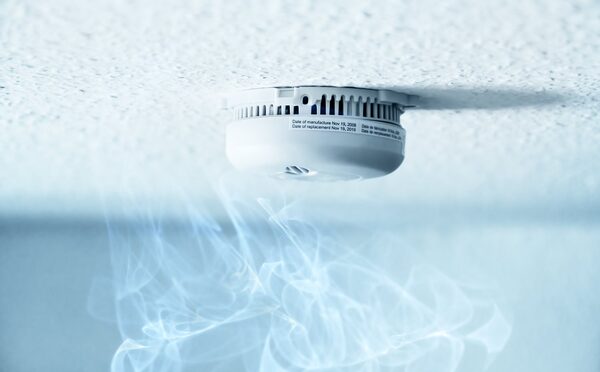
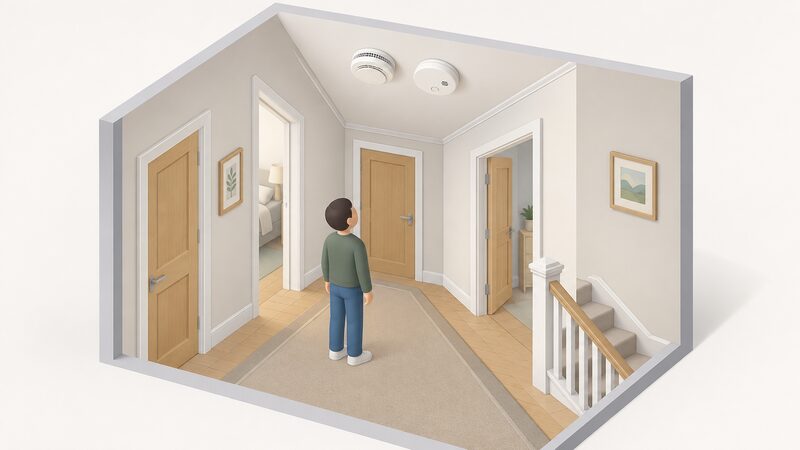
The floor-by-floor minimum is the baseline that every independent source repeats: at least one smoke or heat alarm per floor1. It is a floor, not a target. A three-storey house with one alarm per level meets the minimum and still leaves the bedrooms at the top of the house a long way from the alarm on the ground floor.
A fuller layout appears in the official rules for Scottish area-based schemes, which specify one smoke alarm in the living room or the room used most, one smoke alarm in every hallway or landing, and one heat alarm in the kitchen4. That arrangement reflects how fires actually start and how people actually escape: the living room and kitchen are the likely sources, the hallway and landing are the escape route.
Rented homes carry their own requirements. In Wales, the Fitness for Human Habitation Regulations require a smoke alarm, in proper working order, to be present on every storey of a dwelling, and that alarm must be connected to the electrical supply and inter-linked with all other smoke alarms connected to the electrical supply14. The same regulations do not require additional battery powered alarms to be inter-linked14. Official guidance for the private rented sector in England tells landlords and letting agents to fit smoke alarms on every floor13.
The practical question for a householder is not the legal minimum but the escape route. An alarm that sounds in a closed room on a floor nobody is sleeping on adds little. Alarms on the route out, and in the rooms where heat sources sit, do the work.
| Property type | Minimum | Fuller layout |
|---|---|---|
| Single-storey flat | One smoke or heat alarm1 | Smoke alarm in the room used most, heat alarm in the kitchen4 |
| Two-storey house | One per floor1 | Smoke alarms in living room and every hallway or landing, heat alarm in kitchen4 |
| Rented home in Wales | Smoke alarm on every storey, mains-connected and interlinked14 | As above, plus CO alarm in any room with a gas, oil or solid fuel appliance14 |
Where alarms belong and the BS 5839-6 standard
Placement is governed by a British Standard rather than by preference. Smoke and heat alarms must be installed and maintained in accordance with British Standard BS 5839-6, which covers the planning, design, installation, commissioning and maintenance of fire detection and fire alarm systems in domestic premises5. BS 5839 (part 6) sets out the requirements for the proper fitting of smoke alarms in domestic properties14.
The standard's most consequential rule for everyday households concerns kitchens. BS 5839-6:2019 states that only heat alarms should be installed in kitchens4. A heat alarm contains a thermistor set to respond to temperatures above 58°C by sounding an alarm5. That threshold is high enough to ignore steam, smoke from toast and cooking fumes, and low enough to catch a real fire. A smoke alarm in the same position would sound every time the oven door opened.
Smoke alarms themselves should meet BS EN 14604:20054. Combined smoke and carbon monoxide detectors are permitted in some settings provided they meet the appropriate requirements of BS EN 50291 for CO detection and alarm activation and BS EN 14604 for smoke detection and alarm activation15.
Alarms may be hard wired or battery sealed, or a combination of both5. The choice affects maintenance rather than coverage: a sealed battery removes the annual battery change but not the monthly test, and it does not extend the ten-year replacement limit.
Carbon monoxide alarms: the EN 50291 certification to look for
Carbon monoxide is the harder alarm to get right, because the standard is more specific and the failure mode is silent. The certification to look for is BS EN 50291. Approved Document J, in its 2010 edition incorporating the 2010 and 2024 amendments, states that carbon monoxide alarms should comply with BS EN 50291-1:201816. Earlier Welsh guidance cites BS EN 50291:200117, and Northern Ireland's Technical Booklet L cites BS EN 5029118. The standard has been revised over time; the current reference is the 2018 version.
Independent guidance adds the marks that show compliance. The HHIC advises choosing alarms compliant with EN 50291 and displaying a Kitemark6. Energy UK describes alarms marked with the EN50291 standard, which may be written as BSEN 50291 or EN50291, with the CE mark and a Kitemark or Loss Prevention Certification Board logo19. The Health and Safety Executive's gas safety guidance for homeowners says to ensure the alarm meets current safety standards (BS EN 50291) and carries the Kitemark20.
Installation and maintenance follow a second standard. Northern Ireland legislation requires carbon monoxide alarms to be installed and maintained in accordance with British Standard BS EN 502925. Approved Document J points to BS EN 50292:2023 for guidance and recommendations on installation16. Scotland's Tolerable Standard requires CO detectors to comply with BS EN 5029121.
Placement advice is consistent: an open space such as a hallway or the kitchen, tested regularly22. The alarm should include an integral sounder16, and it should incorporate a warning device to alert users when the working life of the alarm is due to pass16. Audible alarms are preferable to those giving visible warnings or black spot alarms, because a sleeping occupant will not see a light23.
Does a carbon monoxide alarm need to be interlinked with the smoke alarms?
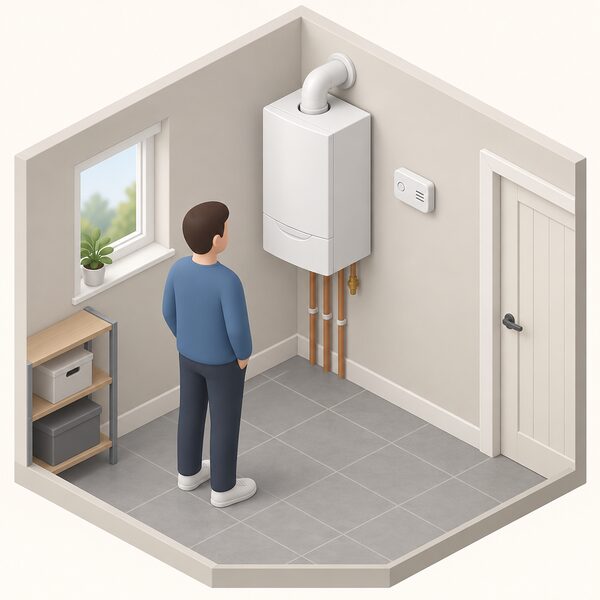
No. The legislation covering smoke and heat alarms states that carbon monoxide alarms do not need to be interlinked5. Scotland's Tolerable Standard does not require carbon monoxide detectors to be interlinked, or to be interlinked with fire alarms21. The Scottish area-based scheme rules say the same in plain terms: a carbon monoxide detector must be present in any room with a carbon-fuelled appliance such as a boiler, fire, heater or flue, but it does not need to be linked to the fire alarms4.
There is one exception worth knowing. Where a telecare system is in use, official guidance says effective CO alarms should be installed which are compatible with any telecare alarms, and connected to the telecare system, ensuring a single system approach21. That is about alerting a monitoring service, not about linking to smoke alarms.
The interlinking requirement that does exist applies to smoke and heat alarms themselves, which must be interlinked5. In Wales, rented homes must have smoke alarms connected to the electrical supply and inter-linked with all other smoke alarms connected to the electrical supply14.
Where a CO alarm goes is a separate question from whether it links. The requirement in Wales is a CO alarm in any room which has a gas, oil or solid fuel burning appliance installed14. Scotland requires a carbon monoxide alarm in all rooms where there is a fixed combustion appliance, excluding one used solely for cooking, or a flue26. In England, carbon monoxide alarms are required when a fixed combustion appliance, excluding gas cookers, is first installed in any home26. Northern Ireland's Technical Booklet L requires a carbon monoxide detector or alarm in the room where a new or replacement combustion appliance not designed solely for cooking is installed18.
A consultation on domestic smoke and carbon monoxide alarms has proposed requiring carbon monoxide alarms upon the installation of a fixed heating appliance of any fuel type in any home, extending requirements that currently only cover solid fuel heating27. That is a proposal, not current law.
When to replace alarms: the ten-year limit
Smoke and heat alarms have a working life, and it is shorter than most householders assume. Independent guidance is to replace them every ten years or when the replace-by date is reached2. The date is printed on the unit; the practical step is to note it when the alarm is fitted, because ten years is long enough to forget.
Carbon monoxide alarms are different. Their sensors are usually more fragile than those within smoke alarms and usually need to be replaced more regularly14. SGN advises checking the expiry date, which can normally be found printed on the alarm itself, so the unit can be replaced before it reaches the end of its life24. Official guidance says the guidance accompanying carbon monoxide alarms should always be followed carefully, including noting the expiry date14.
Batteries are a separate clock. Energy UK advises replacing the batteries annually or when the low battery signal sounds19. Uswitch gives the same rule for CO alarms: test regularly and replace the batteries at least once a year, or when the low battery alarm sounds23. Sealed-battery units remove that task but not the replacement date.
| Alarm type | Test | Battery | Replace |
|---|---|---|---|
| Smoke | Monthly1 | Annually, or when the low battery signal sounds19 | Every ten years or at the replace-by date2 |
| Heat | Monthly1 | Annually, or when the low battery signal sounds19 | Every ten years or at the replace-by date2 |
| Carbon monoxide | Monthly8 | Annually, or when the low battery signal sounds19 | At the expiry date printed on the unit; sensors are more fragile and often need replacing sooner14 |
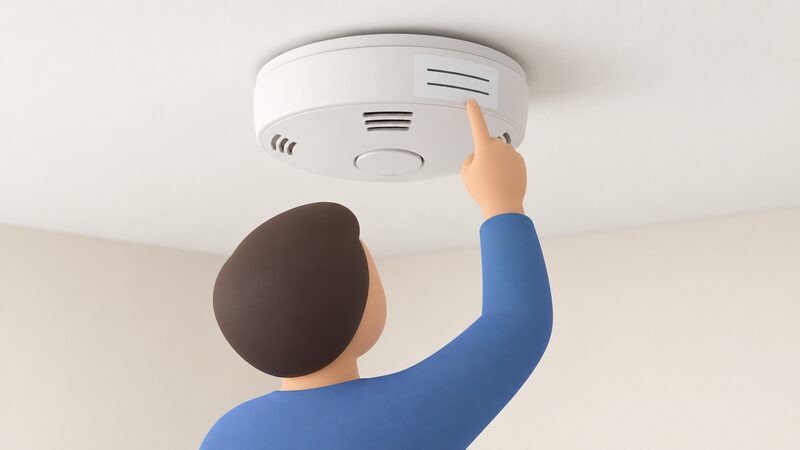
What the test button checks, and what it does not
The test button is a self-check, not a smoke test. It confirms the electronics, the sounder and the power supply are working. It does not prove the sensor will respond to real smoke, and it does not extend the unit's working life. That distinction matters because a unit that passes its button test in year eleven is still past its replace-by date.
Testing with a match or candle is not the method the guidance describes. The instruction across independent sources is to test using the button and to follow the maker's instructions. An open flame held under a plastic alarm risks heat damage and a fire, and it tests nothing the button does not.
Electrical Safety First ran its Electrical Fire Safety Week 2026 campaign around checking and testing smoke alarms, which reflects how much of the problem is behavioural rather than technical28.
Keeping a testing routine that actually happens
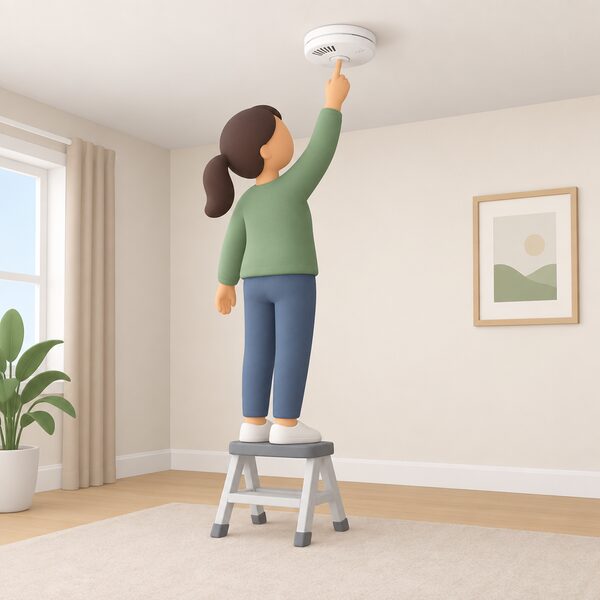
The gap between knowing the advice and following it is where most households sit. The monthly test is easy to forget because nothing bad happens when it is skipped, until it does.
A few structural habits make the routine stick. Tie the test to a recurring event that already happens, such as the first of the month or a bin collection day. HETAS suggests testing on a day you are likely to remember8. Test every alarm in one pass rather than one at a time, so a failure is found in the same session. Note the replace-by date of each unit somewhere the household will see it, because the ten-year limit and the CO expiry date are the two deadlines that cannot be inferred from the alarm's behaviour.
The wider maintenance calendar supports the alarm routine. Annual appliance servicing, flue checks and chimney sweeping are the tasks that reduce the likelihood of the alarm ever needing to sound12. Regular alarm testing, annual appliance servicing and proper ventilation are described as the three simplest ways to prevent poisoning11.
For households thinking about the wider picture of preparing a home for winter, alarms belong on the same list as boiler servicing and pipe lagging. They are not an energy measure, but they protect the systems that keep a home warm and safe, and they are the one part of household energy safety that no supplier, app or smart meter can perform remotely.
Sources28 cited
- Patio heaters safety advice, Electrical Safety First, 2026-09-19
- Energy and rating labels, Electrical Safety First, 2026-09-19
- Portable heaters safety advice, Electrical Safety First, 2026-09-17
- Area Based Scheme guidance, Scottish Government, 2024-08
- The Smoke and Carbon Monoxide Alarm (Amendment) Regulations (Northern Ireland) 2024, legislation.gov.uk, 2024-05-30
- Gas Safety Week 2025: CO alarms, HHIC, 2025-09-09
- Smart homes safety advice, Electrical Safety First, 2026-09-19
- HETAS consumer FAQs, HETAS, 2026-04-01
- Carbon monoxide advice, Cadent Gas, 2026-09-20
- Gas safety in the home: owner occupiers, Health and Safety Executive, 2026
- Carbon monoxide: the silent risk in every home, IIAA, 2026-09-20
- Cooking safely, Cadent Gas, 2025-11-12
- Landlord and tenant rights and responsibilities in the private rented sector, GOV.UK, 2019-04-09
- Fitness for Human Habitation guidance for landlords, Welsh Government, 2022-01-13
- Carbon monoxide alarms in private rented properties: guidance, Scottish Government, 2016-12-01
- Approved Document J: Combustion appliances and fuel storage systems, Welsh Government, 2024-10-04
- Building Regulations guidance Part J: heat producing appliances (archived), Welsh Government, 2010
- Technical Booklet L: 2012, Building Control Northern Ireland, 2012
- Carbon monoxide, Energy UK, 2024-11-21
- Gas safety in the home, Health and Safety Executive, 2011-09
- Tolerable Standard guidance: satisfactory fire and carbon monoxide detection, Scottish Government, 2023-06-20
- Gas leaks safety guide, Uswitch, 2026-06-01
- Carbon monoxide safety guide, Uswitch, 2022-09-25
- 26% of carbon monoxide safety call outs linked to alarm failures and battery faults, SGN, 2025-11-17
- Carbon monoxide: general information, GOV.UK, 2022-05-24
- Carbon monoxide alarm regulations: are you ready?, CO Gas Safety, 2022-07-11
- Domestic smoke and carbon monoxide alarms consultation, CIBSE, 2026-09-17
- Westminster policy and research, Electrical Safety First, 2026-09-17
 Alarm Rules in Rented HomesHow many smoke and carbon monoxide alarms a rented home must have, where they must be sited, and how the rules differ across England, Scotland, Wales and Northern Ireland, including the standards alarms must meet and who tests them.
 Smell Gas or Suspect COThe emergency steps for a suspected gas escape or carbon monoxide alarm, including ventilation, ignition sources and turning the supply off at the emergency control valve.
 Carbon Monoxide SafetyHow carbon monoxide arises from gas, oil, LPG and solid fuel appliances, where alarms must be sited and what the requirements are in each UK nation.
 Maintenance and FaultsWhat does it mean when your home battery starts beeping or showing a warning, and can you fix it yourself?
 The Full Boilers and Heating GuideWhich boiler suits your home, and when is it worth swapping the old one?
 UK Cooling DemandPublished data on air conditioning ownership and home overheating, with projections for summer temperatures in each UK nation, and what rising cooling demand means for summer electricity use.