
In this guide
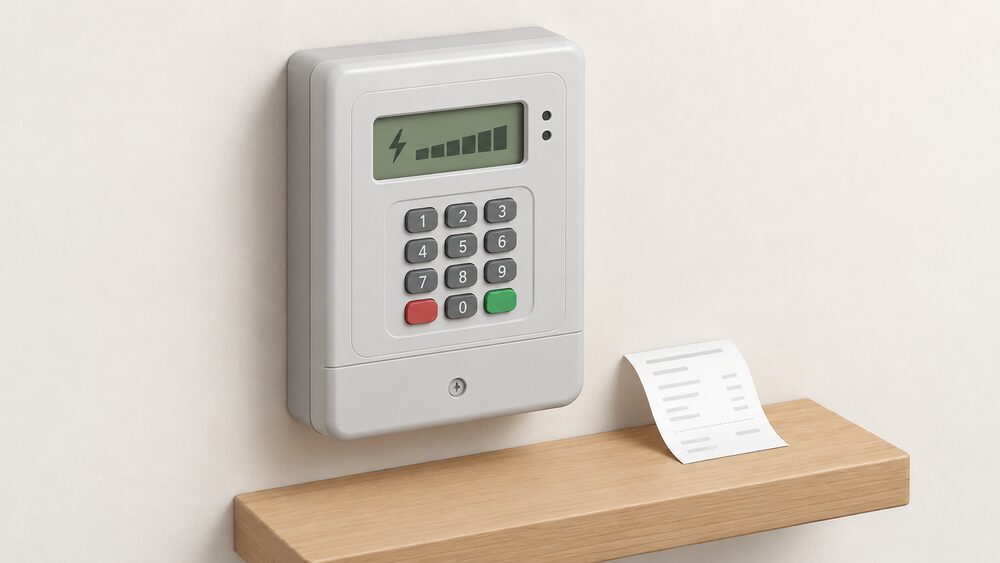
A prepayment meter is paid for before the energy is used, not after: credit is loaded onto a key, a card or, on a smart meter, straight onto the meter itself, and the supply runs only while that credit lasts1. Traditional meters are topped up in person at a shop carrying PayPoint or Payzone, or at a Post Office, using the meter's key, card or a barcode2. A smart meter in prepayment mode needs no key or card at all: credit is bought online, through the supplier's app, by text message or over the phone, and sent to the meter remotely3.
Where a top-up cannot reach the meter over the air, it is entered by hand as a 20-digit code, also called a unique transaction reference number, printed on the receipt or payment confirmation4. In Northern Ireland, Keypad meters work this way as standard: a code bought online or in a shop is typed into the meter's keypad. Power NI customers can buy that code online as a guest with a 19-digit Keypad Premise Number, which usually begins 9826908501, and the property postcode, with no registration and no Keypad card needed5.
When credit runs out, most meters offer a small emergency credit allowance, commonly around ten pounds, which behaves like an overdraft and is repaid from the next top-up6. Beyond that, the position is blunt: once credit is exhausted and emergency credit is used up, no energy can be drawn until the meter is topped up again7.
Pay first, then use: what that means day to day
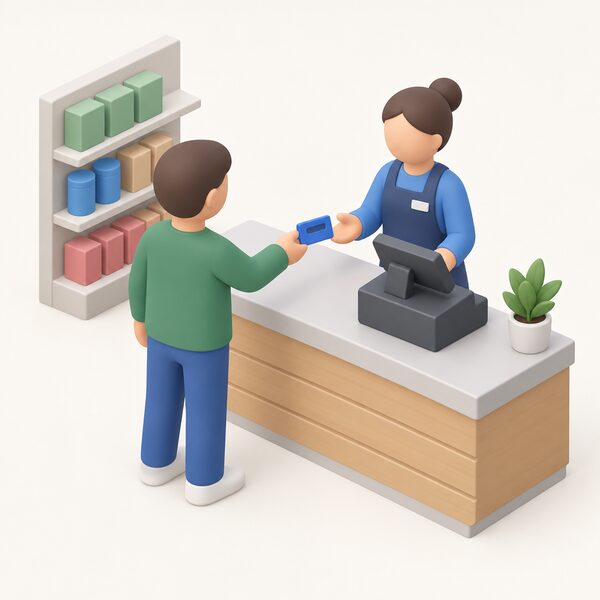
With a prepayment meter you pay for gas or electricity in advance of using it, on a pay-as-you-go basis1. Older meters read a smart card, a key or a token, and a few still take coins2. Credit bought in a shop is written onto the key or card at the till, then carried home and inserted into the meter, which transfers the money across and starts counting it down.
One practical consequence is that the supplier does not need a meter reading to bill: the meter has already been paid, so consumption is settled as it happens rather than after a bill arrives9. That removes estimated billing, but it also removes the cushion a credit account gives. There is no month's grace, and no direct debit smoothing winter against summer. The household's supply depends on someone being able to get to a top-up point, or get online, before the balance reaches zero.
The second consequence is that prepayment is often used as a debt mechanism. Suppliers frequently recommend a prepayment meter to customers already in fuel debt precisely because it stops further debt building and lets the supplier collect part of the arrears from every top-up10. That is the trade: tighter control over spending, at the cost of paying for past debt out of every payment and of losing supply if a payment cannot be made.
Ways to top up: shop, key, card, app or code
The route depends on whether the meter is a traditional prepayment meter or a smart meter running in prepayment mode.
| Meter type | How credit is bought | How credit reaches the meter |
|---|---|---|
| Traditional key or card meter | At a PayPoint or Payzone shop or a Post Office, using the meter's key or card7 | Key or card carried home and inserted2 |
| Smart meter in prepayment mode | Online, supplier's app, phone, or text message11 | Sent over the air across the smart metering network12 |
| Smart meter, cash top-up | In a shop, using a barcode, card or reference number supplied by the supplier13 | Over the air, or by code if needed4 |
| Keypad meter (Northern Ireland) | Online as a guest with the Keypad Premise Number and postcode, or in a shop5 | Code typed into the meter by hand5 |
The smart route is the significant change for households. Because credit is sent over the smart network rather than carried on a plastic key, a prepay customer with a smart meter should be able to top up online, and suppliers offer telephone, text and app top-ups as alternatives14. Ofgem's expectation is that a smart meter customer should be able to top up in the way that suits them, in person or remotely15. A smart meter top-up should appear on the meter within one hour8.
Not every household wants to give up cash. Where someone prefers to pay in a shop, a supplier can issue a barcode, card or reference number to hand over at the counter, and the credit is then applied to the smart meter13. Where a shop is inconvenient or unsafe to reach, a supplier may agree to an alternative such as top-up by text message, a smart meter in prepayment mode that can be topped up online, or a move to a credit meter billed monthly or quarterly13. Those are arrangements to ask about rather than automatic rights.
Topping up a Northern Ireland Keypad meter
In Northern Ireland, prepayment is the Keypad system, and the identifying test is simple: a meter paid for by top-up is a keypad meter, while a meter that produces a monthly or quarterly bill is a credit meter16. Keypad meters are installed as standard single-rate units and as multi-rate units with Economy 7 for homes with storage heating17. Each electricity supplier publishes its own top-up arrangements, and Northern Ireland Electricity Networks, which owns the meters, points customers to those supplier pages rather than handling top-ups itself18.
For a Power NI Keypad, online top-up requires the 19-digit Keypad Premise Number, which usually begins 9826908501, together with the postcode. No registration is required for a guest top-up, and the Keypad card is not needed to buy credit online5. Customers who do register an online account can save payment details for faster future top-ups, view previous top-up codes and letters, manage the account and use the Power NI Perks rewards scheme5.
Keypad meters also have a physical limit on the supply they draw. Where a property repeatedly overloads its connection, the route is an application to alter the existing network equipment to increase the connection capacity, which is a network matter rather than a supplier one16.
Entering a top-up code by hand
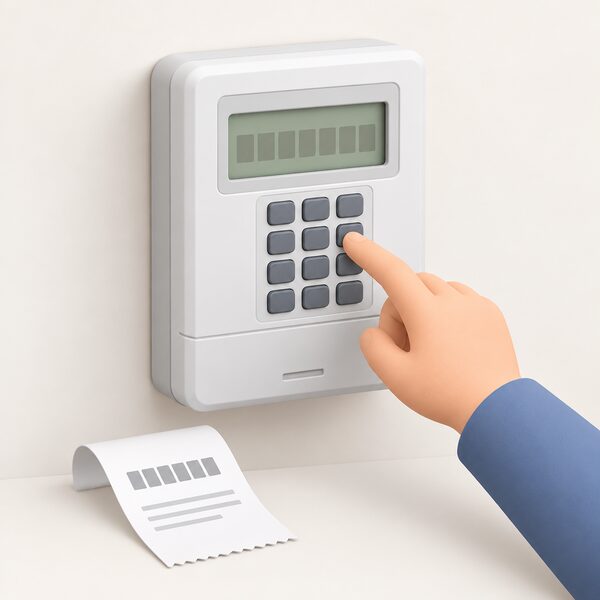
Where credit cannot be delivered over the air, it is added manually using the 20-digit code shown on the receipt or payment confirmation, known as the unique transaction reference number4. The code is unique to one meter and one payment, which is why it cannot be reused and cannot be applied to a different property's meter.
The sequence on a keypad meter is straightforward in principle:
- Buy the credit and obtain the code, on a printed receipt, by email, by text or through the supplier's app4.
- Wake the meter's keypad and begin code entry, using the meter's entry key.
- Type the digits in order, checking the display as each group appears.
- Confirm the entry and wait for the meter to accept the code and show the new balance.
- Keep the receipt or code record until the balance has visibly increased.
Meters differ in which key starts and confirms entry, and in how long they wait before clearing a part-typed code, so the meter's own instruction label or the supplier's guidance for that model governs the exact keystrokes.
Codes are most often rejected for mistyping, for belonging to a different meter, or for having already been applied. Government support vouchers behave differently again: prepayment customers may be required to redeem such vouchers at a local top-up point rather than keying them into the meter19. Vouchers for traditional prepayment meters have been issued by text, email or post, or credited automatically at the next top-up20. Where a code will not take, the supplier that issued it is the only party that can verify or reissue it.
Emergency credit: a limited overdraft, not free energy
Most prepayment meters carry an emergency credit budget that can be drawn on when the ordinary balance runs out, and it is limited6. It is designed to maintain supply for a short period after regular credit is exhausted, and it is reclaimed from the next top-up8. Suppliers commonly provide around £1021. Age UK's position is that "your supplier should offer you emergency credit wherever possible"22.
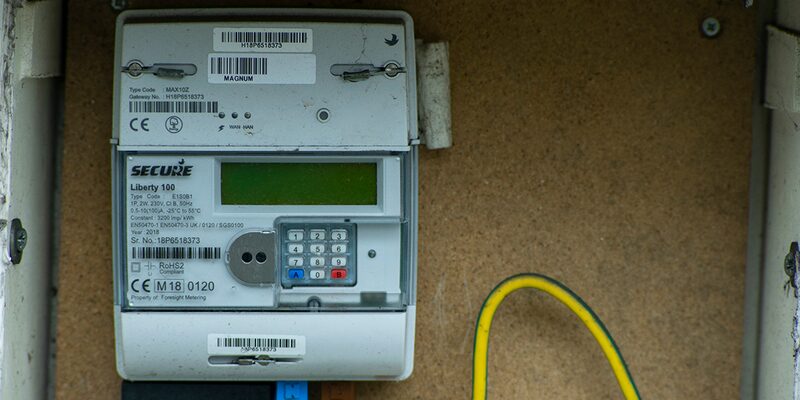
Activation differs by meter. On a traditional meter it is usually triggered by inserting the key or card, or by pressing a button on the meter. On a smart meter in prepayment mode, emergency credit is generally activated at the meter itself or through the in-home display23, and Smart Energy GB describes a dedicated emergency credit button giving "a bit of extra time before you are able to top up"24. An in-home display in prepay mode shows the available balance for each fuel and how close the household is to its next top-up12, and consumer testing describes displays that show the credit balance, alert the user when the balance is running low and let emergency credit be activated25.
Repayment is the part households most often underestimate. The amount used is repaid when the meter is next topped up26, either in full or, by arrangement with the supplier, a little at a time27. Emergency and friendly credit usually have to be repaid in full before they can be used again28. A top-up made after a spell on emergency credit therefore buys less energy than the same top-up made from a positive balance.
Where a household cannot afford to top up at all, a separate route exists. Suppliers can apply temporary credit, often called additional support credit, to a prepayment meter or a smart meter in prepayment mode29. It is not always added automatically, so the supplier has to be contacted31. It too is recovered from future top-ups32.
Friendly credit: staying on overnight and over holidays
Friendly hours credit is a separate protection from emergency credit. It applies where a meter is running low at times when top-up points are closed: overnight, at weekends and on public holidays33. Citizens Advice describes the same protection as temporary credit available if credit runs out at night, at weekends or on bank holidays34. Whether it is applied automatically or has to be requested depends on the supplier35.
The practical effect is that a meter reaching zero at ten on a Sunday evening should not necessarily cut the heating off until Monday. The practical limit is that friendly credit, like emergency credit, is repaid from the next top-up and usually has to be cleared in full before it can be drawn on again28. It buys time, not energy.
Suppliers have at times gone further during winter, with measures including payment holidays, restructured payment plans, credit advances to prepayment customers and reducing or waiving standing charges over winter for certain customers36. These are supplier-by-supplier decisions rather than a uniform entitlement, so the only reliable way to know what applies is to ask the supplier directly. Anyone who needs a constant electricity supply for lifesaving equipment, or who cannot safely reach the meter to read or top it up, should make sure the supplier knows, because that changes what the supplier must offer37.
Reading the display: balance, debt and daily cost
Prepayment meters carry a button that cycles through screens, including how much credit remains and the unit rate and standing charge being applied38. On a keypad-style pay-as-you-go meter, pressing 2 shows the cost of usage for the previous day, week and month, which is the quickest way to see whether consumption is rising39. On a smart meter in prepay mode, the in-home display carries the same information in a more readable form, showing the balance for each fuel and how close the household is to needing a top-up12.
Those screens matter because the balance shown is not always the amount available to spend. Where debt repayment or recovered emergency credit is being taken, part of the balance is already committed. The screens showing standing charge, unit rate and debt recovery are what explain the gap between a £10 top-up and the energy it actually buys. Reading them regularly is also the basis of any attempt to reduce consumption, since the meter is the only record of what the household is actually using. Further detail on meter displays is covered in the guides to taking a meter reading and getting a reading from a smart meter.
Why your top-up buys less than you expect
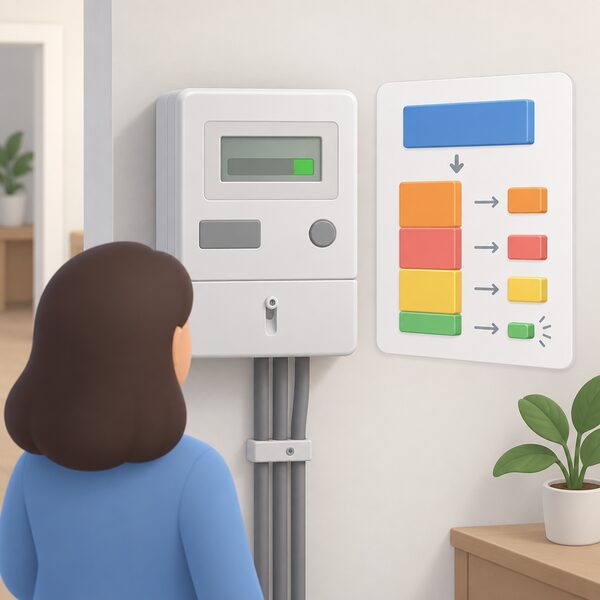
Three deductions sit between money paid and energy delivered.
- Standing charge. A daily standing charge accrues whether or not energy is used. If a meter is not topped up, for example a gas meter left over summer, that charge builds as a debt, and later top-ups are used to pay off previous weeks' unpaid standing charges3.
- Debt repayment. Repayment may be set as a fixed weekly amount or as a percentage. Where repayment is £6 a week and £10 a week is topped up, £6 goes to the debt and £4 is added as credit. Where repayment is set at 30%, every £10 top-up puts £3 to the debt and £7 to credit. Missed payments are added up and deducted from the next top-up3.
- Recovered emergency or friendly credit. Anything advanced comes off the next payment26.
Debt itself can arrive by several routes: using some or all of the emergency credit, missing a standing charge payment, or being on a repayment plan6. Debt from a credit meter account may also be transferred onto a prepayment meter by the energy company, with repayments then taken automatically at every top-up3. That transfer is the mechanism behind many unexpectedly small credit balances.
The cost position is not neutral. Prepayment meters have been described as more expensive to run, harder to switch away from, and capable of leaving a household without electricity if the meter is not kept sufficiently topped up40. Households carrying arrears can read more on energy debt write-off grants and on switching supplier with a prepayment meter and debt.
Lost key, lost card, or a supplier that fails
If the key or card is lost, the supplier should send a replacement, and in the meantime should be able to authorise a temporary card at the nearest PayPoint, Payzone or Post Office so the household is not left without a way to pay6. Power NI sends a replacement Keypad card by post and asks for up to three weeks, while online top-up continues in the meantime5.
If the supplier goes out of business, the meter can still be topped up as usual, and the new supplier appointed to the account provides information on how to obtain new key cards and tokens41. Until that new account is properly set up, the advice is to top up only in small amounts, paying only what is needed to get through a few days42. Loading a large sum during the transfer risks credit being difficult to trace.
Where the meter itself is at fault, the supplier should confirm the problem and offer a solution, either fixing it remotely or replacing it3. That is covered further in the guide to reporting a faulty or inaccurate meter.
Where prepayment is unsuitable
Prepayment is presented by Ofgem as helpful for households on a tight budget, those who want more control over spending, and those managing debt43. The same guidance is clear that a supplier must offer help where a customer cannot afford to top up, for example by giving extra credit in a vulnerable situation43. A prepayment meter may only be installed without permission where other ways of recovering the debt have not worked44.
Circumstances in which prepayment may not be safe and practical include the following.
- The meter cannot be physically accessed to top it up, or the householder is disabled or has a health condition21.
- The household cannot afford to top up and includes children aged between two and five13.
- Someone in the household needs a continuous supply for health reasons, there is a resident over 75 without support, there are children under two, or no one is able to top up because of incapacity27.
- The nearest top-up point is more than two miles away and the household has no car, which Ofgem has said may make a prepayment meter not reasonably practicable45.
- The householder is aged 75 or over, or simply cannot afford to top up21.
For energy independence, the honest summary is that prepayment gives a household precise visibility of what it spends and stops debt accumulating unseen, but it deepens dependence in other directions. Supply is contingent on a successful payment, on a shop being open or a network being available, on the supplier's app or phone line working, and, for smart top-ups, on the national smart metering network carrying credit to the meter12. A household that wants to reduce that exposure has limited levers: keeping a buffer of credit on the meter, knowing the emergency and friendly credit rules before they are needed, and reducing consumption so that each top-up lasts longer. Wider options are set out in the guides to taking more control of your home's energy and to changing from a prepayment meter across the how-to library.
Sources45 cited
- Get help with your prepayment meter, Ofgem, 2026
- Overdue utility bills, nidirect, 2026-09-17
- Energy debt on prepayment meters, Centre for Sustainable Energy, 2026-08
- Troubleshooting smart meter issues, Smart Energy GB, 2026-04-01
- I need a new Keypad card, Power NI, 2026-09-20
- Prepayment meters guide, Uswitch, 2026-08-26
- Prepayment meters consumer guidance, Ofgem, 2026
- Prepayment meters advice, Centre for Sustainable Energy, 2025-08
- How to submit a meter reading, Uswitch, 2026-04-23
- Out of the cold: helping people on prepayment meters stay connected, Citizens Advice, 2022-09-30
- How to read your gas meter, National Energy Action, 2026-07-13
- How do smart meters send readings, Smart DCC, 2026
- Problems getting to or topping up your prepayment meter, Citizens Advice, 2026-09-17
- Do I already have a smart meter, Smart Energy GB, 2026-03-16
- Smart meters: your rights and expectations, GOV.UK, 2025-08-08
- Temporary power outages for Keypad customers, NIE Networks, 2026-09-19
- Selecting your domestic meter, NIE Networks, 2026-09-19
- How can I top up my Keypad meter, NIE Networks, 2026-09-20
- Residents urged not to miss out on energy bill support, West Midlands Combined Authority, 2023-02-22
- Unclaimed prepayment meter vouchers, Which?, 2023-02-14
- Changing a prepayment meter to a credit meter, Confused.com, 2026-04-20
- Energy meters advice, Age UK, 2026-09-10
- How to use a smart meter in prepay mode to save money, Smart Energy GB, 2026-08-17
- Smart meter benefits for you, Smart Energy GB, 2026-08-18
- How to use your smart meter data, Which?, 2026-07-14
- Support for those on prepayment meters, British Gas Energy Trust, 2026-07-07
- Prepayment meter advice, Scope, 2025-01-08
- Advice for those worried about energy bills, Smart Energy GB, 2026-08-19
- Emergency help for unpaid energy bills, British Gas Energy Trust, 2026-04-28
- If your home is on a heat network, Citizens Advice, 2026-09-20
- Help with your energy bills, SGN, 2026
- How to get help with energy bills, Confused.com, 2025-11-10
- Energy UK briefing on prepayment meters, Energy UK, 2022-12-14
- Struggling to pay your heat network bills, Citizens Advice Scotland, 2026-09-17
- If you cannot afford to top up your prepayment meter, Citizens Advice, 2026-09-17
- MPs winter toolkit, Energy UK, 2025-11-17
- Changing a prepayment meter to a credit meter, Uswitch, 2026-04-23
- Reading your gas or electricity meter, Centre for Sustainable Energy, 2026-08
- Preparing for winter, National Energy Action, 2025-10-14
- Paying for energy by cash, Uswitch, 2025-09-05
- What happens if your energy supplier goes out of business, Ofgem, 2026
- Your energy supplier has gone bust, Citizens Advice, 2021-11-22
- Get help with your prepayment meter, Ofgem, 2026
- Installing a prepayment meter without your permission, Ofgem, 2026
- Heat networks consumer protections draft guidance, Ofgem, 2025-09-05
 Prepayment MetersHow do you top up a prepayment meter for gas or electricity, and what happens when the credit runs out?
 Prepayment Meter DebtHow debt repayment is set on a prepayment meter, the limits on the share of a top-up that can be taken, and how to have a rate reviewed.
 Smart Prepayment MetersHow prepayment mode works on a smart meter, remote switching between credit and prepay, topping up, emergency and friendly credit, the prepayment price cap, the £500 debt limit for switching, and the free help available when a household cannot top up.
 Keypad Meters in NICovers the pay as you go keypad metering used across Northern Ireland, topping up by card, app and online, and emergency credit and debt recovery settings.
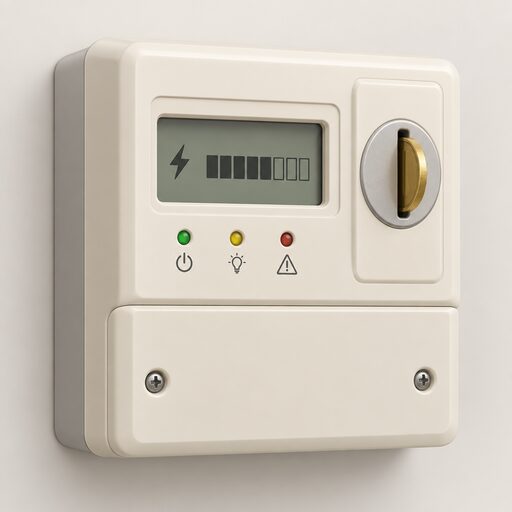 Prepayment and Pay As You GoHow prepayment and pay as you go energy tariffs work in the UK: meter types, top-ups, emergency credit, debt repayment through the meter, price cap treatment and how households move to a credit meter.
 Prepayment Meters and DebtCan your energy supplier force you onto a prepayment meter because you owe them money?