
In this guide
A prepayment energy tariff is a way of buying gas or electricity before it is used, rather than being billed for it afterwards. Ofgem's guidance is direct on the principle: a prepayment meter lets a household "pay for electricity or gas in advance rather than after you have used it"1. Credit is loaded onto a key, a card or, increasingly, a smart meter account, and the meter releases energy until the balance runs down.
The numbers matter more than the mechanism. Ofgem's archetype modelling puts 36% of households in its archetype E13 on prepayment meters for electricity and 37% for gas, a GB average of 12% across the wider population2. Prepayment customers are covered by the energy price cap, which applies to default tariffs "regardless of payment method"3. The cap for prepayment customers rises to £1,678 from 1 October 2026, against £1,723 for Direct Debit customers4.
What prepayment buys a household is control and no bill shock. What it costs is a standing charge that accrues whether or not any energy is used, a supply that stops when credit runs out, and a tariff that has historically been dearer than Direct Debit. This page sets out how the tariffs work, who is on them, how top-ups and debt repayment operate, and what moving off prepayment involves.
What a prepayment tariff is: paying for energy before you use it
The defining feature of a prepayment tariff is timing. Payment happens before consumption, and the meter enforces the link. A household tops up a card or key in a shop, online or through a phone app, and the credit is loaded onto the meter7. There is no monthly bill in the ordinary sense, no direct debit mandate and no reconciliation at the end of a billing period.
Prepayment sits alongside the other tariff structures suppliers offer. Guidance on the tariff types available lists standard variable tariffs, renewable energy tariffs, electric vehicle tariffs, fixed price tariffs and prepayment energy tariffs (pay as you go) as distinct categories9. That matters because prepayment is a payment method as much as a product: the underlying tariff can be a standard variable rate, a fixed deal or, on a smart meter, a time-of-use product.
The price cap treats prepayment as one of the payment methods it covers. Ofgem states that a household is covered by the cap if it is on a default tariff and pays by standard credit, Direct Debit, prepayment meter or Economy 7 meter10. The cap is not a fixed price and does not apply to fixed, green or time-of-use tariffs12. A prepayment household on a default tariff therefore has capped unit rates and standing charges; one that has chosen a fixed or time-of-use product does not.
For a household's energy independence, prepayment is a mixed instrument. It removes the risk of an unexpected bill and makes spending visible in real time, which is genuine budgeting autonomy. It does not remove dependence on the grid, on a supplier, or on the top-up network: the meter only releases energy that has been bought through a supplier's systems, and the standing charge accrues regardless.
Who is on prepayment: around eight million UK households
Prepayment is not a niche. Ofgem's 2024 archetype update records that 36% and 37% of households in archetype E13 are on prepayment meters for electricity and gas respectively, against a GB average of 12%2. The archetype is a modelled household segment, so the figure describes a specific type of home rather than the whole country, but it shows how concentrated prepayment is among lower-income and lower-consumption households.
Behavioural evidence points the same way. In Ofgem's 2021 consumer survey, 48% of those on pre-payment meters said they monitored their energy use, a higher share than in other payment groups13. Prepayment households watch consumption closely because the meter makes the cost immediate.
The reasons households end up on prepayment fall into two broad groups. Some choose it, often to avoid debt or to budget week by week. Others are moved onto it by a supplier because of arrears. Ofgem's rules allow a supplier to install a prepayment meter without permission if a household is building up an energy debt and other ways of recovering that debt have not worked14. Before doing so, the supplier must make reasonable efforts to agree another repayment method and offer support if the household is struggling to pay15.
That distinction, chosen versus imposed, shapes everything else on this page: the tariff options available, the debt arrangements attached to the meter, and the route back to a credit meter. It also explains why prepayment policy has been politically charged since 2022, when the scale of involuntary installations became a public issue.
Meter types: key, smart card and smart prepayment
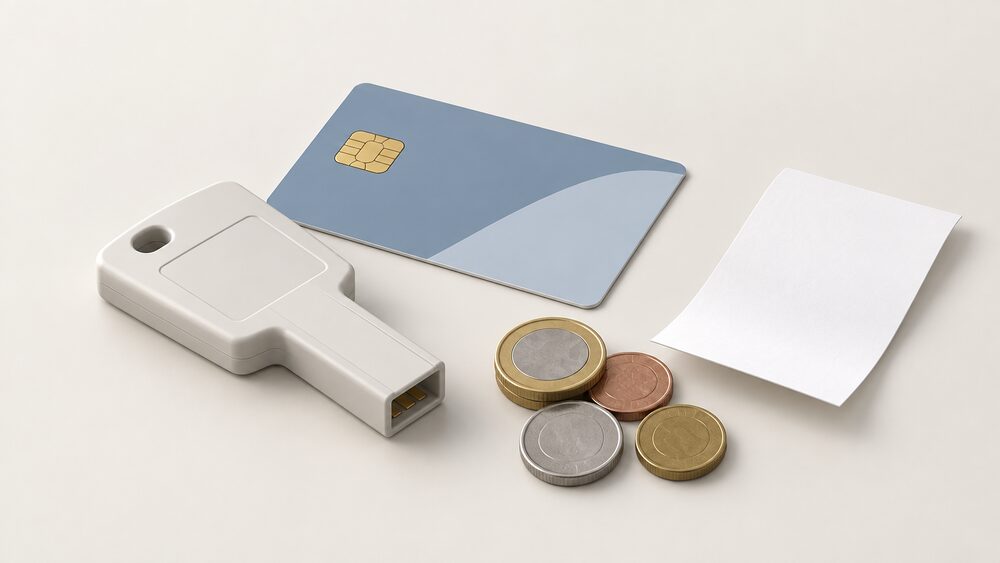
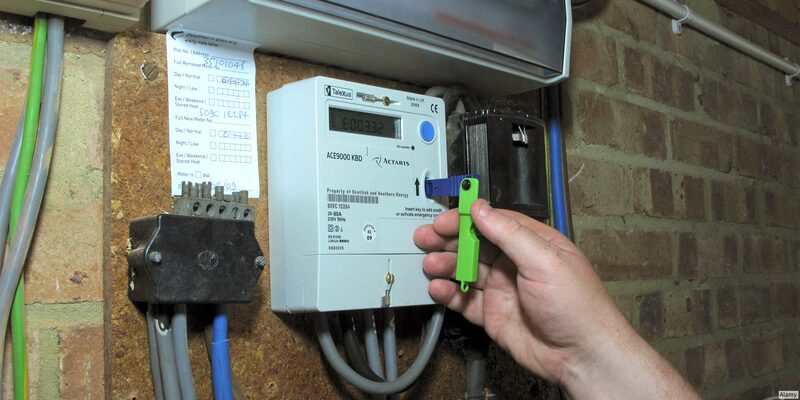
There are three main types of prepayment meter in UK homes: key meters, smart card meters and smart prepayment meters4. The older generation uses a physical token. With a pre-payment meter, a household uses a smart card, key or token, or sometimes coins, to pay for gas or electricity as it is used17. Almost all traditional prepayment meters use either a key or a smart card6.
Smart prepayment changes the mechanics rather than the principle. Smart meters can operate in credit or prepayment mode, and switching between the two is a configuration change rather than a meter swap18. That is why moving from an existing gas or electricity prepay meter to a smart credit meter is described as straightforward for customers who meet the conditions19.
| Meter type | How credit is carried | Top-up route |
|---|---|---|
| Key meter | Physical key | PayPoint or Payzone outlet, Post Office6 |
| Smart card meter | Physical card | PayPoint or Payzone outlet, Post Office6 |
| Smart prepayment meter | Loaded to the meter account | Online, phone, text, app, or in person20 |
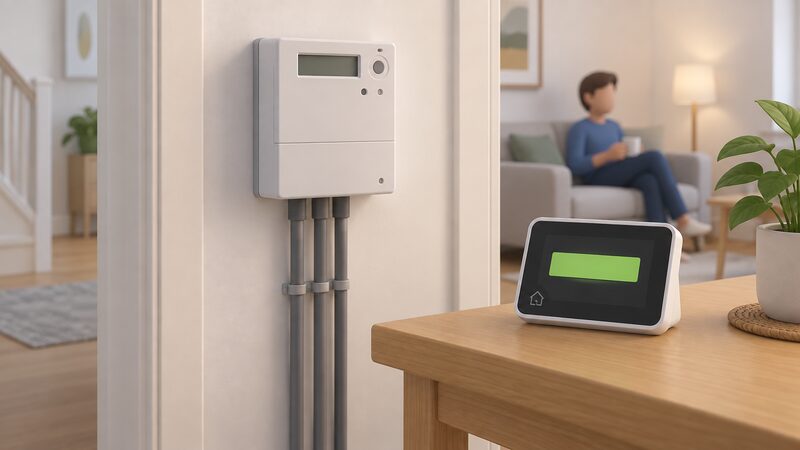
The practical difference is the top-up journey. On a smart prepay meter there is no gas card or electricity key to carry: top-ups can be made online, by phone, by text or through an app, or in person at a local shop, and the channels vary by supplier20. The credit reaches the meter over the smart meter network as an over-the-air top-up21.
For a household, the smart version removes the single most fragile part of prepayment: the trip to a shop with a key. It does not remove the dependence on the supplier's systems or on the meter's connectivity. A smart prepay meter that loses its communications link still needs a fallback route for credit.
How top-ups work: shops, apps and the Post Office
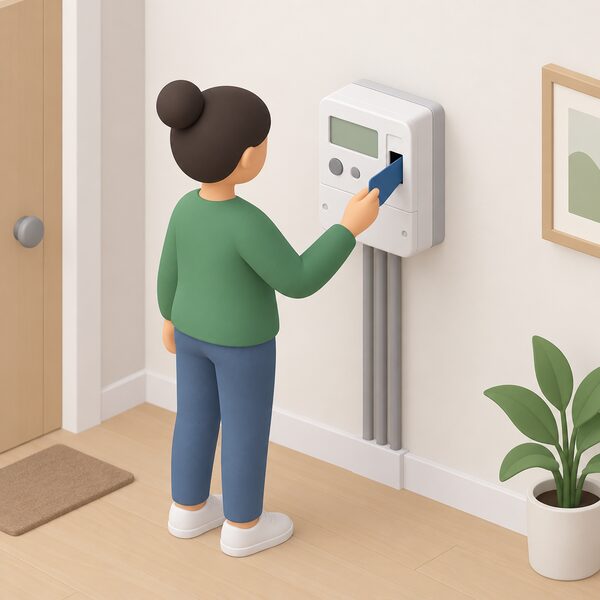
Top-up routes divide cleanly between traditional and smart meters. On a non-smart prepayment meter, credit is added at a local PayPoint store or Post Office using the meter's key or card, or by barcode for smart prepayment meters22. Independent guidance lists the same network: recognised PayPoint or Payzone shops, or the Post Office4. Northern Ireland guidance describes recharging a card or key at PayPoint outlets such as newsagents and Post Offices17.
On a smart prepay meter the options widen. Top-ups can be made online, by phone, by text or via an app, or in person at a local shop, depending on the supplier20. The credit is delivered to the meter over the smart meter network rather than through a physical token21.
One rule is absolute and worth stating plainly: it is illegal to buy credit for a prepayment meter from anywhere other than official outlets, though charities may distribute prepayment vouchers to people at risk of being cut off6. Buying credit through an unofficial channel risks losing the money and does not credit the meter.
Where a supplier goes out of business, the arrangements change. The new supplier will give information on how to get new key cards and tokens23. Households should expect a period of transition in which the old top-up route stops working and a new one begins.
Standing charges and self-disconnection: the debt that builds when credit runs out
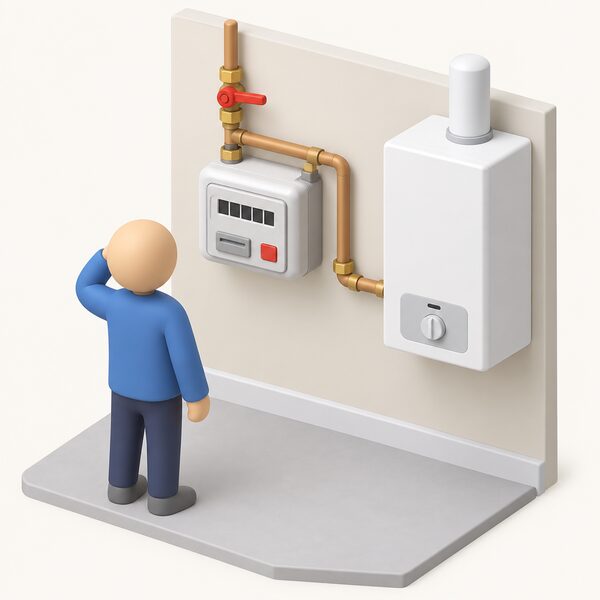
The standing charge is the part of a prepayment tariff that does not stop when consumption does. It is a fixed daily amount payable no matter how much energy is used, deducted automatically along with any unpaid standing charge or fuel debt when credit is added6. Standing charges are defined more broadly as a daily charge that energy customers have to pay even if they use no energy24.
That creates a specific trap. If a meter is not topped up, for example a gas meter over summer, the daily standing charge starts to build as a debt, and top-ups may be used to pay off previous weeks' unpaid daily standing charges7. The standing charge and any fuel debt still apply even if a household completely runs out of credit and stops topping up, a situation known as self-disconnection6.
Self-disconnection is the sharpest limit of prepayment as a model. Once credit runs out, no energy can be used until the meter is topped up again22. There is no grace period built into the tariff itself, only the emergency credit facility described below. For a household, that means the meter is not just a payment device but a supply switch, and the consequences of an empty meter fall on heating, cooking and lighting at the moment they are needed.
The debt dynamic runs the other way too. Energy bill credit builds when a household pays for more energy than it has used, for example by paying a set amount by Direct Debit every month25. Prepayment removes that particular risk, because there is no accrual in the household's favour or against it beyond the standing charge. What it substitutes is a different risk: a balance that can only go one way when income is interrupted.
Emergency credit and friendly credit: what happens when you run out
Most prepayment meters carry an emergency credit budget that works like an overdraft, and it is limited4. The facility is designed to maintain supply after regular credit runs out, and it is reclaimed from the next top-up6. The amount is not set by regulation; it varies by supplier and meter.
Emergency credit is a buffer, not a solution. Once it is exhausted and the meter is not topped up, supply stops. Ofgem's consumer guidance is unambiguous: once credit runs out, no energy can be used until the meter is topped up again22.
Some meters also carry a friendly credit arrangement, which keeps the supply on during certain hours, such as overnight, at weekends and on specified holiday dates, when topping up is impractical. The hours, the qualifying cut-off time and the holiday dates are set by the supplier and the meter type, so the arrangement on one meter will not necessarily match another. Friendly credit is a delay, not a discount: the amount of emergency credit and friendly credit used is deducted from the balance at the next top-up, and both usually need to be repaid in full before they can be used again. A household relying on either is borrowing against its own next payment, so the shortfall carries into the following week rather than disappearing.
The practical consequence for independence is that emergency credit is the only reserve in the system, and it belongs to the supplier's terms rather than to the household. A prepayment home has no equivalent of a credit balance it controls. The buffer exists to prevent immediate disconnection, not to provide a period of grace in which to manage a financial shock.
Repaying debt through the meter: percentages, fixed weekly amounts and the 40% who repay this way
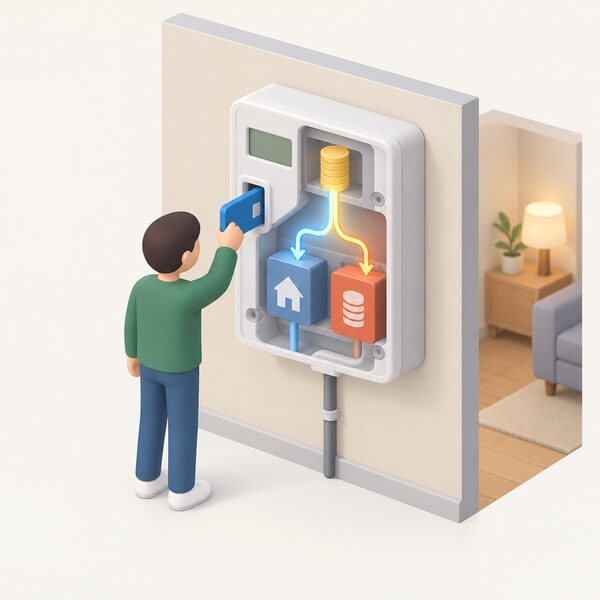
Where a household owes money, the prepayment meter becomes a collection mechanism as well as a supply point. As well as paying the unit rate for the energy used, a household in debt pays a little extra towards what it owes4. Debt is recovered either as a percentage of what is topped up, as a fixed weekly amount, or both7.
The arithmetic is worth setting out because it determines how much of each top-up becomes usable energy. If the debt repayment is set at 30%, every £10 topped up means £3 goes towards the debt and £7 is added as credit7. If the repayment is set at £6 a week and £10 a week is topped up, £6 goes towards the debt and £4 is added as credit, with missed payments added up and deducted from the next top-up7.
A meter can be set up so that debts are paid by both a percentage and a fixed weekly amount, meaning two lots of debt repayment and only a small amount of top-up money crediting the meter7. Where that is the arrangement, guidance suggests asking to pay an affordable fixed weekly amount instead7.
Suppliers often recommend prepayment meters for customers already in fuel debt, set up to repay a specific amount each week based on affordability6. Debt from a credit meter account may be transferred onto a prepayment meter by the energy company, with automatic repayments taken each time the household tops up7.
"your energy company will recover it either as a percentage of what you top up, as a fixed weekly amount, or both."
For a household, the debt deduction is the single biggest determinant of what a top-up actually buys. Two homes topping up the same amount can receive very different quantities of energy depending on the repayment terms attached to the meter.
Cost: capped like credit tariffs, cheaper standing charges, but dearer than direct debit
Prepayment tariffs sit inside the price cap, and the cap has been adjusted to narrow the gap with Direct Debit. Ofgem's cap documentation includes a levelisation allowance whose stated purpose is "making sure prepayment and Direct Debit customers pay the same standing charge"11. That is a deliberate design choice, and it means the standing charge comparison between prepayment and Direct Debit is no longer the straightforward penalty it once was.
The unit rate comparison is different. The cap for prepayment customers rises to £1,678 from 1 October 2026, against £1,723 for Direct Debit customers4. The prepayment figure is lower, but it reflects lower typical consumption in the prepayment customer base rather than a cheaper rate per unit. The cap is a limit on what a typical household pays, not a price list.
The clearest published comparison of payment methods is between standard credit and Direct Debit. Customers paying by standard credit, by cash or cheque, pay an additional £136 compared to those who pay by Direct Debit, as of 27 August 20255. An earlier cap period put the same gap at £10626.
| Payment method | Position under the cap |
|---|---|
| Direct Debit | Reference point for cap comparisons5 |
| Standard credit | £136 a year more than Direct Debit, as of 27 August 20255 |
| Prepayment | Covered by the cap; levelisation allowance aligns standing charges with Direct Debit11 |
For a household, the cost picture is therefore more nuanced than the common claim that prepayment is always the most expensive way to pay. The standing charge has been levelled with Direct Debit. The unit rate depends on the underlying tariff, and a prepayment household on a default tariff is capped in the same way as a credit customer. What prepayment does not offer is the full range of products: fixed, green and time-of-use tariffs sit outside the cap, and access to them depends on the meter.
Moving off prepayment: debt-free accounts, credit checks and landlord permission
Moving to a credit meter is a supplier decision as much as a household one, and debt is the main variable. Ofgem guidance states that a household with a prepayment meter owing up to £500 can switch supplier8. That figure is a threshold for switching, not a write-off: the debt remains owed and is typically transferred with the account.
Smart meters make the change easier. Switching from an existing gas or electricity prepay meter to a smart credit meter is described as straightforward for customers who meet the conditions19. Because smart meters can operate in credit or prepayment mode, the change can be a configuration rather than a hardware replacement18.
Where a supplier installed a prepayment meter without permission, specific protections apply. The supplier must give £30 credit once the meter has been installed or the existing meter remotely switched to prepayment mode15. The conditions for installation without permission are narrow: a household must be building up an energy debt and other ways of recovering that debt must not have worked14.
For households in a property supplied through a business contract, the position is different again. Before moving in, it is worth checking who holds the energy contract, how charges are calculated, how much residents typically pay, whether charges are metered or estimated, whether the supplier or tariff can be chosen, and whether switching to a domestic contract is possible28. Landlord permission and the contract type can determine whether a credit meter is available at all.
Power NI Keypad and Share Energy: how pay-as-you-go works in Northern Ireland
Northern Ireland operates a separate regulatory and tariff landscape, and prepayment there has its own products and support history. The Consumer Council's guidance covers Economy 7 arrangements and lists Budget Energy's Keypad Promotional 1 Economy 7 product as a prepayment meter tariff29. Share Energy has a tariff change scheduled for 1 October 2026, which the Consumer Council advises could affect customers29.
Support during the energy crisis was delivered differently in Northern Ireland. The Energy Price Guarantee provided unit rate discounts of up to 13.6p/kWh for electricity and 3.9p/kWh for gas from January to March 2023, then up to 3.8p/kWh for electricity and 2.6p/kWh for gas from April to June 202330. The scheme was backdated via an additional pence-per-kilowatt payment on top of the base EPG rate from November to March30.
Separately, the Home Heating Oil Support Scheme provided a £100 digital pre-paid card, one per household, supporting around 340,000 households who use oil as their main source of heating31. That is a different mechanism from an electricity prepayment meter, but it matters for Northern Ireland households because off-gas-grid heating is common there.
For pay-as-you-go households in Northern Ireland, the practical position is that the tariff and support landscape is administered separately from GB, and the products available, including keypad Economy 7 tariffs, reflect that. Households comparing options should look at Northern Ireland-specific guidance rather than GB price cap figures.
Compensation for forced prepayment meter installations
Compensation may be available where a household was moved onto a prepayment meter between 1 January 2022 and 31 January 2023 and the supplier installed the meter or switched the household over remotely4. Ofgem's own guidance narrows the window slightly, describing eligibility where a household was forced to have a prepayment meter between 1 January 2022 and 21 January 2023 and the supplier did not follow the rules properly14.
The two published windows differ by ten days at the end, so a household whose meter was installed in that closing period may fall inside one and outside the other. Both dates are given here because the difference decides eligibility for anyone installed on the margin, and the narrower window is the one set by the regulator.
The remedy has partly been delivered collectively rather than individually. Ofgem's market compliance review resulted in suppliers writing off £13 million of debt for customers who had a prepayment meter installed without permission during the assessment period, announced on 28 May 202527. That write-off is separate from any individual compensation claim.
Where prepayment leaves a household's independence
Prepayment gives a household direct control over what it spends on energy and removes the risk of an unaffordable bill arriving after the energy has been used. It also makes consumption visible: 48% of prepayment customers in Ofgem's 2021 survey monitored their energy use, a higher share than other payment groups13.
The dependence it leaves is structural. The household depends on the supplier's top-up network, on the meter's connectivity where it is smart, and on the standing charge accruing whether or not energy is used6. It depends on emergency credit terms it does not set4. Where debt is attached, it depends on repayment terms that determine how much of each top-up becomes usable energy7.
The route out runs through the supplier. A household owing up to £500 can switch supplier8, and a smart meter can be moved from prepayment to credit mode18. Until that happens, the meter remains both the payment method and the supply switch, and the reserve in the system belongs to the supplier's terms rather than to the household.
Sources32 cited
- Get help with your prepayment meter, Ofgem, 2026
- Ofgem archetypes update 2024, Ofgem, February 2024
- Changes to the energy price cap between 1 October and 31 December 2025, Ofgem, 27 August 2025
- Prepayment meters guide, Uswitch, 26 August 2026
- Summary of changes to the energy price cap, 1 October to 31 December 2025, Ofgem, 27 August 2025
- Prepayment meters, Centre for Sustainable Energy, August 2025
- Energy debt on prepayment meters, Centre for Sustainable Energy, August 2026
- Switch your home energy supplier, Ofgem, 2026
- Consumer advice: problems with services, Isle of Anglesey County Council, October 2025
- Changes to the energy price cap between 1 January and 31 March 2026, Ofgem, 21 November 2025
- Energy price cap, Ofgem, 17 September 2026
- Energy price cap explained, Welsh Government, 4 March 2026
- Consumer Survey 2021: Decarbonisation and home energy use, Ofgem, 19 August 2021
- Installing a prepayment meter without your permission, Ofgem, 2026
- Installing a prepayment meter without your permission, Ofgem, 2026
- Debt strategy update: supporting reduction of energy debt, Ofgem, 6 November 2025
- Overdue utility bills, nidirect, 17 September 2026
- Smart meters: your rights and expectations, GOV.UK, 8 August 2025
- How to get a smart meter, Smart DCC, 2026
- How to use a smart meter in prepay mode to save money, Smart Energy GB, 17 August 2026
- How do smart meters send readings?, Smart DCC, 2026
- Prepayment meters consumer guidance, Ofgem, 2026
- What happens if your energy supplier goes out of business, Ofgem, 2026
- Standing charges, House of Commons Library, 17 September 2026
- Check if you are owed money on your energy bill, Ofgem, 2026
- Default Tariff Cap Letter, 1 April 2024, Ofgem, 23 February 2024
- Compensation for installing prepayment meters without permission, Ofgem, 28 May 2025
- If you live in a home with a business energy contract, Ofgem, 2026
- Economy 7, Consumer Council for Northern Ireland, 2026
- Energy Price Guarantee up until 30 June 2023, GOV.UK, 17 September 2026
- £100 Home Heating Oil Support Scheme goes live for applications, Department for Communities, 8 September 2026
- Check if energy suppliers can install prepayment meters without household permission, Ofgem, 2026
 Smart Prepayment MetersHow prepayment mode works on a smart meter, remote switching between credit and prepay, topping up, emergency and friendly credit, the prepayment price cap, the £500 debt limit for switching, and the free help available when a household cannot top up.
 Prepayment MetersHow do you top up a prepayment meter for gas or electricity, and what happens when the credit runs out?
 Prepayment Meter DebtHow debt repayment is set on a prepayment meter, the limits on the share of a top-up that can be taken, and how to have a rate reviewed.
 The Full Tariffs GuideWhich energy tariff suits how you live, and will switching really save you money?
 Ways to Pay an Energy SupplierHow you pay for gas and electricity changes what you are charged, and by how much.
 Which Tariffs Your Meter AllowsHow meter type decides which energy tariffs a household can access, from single-rate and two-rate meters to smart, prepay and restricted configurations, and the constraints faced by flats, rented homes and homes without a working smart connection.